
21 min 53 sec
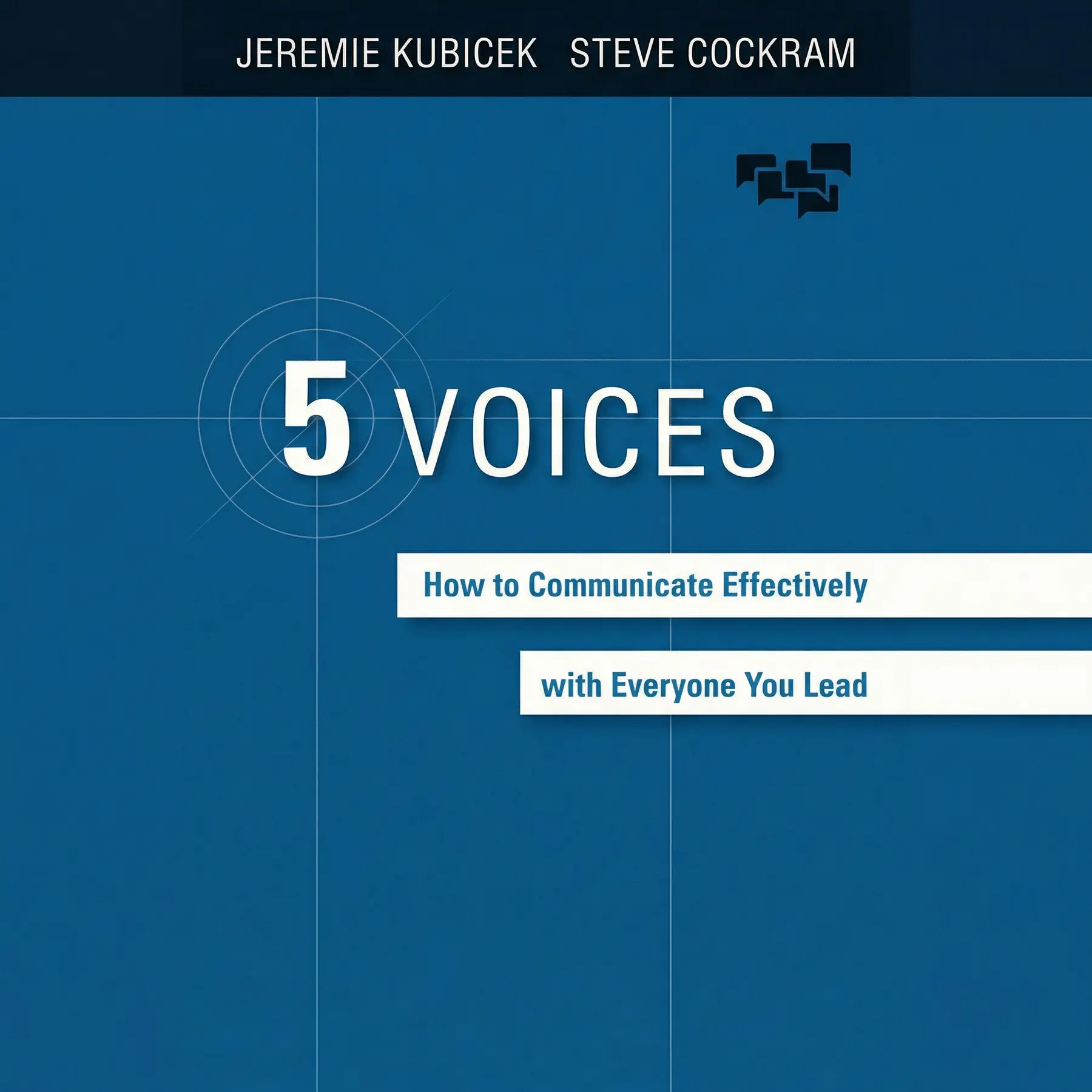
5 Voices: How to Communicate Effectively with Everyone You Lead
Learn to identify and leverage five distinct communication styles to transform team collaboration. This summary explores how recognizing different 'voices' helps leaders empower every member, from quiet nurturers to strategic pioneers.
Table of Content
1. Introduction
1 min 53 sec
In the classical world, the philosopher Plato viewed dialogue as a powerful forge. He believed that the best ideas were hammered out through a process of verbal exchange, where participants challenged and refined one another’s thoughts until they reached a shared truth. It’s an inspiring vision—a world where communication is fluid, receptive, and always moving toward a common goal. However, if you have ever participated in a tense boardroom meeting or had a misunderstanding with a close friend, you know that our modern reality rarely lives up to Plato’s ideal. Instead of a refined exchange of ideas, we often find ourselves stuck in loops, talking past one another, or feeling as though our perspectives are being ignored entirely.
Jeremie Kubicek and Steve Cockram suggest that the root of this frustration isn’t necessarily a lack of intelligence or goodwill. Rather, it’s a failure to recognize that every person speaks with a distinct ‘voice.’ We all have different ways of processing information, evaluating priorities, and expressing our concerns. Most of us fall back on one dominant communication style that shapes how we see the world. When we don’t understand these styles, meetings become battlegrounds where the loudest people win, and the most insightful ideas might never leave the room.
In this summary of 5 Voices, we are going to break down these different archetypes. We’ll look at the strengths and pitfalls of each voice and explore how you can learn to hear what others are truly saying. By mastering these dynamics, you can stop the unnecessary friction that slows down progress and start building a team where every individual—from the quietest observer to the most aggressive strategist—feels empowered to contribute. This isn’t just about being polite; it’s about unlocking the full potential of human collaboration. Let’s dive into the five voices and see where you, and your colleagues, fit into the puzzle.
2. The Nurturer: The Heart of the Team
2 min 09 sec
Discover the voice that prioritizes people over profits and harmony over ego, making up nearly half of the population while often remaining the most unheard.
3. The Creative: Dreaming of the Future
2 min 15 sec
Explore the rare and innovative voice that constantly seeks to redefine the status quo, even when their ideas feel messy or difficult to explain.
4. The Guardian: The Protector of Truth
2 min 00 sec
Learn why the most skeptical voice in the room is often the one that saves the company from costly and impulsive mistakes.
5. The Connector: The Bridge Builder
1 min 55 sec
Meet the voice that thrives on collaboration and enthusiasm, turning every professional challenge into a social opportunity for the whole team.
6. The Pioneer: The Strategic Visionary
2 min 01 sec
Understand the driven and competitive voice of the Pioneer, where every goal is a battle to be won and every decision is a strategic move.
7. Empowering the Quiet Voices
2 min 05 sec
Learn actionable strategies to ensure that Nurturers and Creatives feel safe enough to share their vital insights before they are drowned out.
8. Managing the Loudest Voices
2 min 09 sec
Discover how to direct the energy of Guardians, Connectors, and Pioneers so they support the team rather than dominating or disrupting it.
9. The Power of Leading Yourself
1 min 55 sec
True leadership begins with mastering your own communication style and knowing when to switch to your secondary voices for the good of the task.
10. Navigating Cultural and Global Voices
1 min 59 sec
Learn how regional and national cultures prioritize certain voices over others, and how to spot these biases in your own organization.
11. Conclusion
1 min 32 sec
In the end, effective communication isn’t about everyone learning to talk the same way; it’s about everyone learning to listen differently. We’ve seen how the five voices—the Nurturer, the Creative, the Guardian, the Connector, and the Pioneer—each bring a unique and indispensable piece to the puzzle. When these voices are in balance, a team can be both compassionate and strategic, innovative and grounded, enthusiastic and disciplined. But when one or more voices are silenced, the whole organization suffers.
As you move forward, the most actionable step you can take is to start identifying these voices in your everyday life. Observe your next meeting and try to spot the Guardian asking the tough questions or the Nurturer staying quiet in the corner. Once you recognize these patterns, you can begin to intervene. Create space for the quiet, and give direction to the loud.
Remember that the ultimate goal of the 5 Voices framework is to build a culture of high challenge and high support. When people feel that their unique ‘voice’ is understood and valued, they are far more willing to be challenged and to grow. By mastering this language of leadership, you don’t just improve your meetings; you transform your relationships. You move closer to that Platonic ideal of dialogue where every exchange is an opportunity to refine a great idea and move toward a shared vision of success. Now, go out and find your voice—and then help someone else find theirs.
About this book
What is this book about?
Have you ever felt like your team members are speaking different languages, even when they’re using the same words? 5 Voices addresses the fundamental breakdown in workplace communication by categorizing people into five distinct archetypes: the Nurturer, the Creative, the Guardian, the Connector, and the Pioneer. Each of these voices brings essential value to an organization, but they often clash due to mismatched priorities and misunderstood intentions. The book promises a roadmap for better leadership by teaching you how to listen for these voices and, more importantly, how to manage them. You will learn why the most valuable ideas often go unheard and how to create a culture where every perspective is utilized. By the end, you’ll understand your own primary voice and how to shift between your secondary styles to meet the needs of any situation, ultimately leading to more productive meetings, stronger relationships, and a more harmonious team dynamic.
Book Information
About the Author
Jeremie Kubicek
Jeremie Kubicek is a well-known leadership expert who formerly served as the CEO of Leadercast Conferences, a major platform dedicated to helping leaders reach their maximum potential. He has authored several influential books, including Making Your Leadership Come Alive and 5 Gears. Steve Cockram is a consultant and the co-founder of GiANT Worldwide, an executive leadership training firm. Along with Kubicek, he co-authored 5 Gears and specializes in helping leaders understand and optimize their organizational influence.
Ratings & Reviews
Ratings at a glance
What people think
Listeners find the content exceptionally educational and simple to grasp, noting it serves as an excellent resource for better interactions in both professional and private spheres. This work significantly impacts their daily lives; notably, one listener credited the book with helping to improve their marriage. They further value how accessible the writing is and consider it an essential read.
Top reviews
Watcharee
Ever wonder why your most thoughtful team members sit silently in meetings while the loudest voices dominate the room? Kubicek and Cockram crack that dynamic wide open. In most workplaces, dominant Pioneers and charismatic Connectors unintentionally steamroll the quieter Nurturers and Creatives who actually possess the critical operational insights. This book explains precisely how that accidental intimidation occurs and offers actionable rules of engagement to reverse it. It showed me how to actively draw out the team members who normally hold back until asked directly. Knowing how to facilitate genuine collaboration is far more valuable than simply stockpiling raw knowledge. This guide will genuinely transform your culture.
Show moreJan
We implemented the 'rules of engagement' across our department last month, and the atmosphere shifted almost overnight. Look, dominant leaders rarely realize when their communication style feels like a relentless interrogation to their staff. The concept of communication 'weapons' was an eye-opener; watching our executive team suddenly understand why their natural intensity shut down valuable input from Nurturers was worth ten times the cover price. It gives quiet contributors explicit permission to speak up, while giving louder drivers a concrete reason to pause and listen. If you are struggling with team engagement, psychological safety, or chronic cross-departmental friction, make this mandatory reading.
Show moreMia
This book accomplishes what few business leadership manuals ever manage: it provides an instantly usable language without drowning the reader in psychological theory. Discovering that my primary voice was Creative explained a decade of feeling misunderstood in fast-paced operational meetings. More importantly, it taught me how to articulate my ideas in a structure that Guardians and Pioneers can actually digest without immediately dismissing them. The guidance on establishing healthy team rules of engagement is practical, realistic, and remarkably effective. It bridges the gap between high-level leadership philosophy and messy day-to-day office interactions better than almost anything else on my shelf.
Show moreElan
Our executive coach recommended this for our leadership team, but the biggest surprise came at home. Truth is, learning whether you are a Pioneer, Connector, Creative, Guardian, or Nurturer does more than streamline meetings—it completely reframes how you speak to your spouse and children. The book provides an incredibly accessible framework that lacks the intimidating complexity of standard psychological profiles. My wife and I read through the voice descriptions together and immediately identified where our recurring communication breakdowns originated. It is slightly repetitive in the middle sections, and you can tell it's primarily angled toward corporate workshops. Even so, the practical vocabulary it establishes makes everyday conflicts substantially easier to navigate.
Show moreLayla
Complex personality typologies like Enneagram or full MBTI profiles usually suffer from a brutal half-life in corporate environments. In my experience, teams take an elaborate multi-hour assessment on Monday, marvel at their colorful charts, and completely forget everyone's four-letter acronyms by Friday. That is precisely where 5 Voices shines. The framework is deliberately streamlined so that anyone can remember and apply it immediately without consulting a manual. It provides an intuitive shared language that democratizes team discussions. My only real critique is that human behavior occasionally resists such tidy boxes, but for rapid organizational adoption, simplicity wins every time.
Show moreHiroshi
The chapter detailing the specific 'weapons' each voice deploys when stressed hit far too close to home. Not gonna lie, seeing my own habitual reactions exposed on the page was an uncomfortable reality check. The authors outline not just the gifts of your primary voice, but the blind spots that actively undermine your relationships when you're operating on autopilot. It gave me a tangible roadmap for self-regulation during heated project deadlocks. While the prose is fairly standard corporate non-fiction and lacks literary flair, the sheer utility of the communication tactics makes it an exceptional resource for any developing leader.
Show moreNatnicha
After years of watching high-stakes projects derail due to petty miscommunication, reading Kubicek and Cockram's breakdown felt like finding the missing puzzle piece. Gotta say, the emphasis on empowering the lowest-volume voices in the room represents a refreshing shift away from traditional, swagger-heavy leadership advice. The authors demonstrate clearly that true organizational power lies in unlocking the collective wisdom of the entire group rather than relying on one charismatic visionary. A couple of chapters meander a bit, and certain concepts feel stretched out, but the overarching system provides massive clarity for anyone managing diverse personalities.
Show moreJackson
Picked this up on a colleague's enthusiastic recommendation, and while it definitely has practical merits, the repetition gets exhausting. The foundational concept is brilliant: categorizing communication into five distinct archetypes provides an immediate shorthand that anyone on staff can quickly adopt. To be fair, recognizing how a Guardian approaches risk versus how a Pioneer chases opportunity resolved several persistent friction points in our department. However, the book repeats its core premises relentlessly across every chapter. What could easily have been a punchy, impactful 50-page manual is stretched out to satisfy standard publishing lengths. Worth reading, but you can skim substantial portions without missing much.
Show moreTim
Call me cynical, but whenever a leadership consulting firm publishes a book, I brace myself for a glorified 250-page brochure. Personally, I found the occasional self-referential plugs for GiANT Worldwide tools a bit distracting throughout the text. That being said, the foundational premise behind the five communicative styles is fundamentally solid. It offers a practical framework for diagnosing why certain team members clash repeatedly despite sharing identical strategic goals. It lacks rigorous scientific backing, and sophisticated readers might find it slightly reductive, but it serves as a decent starter toolkit for managers struggling with basic team alignment.
Show moreGun
Strip away the corporate jargon and slick branding, and you're left with a repackaged, dumbed-down version of Myers-Briggs. Frankly, squishing intricate human personalities into five overly tidy categories strips away all necessary nuance without delivering genuinely original insights. The sections discussing the 'weapons' each voice supposedly wields felt like arbitrary corporate filler designed to pad the page count. Furthermore, the constant shoehorning of general relationship habits into high-level 'leadership voices' felt disingenuous, almost as if the authors knew marketing this toward corporate managers would sell more consulting contracts. If you want meaningful psychological depth or actionable team diagnostics, stick with well-established psychometric literature instead of this lightweight primer.
Show more
Readers also enjoyed

A Year with Peter Drucker: 52 Weeks of Coaching for Leadership Effectiveness
Joseph A. Maciariello



Acting with Power: Why We Are More Powerful Than We Believe
Deborah Gruenfeld
All In: How Great Leaders Build Unstoppable Teams
Mike Michalowicz
AUDIO SUMMARY AVAILABLE
Listen to 5 Voices in 15 minutes
Get the key ideas from 5 Voices by Jeremie Kubicek, plus 5,000+ more titles in English and Thai.
- 5,000+ titles
- Listen as much as you want
- 7-day free trial
- Cancel anytime







