
22 min 22 sec
Alchemy: The Dark Art and Curious Science of Creating Magic in Brands, Business, and Life
Alchemy explores how irrationality and behavioral economics can solve complex human problems. It challenges the dominance of logic in business, revealing how unconventional thinking leads to breakthrough creative solutions and brand success.
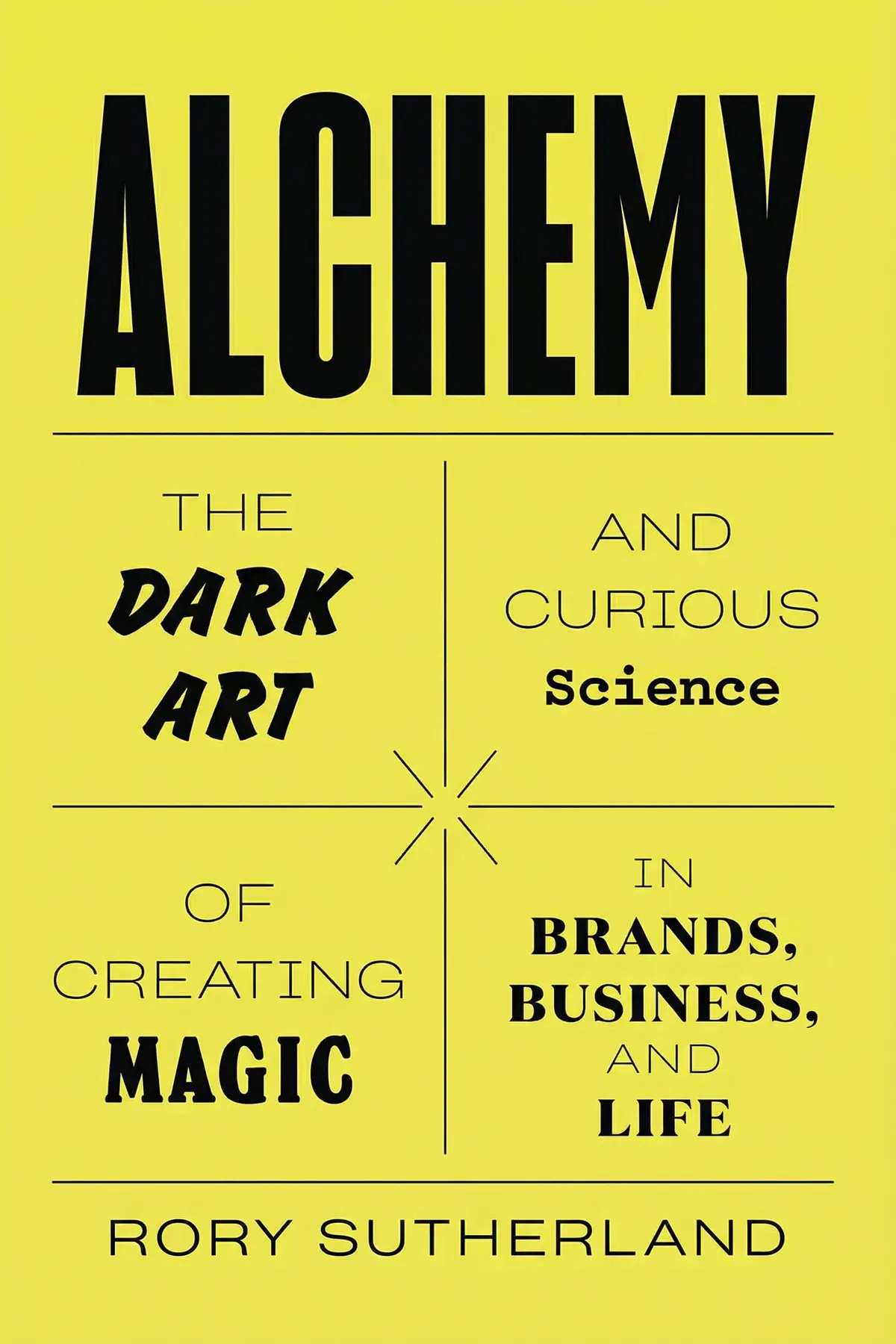
Table of Content
1. Introduction
2 min 01 sec
We live in an age of data-driven certainty. Whether it’s a government setting policy or a corporation launching a new product, there is an almost religious devotion to logic. We assume that if we can just collect enough statistics and build a sophisticated enough model, the ‘correct’ answer will present itself. This reliance on reason gives us a sense of security; it makes us feel like we’re in control of a chaotic world. But there’s a catch. When we limit ourselves to what is strictly logical, we also limit our ability to find truly creative solutions. We end up solving problems the same way everyone else does, and we often fail because humans—the very people these solutions are designed for—are not logical creatures.
Think about the way we actually live. We don’t always choose the cheapest option, the fastest route, or the most efficient tool. We are driven by emotions, subtle cues, and unconscious biases. This gap between ‘how we think people should act’ and ‘how they actually act’ is where the magic happens. This is what we call alchemy. It’s the art of turning leaden, logical problems into golden, creative opportunities by embracing the irrational.
In this journey, we’re going to explore why the most successful ideas often look like nonsense at first glance. We will look at how businesses can find massive success by focusing on tiny, seemingly irrelevant details. We’ll examine why ‘average’ is a dangerous myth and why being a little bit absurd can actually be a powerful communication strategy. The goal is to provide you with a new set of spectacles—a way of looking at the world that values psychological insight over mathematical models. By the time we’re finished, you’ll understand that if you want to influence how people think and act, you have to be willing to step outside the constraints of reason. You have to learn how to be an alchemist.
2. The Limits of Logical Human Behavior
2 min 38 sec
Traditional logic often fails to explain the strange choices we make daily. Discover why stripy toothpaste and European vacation policies challenge our assumptions about how people and productivity work.
3. The Impact of Small Details
2 min 46 sec
Success is often found in the margins. Learn how a four-word script change and a single button swap turned frustration into millions of dollars in revenue.
4. Perception and Psychophysics
2 min 39 sec
What we see isn’t always what’s there. See how changing the shape of chocolate or adding a single egg to a cake mix can completely alter our reality.
5. The Myth of the Average Consumer
2 min 35 sec
Designing for everyone often means designing for no one. Learn why the US Air Force and a gambling Earl show that true innovation comes from the outliers.
6. The Power of Absurdity
2 min 41 sec
Why do cute animals sell insurance? Explore why the most effective messages often contain an element of nonsense and why taking risks is better than being ‘safe.’
7. Solving Problems Through Psychology
2 min 21 sec
Don’t just fix the product; fix the person’s experience. See how Uber ‘shortened’ wait times without moving any faster and why detectives offer a lesson for business.
8. The Virtue of the Counter-Intuitive
2 min 51 sec
Sometimes the best answer is the one that sounds the most foolish. Discover how high-end vacuums and baby-faced shutters solved ‘impossible’ problems.
9. Conclusion
1 min 50 sec
As we wrap up our exploration of alchemy, the central theme is clear: logic is a wonderful tool for the physical world, but it is a clumsy instrument for the human one. We have spent decades trying to turn every human interaction into a math problem, and in doing so, we have lost our ability to see the magic in the margins. We ignore the small details, we obsess over averages, and we dismiss anything that doesn’t fit into a tidy spreadsheet. But the real world—the one where people actually live, breathe, and buy things—is messy, emotional, and delightfully irrational.
The most important takeaway is that you should never be afraid to look foolish. The next time you’re faced with a difficult challenge, whether in your career or your personal life, try to put your rational brain on a brief leave of absence. Instead of asking ‘What is the most sensible thing to do?’ ask ‘What would happen if I did something that made no sense at all?’ This doesn’t mean being reckless; it means being curious. It means testing the limits of perception and recognizing that the human heart doesn’t care about your data points.
Always remember to ask the ‘stupid’ questions. Many of our greatest insights are hidden behind things that seem too obvious or too silly to mention. If you only ever do what is logical, you will only ever get the same results as everyone else. But if you’re willing to embrace a bit of absurdity, to sweat the small details, and to look at the world through the lens of psychology rather than economics, you might just find the golden solution you’ve been looking for. The world is waiting for a little more magic. It’s time to start practicing alchemy.
About this book
What is this book about?
Have you ever wondered why we often make choices that don't seem to make any sense on paper? In a world dominated by data, spreadsheets, and cold logic, we tend to believe that every problem has a rational solution. However, human beings are far from rational. This book explores the space where logic fails and psychological magic begins. It argues that by abandoning our obsession with being 'sensible,' we can unlock innovative solutions that traditional economics and standard business models completely miss. The book introduces the concept of alchemy—the art of finding brilliant results by looking at the world through a non-logical lens. Through a series of fascinating examples from the worlds of advertising, history, and social engineering, you will learn why small changes in perception often outweigh massive changes in reality. It promises to teach you how to influence behavior, craft powerful messages, and solve the kind of 'logic-proof' problems that keep CEOs and policymakers awake at night. By the end, you'll see that the most effective way to change the world is often to stop trying to be so reasonable.
Book Information
About the Author
Rory Sutherland
Rory Sutherland is the vice chairman of Ogilvy, a globally recognized, award-winning advertising agency where he has played a pivotal role since 1988. He is widely considered one of the most influential figures in the modern advertising landscape. Beyond his leadership at Ogilvy, Sutherland is a prolific communicator, having authored The Wiki Man in 2011 and delivered several popular presentations at Ted Global. Today, he continues to share his insights as a regular contributor to prominent publications, including the Spectator, Market Leader, and Impact.
Ratings & Reviews
Ratings at a glance
What people think
Listeners find the book both thought-provoking and engaging, specifically praising the fascinating psychological insights and the author's extensive expertise. They appreciate the unique perspective on design and commercial hurdles, with one listener noting its high-impact solutions. The material is well-regarded for its marketing content, comedic tone, and overall worth, with one review highlighting its witty British humor. Listeners like the writing style, with one noting the effectiveness of its short chapters, and find it highly useful, with one mentioning its applicability to any business.
Top reviews
Noo
Rory Sutherland is the mad scientist of advertising, and this book is his manifesto. Alchemy is a brilliant, often hilarious defense of the irrational, arguing that the most effective solutions to our biggest problems rarely come from spreadsheets or logic. The central thesis—that we are psychological, not logical, creatures—is delivered through a series of punchy, short chapters that make it incredibly easy to digest. I loved the section on why we should 'scent the soap' rather than just making it more effective; it’s a perfect metaphor for the way we perceive value. While some might find his British wit a bit much, I found it refreshing in a genre that is usually as dry as dust. Frankly, it’s the most practical business book I’ve picked up in years because it teaches you how to see the world through a different lens entirely. If you want to understand why people actually do what they do, stop looking at the data and start reading this.
Show moreEli
As someone who spends most of my day staring at spreadsheets and ROI models, this was a necessary slap in the face. Sutherland reminds us that the economy is not a machine, but a complex system driven by messy, emotional humans. The book is packed with 'aha!' moments that make you rethink everything from toothpaste to public transportation. I particularly enjoyed the discussion on how the way a question is phrased—like a waiter asking 'sparkling or bottled'—completely dictates human choice. It’s witty, provocative, and immensely practical for anyone in a creative or managerial role. To be fair, he definitely enjoys the sound of his own voice, but when you have this much experience, you've earned the right to brag a little. Every chapter challenged a different assumption I held about what makes a business successful. It turns out that the opposite of a good idea can also be a good idea.
Show moreSin
Picked this up on a whim after a friend mentioned the 'scent the soap' anecdote, and I'm so glad I did. This book is the perfect antidote to the boring, data-heavy business literature that usually fills the shelves. Sutherland uses his sharp British humor to tear down the idea that humans are rational actors. He argues that magic is possible if we just stop trying to be so logical all the time. The short chapters make it a very quick read, despite the page count, and I found myself highlighting something on nearly every page. It’s practical, hilarious, and deeply insightful. Whether you are a small business owner or a corporate executive, these psychological tweaks can change how you approach every challenge. It’s rare to find a book that is this much fun while still providing genuine value for money. A total masterpiece of creative thinking.
Show morePot
Wow, this was a refreshing departure from the usual dry, data-driven business books that dominate the market. I’ve been a fan of Sutherland’s YouTube clips for a while, and his voice carries over perfectly to the page. He has this incredible ability to take a complex psychological concept and turn it into a witty, memorable anecdote. The book teaches you that value is in the mind of the valuer, not just in the product itself. It’s an empowering message for anyone in a creative field. While the editing is a bit shoddy in places—he lists five reasons for something and then only gives four—the quality of the ideas is top-notch. It’s unconventional, slightly chaotic, and totally brilliant. It should be required reading for anyone who thinks that 'logic' is the only way to win in business. Truly a deep well of experience and wisdom.
Show moreSoontorn
Finally got around to reading this after seeing it on every business 'must-read' list. Sutherland makes a compelling case against the 'technocrats' who try to solve every human problem with a calculator. The concept of 'psycho-logic' is fascinating, and his deep well of experience in the ad world provides some truly high-impact examples of how reframing a question can change the outcome. However, I have to agree with some critics that the book occasionally feels like it’s coming from a very specific, wealthy, Western male perspective. He dismisses things like political correctness or corporate quotas with a hand-wave that can feel a bit dismissive or out of touch. Despite that, the core marketing insights are gold. It’s a breezy, irreverent read that challenges you to ask silly questions. Just be prepared for a bit of rambling in the middle sections.
Show moreChon
Truth is, I found myself nodding along and shaking my head in equal measure throughout this book. On one hand, Sutherland’s critique of 'Homo Economicus' is spot on and incredibly entertaining. He has a way of explaining human behavior that makes you realize how little we actually understand ourselves. On the other hand, the book is riddled with these weirdly sexist and privileged asides that take you right out of the experience. His comments on women's makeup spending vs. men's hobbies felt like a tired trope from a 1980s boardroom. If you can look past the occasionally outdated worldview, there is some real magic here. The ideas on how to create value through perception rather than just utility are transformative. It’s a great tool for 'thinking outside the box,' even if the box he’s in feels a bit dated at times. Definitely worth the read for the marketing insights alone.
Show moreIsaiah
Ever wonder why we pay so much for a brand of water when the tap is essentially free? Alchemy dives deep into the 'why' behind our most irrational behaviors. Rory Sutherland is a master storyteller, and his background in advertising shines through in every example. He brilliantly explains that 'no one ever got fired for making a rational yet stupid decision,' which perfectly captures why corporate culture is so stagnant. My only real gripe is that the book feels a bit unorganized; it’s more of a collection of brilliant thoughts than a cohesive argument. He also has a tendency to set up strawman versions of 'logical' people just to knock them down. However, the insights into framing and human status-seeking are too good to ignore. It’s a thought-provoking read that will definitely make you question the assumptions you bring to your professional life.
Show morePreeda
The chapter on the placebo effect alone is worth the price of admission. Sutherland explores the idea that we can improve the world through psychological tweaks that are often much cheaper than technological ones. It’s a fascinating look at how we value things based on context rather than intrinsic worth. I loved his point about how a management consultant would 'streamline' a restaurant by making it faster, likely destroying the very reason people go there in the first place. The writing is breezy and irreverent, though it does border on self-indulgence at points. He acknowledges his own biases toward the end, but some of the comments regarding social issues still feel a bit ignorant. Regardless, if you want to understand the 'psycho-logical' side of the world, this is a fantastic starting point. It’s a call to arms for more creativity in a world obsessed with efficiency.
Show moreKomsan
Is it revolutionary or just a very long, very expensive pitch for the advertising industry? That’s the question I kept asking myself while flipping through these pages. Sutherland’s premise is that we rely too much on logic, but he often falls into the trap of selection bias to prove his point. He cherry-picks anecdotes where irrationality won the day while ignoring the thousands of times where rational engineering is exactly what saved lives. For instance, his take on the Challenger disaster felt incredibly reaching and, quite frankly, a bit tasteless given the gravity of that event. There is definitely some 'chaff' to sift through here, and the book could have easily been half its length without losing the main message. If you’ve read any behavioral economics before—like Kahneman or Thaler—a lot of this will feel like a repackaged version of things you already know. It’s an entertaining read, but don't expect a rigorous scientific treatise.
Show moreHazel
Look, the central premise—that we shouldn't rely solely on logic—is a sound one, but the delivery is exhausting. This book is a whirlwind of hot air from a man who clearly thinks he’s the smartest person in the room. Sutherland spends 400 pages telling you to 'think differently,' a message that could have been summarized in a single blog post. The anecdotes are repetitive and often lack any real substance or falsifiable data. He dismisses entire fields like economics and science as if they are populated by idiots, yet his own 'Alchemy' relies on ad-hoc rationalizations that wouldn't hold up under any scrutiny. His defense of things like homeopathy or his bizarre takes on why racism is actually about accents were particularly hard to stomach. It’s a collection of just-so stories that sound good over a pint but don't offer any actual framework for solving real-world problems. I’m disappointed I spent so much time on this.
Show moreFeatured in
Readers also enjoyed
59 Seconds: Change Your Life in Under a Minute
Richard Wiseman
A Liberated Mind: How to Pivot Toward What Matters
Steven C. Hayes
AUDIO SUMMARY AVAILABLE
Listen to Alchemy in 15 minutes
Get the key ideas from Alchemy by Rory Sutherland, plus 5,000+ more titles in English and Thai.
- 5,000+ titles
- Listen as much as you want
- 7-day free trial
- Cancel anytime







