

22 min 20 sec
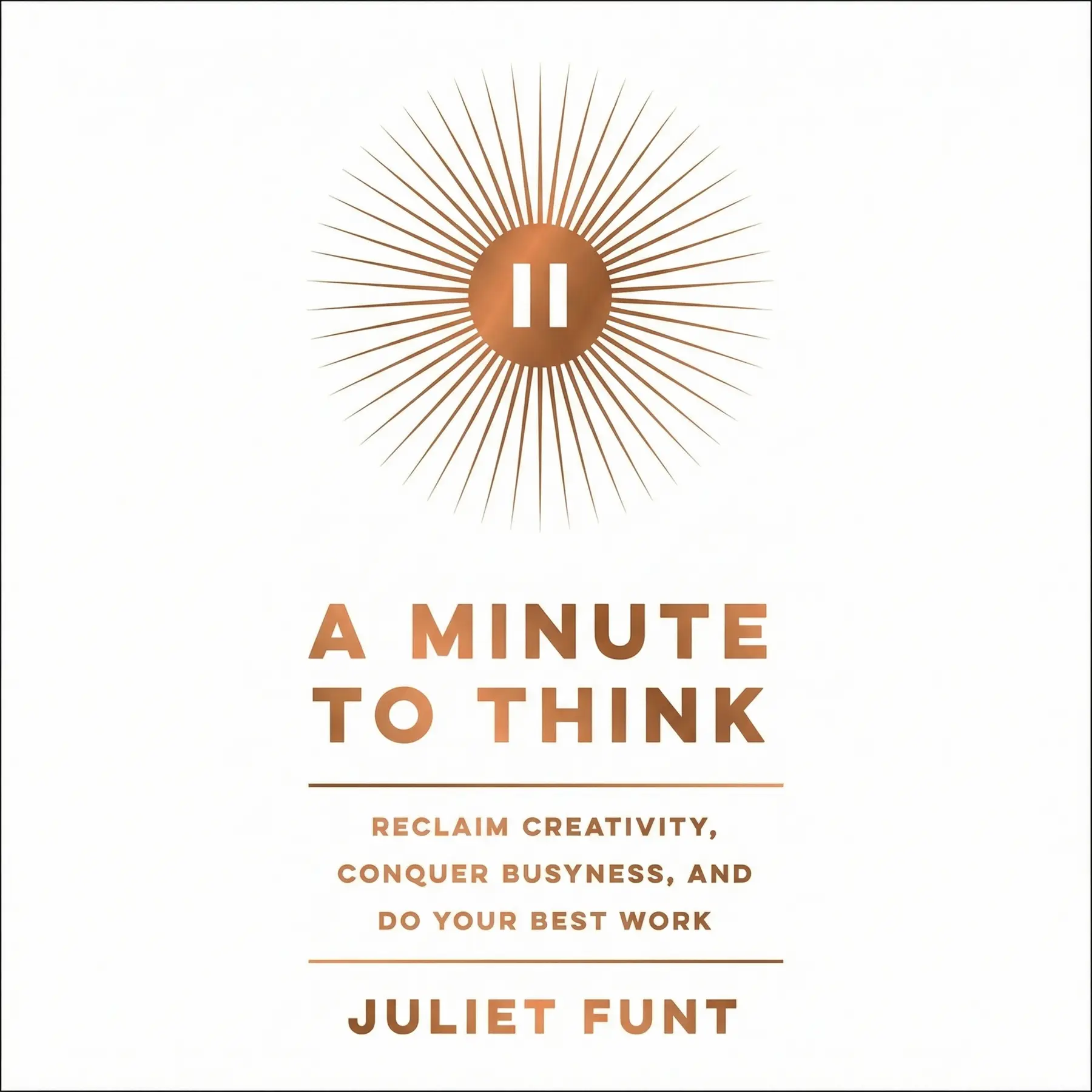
A Minute to Think: Reclaim Creativity, Conquer Busyness, and Do Your Best Work
By Juliet Funt
A Minute to Think explores the modern epidemic of busyness and provides a practical framework for reclaiming mental space. Juliet Funt demonstrates how strategic pauses can transform productivity, creativity, and professional well-being.
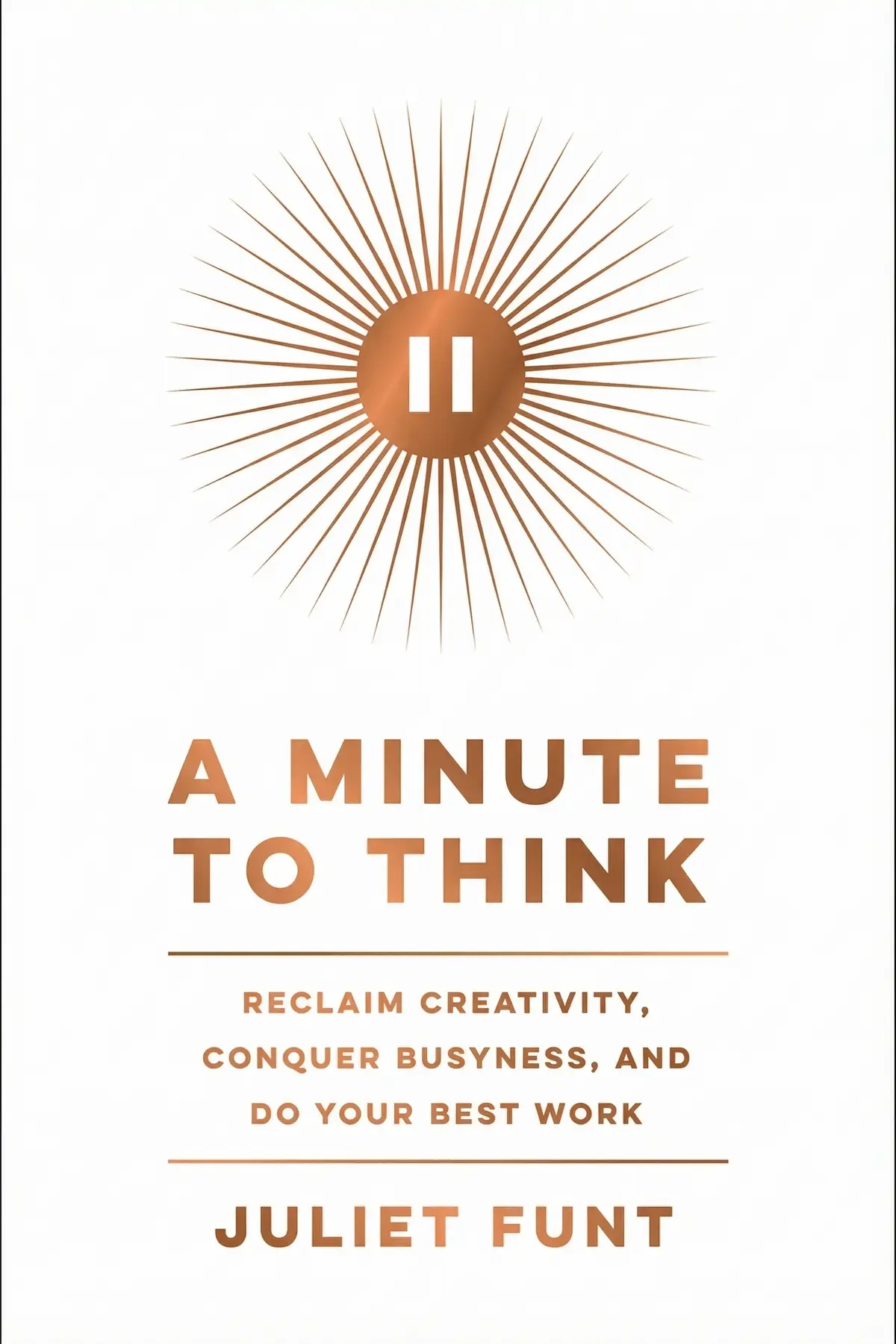
Table of Content
1. Introduction
2 min 19 sec
Imagine for a moment that you are trying to build a fire. You have gathered the finest wood, plenty of dry kindling, and the best fire starters available. You stack them tightly, ensuring every inch of the fireplace is filled with fuel. But when you strike the match, nothing happens. The wood just smolders and dies. Why? Because you forgot the most important ingredient: oxygen. Without space for air to circulate, the fire simply cannot breathe, and without breath, there is no flame.
This is the central metaphor of Juliet Funt’s work. In our professional lives, we are often guilty of packing our schedules so tightly with tasks, meetings, and emails that we leave no room for the ‘oxygen’ of thought. We assume that if we are constantly doing something, we must be succeeding. However, we often find ourselves exhausted at the end of the day, wondering if we actually moved the needle on anything that truly matters. We have become victims of a culture that prizes the appearance of work over the results of high-level thinking.
In this summary, we are going to explore how to reclaim that vital breathing space. We will look at the psychological traps that keep us busy, the neurological reasons why our brains need rest, and the practical tools we can use to fight back against a world that demands we be ‘on’ twenty-four hours a day. By the end of this journey, you’ll understand that the secret to doing your best work isn’t doing more—it’s giving yourself a minute to think. We will examine why your smartphone might be sabotaging your cognitive power, how to put your email on a ‘diet,’ and why the most productive thing you can do today might be absolutely nothing at all. This isn’t just about time management; it’s about shifting your entire philosophy of work to favor impact over activity. Let’s dive into the throughline of this transformation: the power of the pause.
2. The Essential Need for Breathing Space
2 min 31 sec
Discover why the metaphor of a struggling fire reveals the hidden cost of a packed schedule. You will see how reclaiming small moments of breathing space can prevent professional burnout and ignite your true potential.
3. The Social Pressure to Overwork
2 min 32 sec
Explore the psychological reasons why we find it so difficult to stop working. By understanding the ‘cult of overwork,’ you can learn to push back against the unwritten rules that prioritize facetime over actual results.
4. The Neurology of Creativity and Rest
2 min 48 sec
Learn how your brain’s frontal lobe functions like a battery that needs frequent recharging. This insight reveals why taking the right kind of break is the most effective way to solve complex problems.
5. Combating Internal Time Thieves
2 min 37 sec
Identify the internal drives that steal your time under the guise of being helpful. You’ll learn how to balance your desire for excellence with the reality of finite resources to avoid the trap of perfectionism.
6. Breaking the Digital Dopamine Loop
2 min 32 sec
Understand why your smartphone is designed like a slot machine to keep you distracted. Learn how to implement an ’email diet’ to break the cycle of procrastination and reclaim your focus.
7. Navigating 2D and 3D Communication
2 min 41 sec
Discover why choosing the wrong medium can lead to workplace conflict and wasted time. This framework helps you decide when to send an email and when to pick up the phone for better results.
8. The Strategic Meeting Audit
2 min 28 sec
Stop letting meetings hijack your productivity. Learn two essential questions that will help you filter your invitations and decide when your presence is truly necessary for success.
9. Conclusion
1 min 52 sec
As we wrap up our look at the principles of breathing space, it’s worth reflecting on how much of our daily ‘busyness’ is actually self-imposed. We live in a society that treats a packed calendar like a badge of honor, but we’ve seen that this way of living is unsustainable and counterproductive. True success doesn’t come from running faster on the treadmill; it comes from having the wisdom to step off the treadmill and think about where you are actually going.
The throughline of Juliet Funt’s work is simple: your value is not found in your activity level, but in your insights. To unlock those insights, you must protect your mental environment from the constant noise of the digital world and the pressures of performative work. You have to be the one to give yourself permission to pause.
One powerful way to start right now is to tackle what Funt calls ‘hallucinated urgency.’ This is the false sense of panic we feel when an email notification pops up or a new task is assigned. We often rush into action without considering if the task is actually time-sensitive. The next time you feel that surge of ‘I must do this right now,’ take a beat. Ask yourself: ‘Do I really have to do this this second, or can I take a minute to think first?’
By redefining urgency and reclaiming your right to small moments of stillness, you don’t just become a better worker—you become a more creative, engaged, and fulfilled human being. The world will always try to fill your schedule. It is up to you to leave the space for the fire to breathe. Take that minute. Your best work is waiting for you on the other side of the pause.
About this book
What is this book about?
In an era of constant connectivity and overflowing inboxes, many professionals find themselves trapped in a cycle of endless activity without making real progress. A Minute to Think addresses this challenge by introducing the concept of breathing space—the short, intentional pauses that allow our brains to reset and recharge. The book argues that being busy is not the same as being productive, and that our obsession with performative work is actually stifling our best ideas. Juliet Funt provides readers with a roadmap to escape the cult of overwork. By examining the psychological drives that keep us tethered to our desks and the digital distractions that fragment our attention, she offers actionable strategies to streamline communication and meetings. The promise of the book is a more sustainable way of working where excellence is achieved through focus rather than sheer volume. Readers will learn how to distinguish between true urgency and the hallucinated pressure of the modern workplace, ultimately finding the time to do their most impactful work.
Book Information
About the Author
Juliet Funt
Juliet Funt is a renowned keynote speaker and a trusted advisor to many of the world’s leading Fortune 500 companies. As the founder and CEO of The Juliet Funt Group, she leads a corporate consulting and training firm dedicated to improving workplace efficiency. Her expertise has been sought out by global organizations, including Spotify, Nike, Pepsi, and Wells Fargo.
Ratings & Reviews
Ratings at a glance
What people think
Listeners find this book remarkably practical; one mentions it offers a straightforward framework for viewing life from a new perspective. Additionally, it provides concrete time-management strategies, with one listener reporting it helps tidy up their mind and Outlook calendar. They also appreciate the engaging prose, wit, and narrative style, with one listener noting how Juliet Funt’s humor keeps the concepts grounded. The content earns praise for its data-backed approach, and listeners feel it is highly worth the time, with one listener noting its particular value for leaders and their teams.
Top reviews
Roo
Juliet Funt has managed to put words to the exhaustion we all feel but can’t quite name. This book is a masterclass in reclaiming your brain from the 'hallucinated urgency' of modern work. I loved the concept of 'white space'—those small, strategic pauses that allow us to actually breathe between meetings. The framework of the four 'Thieves of Time' was particularly eye-opening for me. I’ve always considered my drive an asset, but seeing how it morphs into 'overdrive' was a necessary reality check. Funt’s writing is sharp, witty, and surprisingly data-driven for a book about doing less. It doesn't just tell you to slow down; it gives you the specific, actionable tools to do it without getting fired. If you're a leader, buy this for your whole team immediately. It might just save your collective sanity.
Show moreJoseph
Finally, a business book that doesn't make me feel like a lazy piece of garbage for wanting five minutes of peace! Juliet Funt brings so much humanity and humor to a topic that is usually treated with clinical boredom. I laughed out loud at the Dr. Seuss reference regarding Results Only Work Environments. It’s refreshing. The 'wedges' of time she suggests placing between activities are so small they feel doable, yet the cumulative effect on my stress levels has been huge. I’m no longer jumping from a high-stakes call directly into a family dinner without a transition. I’m taking a minute to think. It sounds so simple, yet it’s the one thing we never do. This book is a permission slip to be human in a digital age that wants us to be machines. Absolutely worth your time.
Show moreTippawan
Every leader should hand a copy of this to their team if they actually care about long-term retention. We are killing ourselves with 'busy work' that doesn't move the needle, and Juliet Funt provides the antidote. The concept of 'strategic pauses' is brilliant because it’s so low-stakes. You don't need a sabbatical; you just need a minute. I’ve started implementing 'wedges' between my Zoom calls, and the difference in my energy by 5:00 PM is night and day. Funt’s humor keeps the tone light, but the message is vital for the modern workplace. It’s not just about being more efficient—it’s about being more human. The 'reduction mindset' she advocates for is something we desperately need in an era of constant information overload. This is a must-read for the 'peanut butter at the desk' crowd.
Show moreRin
As a manager who has spent way too many years eating lunch over a keyboard, the 'hallucinated urgency' chapter was a massive wake-up call. We’ve become so habituated to responding to every notification instantly that we’ve lost the ability to discern what actually matters. Funt’s humor makes the medicine go down easier, but the advice is incredibly practical. I’ve already started using her simplification questions to audit my weekly meetings. Why are we here? What do I truly need to know? These aren't just fluff; they are legitimate filters for a reduction mindset. I did find some of the storytelling a bit repetitive toward the middle, but the 'bite-sized' summaries at the end of the chapters are perfect for quick reference. It’s a solid manual for anyone trying to de-clutter their Outlook calendar and their mind.
Show moreCaleb
The data-driven approach to cognitive load presented here is what differentiates this from your typical self-help literature. Personally, I was most struck by the distinction between Excellence and Perfectionism. We often wear our perfectionism like a badge of honor, but Funt correctly identifies it as a thief that steals our efficiency and joy. Her 'simplification questions' are now taped to my monitor. They help me pause before I dive into the 'frenzy' of clearing my inbox. The book is well-structured and easy to digest, though I think some of the case studies ran a little long. Still, for any professional feeling the weight of the 'insatiability culture,' this provides a clear, actionable path back to sanity. It’s about working smarter, not just working less, which is a message my boss can actually get behind.
Show moreChamnong
The four simplifying questions have become my new filter for every meeting request that hits my inbox. In my experience, most corporate 'emergencies' are actually just poor planning on someone else's part, and this book gave me the vocabulary to push back. Funt’s style is conversational and down-to-earth, which makes the somewhat radical idea of 'doing nothing' feel achievable. I particularly appreciated the section on 'executive presence' and how it’s tied to our ability to remain calm and thoughtful under pressure. You can't have clarity if you're always in overdrive. My only minor gripe is that some of the templates for communication felt a little stiff for my specific office culture. But the underlying philosophy is gold. It’s a practical framework for anyone tired of the performance race.
Show moreEmma
Picked this up because I was feeling completely burnt out, and it was exactly the reset I needed. Frankly, I used to think my need for quiet time was a professional weakness until I read this. Funt explains how introverts and extroverts alike need 'white space' to process information and make better decisions. The book is incredibly readable and doesn't feel like a chore to get through. I loved the focus on reducing 'activity' to avoid 'frenzy.' We often mistake movement for progress, and this book is a great reminder to stop and check the map. While some of the advice for managing emails felt a bit basic, the overall mindset shift is powerful. It’s a great tool for reclaiming your schedule and your mental energy. I've already seen an improvement in my focus.
Show moreLillian
Is it a revolution or just a well-packaged reminder? Truthfully, it's a bit of both. Funt is an engaging writer, and her perspective on 'white space' is definitely more accessible than some of the drier productivity tomes out there. However, I couldn't shake the feeling that I'd heard much of this before from authors like Cal Newport or Greg McKeown. The ideas are sound—stop over-scheduling, prioritize thinking over busyness—but if you've read deeply in the 'essentialism' genre, you won't find many earth-shattering revelations here. To be fair, her focus on the 'Thieves of Time' is a helpful way to categorize our bad habits. It’s a good introductory book for someone who is just starting to realize that being busy isn't the same thing as being productive, but seasoned efficiency nerds might find it a bit light.
Show moreMarco
Look, the writing is punchy and Funt’s stories are genuinely funny, but I’m struggling to find the 'new' here. If you’ve read any of the major productivity bestsellers from the last decade, you already know that constant busyness is the enemy of great work. She calls it 'hallucinated urgency,' which is a great phrase, but the core message is very similar to books like Deep Work. That said, I did appreciate the 'Thieves of Time' framework, especially the transition from Drive to Overdrive. It's a useful taxonomy for why we get stuck. The book is a solid 3-star read for efficiency junkies who have seen it all, but it's likely a 5-star revelation if this is the first time you've ever questioned your 60-hour work week. It's practical and well-written, just not particularly revolutionary.
Show moreValentina
While the concept of 'white space' sounds lovely on paper, this book feels like it was written for a corporate reality that simply doesn't exist for the average worker. Funt makes a lot of assumptions about our autonomy at work, specifically with ideas like the 'No-Buddy.' In my world, if I tell my boss I’m taking a strategic pause while my inbox is exploding, I’m just going to look lazy. The writing is witty and she clearly knows her stuff, but the advice feels geared toward C-suite executives who have assistants to manage the fallout of their 'thinking time.' For those of us in the trenches of a genuine crisis or a high-pressure environment, many of these principles are frankly impossible to implement. It’s a nice dream, but a bit disconnected from the ground floor. Unless you have significant control over your calendar, you might find this more frustrating than helpful.
Show moreReaders also enjoyed

A Bigger Prize: How We Can Do Better Than the Competition
Margaret Heffernan
168 Hours: You Have More Time Than You Think
Laura Vanderkam
AUDIO SUMMARY AVAILABLE
Listen to A Minute to Think in 15 minutes
Get the key ideas from A Minute to Think by Juliet Funt, plus 5,000+ more titles in English and Thai.
- 5,000+ titles
- Listen as much as you want
- 7-day free trial
- Cancel anytime







