


A Theory of Justice
John Rawls
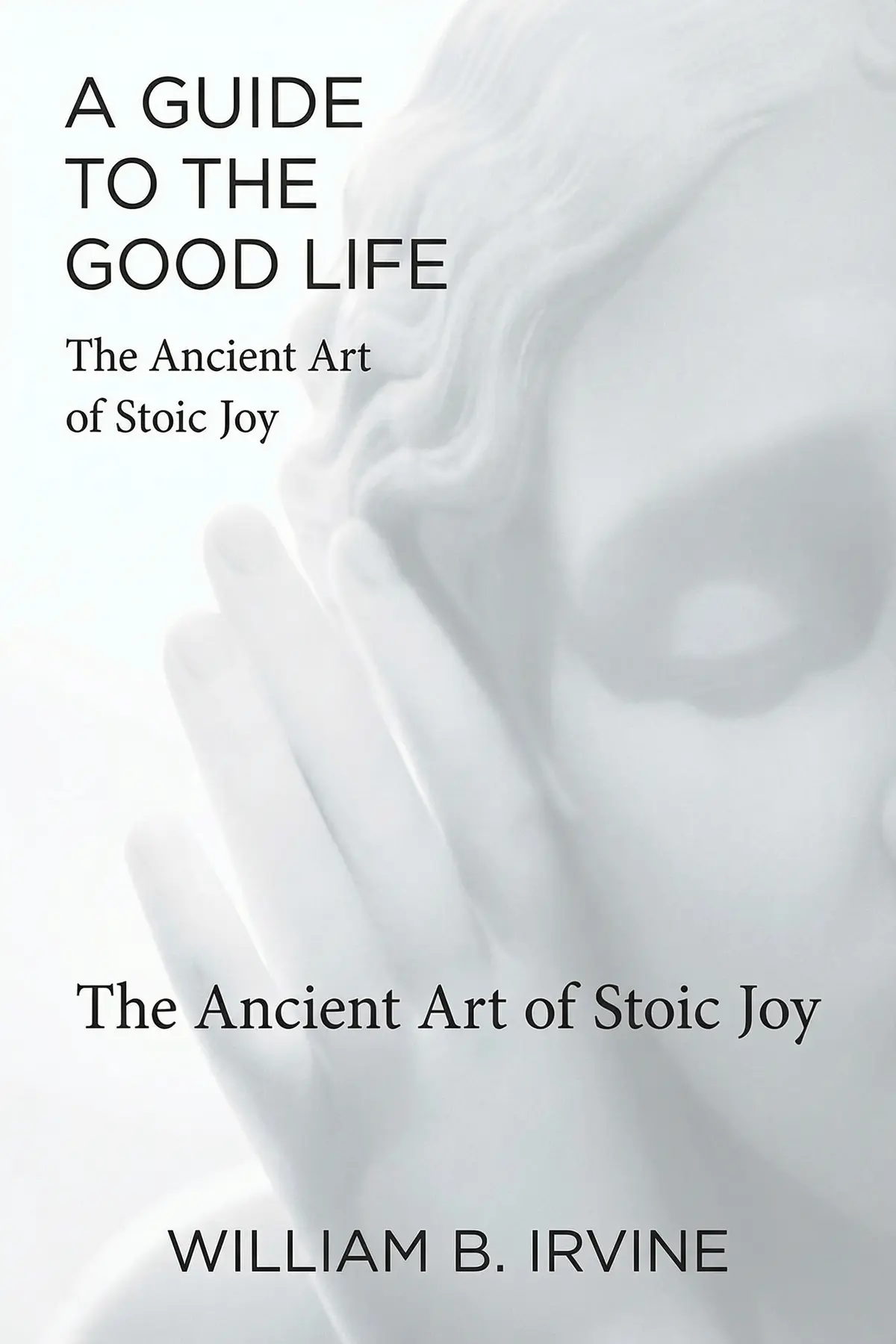
A Guide to the Good Life explores how ancient Stoic philosophy can provide a practical roadmap for modern happiness, teaching us to value tranquility and master our internal reactions to the world.
1 min 39 sec
Imagine you are standing in the longest line at the grocery store. You can feel your pulse quicken as the person at the front fumbles for their wallet. You look at your watch, calculate the minutes ticking away, and feel a surge of resentment toward the cashier, the other shoppers, and the universe in general. This small moment of frustration is a microcosm of a much larger problem: most of us are living without a clear strategy for our own happiness. We allow external circumstances—traffic jams, rude comments, or minor setbacks—to dictate our internal weather.
But what if you could remain completely unruffled by these events? What if you had a mental operating system that protected your peace of mind regardless of what the world threw at you? This is the core promise of A Guide to the Good Life. By revisiting the ancient Greek and Roman school of Stoicism, we discover that philosophy isn’t just an academic pursuit for dusty libraries; it is a practical art form designed to help us navigate the complexities of human existence.
The Stoics believed that by refining our ability to reason and practicing specific mental exercises, we could achieve a state of tranquility and virtue. This throughline connects every technique in the book: the idea that we can find profound joy and stability by focusing exclusively on what is within our control and letting go of the rest. In the following sections, we will explore how to stop the cycle of endless wanting, how to handle the inevitability of loss, and how to build a life that feels meaningful from the inside out. We aren’t just looking for quick fixes; we are looking for a comprehensive way to live that honors our nature as rational, social beings.
2 min 32 sec
Discover why living without a clear set of values is like sailing a ship without a map, and how the Stoic path offers a balanced middle ground.
2 min 44 sec
Understand the two central goals of the Stoic life: acting in accordance with our rational nature and maintaining an unshakeable inner calm.
2 min 31 sec
Learn how the psychological trap of adaptation keeps us perpetually dissatisfied and how a simple mental exercise can break the cycle.
2 min 32 sec
Explore why intentionally stepping out of your comfort zone can toughen your spirit and make your daily life feel more luxurious.
2 min 19 sec
Redefine your relationship with success by learning to distinguish between what you can change, what you can’t, and where you have partial influence.
2 min 19 sec
Master the art of social resilience by letting go of the need for approval and learning to view insults with a philosopher’s detachment.
2 min 20 sec
Discover why the pursuit of riches is often a trap and how a simple life can offer a level of freedom that money can’t buy.
2 min 20 sec
Learn how to use reason to process the loss of loved ones and how a healthy awareness of death can actually make life more vibrant.
2 min 30 sec
Understand that Stoicism is a skill that requires daily training, and learn how to begin your own journey toward inner peace.
1 min 33 sec
In the end, A Guide to the Good Life teaches us that while we cannot control the cards we are dealt, we have total control over how we play the hand. Stoicism isn’t a philosophy of ‘giving up’ or ‘not caring’; it is a philosophy of extreme empowerment. It reminds us that our internal tranquility is a sanctuary that no one can enter without our permission. By practicing negative visualization, we learn to treasure our current reality. By embracing voluntary discomfort, we become resilient. And by internalizing our goals, we protect ourselves from the pain of external failure.
As you move forward from this summary, try to implement one small change today. The next time you feel a surge of frustration—perhaps because someone cut you off in traffic or your internet is running slow—pause for a single breath. Remind yourself that the event is external and your reaction is internal. Choose tranquility over anger. This small victory is the first step on the path to a virtuous and joyful life. Stoicism is a gift from the past, designed to help us flourish in the present. It offers us the chance to stop being victims of our circumstances and to start being the architects of our own peace. The ‘good life’ is not a destination we reach once we have enough money or the right house; it is a way of walking through the world that is available to us right now, in this very moment.
Have you ever felt like you were drifting through life, reacting to every minor annoyance and constantly chasing the next big purchase? A Guide to the Good Life introduces readers to the timeless wisdom of the Stoics—thinkers who mastered the art of living well long before the modern world’s distractions. The book explains that happiness isn't about what happens to us, but how we interpret those events. By adopting a formal philosophy of life, we can move from a state of constant dissatisfaction to one of deep, abiding tranquility. The promise of this work is a practical toolkit for the mind. It offers specific techniques, such as negative visualization and the internalization of goals, to help us appreciate what we have and remain unshakeable in the face of adversity. Rather than viewing Stoicism as a cold or emotionless path, author William B. Irvine shows it to be a vibrant, joy-filled strategy for focusing on what truly matters. It is a guide to reclaiming your time, your energy, and your peace of mind by aligning your daily actions with your highest values.
William B. Irvine is a dedicated scholar and practitioner of philosophy, serving as a professor of philosophy at Wright State University in Dayton, Ohio. Beyond his exploration of Stoic principles, he has delved into the complexities of human motivation and social interaction. His other notable works include On Desire: Why We Want What We Want, which examines the roots of our cravings, and A Slap in the Face: Why Insults Hurt – and Why They Shouldn’t, a study on the psychology of social friction and resilience.
Listeners find this work offers a superb primer on Stoic philosophy, outlining its core principles and presenting them in a clear, approachable manner. Furthermore, they value how readable it is and the actionable guidance it contains, with one listener mentioning it offers numerous methods for today's audience. Also, the text aids in developing joy and contentment, while remaining high-quality and simple to grasp.
Finally got around to reading Irvine's take on Stoicism, and it’s surprisingly refreshing for a philosophy book. Instead of getting bogged down in dense, academic jargon, he presents a practical roadmap for maintaining tranquility in a chaotic world. I particularly loved the concept of 'negative visualization'—imagining the loss of what we value to actually appreciate it more. It’s a bit counterintuitive to think about your car being stolen or a loved one passing away to feel happier, but it really works to combat hedonistic adaptation. The prose is straightforward, making it accessible even if you've never touched Marcus Aurelius or Seneca. My only minor gripe is that some sections feel slightly repetitive, as if he’s trying too hard to drive the point home for a general audience. Still, it’s a solid 5-star guide for anyone looking to build some emotional resilience.
Show moreAfter hearing so much about the 'Stoic revival,' I decided to start here. This book is a masterclass in making ancient philosophy palatable for the modern reader. Irvine doesn’t just tell you what the Stoics thought; he shows you how to think like one. I found the section on 'internalizing goals' to be a total revelation for my professional life. Focusing only on what I can control has significantly lowered my stress levels during big projects. It's written with an almost painful simplicity at times, but that makes it perfect for a quick morning read. Frankly, it’s the most useful self-help book I’ve picked up in years because it’s rooted in something deeper than just 'positive thinking.' It’s about building a psychological fortress.
Show moreWow. This book really changed my perspective on what it means to be successful. We are taught to want everything, but Irvine teaches us how to want what we already have. The concept of 'amor fati'—loving your fate—is so much more powerful than just 'settling.' It’s about active appreciation for the path you’re on. I loved the mental exercise of imagining how much worse things could be; it sounds morbid, but it actually makes me much more cheerful on my commute. The prose is simple and direct, which I appreciated, though I can see why some might find it a bit dry. For me, the utility of the advice is what matters most. It’s a life-changing 5-star read that I’ll be coming back to whenever I feel my peace of mind slipping.
Show moreThis book acts as a perfect bridge between the ancient world and our modern, distraction-filled lives. I’ve been trying to find a 'philosophy of life' for a while now, and Irvine makes a compelling case for why Stoicism is the best candidate. The idea that we should treat the past as something fixed and unchangeable—with total fatalism—has helped me stop dwelling on 'if only' scenarios. It’s about moving forward with what you have left. I also think his explanation of 'tranquility' as the ultimate goal is spot on. It’s not about being a robot; it’s about not letting external events dictate your internal state. Well-written, accessible, and deeply practical. This is a must-read for anyone feeling overwhelmed by the modern world.
Show morePicked this up on a whim after a friend mentioned 'negative visualization.' I wasn't expecting to be so thoroughly convinced by the Stoic way of life. Irvine does a fantastic job of presenting these ancient exercises as modern 'brain hacks' to increase happiness. I’ve already started applying the 'internalization of goals' to my gym routine, focusing on the effort of the workout rather than the numbers on the scale, and it’s made the whole process much more enjoyable. The book is very readable and the structure makes it easy to dip in and out of. Even the parts where I disagreed with him, like his take on political correctness, were thought-provoking. Overall, it’s an excellent 5-star introduction to a philosophy that actually works in the real world.
Show moreThe chapter on insults was easily the most practical part of this book for me, even if it felt a bit strangely emphasized. Why does Irvine think we’re being insulted so much? Regardless, his advice on reacting with humor or silence is gold. This isn't just a history lesson; it's a manual for living that bridges the gap between ancient wisdom and 21st-century stressors. I appreciated the systematic way he broke down 'internalizing goals'—focusing on the effort rather than the result. If I play a tennis match, my goal isn't to win, but to play to the best of my ability. That shift in perspective is a game-changer for anxiety. It’s a 4-star read only because the writing style is a bit too 'self-help' at times, losing some of the grit I expected from the Stoic masters.
Show moreEver wonder why you're never satisfied even after getting exactly what you wanted? Irvine identifies this as 'hedonistic adaptation,' and his 'Guide to the Good Life' is essentially the antidote. The truth is, we spend so much time chasing the next big thing that we forget how to enjoy the current thing. By using Stoic 'tricks' like imagining the last time you'll ever do something—like brushing your teeth or seeing a friend—you regain a sense of presence. The book is well-organized and much easier to digest than jumping straight into Epictetus. While it occasionally feels like the author is over-explaining simple concepts, the practical value far outweighs the stylistic flaws. It has genuinely helped me cultivate a more fatalistic, and thus peaceful, attitude toward the past.
Show moreAs someone who finds traditional philosophy too abstract to be useful, this was exactly what I needed. Irvine strips away the academic fluff and gets right to the heart of how to live. He compares the Stoic mindset to being a spectator at a play: you enjoy the performance, but you don't get destroyed when the curtain falls. That level of detachment combined with active enjoyment is a beautiful balance. I’ve started practicing his advice on responding to social status and it’s incredibly freeing to stop caring about what others think. The book is easy to read, almost too easy, but the message sticks. It’s helped me find a sense of tranquility that I haven't felt in a long time. Four stars for a very solid, practical philosophy.
Show moreTo be fair, Irvine provides a decent introduction to the basics, but I found the execution a bit lacking. The writing is incredibly repetitive, often circling back to the same points several times within a single chapter. It felt like a 100-page essay stretched out to fill a book-length slot. I also wasn't a huge fan of how he dismissed things like grief counseling so quickly; it felt a bit dismissive of modern psychology. However, the core exercises—like negative visualization—are legitimately useful and well-explained. If you've already read the original Stoic texts, you might find this a bit too 'dumbed down.' It’s a fine starting point for a total novice, but it didn't quite live up to the hype for me. Three stars for the content, even if the delivery was tedious.
Show moreGotta say, I have mixed feelings about this one. On one hand, the Stoic techniques for tranquility are brilliant. On the other, the author’s tone can be a bit condescending, and his redundancies made it hard to stay engaged. I found myself skimming the latter half of the book because it felt like he was just repeating the same 'tricks' in slightly different contexts. The chapters on applying Stoicism to daily life were hit or miss—some were insightful, others were just obvious common sense. I did appreciate the historical context at the beginning, though. It’s a 3-star book for me because while the 'Guide' part is helpful, the writing style just didn't click. It’s useful, but it’s definitely not a literary masterpiece.
Show moreJohn Rawls


Richard Wiseman



Andrew D. Thompson
AUDIO SUMMARY AVAILABLE
Get the key ideas from A Guide to the Good Life by William B. Irvine, plus 5,000+ more titles in English and Thai.







