


23 min 58 sec
Company of One: Why Staying Small Is the Next Big Thing for Business
By Paul Jarvis
Discover why relentless growth isn't the only path to success. Paul Jarvis explains how staying small allows for greater autonomy, profitability, and personal freedom in a world obsessed with expansion.
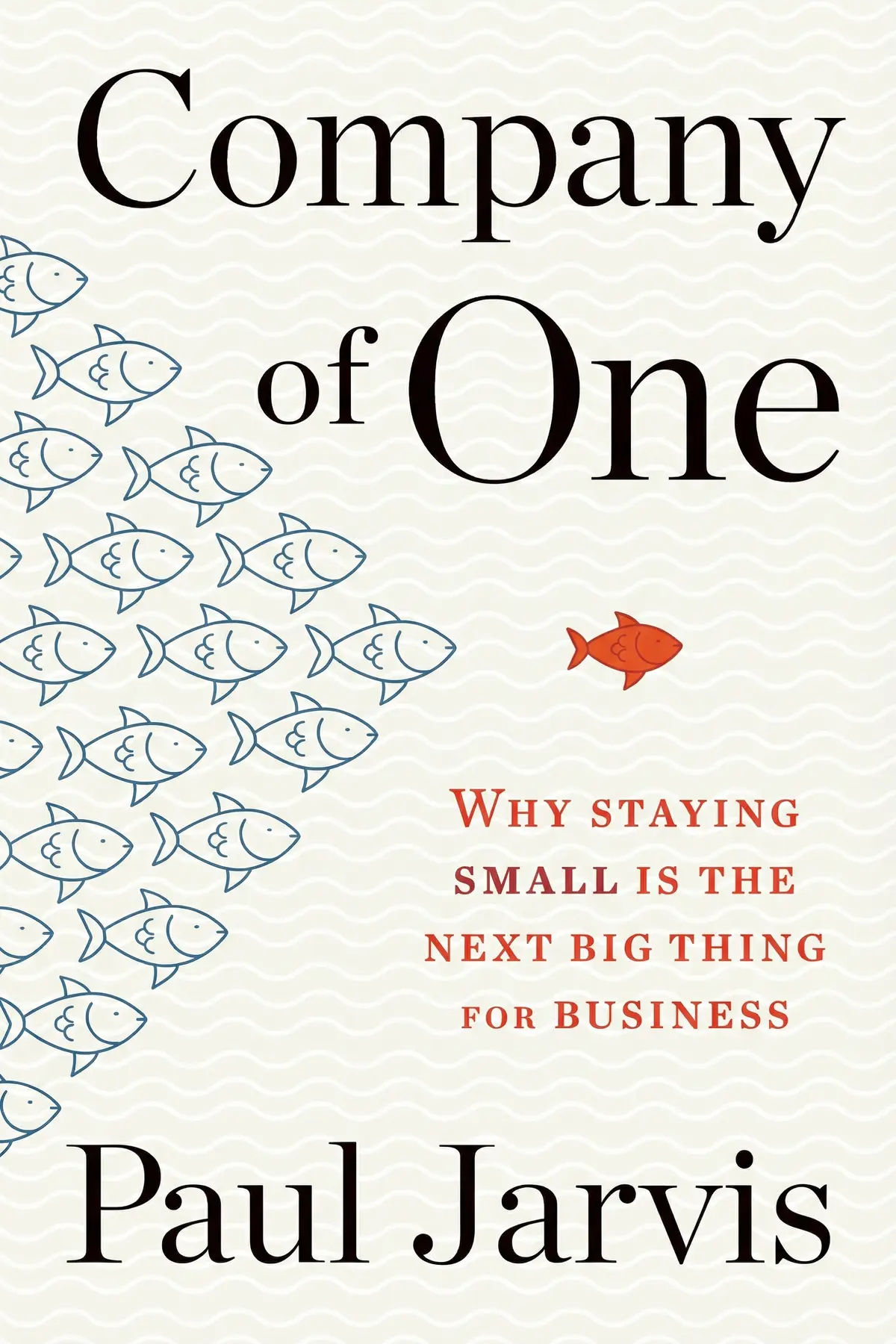
Table of Content
1. Introduction
1 min 45 sec
Think about the names that dominate the headlines of the business world today. We are constantly inundated with stories of massive tech giants, global logistics empires, and visionary founders who have built billion-dollar dynasties. We’ve been conditioned to believe that the only way to measure success is through expansion: more employees, more office space, and more revenue. But there is a hidden cost to this obsession with ‘more.’ When we focus solely on getting bigger, we often lose the very things that made us want to work for ourselves in the first place—our time, our creative control, and our peace of mind.
What if there was another way? What if, instead of aiming for an endless upward trajectory, you decided that your business was already exactly the size it needed to be? This is the core philosophy behind the idea of the Company of One. It isn’t just about being a solo freelancer; it’s a mindset that prioritizes staying small to maximize freedom and sustainability. It’s an approach that suggests that growth isn’t always a requirement for success—in fact, growth can sometimes be the very thing that destroys a good business.
In the following minutes, we are going to explore a different path to entrepreneurship. We’ll look at how you can build a stable, profitable business without sacrificing your personal life on the altar of corporate expansion. We will see how to turn a simple skill into a lasting career, why a tiny niche is better than a massive market, and why your personality is actually your most valuable competitive advantage. If you’ve ever felt overwhelmed by the pressure to scale, or if you’re looking for a way to work that supports the life you want to live, then these ideas are for you. Let’s dive into how you can start thinking smaller to achieve something much bigger.
2. The Fallacy of Constant Expansion
2 min 27 sec
Traditional business logic demands endless growth, but pursuing ‘more’ often leads to diminishing returns and personal burnout.
3. Defining the Company of One
2 min 04 sec
A company of one is distinct from both traditional small businesses and standard freelancing because it prioritizes intentional sustainability over growth.
4. The Safe Path to Independence
2 min 04 sec
Successful solo enterprises are rarely built on impulsive leaps; they are usually the result of careful, gradual transitions from side projects.
5. Mastery Before Passion
1 min 54 sec
Finding work you love is often the result of getting good at a valuable skill, rather than simply following a hobby.
6. The Power of the Niche
2 min 01 sec
Trying to appeal to everyone is a fast track to becoming generic; focusing on a specific, narrow audience builds trust and allows for premium pricing.
7. Personality as a Competitive Edge
2 min 03 sec
Your unique human perspective is the one thing your larger competitors can never copy; use it to brand your business authentically.
8. Building Relationships Through Education
1 min 56 sec
Instead of hard-selling, focus on providing genuine value and teaching your audience, which naturally positions you as a trusted authority.
9. The Lean Path to Profitability
1 min 54 sec
Speed and cost-efficiency are more important than perfection; avoid heavy investments and focus on becoming profitable as quickly as possible.
10. Scaling Through the Snowball Effect
2 min 04 sec
Sustainable growth happens gradually as one success leads to another, allowing you to reinvest profits rather than taking on debt.
11. Retention is Your Best Marketing Strategy
2 min 05 sec
Keeping existing customers is significantly cheaper and more effective than constantly hunting for new ones in a solo business model.
12. Conclusion
1 min 41 sec
We’ve covered a lot of ground, but the core message of the Company of One is simple: you have the power to define what success looks like for you. You don’t have to follow the traditional corporate path of endless expansion, increased complexity, and the eventual burnout that so often follows. Instead, you can choose a path of intentional smallness. By focusing on a marketable skill, finding a narrow niche, leveraging your unique personality, and building deep, lasting relationships with your customers, you can create a business that is both highly profitable and incredibly sustainable.
Remember that this isn’t just a strategy for solo entrepreneurs. Even if you work within a large organization, you can adopt the mindset of a company of one. You can focus on being more efficient, providing better service, and finding ways to deliver value quickly and simply. The principles of autonomy, responsibility, and intentionality are universal. They allow us to move away from the ‘more is better’ trap and toward a life where our work serves our existence, rather than the other way around.
As you move forward, I challenge you to look at your current projects or business ideas through this lens. Ask yourself: Where am I pushing for growth just because I think I’m supposed to? What would happen if I set a limit on that growth to preserve my freedom? How can I use my personality to connect more deeply with the people I serve? By staying small, staying focused, and staying human, you might just find that you’ve built something far more rewarding than any billion-dollar empire. Success isn’t about how many people you manage; it’s about how much of your life you actually own. Go build a business that gives you your life back.
About this book
What is this book about?
Company of One challenges the conventional business wisdom that growth is always good. Instead of scaling up, Paul Jarvis argues that the most resilient and rewarding businesses are those that intentionally stay small. By focusing on sustainability, profit over revenue, and individual freedom, anyone can build a business that serves their life rather than consuming it. This book provides a blueprint for creating a self-sustaining enterprise. It covers everything from finding a profitable niche and building deep customer relationships to leveraging simple technology. The promise is a career that offers the stability of a corporation with the flexibility of a solo creator, allowing you to define success on your own terms.
Book Information
About the Author
Paul Jarvis
Paul Jarvis is a seasoned web designer, writer, and entrepreneur with two decades of experience working for himself. Throughout his career, he has collaborated with major global brands including Microsoft, Mercedes-Benz, and Warner Music. A respected voice in the business world, his insights have been featured in prominent publications such as WIRED, Fast Company, and USA Today.
Ratings & Reviews
Ratings at a glance
What people think
Listeners find the book highly accessible and well-written, providing actionable guidance that aids in developing prosperous businesses. They also value the perspectives shared, with one listener emphasizing the focus on critical questioning and achieving profitability without scaling up. Furthermore, the content earns praise for its relevance to entrepreneurs; specifically, one listener mentions it functions as a refreshing alternative to the start-up growth model.
Top reviews
On
Finally, someone said it out loud: growth isn't the only metric for success. Jarvis challenges the Silicon Valley mindset where you scale or die, offering a refreshing alternative. I loved the emphasis on staying small to maintain a direct connection with your customers. It's rare to see a business book that values personal freedom and psychological wellbeing over a massive headcount. The writing is incredibly smooth and easy to digest, though some might find the lack of a traditional how-to checklist a bit frustrating. Personally, I found the mindset shift more valuable than any spreadsheet could ever be. It’s an essential read for anyone feeling burnt out by the "more, more, more" culture. This is the perfect guide for building a venture that serves your life rather than consuming it.
Show moreOwen
After hearing about this book for years, I finally got around to reading it and I'm impressed by how well it has aged. Even though the business world moves fast, the principles of staying agile and questioning growth remain incredibly relevant. Jarvis writes with a casual, friendly tone that makes complex business theories feel like a conversation over coffee. He avoids the typical jargon and focuses on what actually matters: profit and sanity. I found the chapters on building trust through transparency particularly enlightening. It’s not just for people who want to work alone; even employees can apply these mindsets to their roles. It’s a practical, grounding piece of work that I’ll definitely be revisiting whenever I feel the itch to scale for the sake of scaling. Highly recommended.
Show moreSuphan
This book feels like a breath of fresh air in a room full of people screaming about scaling to seven figures. Jarvis provides a much-needed alternative to the typical startup growth model that usually leads to burnout. He focuses on the idea of enough—how much money and how much growth do you actually need to be happy? It’s a radical question in a world obsessed with constant expansion. The insights into how a smaller company can be more resilient during economic shifts were particularly sharp. Frankly, I think every entrepreneur should read this before they decide to take on debt or hire their first employee. It is well-written, thought-provoking, and deeply human. It genuinely changed how I view my professional trajectory and my definition of success.
Show moreWilliam
Picked this up after seeing it compared to the digital minimalism movement, and the comparison holds up well. Jarvis argues that being small makes you more nimble and better at serving your specific niche. It’s like a Marie Kondo approach for your professional life; if a growth opportunity doesn't spark joy or profit, just say no. I really appreciated the sections on building trust and brand authority without a huge marketing team. My only gripe is that some examples feel a bit dated or feature 'experts' who seem a little suspicious. However, the core message about staying agile to avoid bureaucracy is absolute gold. It’s a grounding read that reminds you why you started your own thing in the first place. You don't need a massive team to have a massive impact.
Show moreSomsri
As someone who has always felt pressured to hire an assistant and expand, this was the permission slip I needed. Success doesn't have to mean a bigger office or more Slack notifications. Jarvis lays out a compelling case for why staying small actually makes you more profitable in the long run. By keeping overhead low and focusing on high-margin products, you can earn more while working less. The book is well-organized and stays focused on the psychological benefits of a manageable workload. I do wish there were more diverse examples outside of the tech and web development world, though. Still, the quality of information is high, and it serves as a great alternative to the standard startup growth model. It’s practical, grounding, and very well-written.
Show moreLucia
The truth is that most of us don't want to manage people; we just want to do the work we love. This book is a manifesto for those who prefer the craft over the management. Jarvis does a great job of highlighting why staying nimble is a competitive advantage in a crowded market. Smaller businesses can pivot faster and offer a level of personalization that giant corporations simply can't match. I found myself highlighting dozens of passages about creating better products through intentional customer listening. While some of the case studies felt a bit 'guru-heavy' and suspicious, the overarching logic is sound. It’s an easy read that manages to be both inspiring and realistic about the challenges of working for yourself. It’s definitely a welcome alternative to the growth-at-all-costs mindset.
Show moreZanya
Questioning the fundamental assumption that growth equals success is a bold move, and Jarvis pulls it off beautifully. The book is less about being a freelancer and more about building a sustainable, product-based business that doesn't require a huge team. It encourages you to find your own version of success rather than following a pre-packaged template. I loved the emphasis on building trust and staying profitable from day one. Some of the advice on charging more when demand goes up is a simple but effective strategy that many small owners overlook. My only minor complaint is that the author’s background as a web developer colors his perspective quite heavily. However, if you can look past the tech-centricity, there is a wealth of wisdom here for any solo operator or creative business owner.
Show moreAmelia
There are some solid affirmations here, but you have to take the advice with a grain of salt if you live in the US. The author is based in Canada, so his perspective on risk is a bit skewed since he doesn't have to deal with our outrageous healthcare costs. That being said, the idea of a 'lifestyle business' that funds your life rather than consuming it is a beautiful goal. I struggled with the fact that he constantly cites Buffer and Basecamp as examples. Those companies have dozens of employees and millions in revenue, which isn't exactly a solo operation. It’s a well-written book, but it feels like it’s recycling a lot of what Jason Fried has been saying for years. It's a decent entry point for beginners but might feel repetitive for seasoned business owners.
Show moreSelin
Look, the central message is fantastic, but I’m not sure it needed to be an entire book. Jarvis makes his point in the first thirty pages and then spends the rest of the time circling the same drain. He argues that being small allows you to care more about your customers, which is a point I totally agree with. But I kept waiting for the 'how-to' and it never really showed up in a meaningful way. The writing style is pleasant enough, yet the lack of concrete systems makes it feel more like a long-form essay than a business manual. If you’ve read any of the 37signals books or blogs, you’ve basically already read this. It’s a good reminder to stay lean, but don't expect a step-by-step guide to solopreneurship.
Show moreMoo
Not what I expected at all, especially considering the hype in the solopreneur community. While I agree with the core premise that scaling isn't mandatory, the book spends way too much time repeating the same three points. Jarvis draws a hard line between freelancers and 'companies of one,' arguing that freelancers are just selling their time. To be fair, he’s mostly focused on product creators, which left me—a service-based professional—feeling a bit excluded. I wanted concrete systems and actionable steps to implement today, but instead, I got 200 pages of high-level philosophy. The examples he uses are often companies like Buffer that already have dozens of employees, which totally undermines the 'company of one' title. It felt like it needed a much tighter editor to actually be useful.
Show moreReaders also enjoyed
7 Powers: The Foundations of Business Strategy
Hamilton Helmer

Alibaba: The House That Jack Ma Built
Duncan Clark
AUDIO SUMMARY AVAILABLE
Listen to Company of One in 15 minutes
Get the key ideas from Company of One by Paul Jarvis, plus 5,000+ more titles in English and Thai.
- 5,000+ titles
- Listen as much as you want
- 7-day free trial
- Cancel anytime







