
17 min 04 sec
The End of Jobs: Money, Meaning and Freedom Without the 9-to-5
The End of Jobs explores why traditional employment is becoming a risky gamble and how the rise of entrepreneurship offers a new path to financial security, personal freedom, and meaningful work.
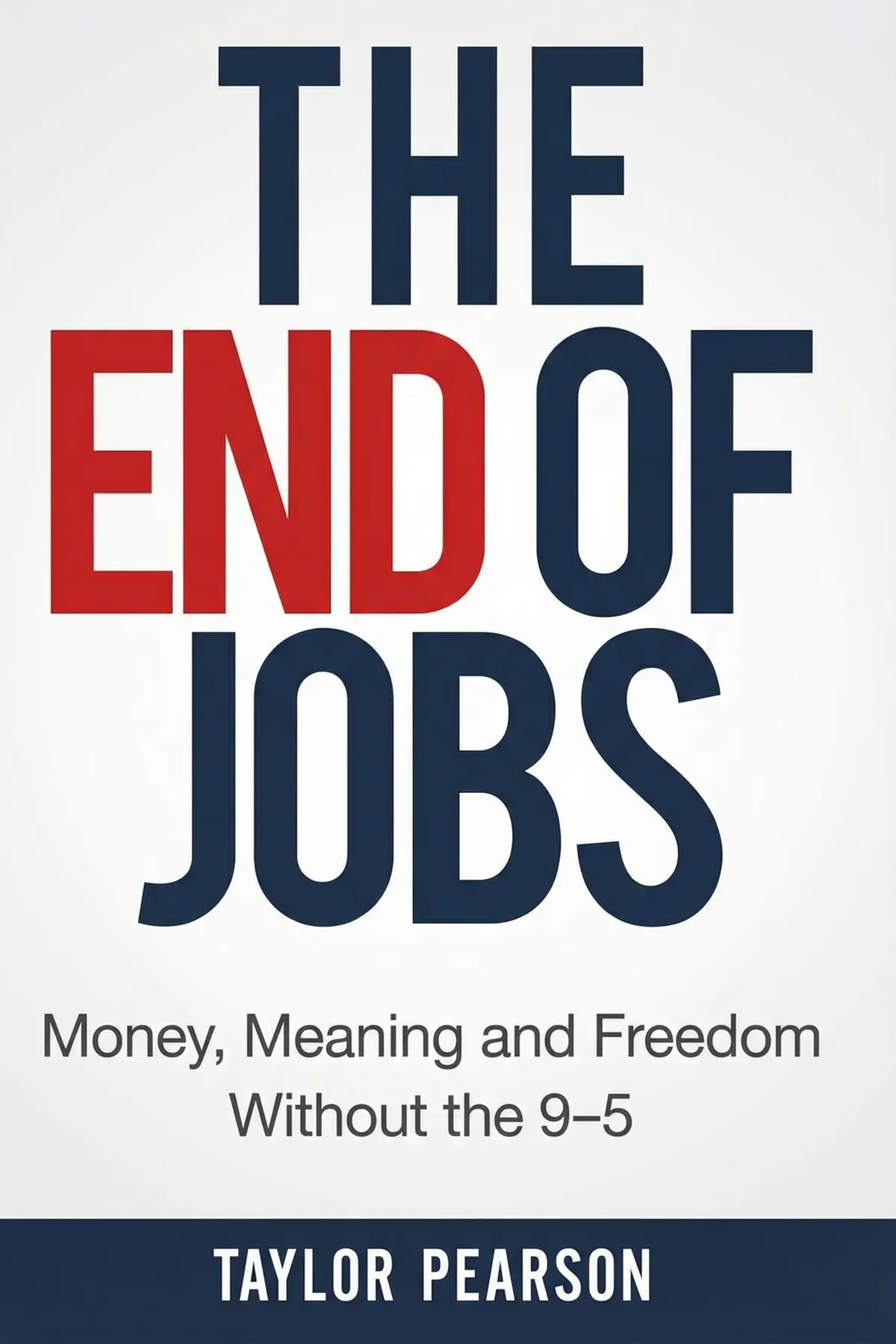
Table of Content
1. Introduction
1 min 52 sec
For generations, the roadmap to a successful life was simple and seemingly foolproof: study hard, earn a degree, and secure a stable job at a reputable company. This narrative has been etched into our collective consciousness, passed down from parents to children as the ultimate blueprint for security. However, as we look around at the current economic landscape, characterized by mounting student debt and a volatile job market, it is becoming increasingly clear that this old promise is breaking down. We are living through a period of profound transition, one where the traditional 9-to-5 job is not just changing, but in many ways, reaching its expiration date.
What we are witnessing is a paradigm shift that redefines what it means to be safe and what it means to be successful. The forces of globalization and rapid technological advancement have disrupted the status quo, making what was once the most conservative path—steady employment—one of the riskiest choices an individual can make. In this exploration, we will dive into why the rules of the game have changed so fundamentally. We will look at the history of economic limits to understand how we arrived at this moment and why entrepreneurship has moved from the fringes to the very center of economic survival.
This isn’t just a story about the decline of the office cubicle; it is a guide to the new entrepreneurial economy. We will uncover how the democratization of technology allows anyone with an internet connection to build a global business, why creativity has replaced credentials as the most valuable currency, and how you can navigate this transition without taking reckless risks. The goal is to move beyond the anxiety of a changing world and see the unprecedented freedom and meaning that this new era offers. By the end of this journey, the idea of a traditional job will no longer look like a safe harbor, but rather like a relic of a bygone age, clearing the way for a more intentional and prosperous way of living.
2. The Evolution of Economic Constraints
2 min 12 sec
Explore how the primary obstacles to wealth have shifted throughout history, moving from land ownership to capital, and why we are now entering the age of the entrepreneur.
3. The Disappearing Safety Net of Credentials
1 min 56 sec
Discover why the traditional path of higher education and job security, which worked so well for previous generations, is no longer a guaranteed route to success.
4. Outsourcing and the Rise of the Micro-Multinational
1 min 59 sec
Learn how global connectivity and automation are transforming the workforce, and why these same forces provide a massive advantage to modern entrepreneurs.
5. Redefining Risk and the Turkey Problem
1 min 55 sec
Understand the hidden dangers of ‘safe’ jobs and why the visible risks of entrepreneurship are actually more manageable in the long run.
6. The Democratization of Business Tools
1 min 54 sec
Find out how the internet has crashed the cost of starting a business, making it possible for anyone to compete on a global scale.
7. The Shift from Obligation to Meaning
1 min 55 sec
Explore the psychological transition from working for survival to seeking work that provides genuine fulfillment and why this shift is economically beneficial.
8. The Stair Step Method for Career Transition
1 min 57 sec
Learn a practical, low-risk strategy for moving from a traditional job to full-time entrepreneurship by building your skills in stages.
9. Conclusion
1 min 24 sec
The transition we are experiencing today is as significant as the move from the farm to the factory. The old world of ‘safe’ jobs and guaranteed career ladders is being replaced by a dynamic, global, and highly creative entrepreneurial economy. While this change brings uncertainty, it also brings a level of freedom and potential that was previously unimaginable. We no longer have to be cogs in someone else’s machine; we have the tools to build our own.
If there is one key takeaway from this exploration, it’s that the most dangerous thing you can do in a changing world is to stand still and rely on outdated systems. Security today doesn’t come from a paycheck; it comes from a skill set. It comes from the ability to spot opportunities, manage risks, and create value in a way that software and low-cost labor cannot. The ‘end of jobs’ is not a crisis to be feared, but an invitation to reclaim your autonomy.
As you move forward, consider the mindset of some of the world’s most successful investors. They don’t look for quick wins or follow every market trend. Instead, they focus on long-term time horizons and concentrate their efforts on a few high-quality opportunities. You can apply this same logic to your career. Stop looking for the next ‘steady job’ and start looking for the next way to build your own value. By embracing the entrepreneurial spirit and using the tools available to you, you can move beyond the 9-to-5 grind and create a life defined by money, meaning, and genuine freedom.
About this book
What is this book about?
This summary explores the profound shift currently taking place in the global economy, moving away from a reliance on traditional employment toward a future defined by entrepreneurship. It challenges the long-held belief that a college degree and a 9-to-5 job are the safest paths to financial stability, arguing instead that these paths are increasingly risky due to automation, outsourcing, and an oversupply of credentials. The book provides a historical context for this shift, explaining how economic limits have evolved from land and capital to knowledge, and now, finally, to entrepreneurship. By examining the structural hazards of modern employment and the mechanics of a graduated approach to starting a business, the summary offers a roadmap for those looking to reclaim their time and find more meaning in their work. It explains how technology has lowered the barriers to entry for starting a business, making it safer and more profitable to work for yourself than to remain a cog in a decaying system. Ultimately, it serves as a wake-up call and a guide for navigating a world where the traditional career path is no longer a viable option.
Book Information
About the Author
Taylor Pearson
Taylor Pearson is an entrepreneur, marketing professional, and business consultant. He leverages his expertise to provide strategic advice to a wide range of clients, including authors, fellow entrepreneurs, and CEOs, helping them clarify their vision and effectively market and scale their business ventures.
Ratings & Reviews
Ratings at a glance
What people think
Listeners view this work as essential reading, particularly for entrepreneurs, and value its thoroughly researched concepts and actionable guidance. Furthermore, the book provides useful viewpoints on the entrepreneurial landscape, with one listener emphasizing its reliable tactics for discovering fulfilling work. Finally, listeners applaud the straightforward writing style and the fascinating historical context regarding the evolution of the economy.
Top reviews
Omar
Taylor Pearson manages to articulate something many of us have felt intuitively for years. The core argument regarding the "Turkey Effect" is a wake-up call for anyone clinging to a traditional corporate ladder. By examining the history of the four economies, Pearson explains why the rules that governed our parents' careers simply don't apply anymore. I found the practical advice on the 90-day sprint system particularly actionable for my own projects. While some critics argue it’s a synthesis of other works, having these ideas distilled into one cohesive narrative is incredibly valuable. It is a must-read for entrepreneurs looking to navigate what he calls Extremistan. The writing style is punchy and accessible, making complex macroeconomic trends feel personal and urgent. If you are worried about digital disruption, this provides a solid roadmap for staying relevant.
Show morePensri
Ever wonder why your secure 9-to-5 feels increasingly fragile despite the steady paycheck? This book answers that question by diving into the silent risks inherent in traditional employment. Pearson argues convincingly that entrepreneurship is actually the safer path in the modern era due to the democratization of production. I loved the historical perspective on economic evolution, which helped me see the current digital revolution as part of a larger cycle. The text is easy to understand and avoids the dense jargon often found in business literature. While he quotes a lot of other thinkers like Taleb and Munger, he weaves them into a practical framework that feels fresh. It’s an empowering read that encourages you to take control of your career rather than leaving it to a corporation. I’ve already started implementing some of the growth triangles in my own small business.
Show moreMadison
The comparison between traditional career paths and the "long tail" of the internet is where this book truly shines. Pearson makes a compelling argument that we are living through an entrepreneurial revolution that is as significant as the industrial one. I found the strategies for finding meaningful work to be both inspiring and grounded in the reality of today's market. It’s well-researched, drawing on a variety of economic theories to explain why the world is moving toward Extremistan. Unlike many business books, it doesn't just sell the dream; it provides a framework for managing the transition. The writing is clear and the chapters are structured in a way that makes the logic easy to follow. I’ve recommended this to several friends who are considering quitting their jobs to start something new. It gives you the intellectual permission to take the leap.
Show moreSelin
After hearing so much buzz about the "entrepreneurial revolution," I found this to be a definitive manifesto for our current era. The book is packed with insights on how globalization and technology are flipping the script on what we consider a "safe" career. Pearson’s take on the democratization of distribution is brilliant and helps explain why small players can now compete with giants. I’ve read a lot of business books, but the way he explains the Cynefin framework in the context of job security was eye-opening. Not gonna lie, I was skeptical at first, but the practical advice in the later chapters won me over. It’s a fast-paced read that manages to be both philosophical and pragmatic at the same time. If you want to understand the macroeconomic trends shaping your future, start here. It’s one of the few books that actually changed how I plan my work week.
Show moreGun
Picked this up during a career transition and found the logic behind the shift from jobs to entrepreneurship to be incredibly grounding. The book does a fantastic job explaining how technology has enabled the "long tail" of business, allowing for niche markets that were previously impossible to reach. Frankly, the idea that a college degree is now a risky investment rather than a safe bet is a tough pill to swallow, but Pearson backs it up well. My only gripe is that the middle sections felt a bit repetitive, almost as if the author was trying to hit a specific word count. However, the strategies for finding meaningful work in a chaotic economy are top-notch. It’s a well-researched piece that offers a much-needed perspective for millennials entering a volatile market. Definitely worth a read if you feel the 9-to-5 life is draining your potential.
Show moreRose
As someone who recently left the accounting world, the chapter titled "How safe is it to be an accountant?" hit incredibly close to home. Pearson identifies the "silent risk" of becoming outdated in a corporate structure that values compliance over value creation. He accurately describes how the credentialism that served previous generations is failing the current workforce. To be honest, I think his portrayal of entrepreneurship is a bit overly cheery and misses the gut-wrenching stress of making payroll. However, the blueprint he provides for starting an online business is quite thorough and easy to follow. The distinction between "Complex" and "Complicated" tasks was a lightbulb moment for me. It’s a great companion piece to more philosophical business books. I would recommend this to anyone feeling stuck in a role where they are just following instructions.
Show morePalm
Finally got around to reading this after seeing it referenced in several business circles. It provides a solid historical perspective on how we transitioned from an industrial economy to one driven by entrepreneurship. The concept of "silent risk" in a steady job is perhaps the most important takeaway for anyone in the corporate world. I appreciated the case studies, though I wish there were more examples of scaling beyond small digital products. The 90-day sprint system is a useful tool for anyone trying to manage their own productivity. Truth is, the book is a bit repetitive in parts, but the message is important enough to warrant the emphasis. It’s a quick read that will definitely change how you view your career trajectory. This should be mandatory reading for students who think a degree is a guaranteed ticket to security.
Show moreTong
Look, I appreciate the distillation of concepts from Taleb and Frankl, but I wish there were more original data points included. The book works well as a primer for those new to the idea of the "new economy," but seasoned entrepreneurs might find it a bit redundant. It’s essentially a summary of the best business blog posts from the last decade. That said, it is a very good summary that collects disparate ideas into a coherent argument for the end of jobs. I did notice some awkward sentence structures and a few typos that distracted from the message. It feels like the author was more focused on shipping the project than perfecting the prose. Personally, I think it’s a great gift for a college graduate, but maybe not for an established business leader. It covers the "why" very well, but is a bit light on the "how" of scaling a company.
Show moreElise
Not what I expected given the sensationalist title, but it's a solid synthesis of modern economic trends. The author uses a lot of hyperbole and scaremongering to drive home the point that jobs are disappearing, which felt a bit unnecessary. However, the core logic about the rise of entrepreneurship is hard to argue with in today's digital landscape. It provides a decent blueprint for starting a small-scale online business, but it doesn't touch on the complexities of scaling or managing stakeholders. I found the references to other books like Man's Search for Meaning to be a bit of a stretch at times. To be fair, it is an easy-to-understand entry point for people who haven't spent much time thinking about digital disruption. It’s a good think piece, even if it lacks the depth of the sources it frequently cites. Worth a read for the perspective shift, even if you don't agree with every conclusion.
Show moreWyatt
To be fair, the central thesis about the democratization of production is valid, but the execution feels like a glorified blog post. The book is heavily reliant on quotes from famous entrepreneurs and authors without offering much in the way of original data or personal narrative. I struggled with the "McKinsey bro" tone that permeates the text, making it feel somewhat conceited and detached from reality. It portrays a lifestyle of micro-entrepreneurs in Southeast Asia that seems more like an arbitrage play than a scalable business model. There are also several typos and grammatical inconsistencies that a professional editor should have caught before publication. It lacks the "nuts and bolts" advice on raising money or managing a team that actual business owners need. If you’ve already read the Four Hour Workweek or Antifragile, you likely won't find much new information here. I was expecting a more rigorous analysis of the end of jobs.
Show moreReaders also enjoyed
AUDIO SUMMARY AVAILABLE
Listen to The End of Jobs in 15 minutes
Get the key ideas from The End of Jobs by Taylor Pearson, plus 5,000+ more titles in English and Thai.
- 5,000+ titles
- Listen as much as you want
- 7-day free trial
- Cancel anytime







