
16 min 34 sec
A Year with Peter Drucker: 52 Weeks of Coaching for Leadership Effectiveness
Explore the foundational principles of modern leadership through the eyes of management legend Peter Drucker. This summary provides a roadmap for professional growth, effective decision-making, and creating a lasting social impact.
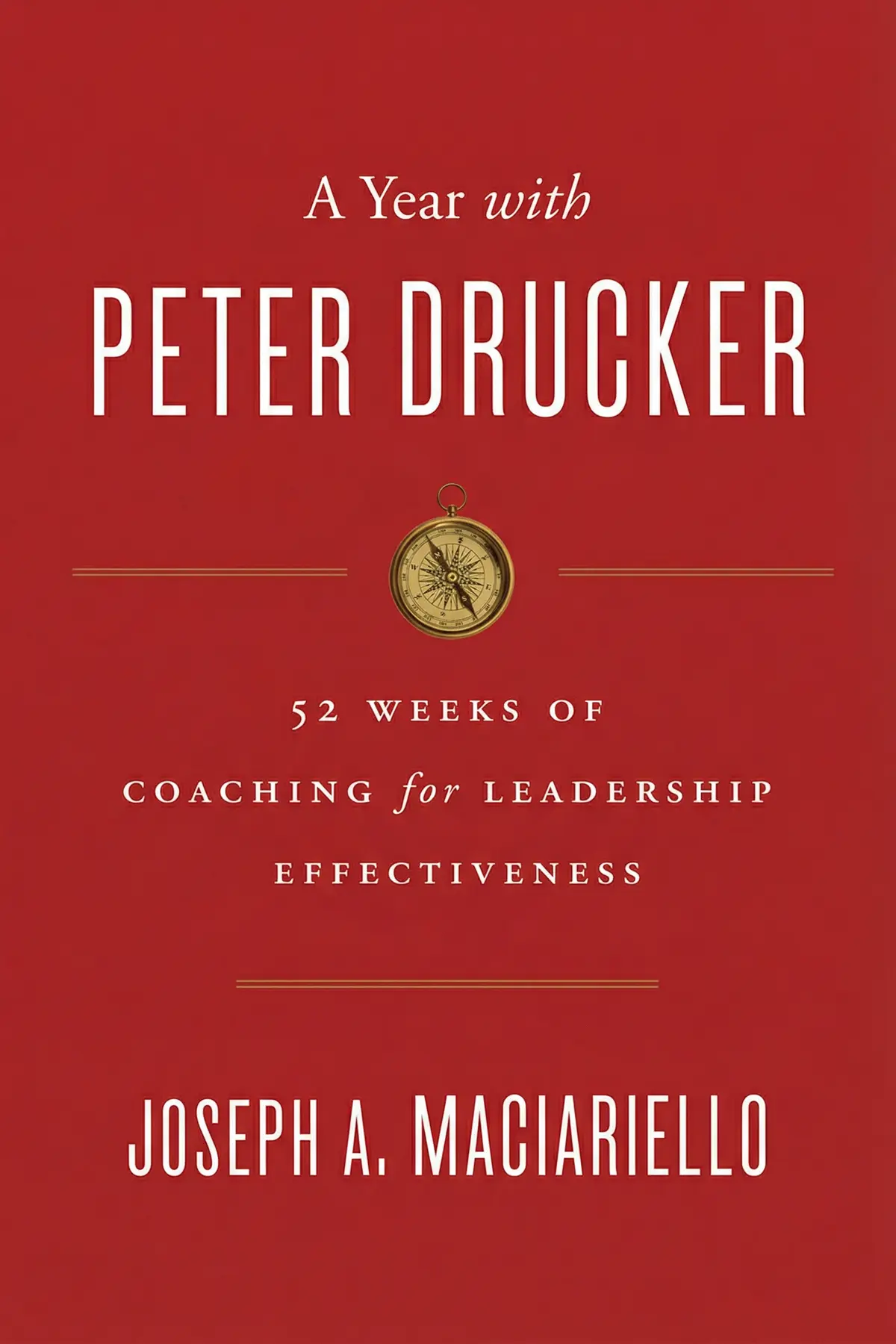
Table of Content
1. Introduction
1 min 29 sec
Management can sometimes feel like a dry subject, filled with spreadsheets and endless corporate meetings. But if we look at it through the lens of Peter Drucker, the picture changes entirely. Drucker didn’t see managers as mere cogs in a corporate machine; he saw them as vital contributors to a healthy society. He believed that good management was the difference between a failing institution and a flourishing one. However, as the decades have passed, many of his original, crystalline insights have been buried under layers of modern business jargon and over-complicated theories.
In this summary, we are stripping back those layers. Guided by Joseph Maciariello, a man who worked closely with Drucker, we will explore the core tenets of leadership effectiveness. We are going to look at why your early career decisions act as a permanent foundation for everything that follows. We will investigate the concept of the knowledge worker and why education is the most powerful form of capital in the modern world. We will also dive into the practical skills of concentration and information literacy—tools that separate the truly effective leaders from those who are simply busy.
Think of this as a coaching session. We aren’t just talking about how to increase quarterly profits; we are talking about how to build a career that lasts and a legacy that matters. By the end of this journey, you’ll understand how to balance the immediate pressures of today with the strategic needs of tomorrow, and how to use your professional skills to create a positive ripple effect throughout your community.
2. Mastering Self-Management Through Feedback
2 min 08 sec
Your career isn’t just something that happens to you; it is something you must actively steer by understanding your own unique patterns of success.
3. The Power of Human Capital in Society
1 min 59 sec
True economic development isn’t just about moving money around; it’s about empowering people with the knowledge they need to lead.
4. Balancing the True Whole of Management
1 min 47 sec
Effective leaders must learn the difficult art of meeting today’s demands without sacrificing the organization’s future potential.
5. Concentration and the Mastery of Information
2 min 07 sec
In a world of infinite distractions and endless data, the best managers succeed by choosing exactly what to ignore.
6. The Manager as a Servant of the Public Good
1 min 53 sec
The skills used to run a successful corporation can be the very same tools needed to solve our most pressing social challenges.
7. Leading Through the Tension of Change
1 min 52 sec
Growth is impossible without change, yet many leaders fail because they refuse to adapt their style as their organization evolves.
8. Ensuring the Future Through Succession
1 min 55 sec
The true test of a leader’s success isn’t what happens while they are in charge, but what happens after they leave.
9. Conclusion
1 min 24 sec
As we wrap up our journey through the insights of Peter Drucker, a clear theme emerges: management is a deeply human discipline. It is not just about the numbers on a balance sheet; it is about the integrity of the person making the decisions. Drucker’s wisdom reminds us that we must be honest about our own strengths and weaknesses before we can expect to lead others effectively. By using tools like feedback analysis and focusing on our core competencies, we can ensure that our professional efforts are actually making an impact.
We’ve also seen that the role of a manager extends far beyond the walls of the office. Whether it’s through executive sabbaticals that help solve public crises or by lending strategic clarity to a non-profit’s mission, managerial skills are a powerful tool for social good. True success is not just measured by the profit you generate, but by the contribution you make to the world around you.
As you move forward in your career, I encourage you to think about your long-term legacy. Don’t just focus on the immediate task in front of you. Ask yourself: how am I building for the future? How am I developing the next generation of leaders? And most importantly, what can I contribute to my community that isn’t just about profit? Perhaps you could volunteer your strategic skills at a local school, a church, or a charity that moves you. When you start seeing your management skills as a way to serve the common good, you aren’t just becoming a better professional—you are becoming a better human. That is the true heart of the Drucker philosophy.
About this book
What is this book about?
Management isn't just a set of business tools; it is a discipline that shapes how we work, how we live, and how we impact the world around us. In A Year with Peter Drucker, author Joseph Maciariello distills the immense wisdom of the man often called the father of modern management into accessible, actionable guidance. The book explores the concept of the knowledge worker—individuals whose primary value is their intellectual expertise—and how they must manage themselves before they can lead others. Through a series of deep reflections, the text promises to help you navigate the complexities of long-term planning versus short-term needs, the importance of focusing on your core strengths, and the necessity of preparing for the future through intentional succession planning. It also moves beyond the office, showing how managerial excellence can solve social problems and bolster non-profit organizations. Whether you are a newly minted graduate or a seasoned executive, this guide offers a timeless framework for becoming a more effective leader by focusing on integrity, clarity, and continuous learning.
Book Information
About the Author
Joseph A. Maciariello
Joseph Maciariello is a distinguished academic who holds a PhD in economics from New York University. He serves as the Marie Rankin Clarke Professor of Social Science and Management at the Peter F. Drucker and Masatoshi Ito Graduate School of Management. Beyond his academic credentials, Maciariello was a close colleague and personal friend of Peter Drucker. This unique relationship allowed him to deeply understand Drucker’s philosophy, which he has shared through various books focused on the legend’s management insights.
Ratings & Reviews
Ratings at a glance
What people think
Listeners find the work's leadership material highly beneficial, and one listener notes that it provides a lifetime of excellent guidance. Furthermore, the book offers quality insights from start to finish, with listeners valuing how the practical applications function as helpful reminders.
Top reviews
Ubolwan
Finally got around to finishing this year-long journey, and it’s basically a masterclass in organizational strategy. Maciariello provides what feels like decades of professional guidance packed into one volume, making it an indispensable tool for any serious executive. I loved the emphasis on information literacy and the ability to distinguish raw data from actual business intelligence. Each chapter forced me to stop and reflect on how I was actually spending my time versus where I should be concentrating my efforts. This isn’t just a book you read; it’s a book you live with. If you actually apply these principles, your leadership style will undergo a massive positive shift.
Show moreViolet
Gotta say, this book delivers a lifetime of wisdom in a way that feels surprisingly accessible. I found the applications serve as excellent reminders of what it actually means to be a responsible manager in a changing world. It highlights the importance of focusing on strengths rather than obsessing over weaknesses, which is a philosophy I’ve tried to implement with my own team. The wisdom regarding 'not majoring in the minors' has already saved me hours of wasted effort this month alone. Even though I’m not a religious person, I could still see the value in the leadership structures discussed in the later chapters. Truly a great year-long journey for any professional.
Show moreKomsan
Diving into this weekly curriculum felt like sitting at the feet of a management titan. Joseph Maciariello does an admirable job of synthesizing Peter Drucker’s expansive wisdom into bite-sized, actionable chunks that keep you grounded throughout the fiscal year. Truth is, most leadership books are filled with fluff, but this collection functions as a persistent reminder of core principles like focus and resource allocation. I found the practical exercises act as mental cues for my daily decision-making process. However, I’ll admit that trying to stretch this out over exactly 52 weeks requires more discipline than I usually possess. It is a dense read, and some of the examples feel a bit dated, yet the underlying logic remains undeniably sharp.
Show moreAnawin
The chapter on information literacy really struck a chord with me because it forces you to think about data differently. Most of us are drowning in numbers but starving for actual insight, and Maciariello captures Drucker’s solution to that problem perfectly. I’ve found that the leadership strategies presented here are indispensable for anyone trying to navigate a complex corporate environment. It’s a solid book to keep on your desk for those moments when you feel like you’re losing sight of the big goal. My only gripe is that it can feel repetitive if you read it too quickly, so definitely take your time with it. Every executive should probably have this nearby for quick reference.
Show moreLandon
Picked this up on a recommendation and found it to be a solid refresher for anyone in a leadership role. The author’s personal connection to Peter Drucker shines through, and he shares some unique anecdotes that you won't find in the standard textbooks. I particularly enjoyed the focus on knowing where to concentrate your resources for maximum impact. It’s far too easy to get bogged down in low-end tasks, and this book serves as a necessary wake-up call to refocus on what actually drives results. While the second half gets a bit bogged down in specific non-profit examples, the core management advice remains top-tier. Definitely worth the time spent reading.
Show moreSkylar
In my experience, books that try to condense a giant like Drucker often fail, but this one mostly succeeds. The structure is logical, and the themes of focus and innovation are woven throughout the entire narrative. To be fair, you have to be in the right mindset to appreciate the slow-burn nature of a 52-week study guide. If you rush through it, you’ll miss the nuance in the interviews and the subtle shifts in management philosophy. It offers a great blend of theory and practice, even if the case studies aren't always relatable to every industry. It’s a high-quality resource that provides consistent value for those willing to put in the work.
Show morePiyanart
Is this better than reading Drucker directly? Frankly, I am not so sure. While the book provides a decent roadmap for those new to his theories, I found myself wishing I had just picked up a copy of The Effective Executive instead. The author’s insights are clearly coming from a place of deep respect, but the structure feels a bit fragmented at times. One moment you are learning about abandoning unproductive projects, and the next, you are deep in a niche case study. It’s a fine refresher if you’ve already read the source material, but it might not be the transformative experience some claim. It’s okay, just not essential.
Show moreHana
As someone who appreciates Drucker’s legacy, I found this collection to be a bit of a mixed bag. The interviews with Bob Buford and Rick Warren were interesting from a historical perspective, but they felt somewhat out of place in a modern management guide. I initially tried to stick to the one-chapter-a-week format, but the pacing was too slow for my taste, so I ended up binging the rest in about ten days. There are definitely some high-quality perspectives tucked away in here, especially regarding the 'minor' tasks we all need to stop majoring in. Still, the tone can be a bit dry, and the frequent deviations into ecclesiastical management might turn off some secular readers.
Show moreMalee
Look, the advice in here is timeless, but the presentation left me wanting more. I appreciated the segments on abandoning projects before they become a drain on resources, as that is a lesson many managers learn the hard way. However, the writing style is quite academic and lacks the punchy, direct energy that Drucker usually brings to his own writing. In my experience, these kinds of curated 'best of' books often lose the soul of the original author. It’s a useful enough compilation if you want a broad overview, but it lacks the depth of a focused monograph. It works well as an introductory text but won't replace the classics.
Show moreTod
Not what I expected from a book that claims to summarize the 'father of management.' To be fair, the first half was quite promising because it offered practical wisdom on managerial concentration and identifying one’s core competencies. But then, right around the thirty-week mark, the narrative took a sharp turn into religious territory and church management. I personally feel that using religion as a primary example for business efficiency is a bit of a stretch since those organizations operate on vastly different emotional drivers. Business is about leadership, creativity, and navigating market resistance, not just spiritual devotion. I ended up feeling quite disappointed by the heavy focus on Rick Warren's model toward the end.
Show moreReaders also enjoyed
Acting with Power: Why We Are More Powerful Than We Believe
Deborah Gruenfeld
All In: How Great Leaders Build Unstoppable Teams
Mike Michalowicz
7 Powers: The Foundations of Business Strategy
Hamilton Helmer
A Bigger Prize: How We Can Do Better Than the Competition
Margaret Heffernan
AUDIO SUMMARY AVAILABLE
Listen to A Year with Peter Drucker in 15 minutes
Get the key ideas from A Year with Peter Drucker by Joseph A. Maciariello, plus 5,000+ more titles in English and Thai.
- 5,000+ titles
- Listen as much as you want
- 7-day free trial
- Cancel anytime







