
13 min 13 sec
Building Social Business: The New Kind of Capitalism that Serves Humanity’s Most Pressing Needs
Building Social Business explores a revolutionary economic model designed to solve human problems through self-sustaining, non-dividend companies. Learn how to combine entrepreneurial efficiency with social goals to create a more equitable world.
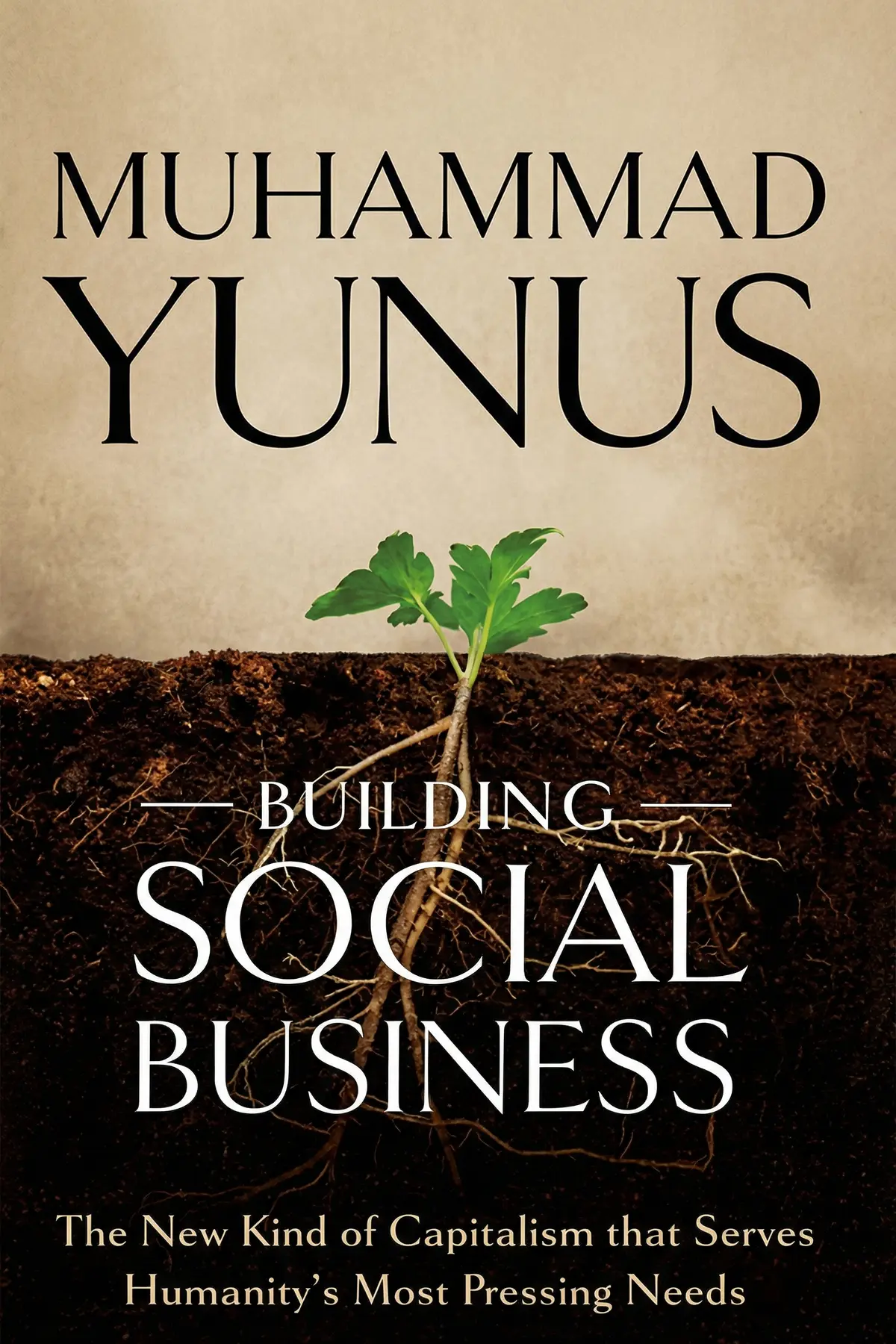
Table of Content
1. Introduction
1 min 32 sec
When we think about the global economy, we often see two distinct worlds. On one side, there is the high-stakes arena of traditional capitalism, where the singular goal is to maximize wealth for investors. On the other side, there is the world of charity, where selfless organizations work to help the vulnerable, often struggling to stay afloat as they rely on the fluctuating kindness of donors. For a long time, we have been told these are the only two paths: you either make money or you give it away. But what if there was a way to combine the efficiency of a business with the heart of a humanitarian mission?
This is the core question at the center of the throughline we will explore today. We are looking at a revolutionary framework that challenges the very definition of what a company can be. Instead of choosing between profit and purpose, we will investigate how to build entities that are financially self-sustaining but dedicated entirely to solving the most pressing issues facing our world—from malnutrition and lack of healthcare to environmental degradation and crushing poverty.
In the following sections, we will break down the mechanics of this new model. We will look at how it differs from traditional non-profits and why it represents a more sustainable way to enact change. We will also walk through the practicalities of launching such a venture, from identifying the right problem to solve to building a business plan that actually works. By the end, you will see why the current capitalist system is incomplete and how adding this social dimension can lead to a more balanced and equitable future for everyone.
2. Redefining the Purpose of a Business
2 min 10 sec
Explore the foundational principles of a social business, where solving human problems takes precedence over personal wealth, creating a self-sustaining cycle of impact.
3. The Sustainable Edge Over Traditional Charity
1 min 57 sec
Understand why social businesses offer a more robust and scalable solution for change compared to NGOs and philanthropic foundations.
4. Identifying and Addressing Specific Human Needs
2 min 02 sec
Learn the strategic process of launching a social business by focusing on a single, solvable problem that aligns with your unique skills.
5. The Blueprint for Financial and Legal Viability
2 min 09 sec
Discover the practical requirements for building a robust social business, from crafting a detailed five-year budget to navigating legal frameworks.
6. Completing the Economic System for a Better World
2 min 10 sec
Examine why modern capitalism is an incomplete model and how social businesses serve as the missing piece to ensure global prosperity.
7. Conclusion
1 min 13 sec
As we wrap up our exploration of the social business model, the message is clear: the tools of entrepreneurship are some of the most powerful weapons we have in the fight against global suffering. We have seen how a company can be both financially rigorous and deeply humanitarian. By removing the pressure to provide dividends to wealthy investors, we free up immense resources to tackle the problems of poverty, disease, and environmental decay.
The throughline we’ve followed shows us that the division between ‘doing well’ and ‘doing good’ is a false one. A social business allows us to do both by creating self-sustaining systems that don’t rely on the whims of charity. If you are inspired to take action, the path starts with a simple observation. Look at your community or the world at large and find a problem that moves you. Talk to people, understand their struggles, and then use your unique talents to design a business-based solution. You don’t have to change the whole world overnight. You just have to start one small, sustainable venture that puts people before profits. By doing so, you join a growing movement that is redefining capitalism for the twenty-first century and building a world that truly serves the needs of all its inhabitants.
About this book
What is this book about?
For centuries, the world has operated on a binary economic system: businesses that exist solely to maximize profit and charities that rely on the generosity of others to survive. In Building Social Business, Muhammad Yunus introduces a powerful third option. This book outlines the framework for a new kind of capitalism—one where the primary objective is to alleviate poverty, hunger, and disease rather than generate wealth for shareholders. Through practical advice and real-world examples, Yunus demonstrates how these self-sustaining ventures can address the shortcomings of traditional free markets. He explains the operational differences between social businesses and non-profits, providing a roadmap for aspiring entrepreneurs to identify pressing social needs and build viable models to meet them. The promise of the book is a more compassionate global economy where the tools of business are harnessed to serve humanity’s most urgent requirements, ensuring that no one is left behind by the march of progress.
Book Information
About the Author
Muhammad Yunus
Muhammad Yunus was born and educated in Bangladesh. He later served as a professor of economics at Chittagong University. He is widely recognized as a pioneer in the field of social development and is the founder and director of Grameen Bank in Bangladesh, an institution renowned for its innovative approach to empowering the poor.
Ratings & Reviews
Ratings at a glance
What people think
Listeners describe this work as highly accessible and a superior primer on social business models, with one noting its effectiveness in tackling poverty and other societal challenges. Additionally, the content is viewed as well-researched; one listener emphasizes the specific guidance and practical illustrations included, while another depicts it as a compelling exploration of Yunus's groundbreaking vision. Furthermore, listeners find the text deeply motivating, with one remarking that it provides optimism for the future, and they value how easy it is to digest.
Top reviews
Tanyaporn
Finally got around to reading this after hearing so much about the Grameen model. I expected a dry, academic treatise on economics, but what I found was a deeply hopeful manifesto that feels entirely practical because it is backed by Muhammad Yunus’s real-world track record. The book argues that we can solve poverty not through traditional charity, which he views as a temporary fix, but through self-sustaining businesses where the primary goal is social change rather than investor dividends. The case studies involving multinationals like Danone and Adidas were eye-opening, showing that even massive corporations can pivot toward human welfare when structured correctly. To be fair, his definition of 'social business' is incredibly strict—he won't allow a penny of profit for shareholders—but that purity is what makes the vision so compelling. It is a quick and easy read that somehow manages to make the impossible feel within reach.
Show moreSomboon
Wow, talk about a perspective shift. I am not an economist, but I found this book incredibly easy to digest and full of 'aha!' moments. Yunus has this way of explaining things that makes you wonder why we have not been doing this all along. He talks about how we have basically 'half-built' capitalism by assuming people are only motivated by greed, and it is just so true! The examples of the one-euro shoes with Adidas were fascinating and gave me a lot of hope that we can actually solve global poverty if we stop focusing on dividends for a second. Some might call it a dream, but he is already doing it on the ground in Bangladesh. It is a short, punchy book that I think every young entrepreneur should read, especially if they want their work to actually mean something beyond a paycheck.
Show moreBrahim
Ever wonder if there is a better way to do business? This book is absolute genius! Muhammad Yunus takes us on a fascinating journey through his vision for a world where businesses are designed to solve human problems rather than just line the pockets of the wealthy. I loved the detailed advice on how to structure a social business and the examples of how small changes can lead to huge impacts in poverty reduction. It is written in such an accessible way that anyone can understand it, regardless of their background. Got to say, I feel much more optimistic about the future of the global economy after finishing this. This isn't just theory; it's a blueprint for a more compassionate world. A must-read for anyone who cares about social justice!
Show moreTang
Directly addressing the flaws of modern capitalism, Yunus delivers a powerful message about our potential to change the world. This book reminds us that we have the creative power to solve any problem if we just stop using all our energy to hunt for money. The idea of creating companies dedicated to solving a 'small part of a problem' is so much more manageable than trying to save the whole world at once. I really enjoyed the transparency regarding the challenges Grameen faced and how they overcame them through trial and error. It is a quick and easy read, but it leaves you with enough information to actually start thinking about your own social business. Truly inspiring work that proves business can be a force for good in the fight against poverty.
Show moreSue
As someone who works in the non-profit sector, this book provided an excellent introduction to a concept that could revolutionize how we think about the global market. Yunus writes with a clear, accessible tone that makes complex socioeconomic theories feel like common sense. I was particularly fascinated by the section on the social business stock market, though I have to admit I am a bit skeptical about the logistics. How do you maintain trader interest without a financial upside? While his rigid stance against any profit-sharing might alienate those used to the B-corp or 'blended value' models common in the US, his arguments are well-informed and hard to ignore. The prose is straightforward, though it occasionally feels a bit repetitive in its optimism. It is a great starting point for anyone looking to fix the inherent flaws in modern capitalism.
Show moreNatnicha
The chapter on the Grameen-Danone partnership alone makes this a worthwhile purchase for anyone interested in social enterprise. There is a sense of practicality in this essay that I really appreciate, despite some of the more pie-in-the-sky predictions toward the end. Yunus is an engaging writer who clearly knows his stuff, and his transparency about the mistakes made during early ventures is refreshing. Truth is, most business books are just theory, but this is a journey through the innovative world of someone who has actually walked the walk. I do wish he was not so dismissive of businesses that allow for small profits; it feels like he is gatekeeping the term 'social business' a little too much. However, his vision for a world where social status is based on the good you do rather than the money you make is a beautiful thought. It is a solid read that will make you think differently.
Show moreTom
After hearing the author speak, I had high expectations for this book and it mostly delivered. The book is a fascinating exploration of what happens when the profit motive is removed from the equation. I was surprised to find so many big names like Veolia and Danone involved in these projects. Some might say it is just 'greenwashing' or corporations trying to look good, but as Yunus points out, who cares about the motivation if the result is clean water for the poor? My only gripe is that the writing can be a bit dry in the technical sections, and the tone is occasionally overly-utopian. But to be fair, the man did win a Nobel Peace Prize for these ideas, so he has earned some leeway. It is a detailed, well-informed guide that provides a genuine alternative to traditional charity.
Show moreHiroshi
Not what I expected after reading 'Banker to the Poor' a few years ago. While the author’s Nobel Peace Prize credentials are undeniable, I found this particular volume a bit too light on actual economic rigor. Yunus spends a lot of time describing a utopian future where social businesses replace government welfare, but he glosses over the 'why' regarding investor motivation. If I cannot earn a return, why would I choose this over a standard philanthropic donation? The middle chapters detailing the Grameen-Veolia water project were the highlight for me, as they actually addressed the gritty reality of operational challenges. Frankly, the rest felt like 'fluff' that ignores basic human incentives. It is still worth a read for the case studies, but do not expect a rigorous academic defense of the model. It reads more like an extended brochure for his specific vision than a comprehensive theory.
Show moreAria
Picked this up to learn more about social entrepreneurship after seeing a documentary on the Grameen Bank. This is a decent enough introduction to the concept, but it feels a bit repetitive if you have already read his other work. I appreciated the real-life examples of how Grameen works with multinationals like Intel, yet I found the 'no-interest/no-dividend' requirement to be a bit too restrictive for most Western investors. Personally, I think the B-corp model is more realistic for the average person to implement. It is an easy read and very well-informed, but it lacks the depth I was hoping for regarding the actual scaling of these businesses. If you are new to Yunus, it is a 4-star; if you are a long-time follower, it is probably a 3. Still, it provides a much-needed sense of hope.
Show moreBond
Look, I really wanted to love this, but I struggled to get through the intense idealism. Yunus seems to believe that you can simply 'reform' the theory of capitalism to include compassion, but capitalism is an observation of human behavior, not a set of rules you can just change like a dress code. He treats it like something you can tweak, but it is more like trying to 'reform' gravity. Without price signals or profit motives, how does his proposed social stock market actually function? He suggests people will spend their lives researching these businesses just for the 'joy' of it, which sounds great in a speech but fails in reality. I respect his work with microfinance, but this book is just too much wishful thinking for me. The stories about the Bangladeshi villages are interesting, but they do not provide a solid enough foundation for the earth-shattering claims he makes. Disappointing.
Show moreReaders also enjoyed
1929: Inside the Greatest Crash in Wall Street History--and How It
Andrew Ross Sorkin
23 Things They Don’t Tell You About Capitalism
Ha-Joon Chang

A Little History of Economics
Niall Kishtainy
A Splendid Exchange: How Trade Shaped the World
William J. Bernstein
AUDIO SUMMARY AVAILABLE
Listen to Building Social Business in 15 minutes
Get the key ideas from Building Social Business by Muhammad Yunus, plus 5,000+ more titles in English and Thai.
- 5,000+ titles
- Listen as much as you want
- 7-day free trial
- Cancel anytime







