
1929: Inside the Greatest Crash in Wall Street History--and How It
Andrew Ross Sorkin
Explore the fascinating and often bizarre history of collective human folly. This summary examines how financial bubbles, pseudoscientific scams, and mass hysterias reveal the enduring vulnerabilities of the human mind.
1 min 44 sec
Imagine a world where a single flower bulb is worth more than a luxury estate in the heart of a major city. Or a city where a meaningless word becomes a national obsession overnight, shouted by everyone from street sweepers to royalty. These scenarios aren’t the plot of a surrealist novel; they are documented episodes from human history. Since humans first began gathering in large societies, we have been prone to what Charles Mackay famously termed ‘the madness of crowds.’
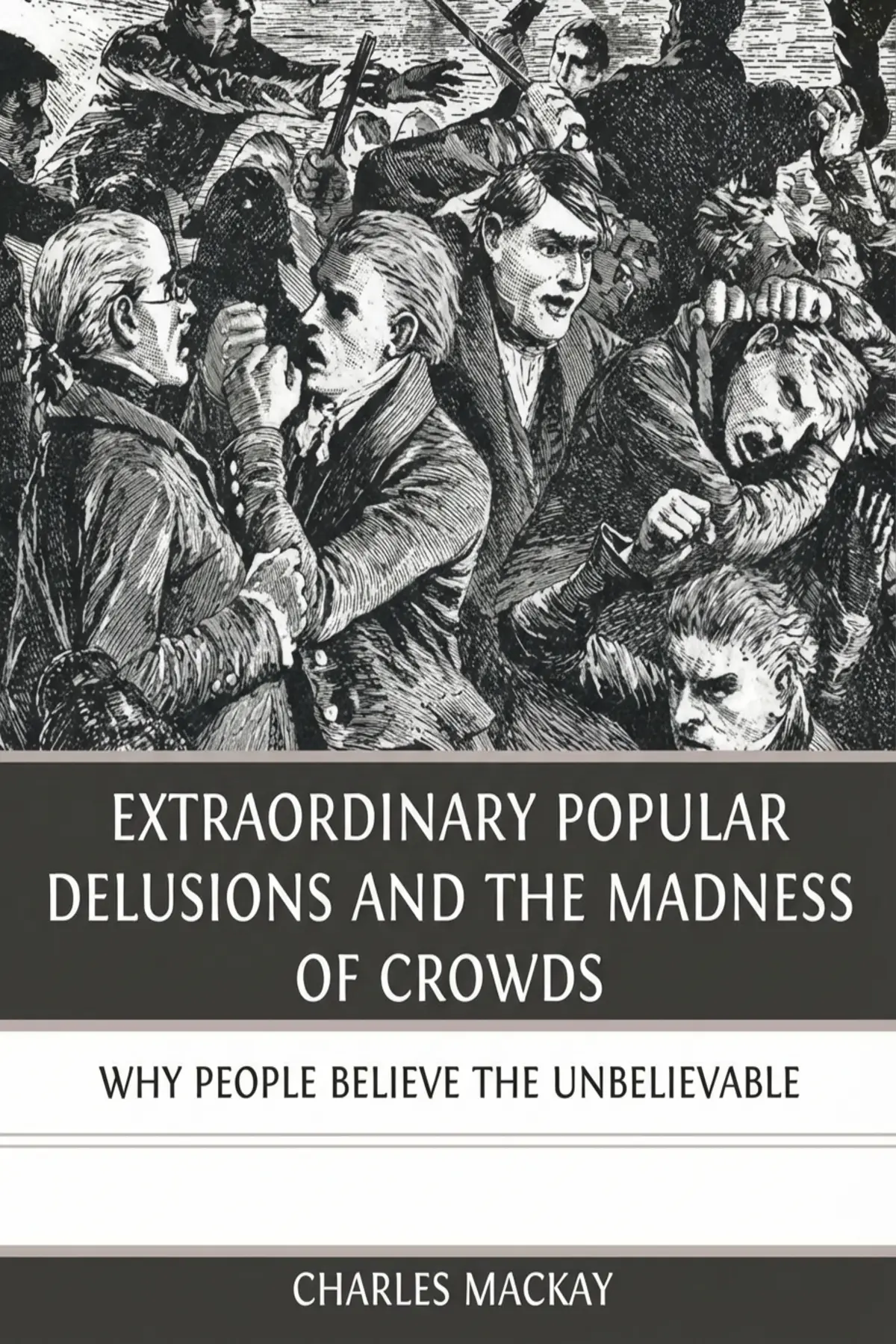
In his seminal work, Extraordinary Popular Delusions and The Madness of Crowds, Mackay serves as a guide through the labyrinth of human folly. He doesn’t just list historical errors; he provides a psychological autopsy of how and why sensible individuals lose their identity to the collective. The throughline of this exploration is the realization that while the objects of our obsession change—moving from tulips to South Sea stocks, and from alchemical potions to digital memes—the underlying machinery of our brains remains remarkably constant.
As we walk through these historical accounts, notice the patterns. You will see how greed masks itself as opportunity, how fear disguises itself as justice, and how the need for belonging can make the most absurd lie feel like an undeniable truth. By looking back at the centuries of mass hysteria, financial ruin, and social fads, we gain more than just trivia; we gain a defensive toolkit for navigating a modern world that is more connected, and thus more susceptible to contagion, than ever before. Let’s dive into the fascinating, tragic, and often hilarious world of collective delusion to see what it can teach us about our own tendencies today.
2 min 53 sec
Discover how a simple flower caused a national economic collapse and why even the world’s most brilliant scientists couldn’t resist the allure of the South Sea Bubble.
2 min 35 sec
Examine the centuries-long obsession with alchemy and the healers who convinced kings they held the secrets to eternal life and infinite gold.
2 min 42 sec
Learn how a simple prank or a well-timed rumor can depopulate neighborhoods and transform the real estate market through the power of ghosts.
2 min 47 sec
Discover the chilling mechanics of the European witch hunts and how fear can turn an entire legal system into a weapon of mass destruction.
2 min 51 sec
See how meaningless catchphrases and bizarre social trends once took over the streets of London, proving that the desire to belong is our strongest instinct.
2 min 03 sec
As we reflect on the incredible stories chronicled in Extraordinary Popular Delusions and The Madness of Crowds, a clear picture of the human psyche emerges. Whether we are looking at the financial ruin of the South Sea Bubble, the tragic injustice of the witch trials, or the absurd rise and fall of street slang, the common denominator is our collective vulnerability to the influence of others. Charles Mackay showed us that the crowd is not just a collection of individuals; it is a separate entity with its own logic—or lack thereof.
The core lesson is one of vigilance. We like to believe that we are immune to these delusions because we live in an age of science and instant information. However, Mackay’s work suggests the opposite: increased connectivity can actually accelerate the spread of madness. The ‘tulips’ of today might be digital assets, and the ‘witch hunts’ might take place on social media, but the psychological triggers—greed, fear, and the desperate need for belonging—remain unchanged.
So, what can we do? The most powerful defense against the madness of crowds is individual skepticism. It means having the courage to ask ‘why’ when everyone else is saying ‘buy.’ It means looking for evidence when the crowd is demanding a scapegoat. And it means recognizing that when a story feels too good to be true, or a fear feels too overwhelming to question, that is precisely when we are most at risk.
As you move forward, keep the image of the tulip bulb and the alchemist’s crucible in mind. Remember that the smartest people in history have been fooled by the same tricks that exist today. By understanding the patterns of the past, you can learn to see the manias of the present for what they truly are. Don’t be afraid to stand apart from the herd; in the history of human folly, the person who stays calm while the crowd goes mad is often the only one who survives the crash. Thank you for listening to this exploration of collective delusion. We hope these insights help you navigate the ‘madness’ of our own times with a bit more clarity and caution.
Have you ever wondered why seemingly rational people suddenly lose their common sense in a group? This exploration of Charles Mackay’s classic work, Extraordinary Popular Delusions and The Madness of Crowds, takes you on a journey through some of history’s most incredible instances of mass delusion. From the peak of the Dutch tulip craze to the dark days of European witch hunts, the book uncovers the psychological mechanics that drive crowds to believe the unbelievable. By examining financial ruins like the South Sea Bubble and the strange allure of alchemy, the narrative promises to sharpen your awareness of modern manias. You will learn how the fear of missing out, the desire for easy solutions, and the power of social contagion can override individual intelligence. It is a timeless lesson in human nature that remains strikingly relevant in our era of digital viral trends and market volatility.
Charles Mackay (1814-1889) was a prominent Scottish journalist, poet, and author. Throughout his career, he served as a correspondent for the Times and as the editor of the Glasgow Argus. His professional background in stock market reporting and history informed his deep interest in mass psychology. A respected man of letters, Mackay published poetry collections such as Songs and Poems and historical works including A History of London. He was awarded a doctorate from Glasgow University and was a fellow of the Society of Antiquaries of Scotland.
Listeners find the text captivating from beginning to end and suggest it is a vital read for those interested in history, with one pointing out its remarkable insights into the human spirit. The narrative provides high-quality case studies on mass hysteria, and listeners value its connection to current events. The prose and vocabulary receive varied feedback; listeners mention the use of 19th-century English and describe the style as stilted. Overall, the work earns praise for its psychological observations, with one listener highlighting that human thought patterns and behaviors have not changed over time.
Ever wonder why people collectively lose their minds over the latest trend or financial fad? This book, though written in the mid-1800s, offers a chillingly accurate mirror to our modern world. Mackay explores everything from the infamous Dutch tulip mania to the South Sea Bubble with a dry, witty detachment that is both educational and entertaining. It is fascinating to realize that human nature remains unchanged; we are just as prone to mass hysteria today as we were during the crusades or the witch hunts. The author’s voice is quintessentially Victorian, which adds a layer of sophisticated charm to the descriptions of absolute human folly. Frankly, it should be required reading for anyone entering the stock market or social media. While the prose is dense, the insights into the 'madness of crowds' are worth every minute spent navigating the 19th-century syntax. It provides a necessary perspective on how easily logic is discarded when greed or fear takes hold of a population.
Show morePicked this up during a period of market volatility and felt an immediate sense of perspective. Mackay’s detached amusement at the 'daftness' of humanity is the perfect antidote to modern-day panic. He reminds us that whether it’s the philosopher's stone or a tech bubble, the patterns of mass hysteria are finite and predictable. The chapters on the crusades and the witch-hunt trials are particularly sobering, showing the darker, more violent side of popular delusions. I love the dry wit he employs when debunking fortune tellers like Nostradamus; it’s clear he had a very low tolerance for nonsense. Despite being nearly 200 years old, the language is surprisingly clear if you have a bit of patience for longer sentences. This is a masterpiece of social observation. It’s a thick book, but the sheer variety of topics—from slow poisoners to popular songs—keeps it from becoming too dry. Truly a classic for a reason.
Show moreThis book proves that human nature hasn't changed a bit since 1841. It is amazing how Mackay identifies the same patterns of mass hysteria that we see on social media every single day. The description of how people vie with each other to believe the most extraordinary things once a trend starts is spot on. I was particularly struck by the section on relics and how both the 'educated and ignorant' fell for the same obvious scams. The language might be a bit flowery and the sentences long, but the wit is sharp and the observations are profound. It’s an essential piece of work for anyone who wants to understand why societies periodically go crazy. From the Crusades to the South Sea Bubble, Mackay assembles a mountain of evidence that we are a deeply irrational species. This is a brilliant, essential classic that deserves a place on every thinking person's bookshelf.
Show moreCharles Mackay delivers a biting, if somewhat archaic, look at the darker side of communal belief and economic insanity. The first three sections covering financial bubbles are easily the strongest, providing a detailed breakdown of how entire nations can be swindled by their own optimism. I found the transition into alchemy and fortune-telling a bit jarring, as the book shifts from economic history to a more biographical catalog of charlatans. To be fair, the Victorian writing style is a bit stilted and might slow down casual readers, but the content remains incredibly relevant. It’s a massive collection of case histories that prove there is truly nothing new under the sun. Whether he is discussing the Mississippi scheme or the strange laws regarding beards and long hair, Mackay highlights our eternal 'love of the marvelous.' It’s a brilliant, if occasionally long-winded, survey of the times when society collectively decided that up was down. A must-read for history buffs.
Show moreThe chapter on the South Sea Bubble alone justifies the price of admission here. It’s a fascinating, blow-by-blow account of how an entire government and public went absolutely bonkers over a scheme of no real worth. Mackay has a gift for storytelling, even if he hides it behind some very dense, academic language. You can see the roots of every modern financial crisis in these pages. I also enjoyed the smaller, weirder sections, like the rise and fall of certain slang phrases in London. It shows that 'viral' trends didn't start with the internet. My only gripe is that some of the philosophical sections on alchemy dragged on far longer than necessary. Still, the insight that humans would rather believe a marvelous lie than a boring truth is timeless. It’s a solid 4-star read that requires some dedication but pays off in wisdom.
Show moreAs someone who loves historical oddities, I found the sections on beard taxes and hair laws absolutely delightful and hilarious. Mackay captures the absurdity of human vanity so well. The book is essentially a catalog of the different ways we’ve managed to be stupid over the last few centuries. While it is written in a very old-fashioned style, that adds to the 'vintage' feel of the stories. You get a real sense of the 1840s perspective on the 'ignorant' past, which is ironic considering we probably look just as foolish to future generations. The accounts of the thugs in India and the witch trials provide a necessary weight to the book, ensuring it’s not all just lighthearted fun. It is quite long, and I’ll admit I didn’t read every single page about the philosopher’s stone, but the parts I did read were genuinely eye-opening. It’s a great book for browsing and gaining some much-needed humility.
Show moreTruth is, I found this to be more of a reference tome than a narrative read that you can enjoy from cover to cover. I started with high hopes because of the reputation this work has in finance circles, but the momentum died for me somewhere around the 80th description of a Renaissance alchemist. The style is very much of its time—very wordy and occasionally repetitive. While the sections on the tulip mania and the South Sea Bubble were gripping, the latter half of the book felt like a slog through obscure biographies. It’s a valuable resource, no doubt, but the 'madness' described starts to feel a bit samey after a few hundred pages. If you are looking for a deep psychological study, you might be disappointed, as Mackay mostly just assembles anecdotes without much modern scientific analysis. It’s a decent book to keep on the shelf for browsing specific chapters rather than reading straight through.
Show moreNot what I expected given the title's psychological promise, but still an impressive feat of historical compilation. I was looking for a deep dive into the 'why' of crowd behavior, but Mackay focuses more on the 'what' by providing an endless stream of examples. The book is divided into national, peculiar, and philosophical delusions, though the categories feel a bit arbitrary at times. For instance, jumping from the crusades to haunted houses and then to the history of dueling makes for a disjointed experience. I'll admit the Victorian English is quite thick, which makes it a difficult book to fly through. Personally, I think the first third of the book is essential, but the rest functions more as a historical curiosity. It’s interesting to see how little our ancestors' gullibility differs from our own, yet the lack of a cohesive narrative thread makes it hard to stay engaged for the full duration.
Show moreFinally got around to this classic after seeing it cited everywhere in finance circles. Honestly, it’s a bit of a mixed bag. On one hand, the case studies of the Mississippi scheme and tulip mania are foundational texts for understanding market psychology. On the other hand, the sheer volume of text dedicated to alchemists like Paracelsus and Agrippa felt like overkill. The writing is very Victorian—dry, overly formal, and often condescending toward the subjects. It’s less of a 'page-turner' and more of a slog that you have to commit to. I think many people would be better off reading a summary of the first three chapters than trying to tackle the entire three-volume set. It’s informative, sure, but the density of the 19th-century English makes it hard to recommend to everyone. It’s a 3.5-star book that I’m rounding down because of the repetitive nature of the second half.
Show moreLook, I appreciate the historical value, but the Victorian prose is incredibly stilted and made this a chore to finish. I feel like I spent more time deciphering 19th-century sentence structures than actually absorbing the history. While the first few chapters on the famous economic bubbles were interesting, the book quickly descends into a repetitive list of alchemists and obscure European 'prophets' that I had zero interest in. It feels more like a dusty encyclopedia than a book written for a general audience. I was hoping for more analysis on the psychology of the 'madness,' but instead, I got page after page of biographical data. If you aren't a hardcore history enthusiast or someone obsessed with the Victorian era, you’ll probably find this quite boring. I gave it two stars because the information is clearly well-researched, but the readability is extremely low for a modern reader. I ended up skimming the last few sections just to be done with it.
Show moreAndrew Ross Sorkin

Philip Freeman
Ha-Joon Chang
Niall Kishtainy

Michael Axworthy
AUDIO SUMMARY AVAILABLE
Get the key ideas from Extraordinary Popular Delusions and The Madness of Crowds by Charles Mackay, plus 5,000+ more titles in English and Thai.







