
A Guide to the Good Life: The Ancient Art of Stoic Joy
William B. Irvine
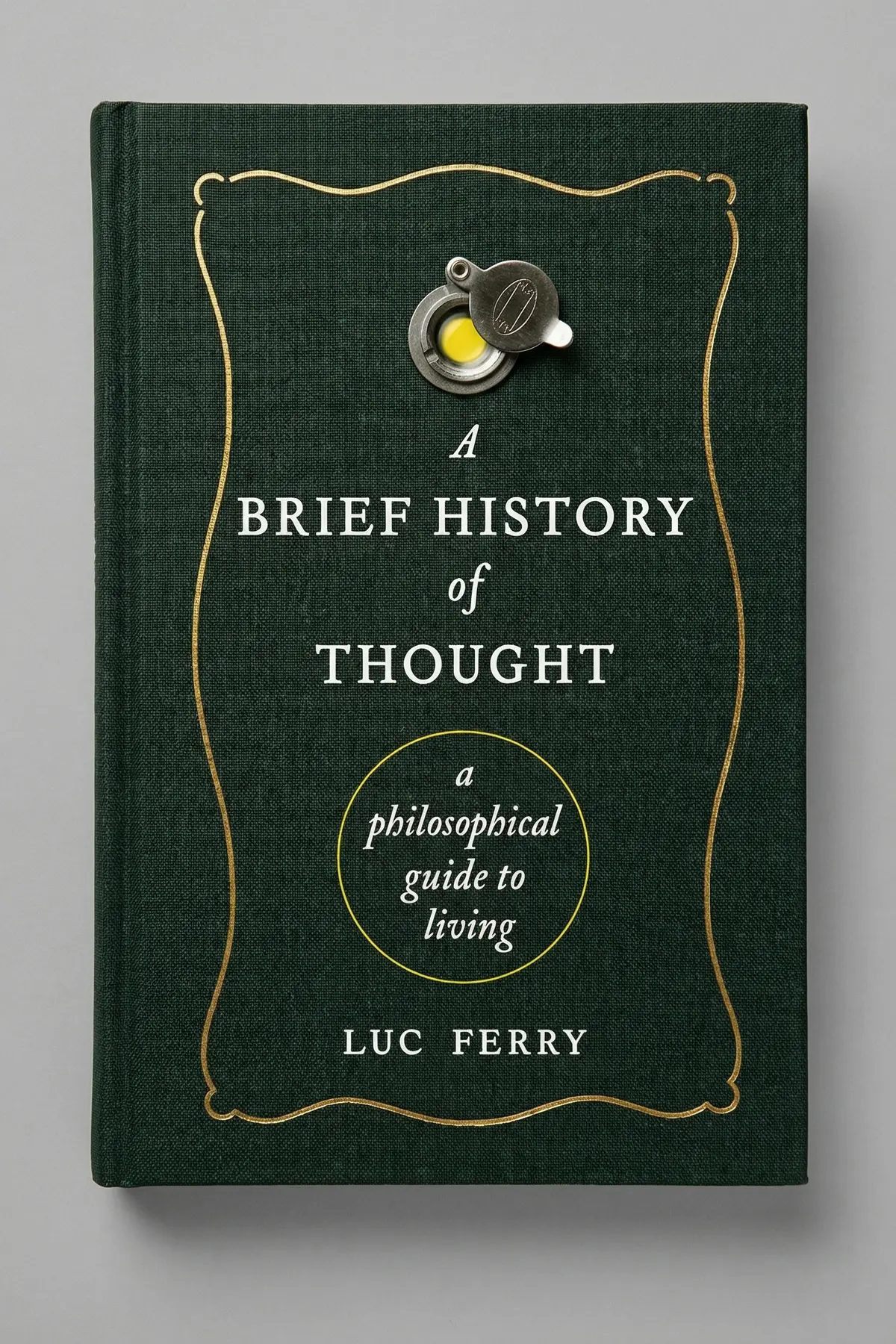
A Brief History of Thought explores the evolution of Western philosophy from ancient Greece to the present, focusing on how different eras have addressed the human search for meaning and the conquest of mortality.
2 min 19 sec
Have you ever picked up a book on philosophy and felt like you were staring at a wall of dense, impenetrable fog? It’s a common experience. We often think of philosophy as an abstract, academic pursuit filled with confusing terminology and sentences that seem to go on forever without ever reaching a point. But beneath that layers of complex language lies something deeply personal and profoundly practical. At its heart, philosophy isn’t just about debating logic in a dusty classroom; it’s a search for how to live. It is an attempt to answer the most fundamental questions we face: Why are we here? How should we treat others? And perhaps most importantly, how do we deal with the looming shadow of our own mortality?
This summary acts as a clear, guiding light through that fog. We are going to embark on a journey through the major movements of Western thought, from the sun-drenched squares of ancient Greece to the revolutionary shifts of the Enlightenment and into the complex world we inhabit today. Along the way, we will see that philosophy is actually a quest for salvation—not through divine intervention, but through human reason.
We will explore how the Greeks found peace in a harmonious universe, how Christianity introduced a radical new way of valuing the individual, and how thinkers like Descartes and Rousseau paved the way for modern humanism. We will also dive into the provocative critiques of Nietzsche, who challenged us to find meaning in life itself rather than in some distant heaven. By the time we reach the end, you’ll see how these historic ideas flow into what we call contemporary humanism—a way of thinking that helps us find purpose and beauty in the here and now.
Think of this as a throughline connecting thousands of years of human struggle and insight. Each chapter of this history is a response to the one before it, a constant refining of what it means to be human. Whether you’re a total beginner or someone looking to reconnect with these vital ideas, this journey offers a sure path through the twists and turns of Western thought, distilling complex concepts into insights you can actually use to enrich your daily life. Let’s begin by looking at the basic structure that holds all of these diverse ideas together.
3 min 10 sec
Explore the foundational framework that supports every major school of thought, revealing why humans seek wisdom through theory, ethics, and the quest for salvation.
2 min 48 sec
Step into the ancient Greek world where the universe was seen as a living, breathing order and humans found peace by aligning themselves with the rhythm of nature.
2 min 55 sec
Witness the radical transformation of Western thought as Christianity replaced the impersonal laws of nature with a personal relationship with the divine.
3 min 15 sec
Learn how the discovery of an infinite, mechanical universe shattered old certainties and forced humanity to find a new center within itself.
2 min 52 sec
Dive into the rigorous moral world of Immanuel Kant, where true goodness is found by rising above our selfish instincts for the sake of a universal human good.
2 min 58 sec
Explore the radical philosophy of Friedrich Nietzsche, who challenged us to stop chasing shadows in ‘other’ worlds and embrace the raw, vibrant power of life in the here and now.
2 min 55 sec
Discover a modern way of thinking that balances the skepticism of the past with a renewed sense of the sacred found in human connection and truth.
2 min 31 sec
As we look back at this sweeping landscape of Western thought, we can see a clear evolution. We started with the Stoics, who found peace by aligning themselves with a harmonious, living cosmos. We saw how Christianity revolutionized this by making the divine personal and promising that every individual soul is eternally significant. Then came the era of Modernity, which used reason to challenge old dogmas and placed human beings at the center of their own destiny. We felt the shock of Nietzsche’s hammer as he cleared away the ‘idols’ that made us turn away from life, and finally, we explored contemporary humanism, which seeks to find a new sense of the sacred in our shared human experience.
The throughline of all these different eras is the human effort to live a life that is not ruled by fear. Whether through the logic of the cosmos, the faith of the church, the duty of the Enlightenment, or the vibrancy of the present moment, philosophy has always been a quest for ‘salvation’ in the broadest sense of the word. It is the attempt to find a perspective that allows us to face our mortality with grace and to fill our limited time on this planet with purpose.
So, what can we take away from this history for our own lives? Perhaps the most important lesson is that we are not alone in our search for meaning. For thousands of years, the greatest minds in history have been wrestling with the same anxieties and questions that we face today. By understanding their journeys, we gain a richer vocabulary for our own. We can learn to be skeptical like Descartes, principled like Kant, and life-affirming like Nietzsche.
Ultimately, contemporary philosophy invites us to stop looking for answers in some distant, abstract realm and to start looking at the world and the people right in front of us. It tells us that meaning is something we build through our choices, our relationships, and our commitment to a common humanity. The ‘Brief History of Thought’ isn’t just a record of the past; it’s a living guide for the present. It encourages us to use our reason to clear away the fog of confusion and to embrace the here and now with curiosity, courage, and love. As you move forward, remember that philosophy is not a destination, but a way of traveling—a lifelong practice of seeking wisdom and finding beauty in the midst of our finite, human journey.
This guide serves as an accessible roadmap through the complex landscape of Western philosophy. Rather than getting lost in dense academic terminology, the text focuses on the central question that has driven thinkers for millennia: how can we live a good life while facing the reality of our own finitude? By tracing the journey from the Stoics' harmonious cosmos to the revolutionary ideas of Christianity, and from the Enlightenment's focus on reason to the radical critiques of Nietzsche, the book reveals how each era built upon or dismantled the ideas of the past. The promise of this exploration is not just historical knowledge, but a practical toolkit for modern living. It explains the three fundamental pillars of any philosophical system—theory, ethics, and salvation—and shows how understanding these can help us navigate the anxieties of the contemporary world. Ultimately, it introduces contemporary humanism as a way to find transcendence and purpose in a post-religious age, focusing on the inherent value of human connection and collective wisdom.
Dr. Luc Ferry is a French philosopher and prolific author, whose books include On Love: A Philosophy for the Twenty-First Century (2012) and The New Ecological Order (1992). Between 1996 and 2011 he was Professor of Philosophy at Paris Diderot University, and from 2002 until 2004 was Minister of Education for the French government.
Listeners find this work to be an excellent roadmap through the history of philosophy, utilizing clear and exact prose that makes it approachable for both beginner and intermediate audiences. The composition is skillfully handled—one listener points out its rhythmic quality—and they value the intellectually stimulating material, with one review emphasizing its thorough examination of various philosophical epochs. Listeners find the text captivating, with one review specifically commending its balanced and fair depiction of Christianity.
Ever wonder why ancient Stoics seemed completely unbothered by death while modern thinkers obsess over existential dread? Luc Ferry breaks down centuries of human reasoning through a brilliant tripartite framework: how each era views truth, ethics, and ultimate salvation. The prose possesses a natural, rhythmic elegance that makes dense French intellectualism feel remarkably inviting. Even as an atheist, Ferry provides one of the fairest, most nuanced summaries of Christian thought I've ever encountered in an introductory text. It is sweeping yet remarkably concise, clarifying historical shifts without burying the reader in impenetrable academic jargon. A genuinely illuminating masterclass in intellectual history.
Show moreLuc Ferry achieves what few professional philosophers can: genuine clarity without condescension. He lays out the monumental shifts in human consciousness with a fluid, melodic cadence that pulls you forward chapter after chapter. What stood out most was his balance; instead of sneering at religious traditions, he treats the Christian revolution with profound historical respect and intellectual seriousness. It reframed how I perceive our current cultural anxieties, especially our collective struggle to find purpose in an increasingly secular world. An absolute triumph of synthesis that respects the reader's intelligence while keeping the threshold for entry remarkably low.
Show moreFew introductions manage to be this intellectually stimulating while remaining effortlessly readable. Ferry treats philosophy not as an abstract parlor game, but as an urgent life skill essential for navigating the modern condition. The way he traces morality through the Enlightenment transformed how I understand our modern institutions. Truth is, many introductory guides bore you to tears with dry biographical trivia, but Ferry focuses purely on the vitality of the ideas themselves. It's concise, articulate, and filled with insights that linger in your thoughts long after you put the book down.
Show morePicked this up after hearing Tim Keller praise it years ago, and it largely delivers on the hype. Ferry manages to condense the broad sweep of Western civilization into under three hundred pages, tracking how our quest for meaning evolved from cosmic harmony to Christian faith to secular humanism. His definition of philosophy as a secular search for salvation—a way to conquer the fear of mortality without religious dogma—is deeply compelling. My only real gripe is that he rushes through twentieth-century thought toward the end, leaving the contemporary era feeling slightly undercooked compared to his superb chapters on Antiquity.
Show moreAs someone who always felt intimidated by philosophy, I found Ferry’s lucid style a breath of fresh air. He writes with precision and warmth, clearly wanting ordinary citizens to reclaim foundational ideas that have been locked away in university departments for far too long. He doesn't just catalog names and dates; he explains why these ideas matter for how we live today. Frankly, certain passages on Kant required me to re-read sentences three or four times to fully grasp the argument, but the intellectual payoff was consistently worth the mental sweat.
Show moreFinally got around to reading this over my vacation, and it proved to be a surprisingly gripping journey. Rather than marching alphabetically through every thinker since Thales, Ferry organizes his investigation around core existential dilemmas, particularly how human beings confront death and suffering. The chapter detailing the transition from Greek cosmology to Christian revelation was particularly eye-opening for me. Gotta say, the concluding section on contemporary secular humanism felt a bit rushed and overly idealistic compared to the rigor of the earlier sections, but overall, it remains a fantastic, accessible guide for curious minds.
Show moreThe chapter on Nietzsche alone is worth the price of admission. Ferry writes with a rhythmic clarity that unpacks notoriously difficult German metaphysics without stripping away their inherent edge or radical power. In my experience, French intellectuals translated into English often sound stiff or overly ornate, but this translation preserves a sparkling, conversational energy throughout. My only critique is that a newcomer might still feel a bit lost during the swift transitions between historical epochs. Nevertheless, it is a remarkably generous, open-minded overview that will help anyone make sense of Western culture.
Show moreA wonderfully structured guide that treats philosophy as the ultimate quest to live freely and meaningfully. Ferry demystifies profound concepts using clear everyday language, showing that understanding ancient wisdom isn't just about academic prestige—it's about emotional survival. I appreciated how each section methodically examines theory, ethics, and salvation, giving the historical progression an internal logic that standard textbooks sorely lack. It won't turn you into a tenured scholar overnight, and you might disagree with his final secular conclusions, but it will definitely equip you to read primary texts with far greater confidence.
Show moreThis book operates more like an extended philosophical essay than an exhaustive survey course. Ferry has a specific thesis about salvation and death, and he bends the history of thought to serve that narrow lens. Certain eras get lavish, gorgeous treatment—the Stoics and early Christians are rendered brilliantly—while entire traditions are reduced to passing footnotes. Look, the writing is crisp and the author’s voice is undeniably engaging, but calling it a comprehensive history is misleading. Useful as a thought-provoking companion piece, just don't treat it as a standalone textbook.
Show moreNot what I expected given all the glowing recommendations. The narrative felt completely disjointed, jumping erratically between schools of thought without providing the connective tissue necessary for a cohesive history. Marketed as an approachable primer, it skips massive chunks of modern philosophy while spending pages overanalyzing niche conceptual distinctions. To be fair, the prose itself flows well enough, but Ferry's structural choices make the entire exercise feel aimless. If you actually want a clear, chronological journey from Socrates to postmodernity, this book will leave you frustrated and filling in huge historical gaps on your own.
Show moreWilliam B. Irvine
Nigel Warburton
John Rawls
Robert Nozick
Nassim Nicholas Taleb
John Milton
AUDIO SUMMARY AVAILABLE
Get the key ideas from A Brief History of Thought by Luc Ferry, plus 5,000+ more titles in English and Thai.







