
15 min 24 sec
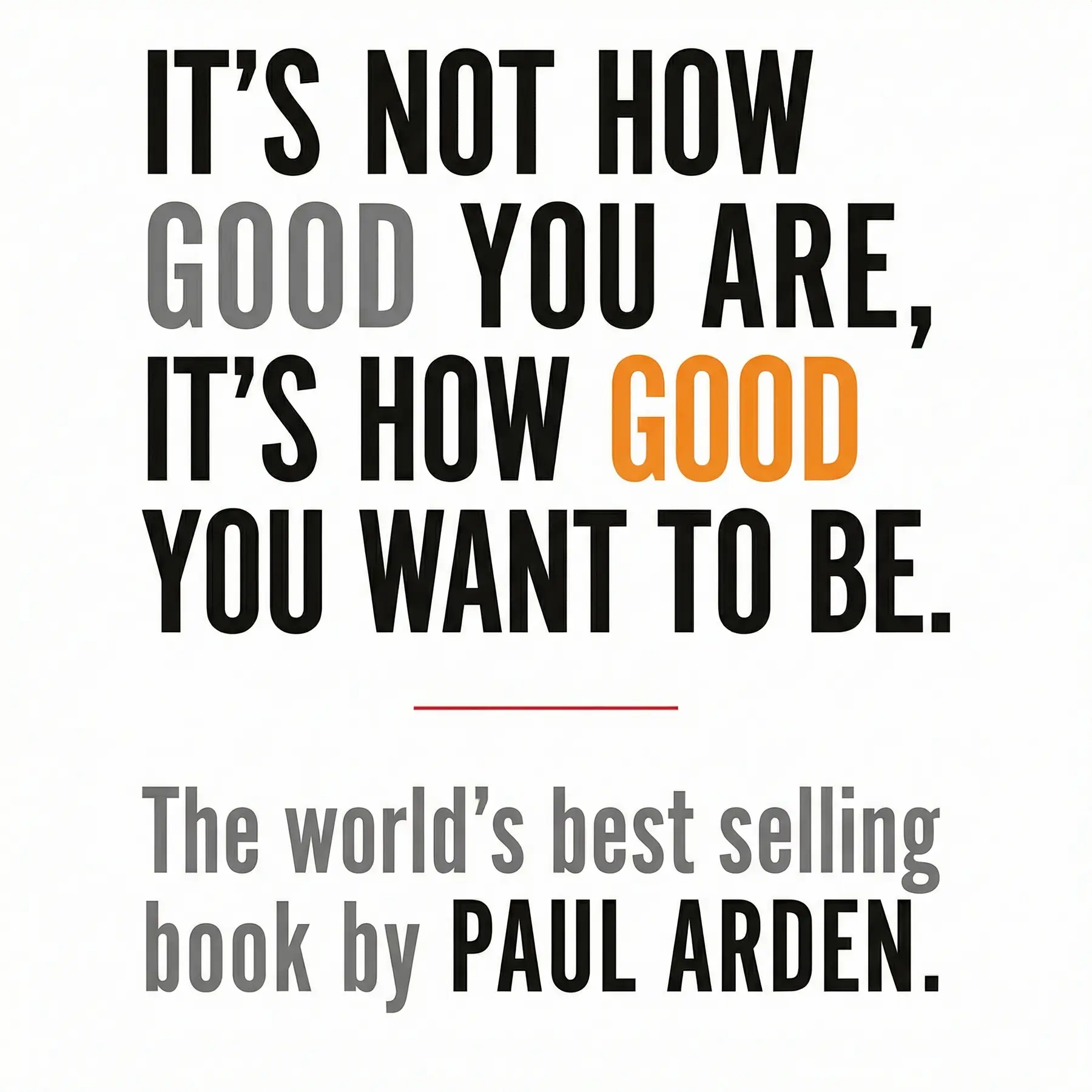
It’s Not How Good You Are, It’s How Good You Want to Be: The World’s Best Selling Book
By Paul Arden
Discover how ambition, a willingness to fail, and unconventional thinking can propel you to the top of your field. This guide explores the creative secrets of a legendary advertising mastermind.
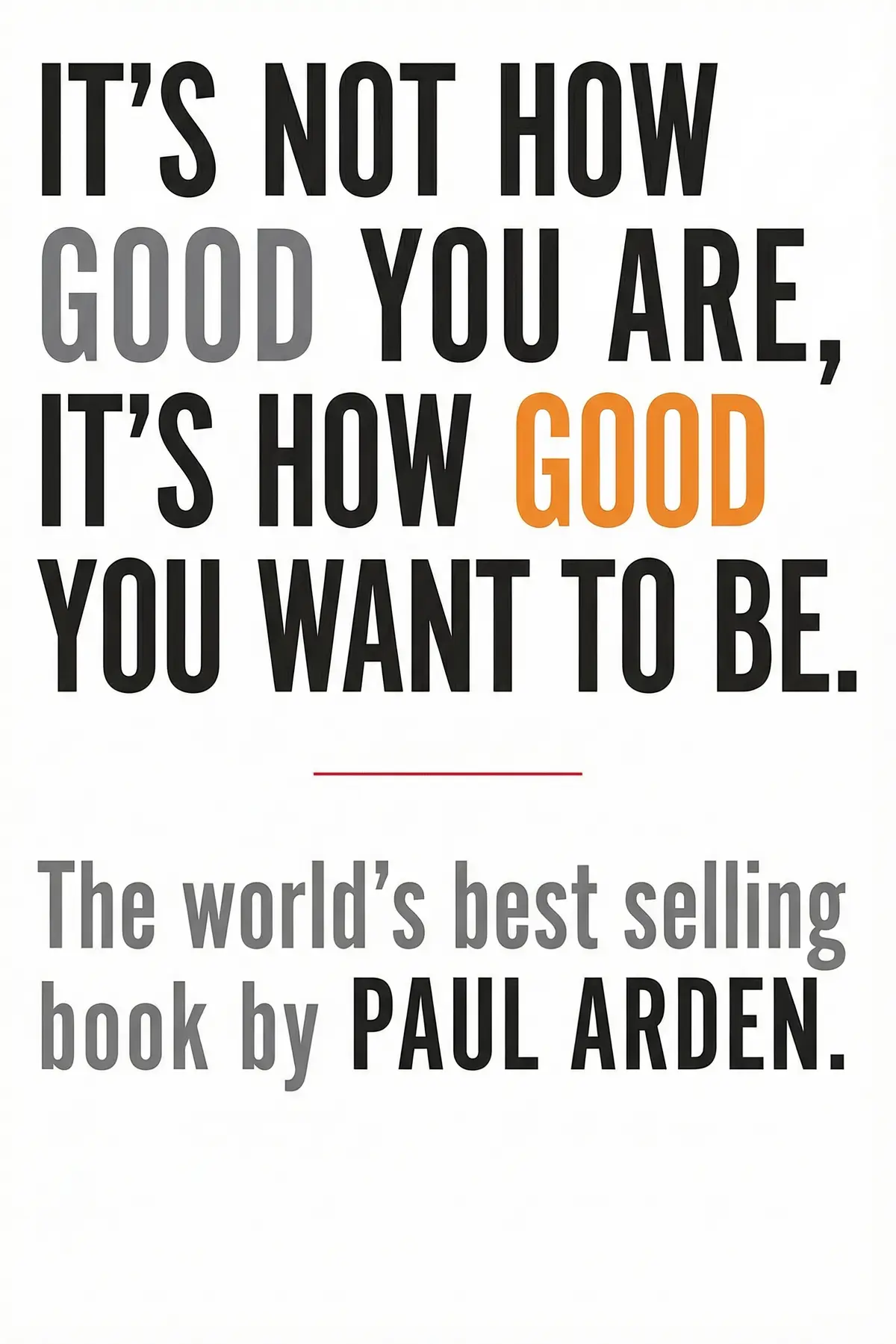
Table of Content
1. Introduction
1 min 32 sec
Think about the most successful person you know. Now, think about the most talented person you know. Surprisingly, these two descriptions rarely apply to the same individual. We often grow up believing that the world is a meritocracy where the smartest and most skilled naturally rise to the top, like cream in a bottle of milk. But if you look at the landscape of business, art, and leadership, you’ll see something different. You’ll see that the people who reach the pinnacle are often those who simply wanted it more.
This brings us to the core philosophy of Paul Arden, a man who spent decades at the heart of the high-stakes British advertising world. He wasn’t just a witness to success; he was an architect of it, crafting campaigns for global giants. Arden realized that the secret to greatness isn’t found in your current resume or your innate IQ. Instead, it’s found in the size of your ambition and your willingness to defy conventional wisdom.
In the following minutes, we are going to explore a roadmap for those who aren’t satisfied with just being ‘good enough.’ This isn’t your typical, dry business manual. It’s a collection of sharp, counterintuitive insights designed to kick-start your creative engine. We’ll look at why you should stop trying to be right, why you should give your best ideas away for free, and how a household cleaning product can teach us everything we need to know about setting goals. Throughline here is simple: your potential is not a fixed ceiling; it is a horizon that moves as far as you are willing to push it. Let’s dive into the mindset of a creative legend and see how we can apply these lessons to our own lives and careers.
2. The Power of Radical Ambition
1 min 53 sec
What if your current skills don’t define your future success? Learn why setting impossible goals is the only way to bypass the limitations of talent and reach world-class heights.
3. Accountability and the Search for Hard Truths
2 min 06 sec
Seeking praise feels good, but it’s a dead end for growth. Discover why the best way to improve is to actively hunt for the flaws in your own work.
4. The Value of Being Wrong and Silly
2 min 01 sec
The desire to be right is often the greatest barrier to innovation. Find out how embracing mistakes and illogical ideas can lead to your biggest breakthroughs.
5. Persistence and the Client’s Perspective
1 min 56 sec
Success often comes down to who is willing to keep going after the first ‘no.’ Learn the art of the hustle and how to align your goals with those of your audience.
6. The Dominance of Visual Impact
2 min 16 sec
In a world full of noise, how do you make your ideas stick? Explore why visual engagement is more powerful than words and why ‘rough’ drafts are better than polished ones.
7. Defining Creativity and Protecting the Work
2 min 10 sec
Creativity is subjective, and navigating different definitions is key to winning. Learn how to speak the client’s language and how to fund your most daring ideas.
8. Conclusion
1 min 30 sec
As we reach the end of this journey through the mind of Paul Arden, it’s clear that the path to success is paved with more than just good intentions and high IQ scores. We’ve explored the idea that ambition is the ultimate equalizer—the force that allows you to bypass your current limitations and aim for a future you haven’t yet earned. We’ve seen that accountability means seeking out the flaws in our work rather than the praise, and that the most ‘wrong’ or ‘silly’ ideas are often the ones that break through the noise of a crowded marketplace.
The throughline of all these lessons is that success is a choice of will. It’s about how much you want it, how much you’re willing to risk being laughed at, and how much you’re willing to hustle when everyone else has gone home. You are not defined by how good you are today; you are defined by the height of the goals you are brave enough to set.
As a final piece of actionable advice, try to ‘paint a picture’ with your words in every interaction you have today. Whether you’re explaining a problem to a friend or pitching a project to a boss, don’t just use abstract concepts. Use visual language. Describe the scene, the colors, and the feeling. Humans are hardwired to remember images far better than we remember bullet points. By making your ideas visual, you make them permanent.
Take these insights and start applying them. Don’t wait until you’re ‘ready’ or ‘good enough.’ Start wanting it more, start being willing to be wrong, and start aiming for the horizon. The world doesn’t belong to the most talented; it belongs to the ones who refuse to be anything less than great.
About this book
What is this book about?
Have you ever wondered why some people with moderate talent reach the heights of global success while geniuses often remain in obscurity? It’s Not How Good You Are, It’s How Good You Want to Be argues that the missing link is not skill, but a relentless, almost irrational ambition. Drawing on decades of experience at the highest levels of the British advertising industry, this book dismantles traditional ideas about professional achievement. It offers a provocative look at how to pitch ideas, how to handle criticism, and why being 'wrong' is often the most productive path you can take. Readers will learn the psychological tricks of top-tier communicators and the importance of owning your mistakes. The book promises to shift your perspective from what you are currently capable of to what you are willing to become. It provides a toolkit for anyone—from artists to executives—who wants to make their mark on the world by embracing risk and prioritizing visual impact. By the end, the goal is to transform your mindset from a passive observer of your career to an active, ambitious creator of your own future.
Book Information
About the Author
Paul Arden
Paul Arden was a creative mastermind with over thirty years of experience in the advertising industry. He worked with major companies such as Toyota, British Airways, and Fuji to create some of the most successful advertising campaigns in Britain. He is also the author of Whatever You Think, Think The Opposite, published in 2006, and God Explained in a Taxi Ride, released in 2007.
Ratings & Reviews
Ratings at a glance
What people think
Listeners consider this book a pleasant, rapid read that offers high motivational impact along with quality insights and guidance. They also enjoy the comedic touch, with one listener pointing out how it provides amusing reminders of advertising days. Additionally, the book functions well as a gift to encourage creativity. However, listeners express mixed feelings concerning the book's total length and its value for money.
Top reviews
Kru
Stop waiting for permission to be great and just read this little powerhouse of a book. Arden understands that talent is secondary to the hunger to improve, which is a message that resonated deeply with my current career goals. The layout is brilliant—minimalist, bold, and designed to make you think about the space between the words. I found myself highlighting almost every other page because the insights on 'failing better' were exactly what I needed to hear. To be fair, it is a very quick read, but the impact lingers long after you've closed the cover. It’s the kind of book you keep in your bag to flip through before a big interview or a difficult presentation.
Show moreTanawan
Imagine a mentor who refuses to sugarcoat anything and speaks only in headlines—that is exactly what this reading experience feels like. I bought five copies to give to my team because it perfectly encapsulates the 'fail fast' mentality we are trying to foster. It’s not just for advertising types; the lessons on imagination and taking risks are applicable to anyone who wants to push past their own comfort zone. Not gonna lie, I was skeptical of the small size at first, but every page delivers a punchy realization that sticks with you. It’s a motivational spark plug that ignores the boring rules of traditional business books. Truly a gem for anyone who values time and impact.
Show moreManop
Wow. This is the ultimate 'no-nonsense' guide for people who hate traditional self-help books but still want to grow. Paul Arden turns the entire idea of a management manual on its head by focusing on the power of being wrong and the necessity of looking silly. The way he references his time at Saatchi & Saatchi gives the advice a grit that you don't get from university professors or career coaches. It’s a visual delight, and while some critics call it a 'trifle,' I think the simplicity is where the genius lies. Frankly, if you can’t find one life-changing idea in these pages, you probably aren't looking hard enough. This is essential reading for every aspiring creative I know.
Show moreAisha
Picked this up during a creative slump and it definitely provided the jolt I needed to get moving again. Paul Arden has a very specific, punchy way of writing that mirrors a high-energy pitch meeting, which keeps the momentum high throughout. I particularly enjoyed the section on doing the opposite of what is expected; it’s a refreshing take in a world obsessed with 'best practices' and safe choices. While some of the tips—like the specific days to pitch—feel a bit like personal superstitions, the core message about ambition over raw talent is empowering. Just be aware that this isn't a deep dive into psychology. It's more of a visual pep talk that you can revisit whenever your ego needs a reality check.
Show moreSamroeng
Looking back at the golden age of London advertising, you can really see where Arden’s 'out of the box' mindset came from. This book is a witty, somewhat arrogant, but ultimately charming collection of thoughts from a man who lived and breathed the creative circus. It provides an amusing reminder of the days when guts mattered more than data, though some of it feels a bit dated in the digital age. I loved the section about sharing credit with others; it’s a surprisingly humble note in an otherwise ego-heavy industry. It isn't a perfect manual, and some might find the brevity annoying, but the spirit of the thing is undeniably infectious. It’s a great spark for anyone feeling stagnant.
Show moreRome
Ever wonder why some people with less skill always seem to end up on top? Arden argues it’s all down to the 'want,' and he makes a compelling case using the visual language of an ad campaign. The tip about drawing with a different pen when you’re stuck sounds silly until you actually try it and feel your brain shift gears. Gotta say, the brevity is actually a strength here because it forces the reader to focus on the core sentiment rather than getting lost in academic fluff. My only gripe is that it can feel a bit dismissive of people who actually value being 'right' or precise in their work. Still, for a creative kick in the pants, you can’t do much better than this.
Show moreRuangrat
Is it worth the price of admission? That depends entirely on how much you value a thirty-minute reading experience that looks great on a desk. The advice about seeking criticism instead of praise is a genuine gem that I’ve started implementing in my own workflow. However, I can't ignore the fact that half the pages are nearly empty or filled with unremarkable stock photos. In my experience, you can find more actionable advice in a single long-form blog post for free. It’s a good-natured attempt at motivation, but calling it the 'world's best-selling book' is a cheeky ad-man lie that leaves a sour taste. It's a solid middle-of-the-road coffee table addition.
Show moreArm
Finally got around to finishing this today, and I have mixed feelings about the 'Phaidon' prestige attached to such a slim volume. The book makes some bold claims and uses striking typography, but the content feels a bit like a collection of posters rather than a cohesive argument. I appreciated the advice to 'seek criticism' because it’s a difficult mindset to adopt but incredibly rewarding. On the flip side, paying full price for something that takes twenty minutes to read feels like a bit of a marketing trick. It’s a charming little object, and the humor is top-notch, yet I found myself wishing there was more 'meat' on the bones. Decent, but maybe borrow it from a friend first.
Show moreFon
After hearing so much hype about this supposed 'biblical' business text, I felt quite let down by the lack of universal application. As someone training for a high-stakes technical field, the suggestion that 'making mistakes is good' feels reckless and poorly translated to any world outside of 1980s Madison Avenue. The book is incredibly aesthetic and fast to get through, yet it lacks the depth needed to truly change a professional's trajectory. Truth be told, I spent more time looking at the layout than I did reflecting on the actual prose. It might work as a fun stocking stuffer for a marketing intern, but it shouldn't be marketed as a serious management manual for the rest of us.
Show moreDivya
This book is a masterclass in advertising smoke and mirrors, which isn't surprising given Paul Arden's background at Saatchi & Saatchi. He tries to convince you that being contrarian is the same as being a genius, but most of the advice boils down to expensive-looking fluff. I found the 'it’s wrong to be right' philosophy to be a dangerous oversimplification for anyone not working in a high-budget creative agency. Frankly, the publisher, Phaidon, seems to be coasting on their reputation for fine art while printing what is essentially a glorified pamphlet. If you want actual substance or a step-by-step guide to success, you are looking in the wrong place. It feels like Arden is still trying to sell me a product that doesn't actually exist once you open the packaging.
Show moreReaders also enjoyed

AUDIO SUMMARY AVAILABLE
Listen to It’s Not How Good You Are, It’s How Good You Want to Be in 15 minutes
Get the key ideas from It’s Not How Good You Are, It’s How Good You Want to Be by Paul Arden, plus 5,000+ more titles in English and Thai.
- 5,000+ titles
- Listen as much as you want
- 7-day free trial
- Cancel anytime







