
17 min 16 sec
Nonsense: The Power of Not Knowing
By Jamie Holmes
Nonsense explores the hidden mechanics of ambiguity, revealing how our drive for certainty influences everything from our sense of humor and romantic choices to high-stakes political and military decisions.
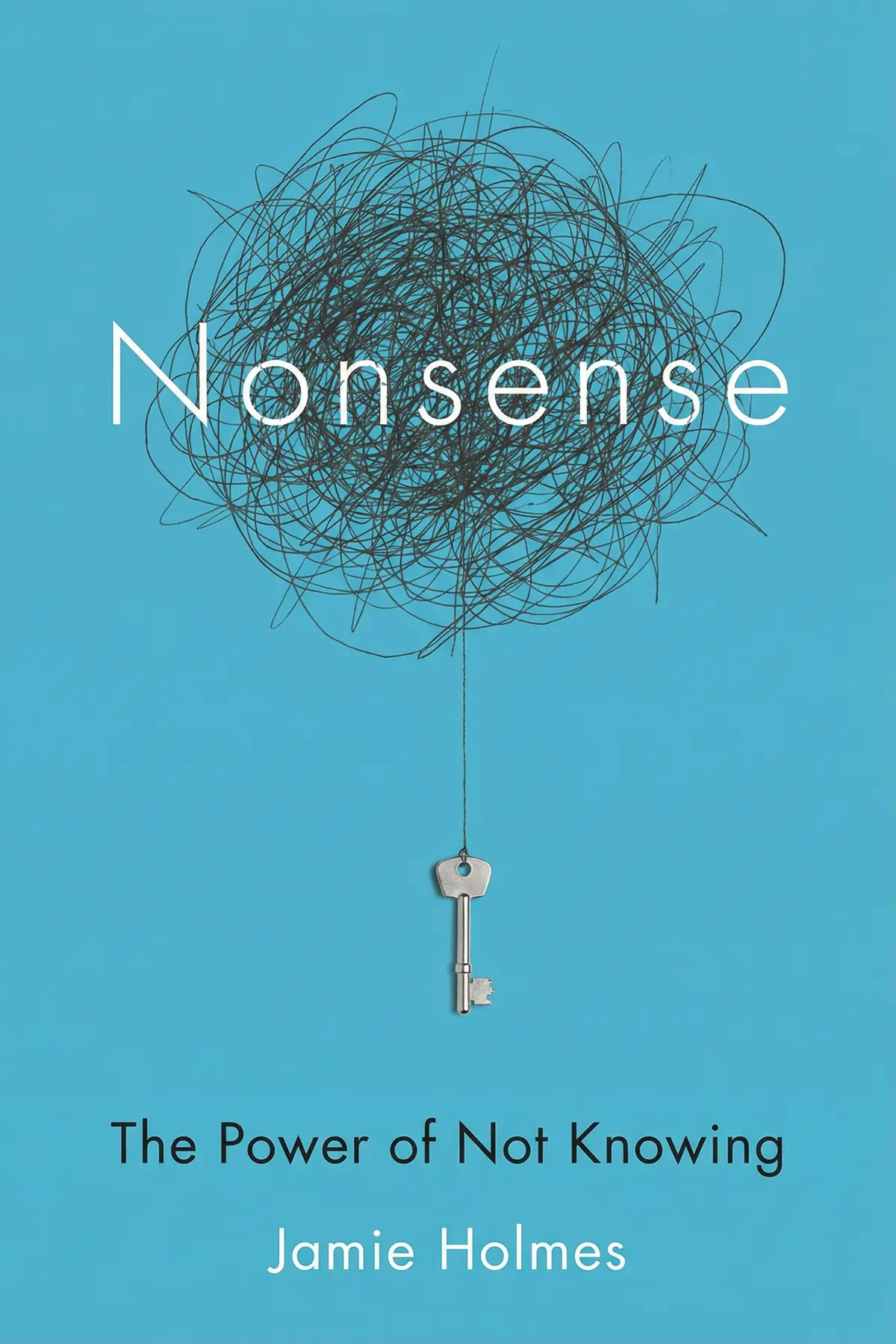
Table of Content
1. Introduction
1 min 42 sec
Have you ever walked through a museum of modern art, stopped in front of a canvas like René Magritte’s *The Son of Man*, and felt a strange mix of confusion and irritation? You’re looking at a man in a bowler hat, but his face is almost entirely obscured by a floating green apple. It doesn’t quite make sense. Your brain wants to resolve the image, to peel that apple away and see the face behind it, but the painting refuses to cooperate. That feeling—that itchy, restless sensation of encountering something that doesn’t fit a neat category—is what we call the experience of nonsense.
In this exploration of Jamie Holmes’s work, we are going to dive deep into the concept of ambiguity. We often think of our decisions as being based on logic and clear facts, but a massive part of our cognitive life is actually spent reacting to things we don’t understand. This is the “need for closure.” It’s a psychological drive to find an answer, any answer, just to stop the discomfort of uncertainty.
What we’ll discover is that this drive affects almost every corner of human existence. It’s why some jokes make us burst into laughter and why others fall flat. It’s why a noisy office might actually make you more stubborn in your opinions. It’s even the reason why people might rush into a marriage or a divorce following a natural disaster. By the end of this journey, you’ll see that the throughline of our lives isn’t always a straight path of reason; often, it’s a zig-zagging attempt to make sense of a world that is inherently nonsensical. Understanding how we process—or fail to process—ambiguity is the first step toward making better decisions in a world that rarely gives us the full picture.
2. The Playful Side of the Unknown
1 min 52 sec
Explore why we find certain jokes hilarious and how advertising geniuses use hidden patterns to keep us hooked without us even realizing why.
3. How Stress Colors Our Convictions
2 min 18 sec
Discover the surprising way that environmental noise and visual puzzles can trick your brain into becoming either more stubborn or more easily swayed.
4. The Imaginative Advantage of Youth
2 min 04 sec
Why do children embrace the absurd while adults struggle with it? Learn how exposing yourself to nonsense might actually sharpen your analytical mind.
5. The Dangerous Lure of Simple Answers
2 min 06 sec
In times of national crisis, the human brain craves a strong, single narrative. See how this biological urge can lead to political errors and cult-like devotion.
6. Decisions Born from Chaos
2 min 03 sec
Natural disasters don’t just destroy buildings; they force us to make life-altering personal choices. Find out why earthquakes and hurricanes lead to sudden marriages and divorces.
7. Learning Without the Pressure of Perfection
1 min 42 sec
A revolutionary teaching method proves that we learn languages faster when we stop trying so hard. Discover the power of creating a “zero-anxiety” environment.
8. The High Cost of Impatience
2 min 06 sec
In life-and-death situations, the urge to “just do something” can be fatal. Learn why patience and “Red Teams” are vital for military and negotiation success.
9. Conclusion
1 min 23 sec
As we have seen, the human relationship with nonsense and ambiguity is complex. On one hand, our drive for closure helps us make sense of the world and make decisions. On the other hand, that same drive can make us stubborn, impatient, and prone to poor judgment when the stakes are high. Whether it’s the way we react to a painting, a joke, or a national crisis, our brains are constantly trying to bridge the gap between what we know and what we don’t.
The throughline of this journey is that ambiguity is not an enemy to be defeated, but a reality to be managed. The most successful people—whether they are negotiators, teachers, or artists—are those who have learned to tolerate the discomfort of not knowing. They don’t rush to the first available answer just to stop the feeling of uncertainty. Instead, they stay curious, stay open, and stay patient.
So, here is your actionable takeaway for the next time you feel that itch of anxiety when things aren’t clear: don’t make your biggest moves when you’re in that state. If you’ve had a chaotic day or a stressful confrontation, recognize that your brain is currently hunting for closure and might lead you to a rash decision just to end the tension. Take a breath, wait for the dust to settle, and remember that sometimes, the best thing you can do is simply sit with the nonsense until the real answer reveals itself.
About this book
What is this book about?
Nonsense explores the fascinating and often overlooked psychological force known as the need for cognitive closure. It examines how our brains react when faced with information that doesn't fit a clear pattern, and why we often rush to judgment just to escape the discomfort of not knowing. From the whimsical world of modern art and wordplay to the life-and-death stakes of hostage negotiations and military strategy, Jamie Holmes reveals that our aversion to ambiguity is a double-edged sword. The book promises to change the way you view uncertainty. Instead of seeing it as a source of stress to be avoided, you will learn how ambiguity can be harnessed to spark creativity, improve learning, and sharpen your decision-making skills. By understanding why we cling to simple answers in complex times, we can better navigate a world that is increasingly defined by its lack of clear-cut solutions.
Book Information
About the Author
Jamie Holmes
Jamie Holmes was an economics research coordinator at Harvard before he became a writer. His work has been published by the New York Times, CNN and The Huffington Post. Nonsense is his first book.
Ratings & Reviews
Ratings at a glance
What people think
Listeners find the title to be an enjoyable and intriguing listen, with striking examples that ensure the material remains highly captivating.
Top reviews
Sarawut
Wow, I didn't expect a book about ambiguity to be so incredibly gripping and relevant to my daily life. Holmes uses vivid examples, like the weird way we reacted to that viral white and gold dress, to show how our brains struggle with conflicting information. It’s a masterclass in pop-psychology that feels much more nuanced than the typical Malcolm Gladwell fare because it admits that the world isn't easily solved. The stories about how diversity in Japanese society led to bursts of creativity two generations later really stuck with me. Frankly, this book changed how I view my own knee-jerk reactions on social media. It teaches you that owning your uncertainty isn't a weakness; it actually makes you more empathetic and alive. This is the kind of book you’ll want to highlight every other page.
Show moreAnchalee
Finally got around to reading this, and it’s easily one of the most fascinating deep-dives into human cognition I’ve picked up this year. Holmes has a way of taking complex ideas, like Piaget’s assimilation and accommodation, and making them feel relevant to why we buy certain clothes or how we vote. The chapter on the 'Hidden A's' opened my eyes to how we subconsciously affirm our beliefs when we feel threatened by new, confusing information. I particularly appreciated the discussion on how medical professionals often over-test patients just to avoid the anxiety of a 'not sure' diagnosis. It’s a sparkling, well-written exploration of the human mind that encourages us to stop rushing toward easy answers. If you’ve ever felt overwhelmed by the complexity of the modern world, this book will give you a new lens to view it through.
Show moreAey
Not what I expected at all, but in the best way possible. This isn't a boring self-help book; it's an engrossing look at how 'nonsense'—the stuff that doesn't fit our worldview—actually drives progress. The stories about Alexander Graham Bell and the development of the Zara fashion chain were brilliant illustrations of how embracing uncertainty can lead to massive success in business. I loved the idea that the capacity to be puzzled is the premise of all creation. Holmes manages to bridge the gap between hard science and storytelling with ease, making for a book that is both educational and fun. It made me realize that my own discomfort with not knowing is actually an opportunity to be more creative. Highly recommend this to anyone who feels stuck in their thinking!
Show moreMaria
Ever wonder why people cling to crazy beliefs even when they’re proven wrong? Holmes dives deep into this phenomenon by examining the Waco Siege and the 1993 standoff, illustrating how the human brain panics when faced with total uncertainty. I found the section on 'cognitive closure' particularly enlightening because it explains our desperate need to simplify a messy world into neat, manageable boxes. While the narrative occasionally drifts into over-detailed anecdotes that feel a bit disconnected from the core thesis, the underlying message is incredibly powerful. We are naturally wired to hate ambiguity, yet learning to sit with that discomfort is exactly what leads to better decision-making. It’s a fascinating read for anyone who wants to understand why we jump to conclusions or entrench ourselves in tribalism during stressful times.
Show moreBella
As someone who struggles with a high need for closure, I found Holmes’ exploration of the 'Hidden A’s' and our visceral reaction to disorder surprisingly helpful. The book argues that in an unpredictable world, our IQ matters less than our ability to handle what we don't understand. I loved the section on how bilingualism and biculturalism can foster a more creative mindset by forcing the brain to juggle multiple meanings at once. Though the author’s foray into the Israeli-Palestinian conflict felt a bit tone-deaf and oversimplified, the general point about diversity being a catalyst for innovation was well-made. The writing is snappy and accessible, making complex cognitive theories feel like a casual conversation. It’s a great tool for anyone looking to increase their tolerance for the grey areas of life.
Show moreSaovapa
Truth is, we live in a world that demands black-and-white answers, so Holmes’ defense of 'shades of grey' feels like a necessary intervention. The book is at its best when it’s exposing the hazards of denying ambiguity, such as the tragic failures during intelligence briefings or the Ruby Ridge standoff. Holmes provides a 'closure test' that really makes you reflect on your own mental rigidity and how stress or fatigue can make you more likely to revert to stereotypes. My only gripe is that some of the later chapters on creativity felt like they belonged in a different book entirely. However, the prose is so engaging and the examples are so diverse that I didn't mind the occasional detour. It’s a solid 4-star read that offers some much-needed perspective on our collective need for certainty.
Show moreAnong
The premise of this book is absolutely stellar, yet the execution left me feeling a bit like the doomsday cult members described in the first chapter—waiting for a payoff that never quite arrived. To be fair, the first third is brilliant, especially the experiments involving reverse-colored playing cards that prove we see what we expect to see. But as the pages turn, the stories become increasingly redundant and start to feel like filler for a thesis that could have been a long-form essay. I was particularly confused by the massive section of endnotes at the back, which makes the actual book feel surprisingly short. It’s a decent enough read if you enjoy trivia and light psychology, but don't expect a rigorous academic breakdown of cognitive science. It’s more of a collection of interesting 'what if' scenarios.
Show moreTakeshi
While I enjoyed the vivid anecdotes about the failure of the midi-skirt and the psychology of bilingualism, the book’s overall structure is undeniably messy. Holmes is a gifted storyteller, but he often fails to connect his fascinating examples to a central, meaningful point. I found myself halfway through a chapter on motorcycle racing wondering how we got there and what it had to do with ambiguity in the first place. The book ends abruptly at around 70%, with the rest being a massive wall of endnotes that felt like a way to pad the page count. It’s a quick, pleasant read if you take it for what it is—a collection of 'cool facts'—but it’s definitely not the definitive text on uncertainty that I was hoping for. It’s just okay.
Show moreRuangrat
Jamie Holmes certainly picked an appropriate title for this book, because much of the middle section felt like total nonsense to me. The author starts with a compelling premise about how we handle the unknown, but the actual delivery is a disjointed mess of scissors-and-glue research. Specifically, Chapter 2 was an absolute slog; he introduces the 'Hidden A’s' but then fails to even define 'abstraction' after making the reader hunt through sixty pages of extraneous fluff. I felt like I was doing more work to cobble together his points than he did to write them. Some of the stories, like the one about the San Francisco earthquake and sudden marriages, are interesting on their own. However, the book lacks any real penetrative analysis to tie these threads together into a cohesive argument.
Show moreEvelyn
This was a massive disappointment that felt more like a disorganized collection of Wikipedia entries than a cohesive psychological study. I honestly suspect the author was playing a trick on the reader by making the book itself as confusing and muddled as the 'nonsense' he claims to investigate. He makes bold, pseudo-profound claims about war and marriage that aren't backed up by anything other than his own fancy prose. For example, quoting the 'Cambridge University Effect' when it has been thoroughly debunked really damaged his credibility for me. The structure is a complete disaster, with trains of thought that leapfrog over digressions and then backtrack to points that were supposedly finished chapters ago. Save your money and just read the original research papers he quotes; you’ll get much more substance and a lot less frustration.
Show moreReaders also enjoyed
A Liberated Mind: How to Pivot Toward What Matters
Steven C. Hayes
Acting with Power: Why We Are More Powerful Than We Believe
Deborah Gruenfeld
Age of Propaganda: The Everyday Use and Abuse of Persuasion
Anthony Pratkanis
AUDIO SUMMARY AVAILABLE
Listen to Nonsense in 15 minutes
Get the key ideas from Nonsense by Jamie Holmes, plus 5,000+ more titles in English and Thai.
- 5,000+ titles
- Listen as much as you want
- 7-day free trial
- Cancel anytime







