
Willful Blindness: Why We Ignore the Obvious at Our Peril
Margaret Heffernan
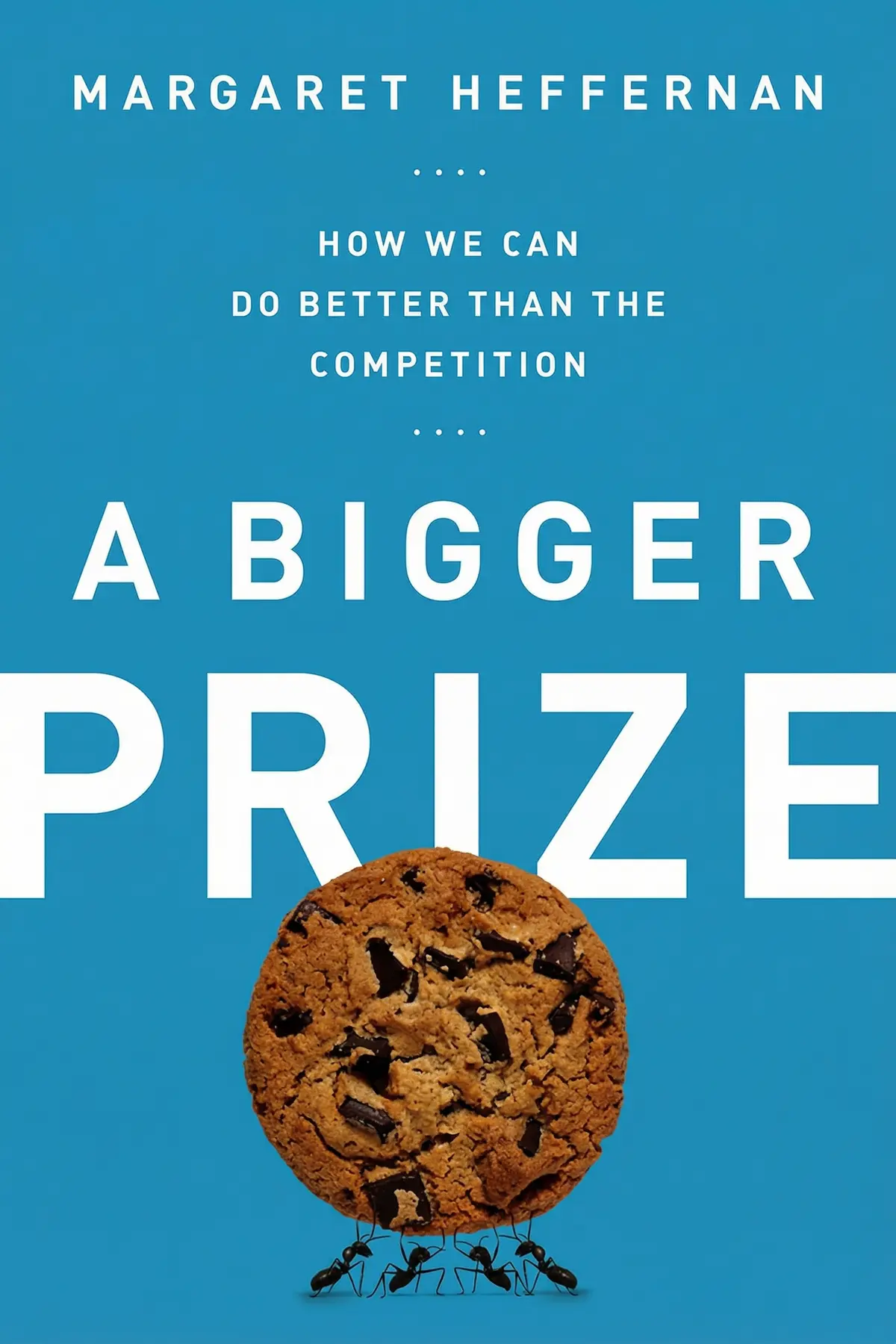
A Bigger Prize reveals how our obsession with competition sabotages success. Margaret Heffernan argues that true progress, innovation, and well-being come from fostering collaboration rather than constantly trying to outdo one another.
1 min 52 sec
Imagine being asked a question that pits your greatest dreams against your very life. In 1984, a researcher named Robert Goldman posed a hypothetical scenario to a group of nearly two hundred elite athletes. He asked if they would take a performance-enhancing drug that was completely undetectable and guaranteed them a gold medal, but would result in their death within five years. The response was chilling: more than half of these top-tier performers said they would take the deal. They were willing to trade their future for a single moment on the top step of the podium.
This story is a stark illustration of a broader cultural phenomenon. We have become a society obsessed with winning, often at any cost. We don’t just want to succeed; we want to be the best. We measure our worth by the prestige of our job titles, the grades our children receive, the number of followers we have on social media, and even the perceived quality of our lifestyles compared to our neighbors. We have internalized the idea that life is a zero-sum game—a race where there are winners and there are losers, and being part of the pack simply isn’t enough.
But what if this competitive drive is actually working against us? In this exploration of Margaret Heffernan’s insights, we are going to look behind the curtain of our high-stakes culture. We will see how the pressure to outperform others can lead to massive stress, a lack of innovation, and even systemic economic failures. We’ll look at the classrooms of Finland, the research labs of the world’s greatest scientists, and the internal workings of major corporations to understand why the biggest prizes in life aren’t won by individuals fighting for dominance, but by communities working in concert. It’s time to discover why moving beyond competition is the only way we can truly do better.
2 min 27 sec
When we treat every aspect of our lives as a race to the finish line, we ignore the statistical reality that most of us are destined to lose.
2 min 28 sec
The classroom should be a place of wonder, but a heavy focus on rankings and rewards can actually kill a student’s natural desire to learn.
2 min 09 sec
Competition doesn’t stop at the office door; it often invades our homes, turning family members and partners into rivals for attention and power.
2 min 10 sec
The myth of the lone genius suggests that greatness comes from individual triumph, but history shows that the biggest breakthroughs happen through sharing.
2 min 19 sec
In the business world, the drive to beat the competition often leads to massive mergers and risky behaviors that endanger the entire global economy.
2 min 18 sec
It is possible to build a society that values cooperation over rivalry, as seen in innovative companies and successful national education systems.
1 min 41 sec
As we have seen, the cultural obsession with competition is a double-edged sword that has become far too sharp. While it might provide a quick burst of adrenaline or a temporary boost in performance, its long-term effects on our health, our children, our relationships, and our global economy are profoundly damaging. We have spent decades building systems that reward the ‘winner’ while ignoring the wreckage left behind for everyone else. We’ve seen how this manifests in the tragic risks taken by athletes, the stifled creativity in our schools, and the systemic failures of our largest institutions.
But the most important takeaway is that we have a choice. Competition is not a law of nature; it is a cultural preference that we can change. By looking toward collaborative models—whether it’s the grade-free schools of Finland or the flat organizational structures of innovative companies—we can see a path forward. We can choose to value cooperation, transparency, and mutual support.
True success isn’t about standing alone at the top of a mountain of losers. It’s about building a mountain together that everyone can stand on. The ‘bigger prize’ promised by Margaret Heffernan is a world where we no longer feel the need to outdo our neighbors, but instead find ways to lift them up. As you move forward, look for opportunities in your own life to swap rivalry for partnership. Whether in your family, your workplace, or your community, remember that we are always stronger when we work together than when we try to beat each other. The race to the top is exhausting, but the journey of collaboration is where we truly find our potential.
We are raised in a culture that treats life like an endless series of tournaments. From the classroom to the boardroom, we are taught that for us to win, someone else must lose. This book, A Bigger Prize, takes a critical look at this fundamental assumption. Margaret Heffernan explores the psychological, social, and economic damage caused by our fetishization of rivalry. She reveals how extreme competition leads to burnout, unethical behavior, and a stifling of the very creativity it claims to promote. The promise of the book is a more effective and humane alternative. By examining successful models in education, science, and business, Heffernan shows that collaboration is not just a moral choice, but a practical one. You will learn how shifting from a competitive mindset to a cooperative one can lead to better health, stronger relationships, and a more resilient economy. It is a call to rethink the structures of our society to unlock the true potential of human collective effort.
Margaret Heffernan is a multimedia entrepreneur who has built a diverse career across several industries. She began her professional journey producing radio and television programs at the BBC, which eventually led her to running companies, teaching and writing. A Bigger Prize represents her fourth book, cementing her reputation as a leading voice on leadership, innovation, and organizational behavior.
Margaret Heffernan
Listeners find that while perspectives differ regarding the text's total length and its reliance on anecdotes, the fundamental premise favoring partnership over intense competition is intellectually stimulating and supported by solid research. They value the wide-ranging case studies in sectors like business, science, and education that demonstrate how working together can spark increased creativity and moral conduct. Additionally, they are moved by the uplifting examples of groups that avoid zero-sum mentalities, with one listener observing that the book successfully refutes the notion that human beings are fundamentally designed for constant competition. Finally, they note that the author delivers an optimistic, fact-based roadmap for attaining higher performance through shared endeavors.
A masterclass in dismantling the foundational myths of modern capitalism and institutional design. Margaret Heffernan has delivered an electrifying study of why our addiction to winning actually produces widespread failure, institutional blindness, and systemic fraud. What elevates this work above standard business literature is its breadth. She traverses effortlessly from mega-churches and banking conglomerates to chamber orchestras and seed-saving cooperatives, showing that shared purpose consistently outperforms Darwinian competition. The prose is lucid, humane, and supported by a mountain of research. It entirely reframes the concept of success. Rather than asking how we can defeat our rivals, this book asks the far more profound question: what extraordinary things could we create if we actually joined forces?
Show moreWe have been sold a dangerous myth that ruthless individual ambition is the only true engine of human progress. A Bigger Prize tears that toxic assumption to shreds with forensic precision and moral brilliance. By examining how hyper-competition fosters corner-cutting, depression, and institutional fragility, Heffernan exposes the enormous hidden costs of our winner-take-all society. Yet the book never surrenders to cynicism. The counter-examples she provides—cooperatives like Ocean Spray, flat-structured enterprises, and collaborative research initiatives—prove that trust and mutual aid are practical necessities for survival, not fuzzy ideals. This should be mandatory reading in every business school and policy think-tank in the country.
Show moreThe chapter dissecting how cutthroat grading models wreck student curiosity hit uncomfortably close to home. In my experience as a high school educator, hyper-competitiveness turns learning into a paranoid sprint toward credentials rather than a genuine pursuit of understanding. Heffernan does a phenomenal job illustrating how standardized rivalry drives students toward academic dishonesty, anxiety, and intellectual timidity. Contrasting our test-obsessed culture with collaborative models like the Finnish educational system provides a refreshing breath of sanity. She writes with warmth and clear moral clarity. My only gripe is that the transitions between global macroeconomics and personal family dynamics occasionally feel disjointed. Still, it delivers an urgent warning for parents and teachers alike.
Show morePicked this up after a colleague mentioned the critique of stack ranking, and it delivered plenty of food for thought. Gotta say, the organizational case studies are where Heffernan really shines. Learning about companies like Interface and W.L. Gore that deliberately cap group sizes around Dunbar’s number to maintain trust was fascinating. She methodically demonstrates how internal rivalry eats companies alive from the inside out, turning brilliant teams into bitter rivals who withhold crucial information. The book can feel slightly dense when she piles anecdote upon anecdote, but the central conclusion remains irrefutable: cooperation generates far sturdier long-term value than hyper-aggressive jockeying for status. A very worthwhile read for leaders.
Show moreHeffernan mounts a devastating indictment of our culture's obsession with individual supremacy. From Wall Street trading desks to agricultural monocultures, she traces how the desperate race to finish first consistently triggers catastrophic ethical compromises. What makes the book persuasive is that she does not merely complain about corporate greed; she presents hard evidence showing that cooperation unlocks higher collective intelligence. Her analysis of game theory and zero-sum assumptions is particularly sharp. Yes, the narrative structure occasionally meanders into prolonged tangents, and some case studies feel slightly dated now. Even so, the overarching argument that winning at all costs ultimately leaves everyone impoverished is masterfully handled.
Show moreFinally got around to reading this after keeping it on my nightstand for months, and I found myself nodding along constantly. The biological references, particularly the historic experiments tracking how dominant chickens establish destructive pecking orders that diminish the flock's total egg output, were hilarious yet terrifyingly applicable to modern corporate life. Look, we have been conditioned since kindergarten to treat our peers as obstacles to overcome rather than partners to build with. Heffernan systematically dismantles that dogma across sports, arts, and enterprise. It gets a little talky in the second half, but the hopeful tone kept me hooked.
Show moreCompelling, rigorous, and deeply countercultural. We live in an era that worships the ruthless 'lone genius' myth, making Heffernan's defense of collective solidarity feel radical. She highlights how small, flat teams operating with psychological safety produce far more resilient creative work than terrified employees competing for bonuses. The text challenges conventional wisdom on every page. Personally, I found the chapters on scientific discovery and peer review most striking, as they reveal just how much innovation gets sacrificed on the altar of personal vanity. A few sections drag under the sheer weight of interview transcripts, but the underlying philosophy is brilliant.
Show moreAs someone working in corporate sales, I wanted to believe Heffernan’s vision with my whole heart. Her takedown of forced-ranking evaluation methods and the absurdity of 'hackordnung' pecking orders resonates deeply with anyone trapped in a cubicle. Who hasn't seen internal politics sabotage real innovation? Frankly, though, the alternative she champions borders on wishful thinking. While cooperative endeavors sound wonderful around a conference table, human nature remains stubbornly tethered to self-interest and status seeking. The text repeatedly skirts around how to bridge the gap between our primal competitive urges and her communal ideal. It is certainly a thought-provoking critique of zero-sum workplaces, but without an actionable mechanism to govern bad actors, the cooperative utopia she describes feels frustratingly out of reach.
Show moreWhy does an important 300-page book so often feel like an essay stretched past its breaking point? Heffernan hits hardest when exposing how extreme rivalry corrupts higher education and medical science. The revelation that researchers deliberately hoard data—slowing down potential cures just to beat rivals to publication—is genuinely horrifying. But to be fair, the narrative engine sputters frequently. The pacing feels sluggish across the middle sections, bogged down by repetitive examples that hammer the exact same conclusion repeatedly. A sharper editorial hand could have cut a third of the text without losing any substance. It offers a solid perspective on modern burnout, yet finishing it requires considerable patience.
Show moreNot quite the revelation I hoped for. Margaret Heffernan sets out with an urgent and vital premise, yet the execution quickly devolves into an endless parade of anecdotal interview clips that start blurring together after fifty pages. You end up feeling like you are watching an unfocused documentary stuffed with talking heads rather than digesting a rigorous analytical framework. Truth is, I actually agree that cutthroat environments produce toxic results, so I desperately wanted this to work. Instead of providing concrete blueprints for reshaping institutional systems, the book meanders through bizarrely specific relationship dynamics and familiar corporate tales that drag on endlessly. If you already suspect that rivalry breeds cheating and demoralization, you will not uncover much fresh insight here. It simply takes far too long to prove an obvious point.
Show more
Joseph A. Maciariello



Deborah Gruenfeld
Mike Michalowicz
AUDIO SUMMARY AVAILABLE
Get the key ideas from A Bigger Prize by Margaret Heffernan, plus 5,000+ more titles in English and Thai.







