
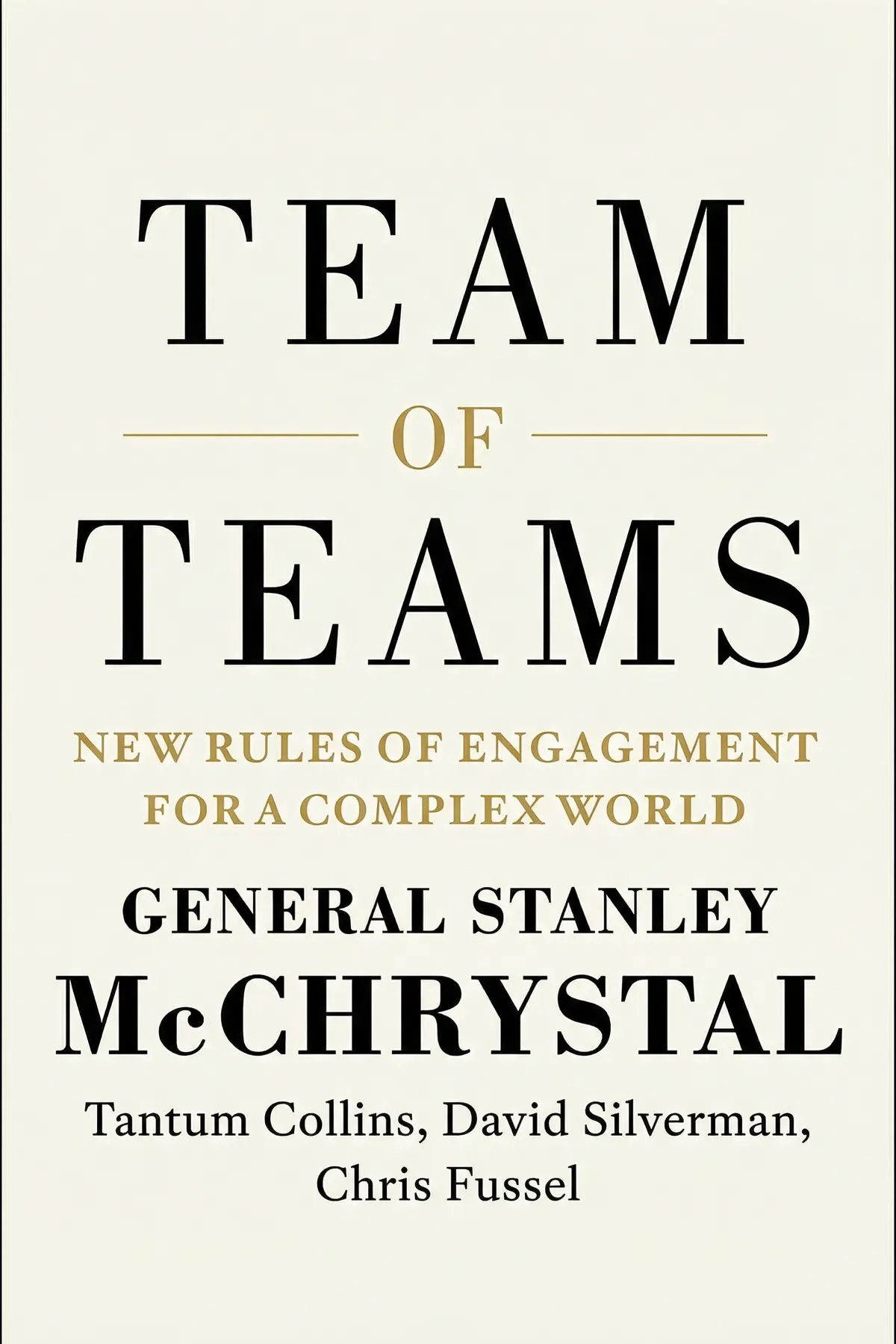
Team of Teams: New Rules of Engagement for a Complex World
Stanley McChrystal
General Stanley McChrystal explores the foundational elements of character, arguing that it is not an innate trait but a deliberate, lifelong construction formed through the combination of deep-seated convictions and consistent self-discipline.
1 min 28 sec
Have you ever paused to consider what really keeps a person standing tall when the world seems to be falling apart? We often talk about character as if it’s a static quality, something a person either has or they don’t, like their height or the color of their eyes. We look at leaders, heroes, or even our own parents and assume their strength is just part of their DNA. But what if that perspective is entirely wrong? What if character isn’t a gift at all, but a craft that must be practiced every single day?
This exploration into the heart of human integrity comes from a perspective forged in the highest stakes imaginable. When you think of a four-star general, you likely imagine someone who has it all figured out, a person whose moral fiber is as rigid as the starch in their uniform. However, the reality is far more human and, ultimately, far more encouraging. Character is not about achieving a state of perfection; it is about the ongoing tension between who we are and who we strive to be.
In the following minutes, we are going to dive into a battle-tested blueprint for building that inner strength. We will move past the feel-good slogans and get into the actual mechanics of how identity is formed. We’ll look at why your title doesn’t define you, how to tell which of your beliefs are actually yours, and why the most important choices you make are the ones no one else will ever see. By the end, you’ll see that building an unshakeable character is a path open to anyone willing to do the work, one small choice at a time.
1 min 47 sec
Discover why character is far more than a natural-born trait and how it serves as a deliberate calculation between your deepest beliefs and your daily habits.
1 min 55 sec
Learn the vital importance of questioning where your beliefs truly come from and how to transform borrowed values into authentic personal convictions.
2 min 10 sec
Explore why identifying your ultimate priorities is an ongoing journey and how your sense of purpose must evolve through different seasons of life.
2 min 00 sec
Shift your perspective on discipline from a form of punishment to a tool for liberation and learn why showing up matters more than being perfect.
1 min 53 sec
Uncover the reality of what it takes to lead effectively, focusing on the power of presence, service, and the daily decision to put others first.
2 min 06 sec
Understand why character is a marathon rather than a sprint and how the most difficult test of your values often comes when you are no longer in the spotlight.
1 min 28 sec
As we wrap up this exploration of character, it’s worth returning to that central throughline: who you are is the result of a deliberate, ongoing process. We’ve seen that character is neither an accident of birth nor a permanent achievement. It is a living, breathing thing that requires the constant nourishment of honest conviction and the steady guidance of self-discipline. It’s about the intersection of the values you claim to hold and the actions you actually take when no one is there to applaud.
The journey toward a life of character starts with a simple audit of your own heart. Take a moment to look at the beliefs you carry. Which ones are truly yours, and which ones are just echoes of the world around you? Once you find your core, the challenge is to build the habits that protect those values. Remember, discipline isn’t about being a robot; it’s about being a person of your word. It’s about showing up for your family, your team, and yourself, especially on the days when you’d rather stay in bed.
Ultimately, the lesson General McChrystal shares is one of profound hope. No matter where you are starting from, you have the power to reshape your character starting right now. It doesn’t require a uniform or a title. It just requires the willingness to be honest with yourself and the courage to make the harder choice when it’s the right one. Character is built in the small, quiet moments of integrity that eventually add up to a life well-lived. So, as you move back into your day, ask yourself: what is one small choice I can make right now that reflects the person I truly want to be?
On Character provides a profound look into the psychological and moral architecture that defines a successful and meaningful life. Drawing from a storied military career and a transition into civilian leadership, the book dismantles the myth that character is something one is simply born with or granted through status. Instead, it presents a practical framework where character is viewed as the product of our core beliefs multiplied by our daily discipline. The promise of this work is to guide readers through the difficult process of self-examination and habit-forming. It covers the necessity of auditing inherited beliefs, the challenge of maintaining standards when the spotlight is off, and the importance of leading others through service rather than authority. By weaving together personal anecdotes of failure and redemption with broader observations on organizational integrity, it offers a roadmap for anyone looking to build an unshakeable inner core in an increasingly complex world.
Stanley McChrystal is a retired four-star general who served over 34 years in the U.S. Army, culminating as commander of NATO forces and all U.S. troops in Afghanistan. He has authored multiple New York Times bestsellers, including his memoir My Share of the Task and Team of Teams, which explores organizational leadership in complex environments. Currently a senior fellow at Yale University's Jackson Institute for Global Affairs and partner at McChrystal Group, he specializes in helping organizations become more adaptable and effective.
Stanley McChrystal
Listeners find the writing both stimulating and articulate, with one listener observing that it relies heavily on the author’s own professional background. The text earns praise for its emphasis on personal growth, as one listener mentions its value for building or rebuilding character. Additionally, the values-based approach to leadership is well-regarded for being wise and insightful. Regarded as essential for those in leadership roles, one listener characterizes the book as a deeply reflexive read.
Few leaders possess the humility to publish their failures alongside their triumphs, but McChrystal does exactly that in this deeply reflexive read. He avoids the typical arrogance of four-star memoirs, instead offering what feels like a final testament to his grandchildren about the weight of our choices. The way he breaks down his 'Character = Convictions x Discipline' formula is simple yet profoundly challenging to live out. I found the sections on the U.S. exit from Afghanistan particularly moving, even if he was careful with his words. This isn't just another leadership book; it’s a manual for building a life that actually matters when the uniforms are put away. It is imbued with sagacity and a vulnerability that is rare for someone of his rank. Truly, it’s a must-read for any developing leader looking to ground their ambition in something more permanent than a title.
Show moreThe chapter regarding the U.S. withdrawal from Afghanistan was the main reason I grabbed this, though I walked away with much more. McChrystal doesn't shy away from the hard stuff, even when he’s mincing words to stay within the lines of professional propriety. This book is a love story to his family and a call to arms for anyone who feels the erosion of character in modern society. I loved his focus on discipline—even mentioning things like the 'One Meal A Day' diet to show how self-control in small things translates to big decisions. It’s a deeply insightful work that prioritizes the internal life over external accolades. He argues that character is the ultimate metric of a life, and after reading his reflections on mortality, I’m inclined to agree. It’s a gift of wisdom from a life well-served.
Show morePicked this up during a transition in my own career and found the 'Conviction x Discipline' formula surprisingly helpful for recentering my priorities. McChrystal has a way of cutting through the noise to focus on what truly matters: the sum of our choices. He draws extensively on his experience to show that rank and reputation are hollow without a core of integrity. The book is structured around three pillars that feel both urgent and timeless. I particularly liked the focus on the daily, mundane efforts required to stay true to one's beliefs. It is a deeply reflexive read that feels like a conversation with a mentor over coffee. For anyone looking for a values-based approach to life and work, this is an essential addition to your shelf. It is full of wisdom and soldierly grace.
Show moreAfter hearing McChrystal speak on a podcast, I was curious to see if his written philosophy on integrity matched his public persona. To be fair, this is a very personal book, almost a 'what I think about the things I think about' type of deal. He doesn't just lecture; he draws on a career distilled from years in the shadows to show how character is forged in mundane moments, like waiting for luggage or writing handwritten notes. I appreciated his candor regarding his own shortcomings as a father and the public end of his military service. While it lacks the tactical 'Team of Teams' vibe, the values-based approach is refreshing in an era of such cynicism. It’s not a quick fix or a 'how-to' guide. It’s a slow-burn reflection that requires you to sit with your own convictions and ask if you actually have the discipline to follow them.
Show moreCharacter is forged in the small, boring moments, and that is the central heartbeat of this entire work. Frankly, I wasn't sure what to expect from a retired general, but I was surprised by how liberal and reflective his views have become in his later years. He touches on everything from civil rights to the death penalty, showing a mind that is still evolving and questioning. Some of the chapters feel like 'miscellaneous opinions,' but the overarching theme of living with purpose remains strong. He reminds us that while we will eventually be forgotten, the choices we make now define our humanity. The writing is practical and grounded, lacking the dry academic tone you find in similar books. It’s about closing the gap between who we say we are and how we actually act when no one is watching.
Show moreTo be fair, I expected a dense tactical manual on special operations leadership, not a philosophical meditation on mortality and legacy. The publisher might have packaged this as a leadership guide, but it's really a parting gift of lessons from an elder gentleman. I actually enjoyed the 'vignette' style because it made the heavy topics of morality and integrity much more digestible. McChrystal is very candid about his regrets, which makes his advice on discipline feel earned rather than preached. He doesn't offer easy answers or a prescriptive framework, but he does invite you into a conversation about becoming your best self. It’s a thought-provoking read that will stay with me for a while. Not every story is a home run, but the hits are powerful enough to justify the price of admission.
Show moreLook, if you want a dry academic text on Stoicism, go elsewhere, because this is raw, personal, and unapologetically sincere. It is a values-based reflection that prioritizes human connection over corporate metrics. McChrystal is surprisingly vulnerable here, discussing his career’s public end with a level of humility you rarely see in high-ranking officials. He doesn't blame others; he looks in the mirror. That alone makes the book worth reading. While some might find the anecdotes a bit like 'Reader's Digest' vignettes, I found them grounded and relatable. He shows that character isn't a destination but a constant practice of aligning your actions with your ideals. It’s a thought-provoking book that encourages you to look at your own life through a different lens. Definitely a solid read for anyone in a leadership role.
Show moreIs this a groundbreaking moral framework? Not really, but there's still value here if you're willing to dig through some repetitive themes. McChrystal's military background gives him a lot of credibility, yet the book often reads like a Reader's Digest collection of leadership vignettes rather than deep philosophy. I was hoping for more exploration into psychology or the Stoics, who only make brief cameos without adding much new to the conversation. That said, the three-part structure of Conviction, Discipline, and Character provides a decent enough skeleton for his thoughts. It’s a fine read if you’re new to leadership literature, but seasoned readers might find it a bit underwhelming. It’s clear he cares deeply about the country, but the message that 'we are imperfect' is something most of us already know. It feels a bit like a legacy project for his granddaughters.
Show moreFinally got around to finishing this, and while I have immense respect for the General, the structure left me wanting a bit more cohesion. The book feels like a collection of thoughts for his family that got rebranded for a wider audience. There isn't a clear narrative arc, which makes it feel a bit scattered at times. One minute he's talking about handwritten notes, and the next he's reflecting on the Taliban's return to power. I appreciate his sincerity and his call for integrity in public life, but I wish he had gone deeper into fresh examples or actionable frameworks. It’s not bad, but it’s definitely not his best work. If you're looking for a rigorous exploration of character, you might be better off with the classics. It's okay, but not essential reading.
Show moreMaybe it’s just me, but this felt less like a deep exploration of ethics and more like a loose collection of anecdotes that don't quite land. The book is titled 'On Character,' but honestly, it’s just a series of vignettes that lack a cohesive thesis or a fresh moral framework. If you’ve read David Brooks or Samuel Smiles, you’ve already encountered much stronger arguments on this topic. McChrystal is clearly a man of integrity, but sincerity isn't a substitute for a rigorous argument. I felt like I was sitting through a 30-mile march just to get to the point, only to find out the point was 'do your duty.' Some of the stories end so abruptly that I was left wondering if a chapter had been accidentally deleted. It feels more like a personal journal than a polished book for the public.
Show more
Andrew D. Thompson
Deepak Chopra
Richard Wiseman
AUDIO SUMMARY AVAILABLE
Get the key ideas from On Character by Stanley McChrystal, plus 5,000+ more titles in English and Thai.







