
8 min 03 sec
Playing to Win: How Strategy Really Works
Playing to Win explores a proven framework for business success, detailing how specific strategic choices transformed Olay into a global leader and how any organization can define its winning path.
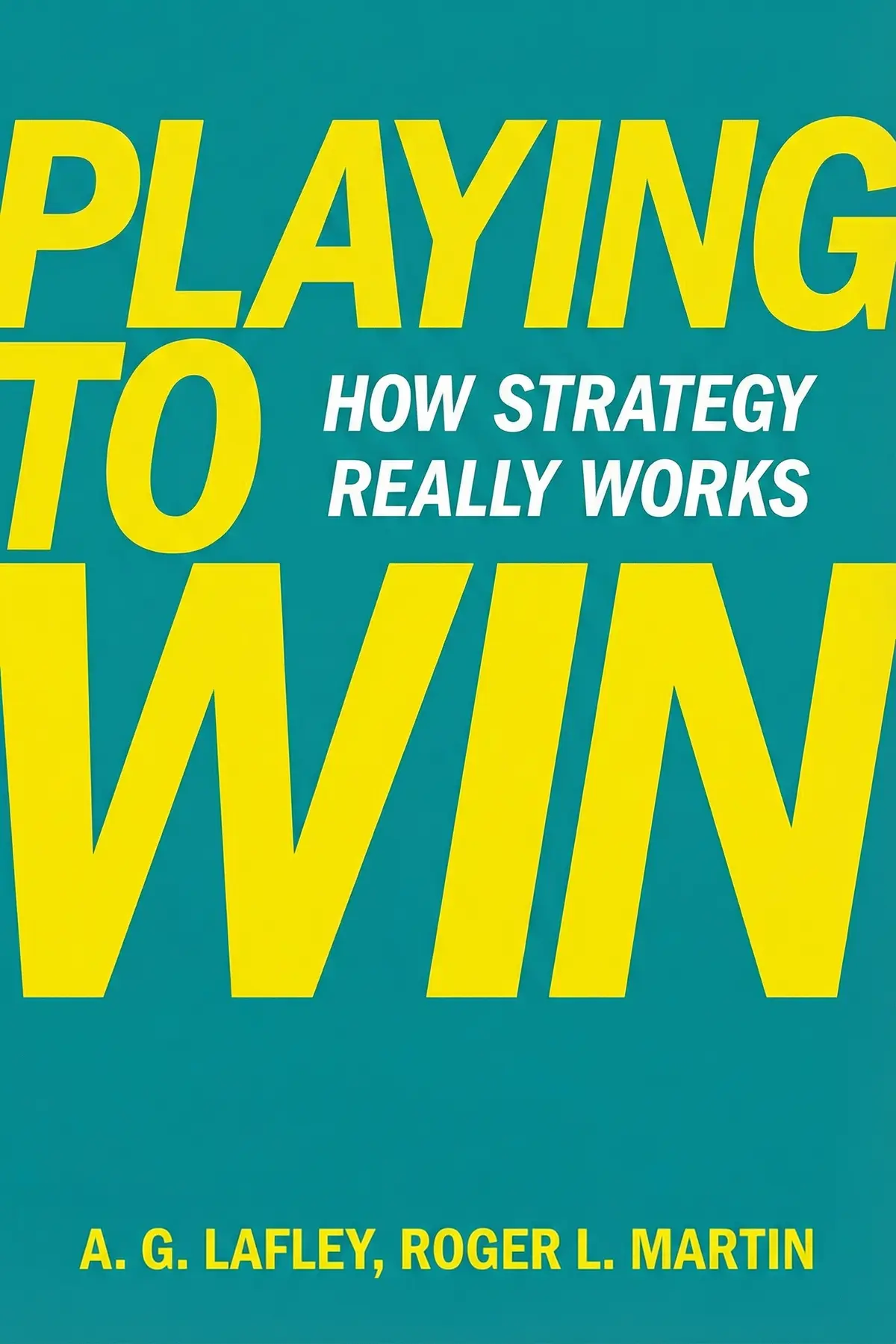
Table of Content
1. Introduction
1 min 01 sec
In the world of business, we often hear the word “strategy” thrown around in boardrooms and during annual meetings, but what does it actually mean? Many leaders mistake a simple list of goals or a budget for a strategy. Others think that just trying harder or being more efficient will lead to victory. However, real strategy is something much more deliberate and, frankly, much more difficult. It is the art of making specific, often painful choices about what an organization will do—and just as importantly, what it will not do.
This guide explores a framework designed to move beyond mere participation in a market and toward true leadership. We will look at how Procter & Gamble used these principles to save one of its most iconic brands from the brink of irrelevance. By the end of this journey, you will understand that strategy isn’t a mystery; it’s a disciplined process of answering five fundamental questions. Let’s dive into how these choices create a roadmap for success that turns aspirations into reality.
2. The Art of Making Hard Choices
1 min 25 sec
Discover why strategy is fundamentally about choosing what not to do and why many companies fail by trying to be everything to everyone.
3. The Olay Transformation Case Study
1 min 39 sec
Follow the journey of Olay from a struggling ‘old lady’ brand to a multi-billion dollar powerhouse through the power of reinvention.
4. The Five Essential Strategic Questions
1 min 35 sec
Uncover the framework that simplifies strategy into five interconnected questions that define your business’s trajectory.
5. The Strategic Waterfall and Iteration
1 min 26 sec
Learn how strategic choices flow together and why strategy is an ongoing process of refinement rather than a one-time event.
6. Conclusion
57 sec
The story of Olay and the five-question framework show us that strategy is not a complicated mystery reserved for elite consultants. It is a practical, disciplined approach to making choices. By defining what winning looks like and being brave enough to narrow your focus, you create the conditions for extraordinary success.
Remember that strategy is about focus and trade-offs. You cannot be all things to all people. Use the ‘Where to Play’ and ‘How to Win’ questions to find your unique edge in the market. Then, back those choices up with the right capabilities and systems to ensure they aren’t just empty promises. Whether you are leading a small team or a global corporation, the principles of making clear, interconnected choices will be your most valuable tool. Take the time to answer these five questions for your own business, and you’ll find yourself moving from just playing the game to truly winning it.
About this book
What is this book about?
Strategy is often misunderstood as a vague set of goals or a complex planning document, but this book clarifies that it is actually a focused set of choices. By examining the real-world success of Procter & Gamble, specifically the revitalization of the Olay brand, the authors demonstrate how a clear strategy can rescue a failing business and drive it toward market dominance. The promise of this summary is to provide a practical toolkit for decision-making. You will learn the five essential questions that every leader must answer to create a competitive advantage. From defining a winning aspiration to establishing the right management systems, the text explains how to align your organization’s capabilities with your market choices to ensure long-term, sustainable growth.
Book Information
About the Author
A. G. Lafley
A. G. Lafley is the former CEO of Procter & Gamble, one of the world's largest consumer goods companies, where he led the organization to double its sales and quadruple its profits. Roger L. Martin, former dean of the Rotman School of Management, is a leading thinker on business strategy and a trusted advisor to CEOs worldwide. He has authored several influential books, including The Design of Business: Why Design Thinking is the Next Competitive Advantage; and Fixing the Game: Bubbles, Crashes, and What Capitalism Can Learn from the NFL.
Ratings & Reviews
Ratings at a glance
What people think
Listeners find this strategy guide superb for entrepreneurs, valuing its straightforward, accessible methodology and practical P&G case studies. Furthermore, the work offers deep perspectives on strategic thinking, as one listener remarks it is essential reading for dedicated leaders. Additionally, the prose successfully demonstrates how well the framework functions, establishing it as a useful asset for building company strategies.
Top reviews
Win
As someone who has spent a decade in middle management, this book finally demystified what strategy actually means beyond corporate buzzwords. Lafley and Martin break down the process into five essential questions that force you to confront the reality of your market position. The 'Where to Play' and 'How to Win' framework is a game-changer because it demands that you actually make hard choices instead of trying to be everything to everyone. While the P&G examples are specific to consumer goods, the underlying logic is universally applicable to any leader who wants to stop reacting to competitors and start shaping their own future. Truth is, most business books are fluff, but this one provides a rigorous, actionable methodology that I’ve already started using in my quarterly planning. It’s a refreshing change of pace to read something so clear and authoritative.
Show moreSamuel
Ever wonder why some brands dominate their category while others just fade into the background? This book provides the answer by showing that winning is the result of deliberate, often difficult choices rather than just luck or brute force. The authors articulate a vision where strategy is not a stagnant document but a living cascade of decisions that empower every level of an organization. I loved the focus on 'Winning Aspirations' because it reminds us that the goal isn't just to participate, but to actually lead. The advice is practical, the tone is encouraging, and the logic is ironclad. Frankly, it is one of the few business books that I would actually recommend to a colleague without reservation. It changed how I view our internal activity systems and helped me identify exactly where our current plan was falling short.
Show moreJune
Truth is, I was skeptical of a book written by a former CEO, but the insights here are genuinely transformative for leadership thinking. Lafley and Martin successfully bridge the gap between high-level theory and the gritty reality of executive decision-making. The core message that strategy is essentially about making specific choices—and choosing what NOT to do—is something every business owner needs to hear. I found the 'Assertive Inquiry' section towards the end to be particularly powerful for improving team communication. It's a must-read for serious leaders who want to move beyond 'program-of-the-month' thinking. The writing style effectively showcases the success of their approach without feeling like a textbook. This is the kind of book you keep on your desk and return to every time you face a major pivot.
Show moreSirinat
Finally got around to reading this classic, and it’s arguably the most concise explanation of competitive advantage since Michael Porter’s original works. The 'What would have to be true' logic is worth the price of the book alone because it completely changes how you conduct strategy meetings. Instead of fighting over who is right, your team ends up collaborating to find the most likely path to success. The authors manage to take a complex subject and make it feel intuitive and, more importantly, actionable. I’ve read dozens of management books, but very few offer a system that is this easy to explain to a board of directors. If you want to move from just 'playing' to actually 'winning' in your industry, you need to master the five questions outlined in these pages.
Show moreWatchara
Lafley and Martin have produced a definitive guide for anyone who feels overwhelmed by the complexity of modern business planning. The writing style is remarkably accessible, avoiding the dense academic jargon that usually plagues strategy texts. I particularly appreciated the section on 'What would have to be true,' as it shifts the conversation from arguing over opinions to testing specific hypotheses. My only real gripe is that the book leans very heavily on P&G case studies, which might make it feel a bit distant if you are running a service-based startup or a small tech firm. Still, the core concepts regarding distinctive capabilities and management systems are robust enough to translate across industries. If you are serious about leadership, this is a essential addition to your bookshelf that you will find yourself referencing whenever a new competitive threat emerges.
Show moreNatnicha
Picked this up after my mentor suggested it, and it provides a very logical flow for decision-making that I haven't seen elsewhere. The authors do a great job explaining why many companies fall into the 'Waterloo Strategy' trap by trying to fight on too many fronts simultaneously. By focusing on five inter-related choices, they help you narrow your focus to what actually drives value for the customer. In my experience, the most valuable part of the book is the discussion on 'nested cascades,' which explains how strategy filters down from the CEO to the brand level. While some of the P&G stories felt a bit repetitive by the end, the clarity of the framework makes it worth the read. It’s an excellent resource for anyone looking to sharpen their strategic thinking and move beyond generic mission statements.
Show moreRotjanee
Strategy is often treated like a dark art, but this text brings it into the light through a practical, choice-based framework. I really enjoyed the 'Six Strategy Traps' section because it felt like the authors were calling out every mistake I’ve made over the last three years. The distinction between 'cost leadership' and 'differentiation' is handled with a level of nuance that makes it feel fresh again. I gotta say, the focus on building the right management systems to support your capabilities is a step many other books skip. It’s not just about having a great idea; it’s about having the structure to sustain it. My only criticism is that the tone can be a bit dry at times, but the quality of the insights more than makes up for the lack of narrative flair.
Show moreBank
Not what I expected given the immense hype surrounding this title in most MBA circles lately. While the 'Choice Cascade' is a helpful mental model, the authors spend an exhausting amount of time praising P&G’s internal culture without providing much grit. It often feels like a victory lap for Lafley rather than a balanced look at strategic challenges. To be fair, the five questions are a solid starting point for any business owner, but the book lacks the 'low-level' tools needed to implement these ideas in a smaller organization that doesn't have P&G’s massive resources. I found the latter half of the book much more engaging than the beginning, specifically the parts about selecting and verifying your strategy through rigorous testing. It’s a decent read, but perhaps a bit over-simplified for those already familiar with Michael Porter.
Show morePenelope
To be fair, the 'Choice Cascade' is a brilliant mental model, though I found the writing style a bit dry and academic in the middle chapters. The book definitely offers some nice morsels of information, especially regarding how to test your strategy against potential barriers. However, I struggled with how focused it was on gargantuan companies with products in dozens of different segments. If you are running a small local business, you might find it hard to relate to the multi-level cascades described in the P&G case studies. Personally, I think the book is a bit over-hyped, but it’s still a solid read if you want to understand how the big players think about competition. It sits somewhere between a 3 and a 4 for me, mainly because it feels a bit dated in the era of digital disruption.
Show moreYok
The constant self-praise regarding P&G’s culture made this a difficult pill to swallow for a reader coming from a lean startup environment. It felt like Lafley was more interested in impressing me with his vocabulary and corporate pedigree than actually teaching a transferable skill. There wasn't a single example of these strategies being applied to a small business or a non-FMCG company, which made the theories feel very one-sided. Look, the 'Where to Play' concept is basically Business 101, and I didn't find much here that hasn't been covered more effectively by other management gurus. The book is very polished, but beneath the surface, it’s mostly just high-level vignettes that are hard to turn into real-world actions for those of us without a billion-dollar budget. I’d suggest looking elsewhere if you need a guide for agile execution.
Show moreReaders also enjoyed
7 Powers: The Foundations of Business Strategy
Hamilton Helmer

A Bigger Prize: How We Can Do Better Than the Competition
Margaret Heffernan
A Year with Peter Drucker: 52 Weeks of Coaching for Leadership Effectiveness
Joseph A. Maciariello
AUDIO SUMMARY AVAILABLE
Listen to Playing to Win in 15 minutes
Get the key ideas from Playing to Win by A. G. Lafley, plus 5,000+ more titles in English and Thai.
- 5,000+ titles
- Listen as much as you want
- 7-day free trial
- Cancel anytime







