Lateral Thinking: Creativity Step by Step
Edward de Bono
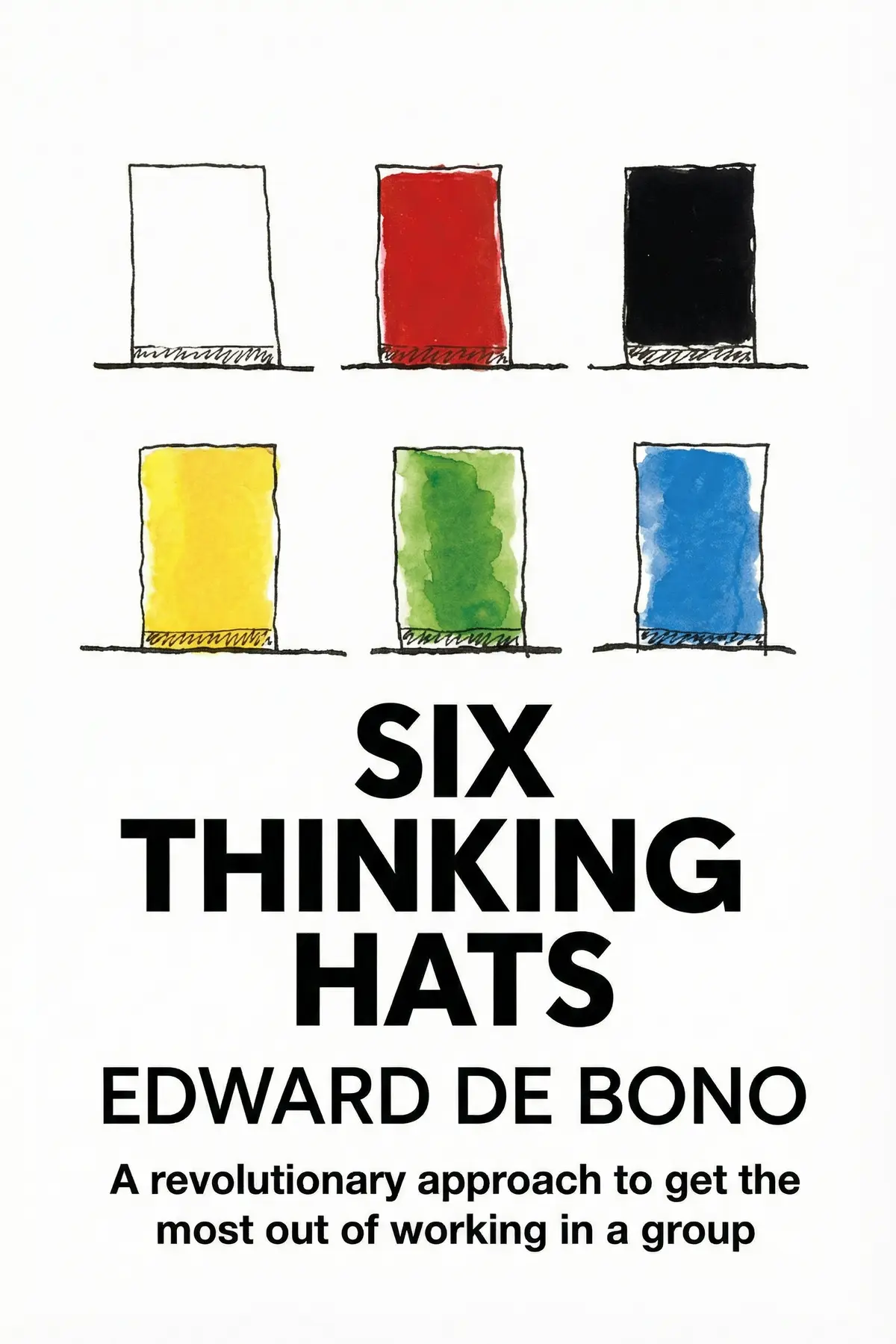
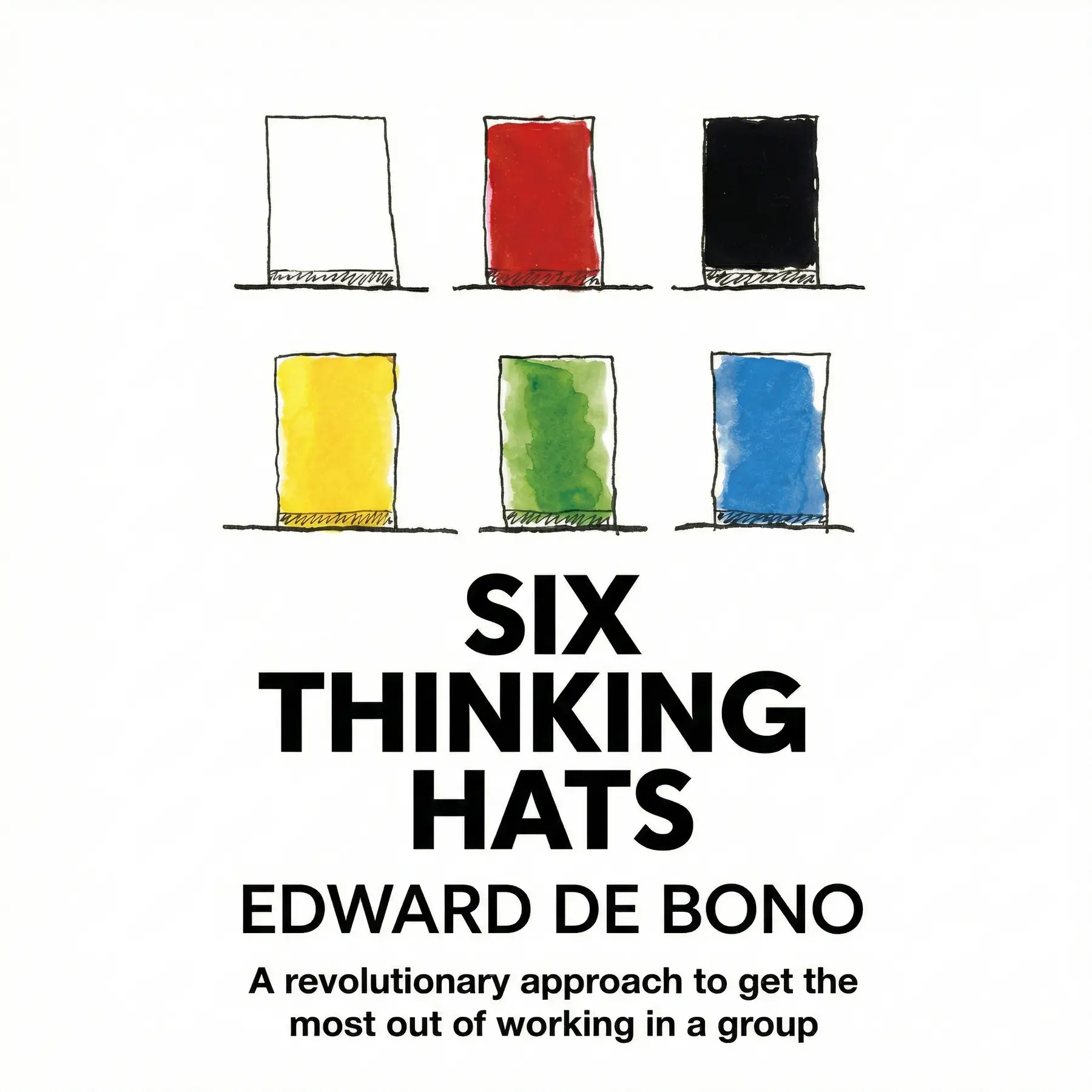
Six Thinking Hats introduces a powerful mental framework for organizing thought. By separating emotions from facts and risks from opportunities, Edward de Bono provides a system for clearer, more effective group decision-making.
1 min 43 sec
We often think of intelligence as a fixed trait, but Edward de Bono argues that effective thinking is actually a skill that can be refined and mastered. In our daily lives, our minds are frequently cluttered. We try to juggle facts, fears, hopes, and creative impulses all at once, leading to a mental fog that makes clear decision-making nearly impossible. It is like trying to paint a masterpiece by throwing every color of paint at the canvas at the exact same moment; the result is usually just a muddy grey mess. This internal confusion is amplified when we work in groups, where different personalities clash and various agendas pull the conversation in a dozen directions.
In this summary, we are going to explore the Six Thinking Hats method, a system designed to untangle this messy web of thought. By compartmentalizing different cognitive functions into six distinct “hats,” we can give each aspect of a problem the dedicated focus it requires. This isn’t just about being organized; it’s about shifting the very nature of how we process information. Instead of a chaotic debate, we move toward a streamlined process of exploration.
Over the course of this summary, we will break down exactly how this system works. We will see why it is sometimes necessary to let emotions take the lead, how to properly vet an idea for danger without being a cynic, and how a simple change in perspective can save a company millions of dollars in a matter of minutes. Whether you are leading a massive corporation or just trying to make a better choice for your own life, these techniques offer a way to cut through the noise and find the most effective path forward. Let’s begin by looking at the fundamental tool that makes this all possible: the concept of parallel thinking and the roles of the six colored hats.
1 min 54 sec
Traditional debate often pits people against one another, but there is a better way to ensure everyone sees the whole picture simultaneously.
1 min 54 sec
Success with this method depends on following a few simple but strict rules regarding timing, sequence, and leadership.
1 min 40 sec
Think like a machine to strip away bias and focus entirely on the information at your disposal.
1 min 49 sec
Emotions are often hidden in professional settings, but this hat brings them into the light where they can be useful.
1 min 48 sec
Avoid potential disasters by looking for what could go wrong, but be careful not to overdo it.
1 min 47 sec
Finding the benefits in an idea requires a deliberate effort to look for the sun, even when it’s hidden behind clouds.
1 min 43 sec
Break out of old patterns and explore the realm of the impossible to find truly innovative solutions.
1 min 33 sec
Step back and view the entire thinking process from above to ensure the session remains productive and focused.
1 min 54 sec
The real-world benefits of this system go beyond just better ideas, saving significant time and resources for those who use it.
1 min 31 sec
In conclusion, Edward de Bono’s Six Thinking Hats is more than just a clever metaphor; it is a profound shift in how we utilize our most valuable resource: our minds. By recognizing that thinking is a multifaceted skill, we can move away from the confusion of trying to do everything at once and toward the clarity of focused, parallel exploration. We’ve seen how the white hat grounds us in fact, the red hat honors our intuition, the black hat protects us from risk, the yellow hat reveals hidden value, the green hat sparks innovation, and the blue hat keeps us organized.
The throughline of this method is the total elimination of adversarial thinking. When we stop trying to win an argument and start trying to map out the truth, everything changes. Meetings become shorter, decisions become more robust, and the creative potential of every team member is finally unleashed.
As you move forward, try applying this to your own life. The next time you are faced with a difficult choice, don’t just let your thoughts swirl in a chaotic loop. Instead, take a piece of paper and spend a few minutes with each hat. Write down the cold facts, acknowledge your gut feelings, list the potential dangers, find the hidden benefits, and brainstorm some wild alternatives. You will find that when you stop trying to juggle all the balls at once, the path forward becomes remarkably clear. Thinking is a skill—and with the right tools, it is one you can master to transform both your career and your life.
Have you ever been in a meeting where everyone seems to be arguing from completely different perspectives? One person is focused on the data, another is worried about the risks, and someone else is just excited about a new idea. This collision of different thinking styles often leads to confusion, frustration, and poor decisions. Edward de Bono’s classic work addresses this chaos by introducing the concept of parallel thinking through the metaphor of six colored hats. The book promises a revolutionary shift in how we approach problem-solving. Instead of traditional adversarial debate—where parties try to prove each other wrong—de Bono suggests a method where everyone looks in the same direction at the same time. By moving through six distinct modes of thought, teams can ensure they’ve covered all the necessary ground, from emotional reactions to logical scrutiny and creative breakthroughs. This system is designed to maximize cognitive efficiency, drastically reduce the time spent in meetings, and lead to more robust, well-rounded outcomes for individuals and organizations alike.
Edward de Bono was a distinguished Rhodes Scholar at Oxford and held various faculty appointments at prestigious institutions, including the universities of Oxford, Cambridge, London, and Harvard. Beyond his academic work, he was a renowned consultant for major multinational corporations such as IBM, Procter & Gamble, Shell, and Ford. He is the author of several influential bestsellers, including Lateral Thinking, De Bono’s Thinking Course, and Teach Your Child How to Think.
Edward de Bono
Listeners consider this work an effective thinking instrument that aids in building new techniques and enhancing comprehension. They find it highly readable, noting it is a great choice for work and that everyone in business should read it, while also praising the clear guidance and uncomplicated ideas which apply to many areas of life. Its usefulness in meetings and discussions is frequently highlighted, particularly for managing tough conversations, and its imaginative methodology is celebrated, with one listener describing how it unites harmony and creativity. Feedback on the book's length is varied, as several listeners point out that it's short.
The brilliance of this book lies in its sheer simplicity, stripping away the ego that usually clogs up corporate decision-making. De Bono introduces the concept of parallel thinking, where everyone wears the same "hat" at once, which prevents that exhausting tug-of-war between the optimist and the critic. While some might find the metaphors a bit childish, the result is undeniably efficient meetings that actually produce actionable outcomes. Truth is, we often waste hours because someone is stuck in "black hat" mode while the rest are trying to brainstorm creatively. By compartmentalizing our thoughts into colors—white for facts, red for feelings, and so on—the book provides a roadmap for harmony and productivity. It’s a short read, but the impact on your professional communication is massive if you actually commit to the process.
Show moreThis isn't just for business meetings; I’ve actually started using these principles to navigate personal decisions and it’s been a total game-changer for my mental clarity. The "white hat" helps me strip away my biases and just look at the cold, hard facts of a situation, while the "yellow hat" forces me to see benefits I might have overlooked. De Bono has a way of making complex cognitive processes feel intuitive and manageable. Not gonna lie, I was skeptical about the "red hat" because we’re usually told to keep emotions out of logic, but acknowledging them upfront actually makes the logic cleaner. It’s a quick, punchy read that I’ll likely revisit whenever I feel stuck in a rut. Highly recommended for anyone who wants to stop overthinking.
Show moreDirect and punchy, this is one of those rare books that provides a tool you can use five minutes after finishing the last page. De Bono understands that our brains aren't naturally wired to juggle multiple perspectives simultaneously, so he gives us a way to offload that mental burden. The beauty of the system is how it democratizes the thinking process, allowing the quietest person in the room to contribute "green hat" ideas without being shut down. I’ve found it especially helpful for difficult conversations where emotions usually run high and cloud the actual facts. It’s a short, effective guide that simplifies complex problems into something you can actually wrap your head around. If you’re tired of circular arguments and dead-end meetings, just read it.
Show moreFinally got around to reading this classic, and I have to say, the logic holds up even decades after it was first published. De Bono’s writing style is clear and accessible, making it an easy weekend read for anyone looking to sharpen their mental toolkit. I especially liked the "blue hat" section because it emphasizes the need for a conductor to manage the flow of a conversation. Sometimes we get so bogged down in data (white hat) that we forget to account for the human element (red hat), which is often the most important part of any big change. My only real gripe is that it feels a bit dated in its examples, but the core methodology remains a powerful way to foster understanding in a divided team. It’s a solid addition to any business library.
Show moreAfter hearing about de Bono for years, I was surprised by how much I enjoyed the straightforward, jargon-free tone of this text. It’s a refreshing change from those 500-page business tomes that use a lot of words to say very little. The "six hats" approach is basically a way to give people permission to speak their minds without fear of being judged for being too negative or too emotional. By assigning a specific role to a specific time, you eliminate the friction that usually happens when two people are looking at the same problem with different goals. To be fair, it takes a very strong leader to facilitate this properly without it becoming a chaotic mess. If you can get your team to buy in, the efficiency gains are well worth the initial awkwardness.
Show moreEver wonder why meetings always feel like a battleground where the loudest person wins? De Bono argues that it’s because we’re all trying to do too many things at once—arguing, facts, feelings—and it just creates a muddy mess of ego. This book offers a brilliant alternative by separating these modes of thought into distinct, manageable segments. It fosters a sense of harmony because everyone is working toward the same goal at the same time, rather than competing to be "right." Personally, I think the most valuable part is the "blue hat," which keeps the discussion on track and prevents the "black hat" from sucking all the energy out of the room. It’s a simple concept, but applying it requires discipline and an open-minded team.
Show moreThe concept of parallel thinking is fascinating, but the execution in a real-world setting is where things start to get a bit messy. On paper, having a designated "green hat" moment for creativity sounds like a dream for innovation, but in practice, people often struggle to switch their mindsets on command. I found the chapter on the "black hat" particularly interesting because it validates the need for critical thinking without letting it derail the entire project. However, the book repeats itself quite a lot for something so short, and I felt like I was reading the same instructions over and over. It’s a useful framework for difficult conversations, but don't expect it to be a magic wand that solves every interpersonal conflict in your office.
Show moreLook, the book is barely 200 pages and feels like it’s mostly padding around a single, very good idea. While the methodology is clever and definitely helps with group dynamics, the writing style can be somewhat dry and repetitive. I appreciate that it’s a quick read, but I couldn't help feeling like I was being sold a consultant's workshop rather than a complete philosophy. The "black hat" and "green hat" sections are the strongest, offering a clear distinction between risk assessment and creative growth. Still, the whole "putting on a hat" metaphor feels a little clunky in a modern professional setting. It’s a decent tool to have in your back pocket, but it might not be the earth-shattering revelation that some of the reviews suggest.
Show moreIs it just me, or does this feel like a primary school exercise disguised as a high-level management strategy? I picked this up hoping for deep psychological insights into cognitive bias, but instead, I got a repetitive manual about literal pretend hats. If I asked my senior developers to "put on their yellow hats" during a sprint retrospective, I’d be laughed out of the room. Frankly, the book is incredibly thin on substance and could have easily been a five-page PDF or a single blog post. While I appreciate the attempt to structure group discussions, it underestimates the intelligence of professional adults who can already look at problems from different angles. It’s too simplistic for complex environments where nuance matters more than color-coded labels.
Show moreI really wanted to like this because the premise of better thinking is so attractive, but the application felt incredibly forced and artificial during my last project. We brought in a facilitator who insisted on the hat terminology, and it just ended up causing more polarization among the staff. Some people loved the "green hat" creative license, while others felt the "red hat" invited unnecessary drama into what should have been a data-driven discussion. The book lacks the nuance needed for high-stakes environments where you can't just switch off your critical thinking for an hour. It’s a mildly interesting concept that probably works better in a classroom than in a boardroom full of skeptical professionals. It felt like a lot of effort for very little payoff.
Show more

Hamilton Helmer

Margaret Heffernan
Joseph A. Maciariello
AUDIO SUMMARY AVAILABLE
Get the key ideas from Six Thinking Hats by Edward de Bono, plus 5,000+ more titles in English and Thai.