
17 min 41 sec
Super Founders: What Data Reveals About Billion-Dollar Startups
By Ali Tamaseb
A data-driven deep dive into the true characteristics of billion-dollar startup founders, debunking common myths about age, education, and venture capital while revealing what actually predicts massive entrepreneurial success.
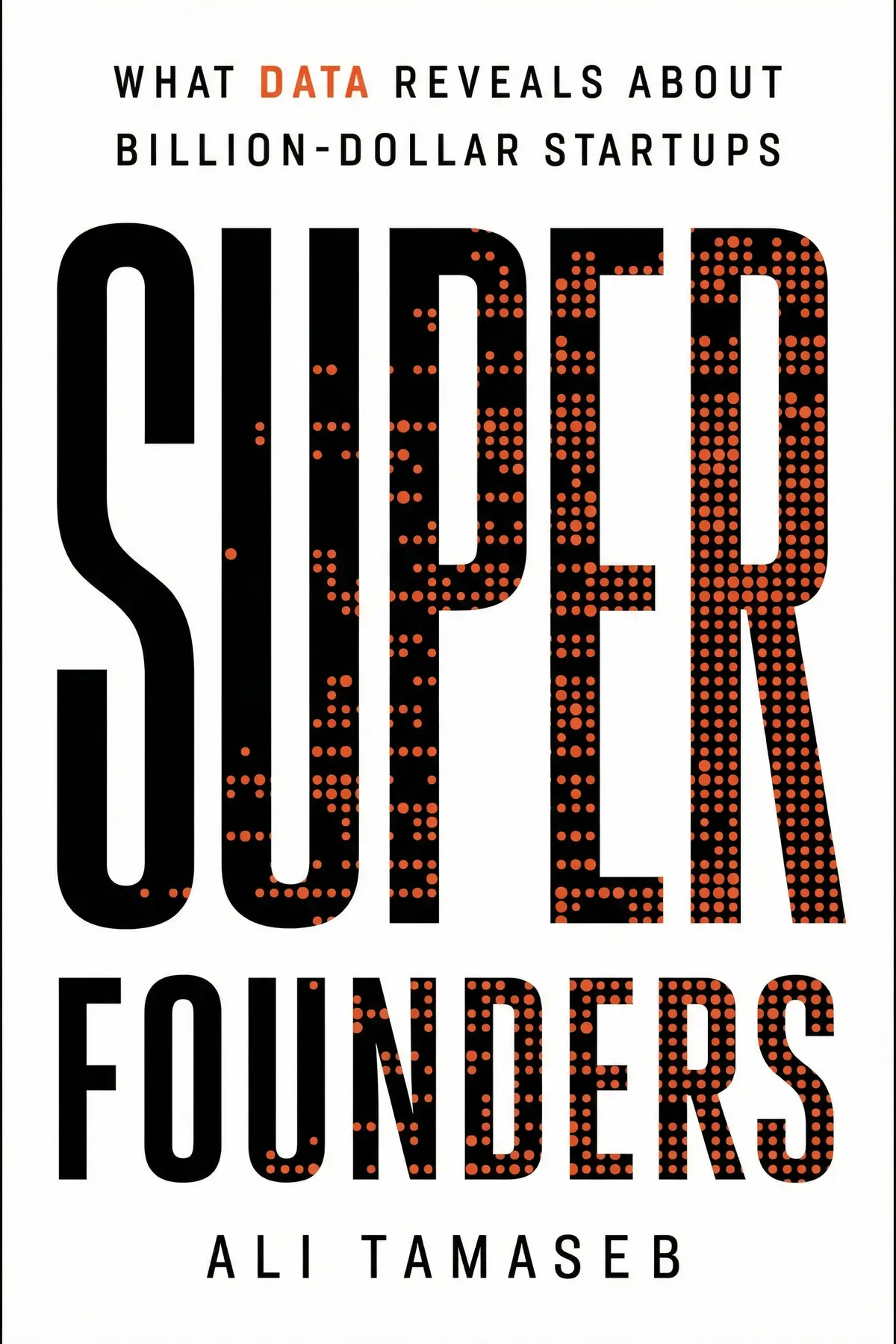
Table of Content
1. Introduction
2 min 07 sec
In the fast-paced corridors of Silicon Valley, there is a certain kind of mythology that has taken root. It’s the story of the brilliant young dropout, the college student who walks away from an elite degree to change the world from a humble garage. We’ve heard it so often that we’ve come to accept it as the standard blueprint for success. We see the faces of legendary figures and assume that if we don’t fit that specific mold—if we aren’t under twenty-five, or if we don’t have a co-founder who is our technical soulmate—then the doors to building a billion-dollar company are essentially closed to us.
But what if those stories are the outliers rather than the rule? What if the traits we’ve been told to emulate are actually distractions from what truly matters? This is where the work of Ali Tamaseb comes in. Rather than relying on the usual anecdotes and lore, Tamaseb decided to look at the hard numbers. By analyzing thirty thousand data points collected since 2017, he set out to discover what the founders of ‘unicorns’—those rare startups valued at over a billion dollars—actually have in common.
The throughline of this exploration is clear: success in the startup world is not about fitting a cliché. It’s about a combination of specific market insights, a willingness to learn from the past, and a level of persistence that often flies under the radar. As we move through these insights, we’ll see how the data shatters common misconceptions about age, education, and the necessity of accelerators. We will look at how the most successful founders often build on failed ideas from the past and why the ‘painkiller’ approach to business usually beats the ‘vitamin’ approach.
This isn’t just a collection of facts; it’s a look at the architecture of success. Whether you are an aspiring entrepreneur, an investor, or simply someone fascinated by the mechanics of the modern economy, understanding these patterns is essential. By the end of this journey, you’ll have a much clearer picture of what it really takes to build something that reaches the stars, and you might just find that the path to success is more accessible than you ever imagined.
2. Debunking the Myth of the Youthful Prodigy
2 min 24 sec
Think you need to be a college dropout to start a billion-dollar company? The data suggests that experience and advanced degrees are far more common than you might think.
3. The Value of Previous Failure and the Builder Mindset
2 min 08 sec
What is the best predictor of whether a founder will succeed? It often lies in their past attempts and a lifelong habit of creating things from scratch.
4. Ideation Through Purpose and the Power of the Pivot
2 min 22 sec
Great ideas rarely happen in a single ‘eureka’ moment. Instead, they come from a deliberate search for problems and the flexibility to change direction.
5. Navigating Markets and the Choice of Differentiators
2 min 21 sec
Is it better to create a brand new market or to fight for space in an old one? The data reveals surprising truths about competition and product types.
6. The Strategy of Timing and Facing the Giants
2 min 21 sec
Being first isn’t always a blessing. Understanding why a ‘recycled’ idea might work now, and how to use a giant’s size against them, can be your greatest edge.
7. The Realities of Funding and Capital Efficiency
2 min 23 sec
Venture capital isn’t always the answer, and more money doesn’t always equal more success. Learning to do more with less can be a founder’s ultimate superpower.
8. Conclusion
1 min 35 sec
We’ve traveled through a landscape of data that challenges almost everything we thought we knew about the world’s most successful companies. We’ve seen that the ‘super founder’ isn’t necessarily a nineteen-year-old genius who dropped out of an Ivy League school. More often, they are someone in their mid-thirties with an advanced degree, a few failed startups under their belt, and a restless drive to build things that matter.
What this data tells us is that success is more systematic than it is accidental. It’s about picking the right kind of problem—a ‘painkiller’ rather than a ‘vitamin.’ It’s about timing the market so that you aren’t too early to the party, and it’s about having the humility to pivot when your original idea doesn’t stick. We’ve also seen that while venture capital can provide the fuel for a billion-dollar rise, the most enduring companies are those that prioritize capital efficiency and understand their own economics from the ground up.
The most important takeaway is this: the path to building a unicorn is not a closed club reserved for a specific demographic. It is a path defined by specific behaviors and strategic choices. If you want to follow in these footsteps, start by looking for those boring, unsolved problems. Build something, even if it’s small. Learn from your mistakes and the mistakes of those who came before you. And most importantly, remember that being ‘different’ is often much more valuable than just being ‘first.’ By focusing on these data-backed realities instead of the myths, you can move forward with a clearer vision and a much higher chance of reaching that astronomical peak.
About this book
What is this book about?
For years, the startup world has been fueled by legends of young dropouts building empires in garages. But what if the data tells a completely different story? This summary explores the reality behind billion-dollar 'unicorns' by examining thirty thousand data points from the most successful companies of the last few decades. Rather than relying on anecdotes, it uncovers the specific traits, market conditions, and strategic decisions that lead to astronomical valuations. You will discover the truth about solo founders, the importance of previous industry experience, and why being first to market isn't always an advantage. It’s a roadmap for anyone looking to understand the mechanics of extreme business growth and the founders who make it happen.
Book Information
About the Author
Ali Tamaseb
Ali Tamaseb is a seasoned professional in the Silicon Valley venture capital scene. As a partner at the firm DCVC, he has been involved with more than ten startups that have surpassed the billion-dollar valuation mark. His expertise is frequently sought after by major media outlets, and his insights have been featured in publications such as Forbes, the Guardian, and the BBC, as well as on the TED stage.
Ratings & Reviews
Ratings at a glance
What people think
Listeners consider the work highly perceptive, and one review points out its deep research and the diverse viewpoints shared by both venture capitalists and entrepreneurs. It earns praise for being an easy read, with one listener describing it as essential reading for the startup community. However, listeners have differing opinions regarding the overall quality of the writing.
Top reviews
A
Ever wonder why some startups hit the billion-dollar mark while others crumble into obscurity? Tamaseb moves away from the typical "eureka moment" stories to provide a rigorous, data-driven analysis of what actually correlates with success. It's refreshing to see someone look at thirty thousand data points rather than just retelling the same three anecdotes about Steve Jobs. I found the breakdown of founder education and previous work experience particularly enlightening, as it dispels several Silicon Valley myths. While the prose can be a bit dry in the data-heavy sections, the interviews at the end of each chapter provide a necessary human element. It is a massive undertaking that serves as a reality check for anyone dreaming of unicorn status. If you prefer hard numbers over vague inspirational quotes, this is the startup book you need to buy.
Show moreTuck
Wow. This completely changed how I look at the "dropout" narrative that has dominated tech circles for decades. It turns out that most successful founders are actually more experienced and better educated than the media leads us to believe. Tamaseb has created a massive database to prove his points, and the result is a fascinating bird's-eye view of the entire ecosystem. I loved the "missionary" concept and the emphasis on the fact that the market often wins regardless of team quality. The book is incredibly readable despite the heavy amount of statistics involved. I’ve already recommended this to three of my colleagues who are thinking about pitching VCs this year. It's an essential reality check for the modern entrepreneur.
Show moreSirichai
As a first-time founder currently in the weeds of fundraising, I found this book to be an absolute goldmine. It helps you understand the "math" that VCs are playing, which is often a mystery to those on the outside. The author’s decision to donate the proceeds to charity is a class act and makes me feel even better about the purchase. I particularly enjoyed the sections debunking the idea that you need to be a "techie" to found a successful software company. The writing is clear, concise, and backed by a staggering amount of data that provides a sense of confidence. It’s a refreshing departure from the usual anecdotal fluff found in the business section. This is easily the most insightful book on startups I have read.
Show morePrim
Ali Tamaseb has done the heavy lifting that most business authors are too lazy to do. By analyzing such a massive dataset, he provides a zoom-out approach that is sorely lacking in a world obsessed with individual founder biographies. The book tackles misconceptions about industry experience and age with precision and clarity. I found the discussion on "high capex" startups particularly interesting, as it challenges the "software is eating the world" mantra. Even if you aren't planning to build a billion-dollar company, the insights on market-fit and team dynamics are universally applicable. It's a must-read for anyone who wants to understand the actual mechanics of the startup world. Purely for the research alone, this deserves a full five stars. Well done.
Show morePiyanart
Picked this up on a whim after seeing it on several "must-read" lists for tech entrepreneurs. The structure is quite predictable, with a data thesis followed by a supporting interview, but that consistency actually makes it a great reference tool. I especially appreciated the sections on capital efficiency and the story of Stitch Fix’s early days. It’s not just about raising huge rounds; it’s about how you manage what you have. Some might find the repetition a bit tedious if reading cover-to-cover, yet the insights from VCs like Peter Thiel are worth the price alone. It’s a solid, well-researched guide that balances quantitative research with qualitative storytelling. Definitely a helpful addition to my shelf, even if some of the advice feels a bit out of reach for the average person.
Show moreIngrid
The chapter on pivoting was worth the entire read for me personally. Hearing about the transition from Flickr to Slack through the lens of data rather than just luck provides a whole new perspective on resilience. Tamaseb does a great job of explaining that a pivot isn't just a failure, but a calculated response to market feedback. The book is well-researched and provides a varied perspective by including both founders and the investors who back them. I did think some of the chapters felt a little long-winded, and the "Super Founder" branding is a bit cheesy. Regardless, the core message about dreaming big while staying grounded in market reality is vital. It’s a strong 4-star book that I’ll likely revisit when I start my next venture.
Show morePetch
Finally got around to finishing this, and I have to say, it lived up to the hype. Look, there are a lot of myths in Silicon Valley, and Tamaseb systematically dismantles them one by one using 30,000 observations. The distinction between "mercenaries" and "missionaries" was a major "aha" moment for me. I also liked the focus on capital efficiency—the Sara Blakely/Spanx example was a great reminder that VC money isn't always the only path. The book is a bit heavy on the "top-tier" everything, which can be a bit discouraging, but the data is the data. It's an interesting, pleasant read that provides a much-needed reality check for the "move fast and break things" crowd. Recommended for anyone looking to build something lasting.
Show moreSomkid
Frankly, the title "Super Founders" is a bit much, but the content inside is surprisingly grounded and analytical. I've been involved in the startup scene for a decade, and I still found three or four data points that genuinely surprised me. Most books in this genre are just ego-trips for the authors, but Tamaseb stays focused on the research methodology throughout. The interviews provide great context, though some feel a bit like pre-packaged PR statements from the guests. I appreciated the nuance regarding solo founders versus teams, as the data shows there isn't one "perfect" way to build. It’s a solid 4-star effort that offers a comprehensive presentation of the current market landscape without being overly academic or too simple.
Show moreLena
To be fair, the data in this book confirms something many of us already suspected: privilege plays a massive role in startup success. Tamaseb points out that coming from a top-tier university and working at a "Big Tech" company are huge predictors for becoming a "Super Founder." While the methodology is impressive, the book sometimes struggles to offer proactive advice for those who aren't already starting from third base. The writing quality is a bit hit-or-miss, occasionally feeling like a collection of blog posts stitched together. However, I can't deny the value of the "mercenary vs. missionary" distinction and the hard look at market dynamics. It’s a 3-star read for me because it’s high on observation but somewhat low on actionable steps for the "non-privileged" founder.
Show morePatcharaporn
Not what I expected given the high praise I’ve seen on LinkedIn. The whole thing feels like a Jim Collins book, but without the narrative flow that makes "Good to Great" so compelling. It’s very repetitive; every chapter hits the same notes and ends with an interview that just repeats what was already said in the data section. Also, much of the data points to things you can’t change, like where you went to college twenty years ago. If you want a slightly entertaining read for general interest, it’s fine, but don't expect a "cheat code" for success. It’s more of an academic aggregation than a helpful manual for the average entrepreneur. I found myself skimming the latter half because the structure became so monotonous.
Show moreReaders also enjoyed
7 Powers: The Foundations of Business Strategy
Hamilton Helmer
Alibaba: The House That Jack Ma Built
Duncan Clark
Bad Blood: Secrets and Lies in a Silicon Valley Startup
John Carreyrou
AUDIO SUMMARY AVAILABLE
Listen to Super Founders in 15 minutes
Get the key ideas from Super Founders by Ali Tamaseb, plus 5,000+ more titles in English and Thai.
- 5,000+ titles
- Listen as much as you want
- 7-day free trial
- Cancel anytime







