
A Year with Peter Drucker: 52 Weeks of Coaching for Leadership Effectiveness
Joseph A. Maciariello
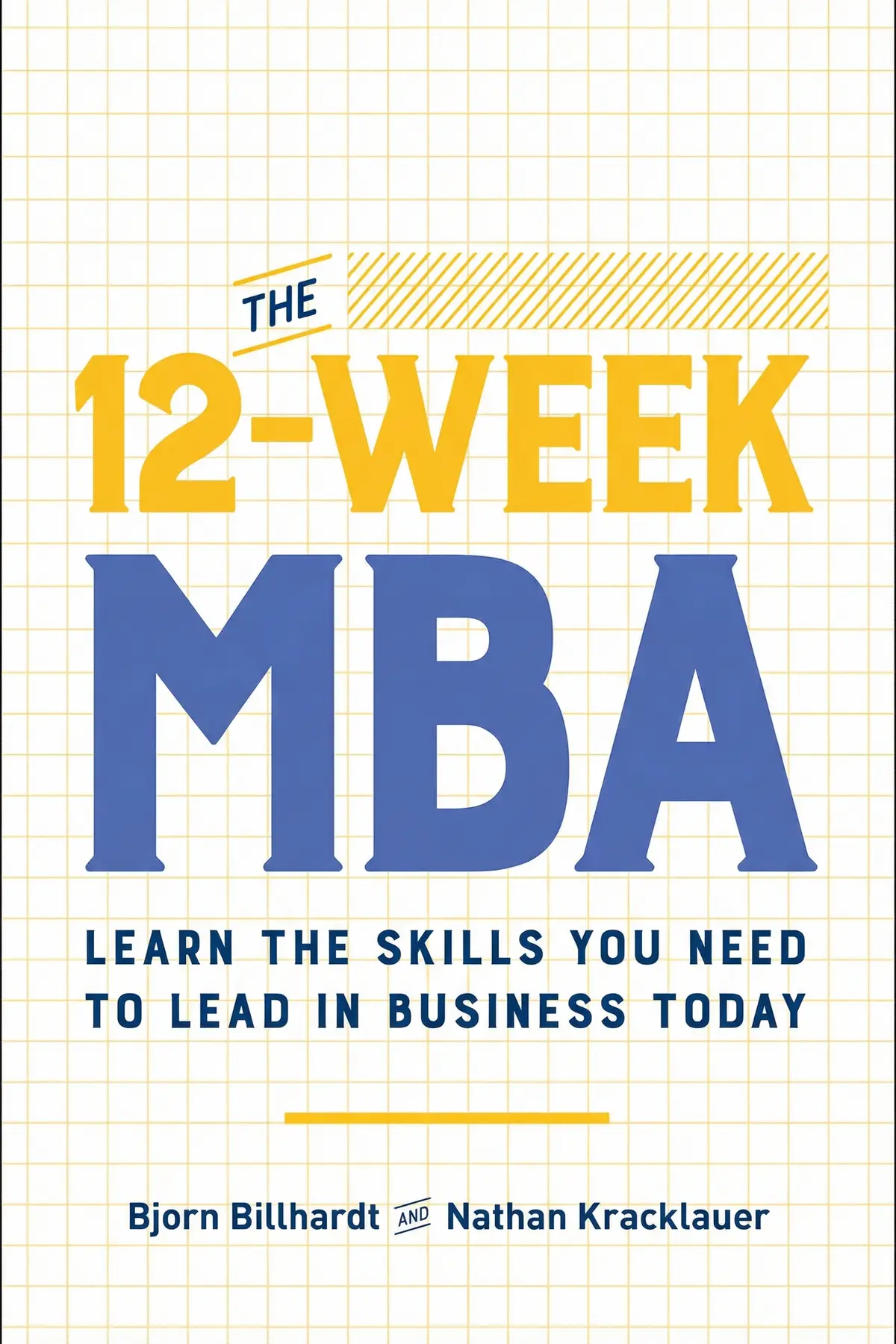
The 12-Week MBA distills the core principles of a traditional business degree into an intensive, practical guide. It focuses on the dual mastery of financial fundamentals and effective human leadership to drive organizational success.
1 min 27 sec
Is a traditional, multi-year university degree the only gateway to high-level business success? For many people, the massive investment of time and money required for a standard MBA feels like an insurmountable wall. Yet, the core principles that drive modern industry—the ability to interpret financial data and the skill to lead a diverse team—are not exclusive to elite classrooms. What if you could strip away the academic filler and focus entirely on the levers that actually move the needle in a real company? That is the premise of the 12-week approach to business mastery.
In this summary, we are going to explore a distilled version of the most critical MBA insights, organized into a practical framework that you can apply immediately. We will look at the business world through two primary lenses: the hard science of finance and the soft art of leadership. You will discover how to look at a company’s financial health not just as a set of static numbers, but as a living story of cash and commitments. Then, we will shift to the human element, exploring how trust and clear communication turn a group of individuals into a high-performing unit.
Whether you are an established executive looking to refresh your perspective or an aspiring entrepreneur ready to launch your first venture, the goal here is to bridge the gap between abstract theory and actionable strategy. We’ll cover everything from the secrets of valuation to the mechanics of execution, providing you with a throughline that connects profitability with purpose.
2 min 21 sec
Success in modern business requires a shift from simple profit-chasing to a holistic view of value that balances shareholder needs with broader social impact.
2 min 21 sec
True financial health is more than just a positive bank balance; it involves a deep mastery of how money moves and where it is tied up.
2 min 10 sec
Understanding why a company is worth what it is requires looking past current performance to the future potential of every dollar earned.
2 min 08 sec
Behind every financial metric is a team of people, and the ability to lead them through trust and communication is the ultimate competitive advantage.
2 min 00 sec
A great strategy is worthless without execution, which requires aligning individual efforts with a shared organizational vision.
1 min 29 sec
As we have seen, the essentials of a high-level business education don’t have to be shrouded in academic complexity. By focusing on the core pillars of financial health and human leadership, anyone can develop the tools necessary to steer an organization toward success. We’ve explored how to view value through the lens of profitability, growth, and risk, and how to use financial snapshots like the balance sheet and cash flow to maintain stability. We’ve also seen that the true worth of a business lies in its future potential, calculated through the lens of the time value of money.
But perhaps most importantly, we’ve recognized that business is a human endeavor. The ability to build trust, provide clear feedback, and navigate the social dilemmas of a team is what separates a mere manager from a true leader. Strategy provides the direction, but it is the culture of cooperation and the legitimacy of the decision-making process that provide the momentum.
The throughline of all these lessons is that business is about the constant management of promises and the creation of value for everyone involved. Whether you are analyzing a spreadsheet or leading a meeting, the goal is the same: to act with clarity, integrity, and a long-term perspective. As you move forward, remember that the skills of an MBA are not just a set of facts to be memorized, but a mindset to be practiced. By applying these principles to your daily work, you can bridge the gap between where you are and where you want to be as a leader in today’s dynamic market.
This summary explores the essential skills required to lead in the modern business world without the need for a multi-year, expensive degree. It breaks down the curriculum of success into two primary pillars: managing the numbers and managing the people. By focusing on these universal truths, the book provides a roadmap for understanding financial stability, business valuation, and the complexities of human motivation. Readers will learn how to navigate balance sheets and cash flow, while also uncovering the strategic importance of risk management and growth. Beyond the spreadsheets, the summary dives into the nuances of building trust, delivering feedback, and ensuring that executive decisions are actually executed on the ground. It promises to bridge the gap between academic theory and the daily realities of running a profitable, purpose-driven organization.
Nathan Kracklauer is a consultant and leadership expert who has worked with global Fortune 500 companies to implement innovative learning solutions. Bjorn Billhardt is a successful entrepreneur and educator in the educational technology sector, dedicated to creating impactful learning experiences for professionals worldwide.
Listeners find this work to be a concise and accessible summary of essential financial principles, such as risk management, cash flow, and valuation. Many appreciate the hands-on perspective on intricate business systems, and one listener points out that it makes an ideal supplement for a "personal MBA" collection. Though perspectives differ regarding the thoroughness of the sections on team-building and leadership, others state the material works as a superb basic review for seasoned experts. Furthermore, they prize the way the writers convert heavy scholarly ideas into practical methods for daily managerial tasks.
Picked this up because I wanted to brush up on my business acumen without spending $100k on a degree. It's a fantastic addition to my personal MBA shelf, providing a tight, distilled essence of what really matters in a corporate environment. The authors do a great job explaining how shareholder value isn't just a buzzword but is actually driven by the interplay of growth, profitability, and risk. I especially liked the breakdown of the P&L versus the cash flow statement; it's a distinction many people miss until it's too late. The prose is clear and moves at a brisk pace. While some of the leadership advice felt a bit familiar, the financial insights are worth the price of admission alone. Truly a solid foundation for anyone looking to understand the mechanics of value creation.
Show moreFinally, a book that bridges the gap between the numbers and the people side of business without being condescending. The explanation of intrinsic value and how it links back to everyday management choices was a lightbulb moment for me. I’ve always struggled with the balance sheet, but the accounting identity section finally made it click. Kracklauer and Billhardt emphasize that managing for value isn't just about cutting expenses; it's about creating trust and setting clear expectations with your team. This dual focus is what makes the book stand out. The writing is sharp, the chapters are digestible, and the focus on working capital as a risk factor is something every startup founder needs to read. This is exactly the kind of practical guide I wish I’d had five years ago.
Show moreWow, this really simplifies the scary parts of business school into something anyone can grasp. I loved the emphasis on how managers create value by raising investor confidence through predictable cash flows. The authors don’t just talk about profit; they talk about the sustainability of that profit through stakeholder alignment. It’s an analytical yet accessible look at how to drive a business forward. The section on cognitive diversity in hiring was also a pleasant surprise—linking identity diversity to better decision-making processes. It’s clear the authors have spent years teaching these concepts to real professionals because the tone is perfectly pitched for a busy reader. Highly recommend for anyone looking to uplevel their strategic thinking without the tuition debt.
Show moreAfter hearing so much about the Personal MBA movement, I finally got around to reading this one, and it didn't disappoint. The book captures the tension between delivering results now and building capacity for the future. I appreciated the specific details on common-sizing and how to use margins to compare performance across time. It’s not just a dry textbook; there’s a real focus on the human element, like how to avoid demotivating employees by respecting their intrinsic motivators. The authors argue that anyone can act like a leader, and they provide the framework to back it up through effective decision-making and clear communication. It’s a comprehensive, actionable guide that makes sense of the numbers and the people behind them.
Show moreEver wonder why some companies have huge profits but still go under? This book explains the why by looking at the divergence between cash flow and profit margins. It's a highly readable overview that avoids the typical academic slog of most business texts. I appreciated how the authors translated dense concepts like cost structures—fixed vs. variable—into actionable strategies for managing a department. The tone is encouraging and direct, making it perfect for someone who didn't major in business but finds themselves in a management role. My only gripe is that the 12-week timeline feels more like a marketing hook than a strict curriculum, but the content is undeniably useful. It’s a great refresher that reminds you to keep your eye on financial health while leading people.
Show moreAs a mid-level manager who graduated years ago, I found this to be an excellent foundational refresher. The authors use their experience with corporate simulations to bring concepts like the 'content trap' in decision-making to life. Truth is, we often forget the basics of risk management and stakeholder value when we’re bogged down in daily tasks. The section on common-sizing profits to compare performance across different companies was a specific highlight for me. It’s a quick read, but there’s enough meat here to make you pause and rethink your current projects. To be fair, it’s not going to give you the networking or the deep case studies of a top-tier MBA program, but for a distilled essence of the curriculum, it hits the target perfectly.
Show moreThe chapter on working capital was a total game-changer for my understanding of business operations. It’s rare to find a book that explains why positive working capital can actually make a company vulnerable. The authors do a great job of demystifying the financial promises we make to stakeholders and how uncertainty influences investor anxiety. I also found the discussion on groupthink and the importance of institutionalizing dissent to be very relevant to my current team dynamics. It’s a very practical approach to complex mechanics. I did feel the section on company culture was a bit brief, but the focus on process guardians in decision-making offered a tangible tool I can use immediately. A very strong, insightful guide for the modern manager.
Show moreWhile the financial sections of this book are absolute gold, the leadership and team management chapters felt a bit like an afterthought. I came for the MBA experience and found the deep dives into discounted cash flows and working capital management incredibly helpful for my day-to-day work. Kracklauer and Billhardt have a knack for making balance sheets less intimidating. However, when the book pivots to soft skills like trust and feedback, it loses some steam. The advice there is fine, but it’s stuff you’ve probably heard in every HR seminar since 2010. If you are looking for a rigorous financial refresher, this is a 5-star read, but as a holistic leadership guide, it falls slightly short. It’s good groundwork, but don't expect it to replace a two-year immersion program.
Show moreNot exactly what I expected, but still worth a skim if you're new to the corporate world. The book serves as a condensed guide to business mechanics, which is great for a fast read. However, I found the 12-week framing a bit forced. Some of the concepts, like the SBI model for feedback, are standard industry knowledge and didn't offer much new perspective. Frankly, I was hoping for more advanced strategic frameworks. That said, the financial fundamentals—especially the bits on valuation and how cash flows from customers don't always align with payments to suppliers—are handled very well. It's a solid book that works well as a primer but might feel a little basic for seasoned executives or those already holding an MBA.
Show moreLook, I wanted to like this, but it felt more like a long-form summary of other business books than a unique contribution. While the financial definitions are accurate and easy to follow, the 12-Week promise feels like a stretch. It’s more of a weekend read. The leadership advice—like the importance of trust and communication—is something you can find in any airport bestseller. I was hoping for more meat on the bones regarding specific industry case studies or deeper simulations. For a total beginner, this might be a 4-star book, but if you’ve been in the game for a while, you probably already know most of this. It’s a bit too light for my taste, though the P&L breakdown was decent.
Show moreJoseph A. Maciariello



Deborah Gruenfeld
Mike Michalowicz

Hamilton Helmer

Margaret Heffernan
AUDIO SUMMARY AVAILABLE
Get the key ideas from The 12-Week MBA by Nathan Kracklauer, plus 5,000+ more titles in English and Thai.







