
16 min 24 sec
The Myths of Innovation
By Scott Berkun
The Myths of Innovation challenges popular misconceptions about how great ideas are born. It reveals the messy, collaborative reality behind history’s biggest breakthroughs, offering a more practical and honest approach to creativity.
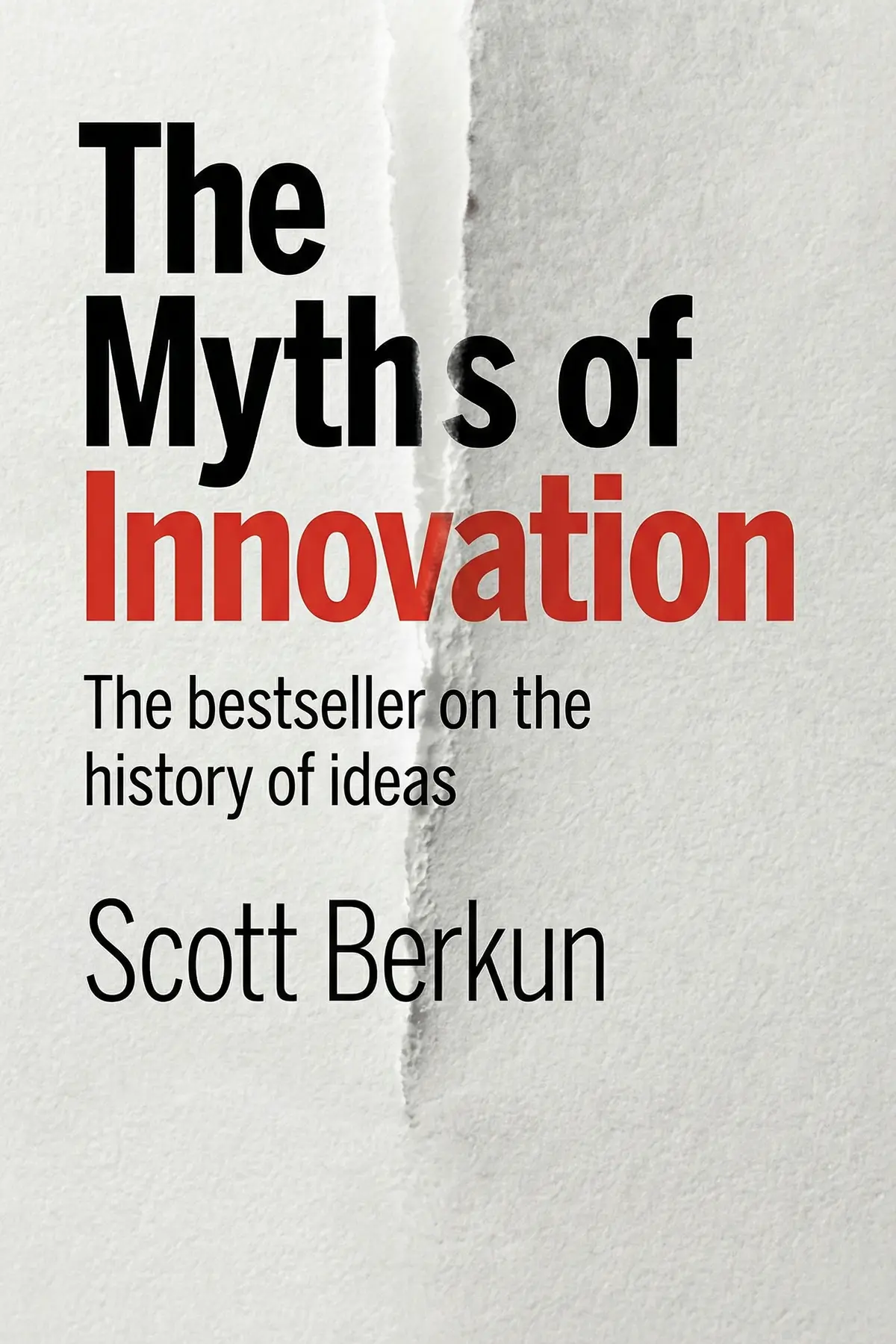
Table of Content
1. Introduction
1 min 20 sec
When we think about the great leaps in human history, we tend to picture a very specific scene. We see a solitary figure, perhaps in a dusty workshop or a quiet garden, suddenly struck by a brilliant insight that changes everything. This image of the ‘eureka’ moment is deeply embedded in our culture. It’s romantic, it’s exciting, and it makes for a great story. But here is the problem: it’s almost entirely false.
By clinging to these romanticized myths of innovation, we actually do ourselves a disservice. We set up an impossible standard for creativity that makes us feel like failures when we aren’t struck by divine inspiration. We wait for the ‘perfect’ idea to arrive fully formed, and when it doesn’t, we give up. We ignore the reality that innovation is a messy, social, and often exhausting process that requires more perspiration than inspiration.
In this journey, we’re going to pull back the curtain on these misconceptions. We will look at why we feel the need to invent heroes, why the best ideas don’t always win, and why the people in charge are often the most likely to stand in the way of progress. By the end of this exploration, you won’t just have a better understanding of history; you’ll have a more realistic and effective framework for bringing your own ideas to life. Let’s start by deconstructing the most famous fruit in the history of science.
2. The Illusion of the Epiphany
2 min 20 sec
Discover why the famous story of Isaac Newton’s apple is a misleading myth and how great ideas are actually built from a long chain of smaller realizations.
3. The Necessity of Persistence and Quantity
2 min 19 sec
Learn why the path to a great idea is paved with hundreds of bad ones and how the world’s most famous creators prioritized volume over initial perfection.
4. The Myth of the Lone Genius
2 min 19 sec
Understand how history and patent laws have distorted our view of invention by crediting single individuals for what are actually collective human achievements.
5. Overcoming the Natural Resistance to Change
2 min 06 sec
Explore why human psychology is wired to reject new ideas and how innovators can use ‘sampling’ to lower the barriers to adoption.
6. The Paradox of Expert Disbelief
2 min 20 sec
See why those with the most experience are often the least likely to recognize a breakthrough and why management structures can be toxic to innovation.
7. Context and the Myth of Meritocracy
2 min 07 sec
Discover why being the ‘best’ isn’t enough for an idea to succeed and how cultural timing and social values dictate which inventions actually change the world.
8. Conclusion
1 min 33 sec
As we have seen, the path of innovation is rarely a straight line, and it’s almost never a solo journey. By debunking these myths, we can finally see the process for what it really is: a marathon of small insights, persistent effort, and cultural navigation. We’ve learned that the ‘eureka’ moment is a distraction, that failures are just stepping stones to greatness, and that the ‘experts’ are often the least qualified to judge the future.
So, what can you do with this knowledge today? The most important takeaway is to take the pressure off yourself to be a ‘genius.’ Instead, focus on becoming a ‘generator.’ Commit to producing a high volume of ideas, and don’t be afraid to share the messy, imperfect versions of them. Remember that even the greatest innovators in history had to fight against a world that was wired to resist change.
To make your ideas a reality, don’t just focus on the ‘what’—the technology or the concept—but also on the ‘how’ and the ‘who.’ Think about how you can present your idea in a way that feels safe and accessible to others. Use the power of sampling and small-scale demonstrations to win over the skeptics. And finally, pay attention to the world around you. An idea doesn’t live in a vacuum; it lives in a culture. If you can align your creative vision with the needs and values of your time, you won’t just be having ideas—you’ll be making history. Now, stop waiting for the apple to fall and go start building.
About this book
What is this book about?
For as long as humans have been inventing things, we have been telling ourselves stories about how those inventions came to be. We love the idea of the lone genius struck by a bolt of lightning, or the 'eureka' moment that changes the world overnight. But as this exploration reveals, these stories are mostly fairytales. The true history of innovation is far more complex, involving years of hard work, countless small steps, and significant cultural luck. In this summary, we will dismantle the legends that hold us back. You will discover why the story of Newton’s apple is more fiction than fact and why even the most brilliant ideas are often met with fierce resistance from the people who claim to want them. By understanding the social, psychological, and historical forces that actually drive progress, you will learn how to navigate the pitfalls of the creative process. This is a guide for anyone who wants to stop waiting for inspiration and start building the future through persistence, collaboration, and strategic thinking.
Book Information
About the Author
Scott Berkun
Scott Berkun is an American author and speaker. He previously worked on the development of Internet Explorer, at Microsoft. His work has appeared in the New York Times and the Washington Post, and he has taught creative thinking at the University of Washington.
Ratings & Reviews
Ratings at a glance
What people think
Listeners find the work captivating and highly accessible, noting the depth of research and inclusion of fascinating facts and citations. They value the stimulating observations throughout, as one listener points out how the text demystifies the aura of fate, while another remarks on its ability to help maintain motivation. The narrative is both straightforward and witty, establishing it as a practical guide; furthermore, one listener underscores its significant worth for individuals in technical industries.
Top reviews
Ubolwan
Wow. This book completely shattered the romanticized 'epiphany' myth for me. Scott Berkun writes with a lucid, contemporary style that makes complex historical shifts feel like a conversation over coffee. I’ve always been prone to 'magical thinking' regarding genius, assuming people like Newton or Jobs were just hit by lightning bolts of fate. Berkun demystifies that aura, proving that innovation is really about the grunt work—the mixing of paints and the cutting of marble. The chapter on 'problem finding' was a particular eye-opener, shifting my focus from seeking immediate solutions to defining the right questions. It is a motivating read that doesn't rely on fluff but on well-researched facts. If you're feeling stuck in a creative rut, this will definitely get you moving again.
Show moreEli
After hearing Berkun speak at a tech event, I picked this up expecting a dry history lesson. Instead, I found a deeply human look at why we create. The concept of 'imagineering' and the need to be a 'co-creator' with the world really resonated with me. Berkun doesn't just list facts; he tells stories of people like Galileo and Mother Teresa to show that manifestation requires effort and a willingness to be seen as 'strange.' Look, the most important takeaway for me was that we shouldn't be ashamed of being idle or 'explorative.' Taking long walks or just watching patterns on a wall can be the fuel for the next big thing. It’s a lucid, humorous, and incredibly refreshing take on a subject that is usually buried in jargon. Highly recommended for anyone who wants to stop consuming and start creating.
Show moreKwan
Not what I expected from a book with 'Innovation' in the title, and I mean that in the best way possible. Instead of giving me a shallow 10-step plan, Berkun gave me a reality check. The focus on 'relentlessness' over 'talent' is something every aspiring entrepreneur needs to hear. I was particularly struck by the discussion on how we reward conformance in schools but then wonder why people are afraid to take risks. It’s a thought-provoking, well-researched book that demystifies the creative process without stripping away the wonder of it. Berkun’s humor kept me engaged through the more analytical sections. If you want to move from being a consumer to a creator, stop reading reviews and just buy the book. It’s a tool for anyone ready to get their hands dirty with the 'grunt work' of making ideas real.
Show moreLook
As a developer who deals with corporate 'idea killers' daily, Berkun’s insights felt incredibly validating. He nails the frustration of pitching to managers who claim to want innovation but actually fear any departure from convention. The section on how even early adopters are just 'adventurous consumers' rather than creators was a sharp observation. I appreciated the clear, punchy sentences and the way he highlights that technology only spreads if it’s compatible with existing habits. My only nitpick is that some of the 'myths' felt a bit like strawmen designed to be easily knocked down. Still, for anyone in a technical field trying to understand why their great ideas are being rejected, this is a must-read. It helped me realize that persuasion is a skill that requires just as much work as the invention itself.
Show moreCarlos
Ever wonder why we're satisfied watching sitcom reruns while minds like Shakespeare or Stephen King produced such massive volumes of work? Berkun tackles these questions by emphasizing the role of relentless persistence over raw talent. I read this as part of a summer reading program and was pleasantly surprised by how fast it went. The truth is often less satisfying than the myths we tell ourselves, but this book makes the truth quite engaging. He argues that innovation is about taking small steps rather than waiting for a muse. I particularly liked the point that education often trains us out of our natural creativity. It's a solid, thought-provoking guide that avoids the typical 'get rich quick' vibe of most business books. Definitely worth a spot on your shelf.
Show moreSven
Look, the most valuable part of this entire experience was the realization that I don't have to be a 'genius' to contribute something meaningful. Berkun’s breakdown of the 'epiphany myth' is essential reading for anyone prone to self-doubt. I especially liked the section on 'idea life cycles' and how healthy teams allow ideas to flow without immediate judgment. It’s a fast-paced book with short, punchy chapters that make it easy to digest during a commute. The author's use of clear language is a breath of fresh air compared to most business texts. While I agree with other reviewers that some points are a bit recycled, the way Berkun synthesizes the information makes it feel fresh and applicable. It’s about building the stamina to survive the closing of doors in your face.
Show moreAva
Finally got around to reading this for my own studies on productivity, and it was a surprisingly refreshing experience. Scott Berkun has a knack for cutting through the 'PR' that surrounds historical figures. I loved the annotated bibliography—it’s sorted by the number of notes the author took, which is such a researcher-friendly touch! The book argues that innovation must be compatible with existing beliefs to take hold, which explains why so many 'superior' designs fail in the market. One of my favorite takeaways was that problem defining is actually more critical than problem solving. Even though some of the examples are common knowledge, the way they are framed helps maintain motivation for the 'long, unavoidable hours' required for real work. A very good, clear resource for anyone in research.
Show moreSiriporn
This book is a decent survey, but frankly, it feels a bit trivial if you have already spent a decade in product development or research. Berkun rehashes many stories I have heard before, like the Xerox PARC vs. Apple saga and the true history of the lightbulb. To be fair, his ranking system for the bibliography is fantastic—it’s actually the most useful part of the book for my own studies. However, the author’s own admission that 'there is no real formula' for innovation felt like a bit of a cop-out. I wanted a new, rigorous theory, but instead, I got a summary of common sense. It’s an easy read and humorous at times, but don’t expect a masterpiece of groundbreaking thought. It's more of a reality check than a roadmap.
Show moreMats
Truth is, I have mixed feelings about this one. On one hand, the historical examples regarding the Apollo Mission and Thomas Edison are well-researched and provide great context for how 'overnight successes' are decades in the making. On the other hand, the book feels a bit like a collection of blog posts rather than a cohesive narrative. It's a short read that reminds you that good things take time, which is a helpful perspective to have. However, I found the advice on brainstorming to be a bit dated—rules like 'produce as many ideas as possible' aren't exactly news. It’s a good survey for beginners, but it lacks the 'silver bullet' that many readers might be searching for. Not a masterpiece, but a solid 3-star effort for the bibliography alone.
Show moreChloe
The chapter on pitching was okay, but the author’s persistent defense against his own critics—admitting the advice isn't 'innovative'—is exactly why I struggled with this. I found the book's core message to be somewhat repetitive and unscientific. Personally, I don't need a 200-page book to tell me that hard work is important or that people hate new ideas. Much of the content felt like a summary of better books, like Csikszentmihalyi’s work on Flow. While the writing is clear, the tone occasionally veers into being a bit militant without enough data to back up the more extreme claims. It might be an eye-opener for a high schooler, but for a professional, it lacks the depth required to be truly useful. I'd skip this and just read the references mentioned in the back.
Show moreReaders also enjoyed

7 Powers: The Foundations of Business Strategy
Hamilton Helmer

Alibaba: The House That Jack Ma Built
Duncan Clark
AUDIO SUMMARY AVAILABLE
Listen to The Myths of Innovation in 15 minutes
Get the key ideas from The Myths of Innovation by Scott Berkun, plus 5,000+ more titles in English and Thai.
- 5,000+ titles
- Listen as much as you want
- 7-day free trial
- Cancel anytime







