
16 min 25 sec
The Ten Types of Human: A New Understanding of Who We Are, and Who We Can Be
By Dexter Dias
Explore the hidden cognitive modules that drive our most extreme behaviors. This summary examines the evolutionary roots of compassion, aggression, and tribalism, revealing why we act as heroes, villains, or survivors.
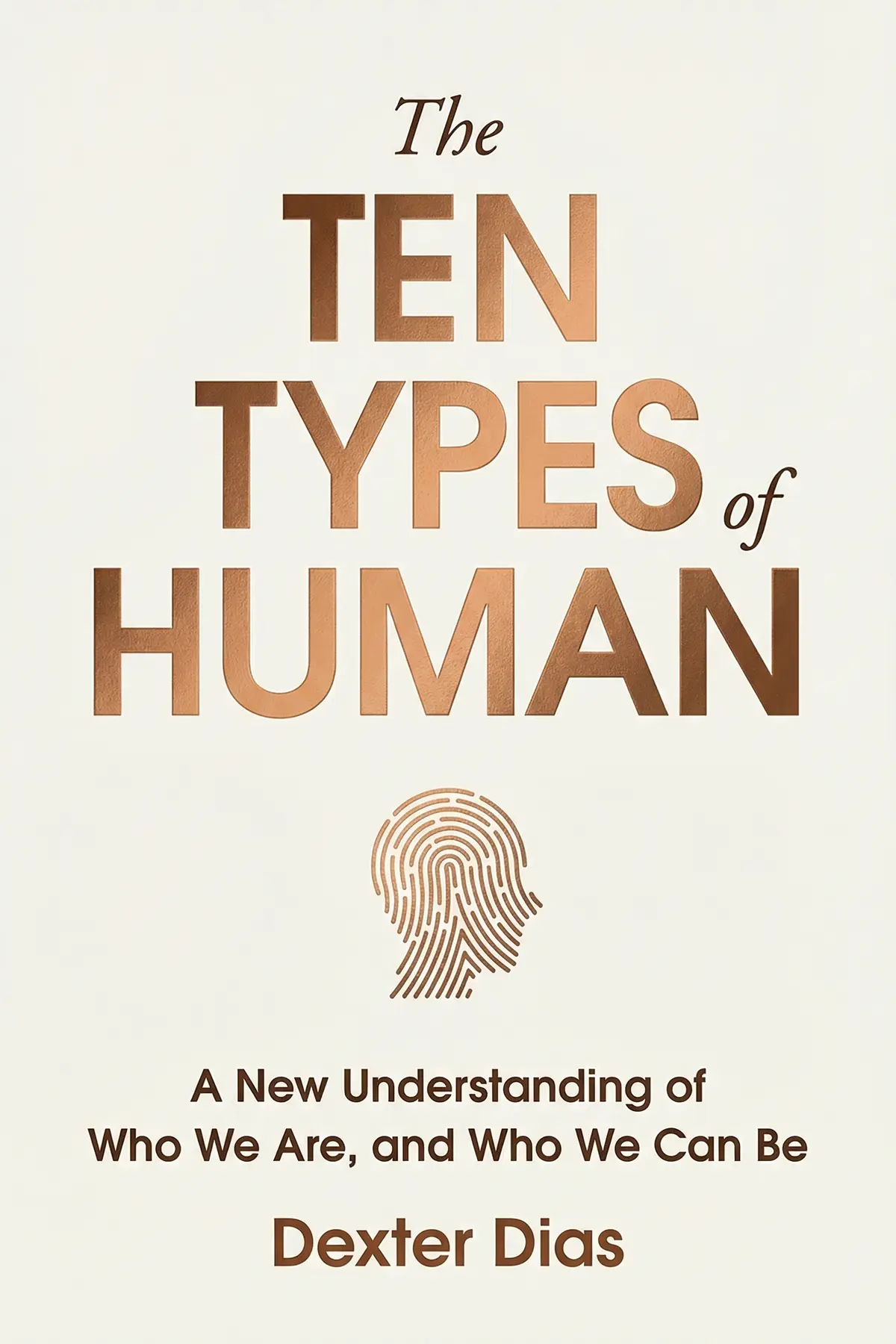
Table of Content
1. Introduction
1 min 29 sec
Every day, we make thousands of choices, most of them mundane. But occasionally, life places us in a crucible where our decisions define who we are—and who we might become. Why does one person risk everything to save a stranger in a blizzard, while another feels a sudden, inexplicable urge to turn away from someone in pain? Why do we find it so easy to divide the world into ‘us’ and ‘them,’ sometimes with lethal consequences? These aren’t just questions of morality; they are questions of biology and evolution.
In this journey through the human mind, we are going to look at the work of Dexter Dias, a human rights lawyer who spent years investigating the most extreme corners of human experience. What he discovered is that the human mind isn’t a single, unified entity. Instead, it is more like a collection of specialized programs, each designed by evolution to solve a specific problem our ancestors faced. We call these ‘The Ten Types.’
Throughout this summary, we will explore how these different mental modules—from the compassionate ‘Perceiver of Pain’ to the fiercely protective ‘Nurturer’—interact within us. We’ll see how these ancient circuits can lead us toward darkness or toward incredible heroism. By the end, you’ll have a new perspective on the hidden architecture of your own mind, understanding that while we are shaped by our past, we are not imprisoned by it. We have the capacity to recognize these internal forces and, ultimately, to decide which version of ourselves we want to bring to the world.
2. The Architecture of our Ancestors
1 min 56 sec
Discover how your brain functions like a specialized toolkit rather than a single computer, using ancient programs to solve modern survival challenges.
3. The Spectrum of Empathy and Compassion
2 min 02 sec
Explore the remarkable neurological circuit that allows us to sense the emotions of others, even when we can’t see them.
4. The Internal Conflict of Aggression
2 min 02 sec
Uncover the surprising psychological friction that makes violence difficult for most humans and how the mind justifies it when that barrier is broken.
5. The Malleability of Tribal Identity
1 min 51 sec
See how our brains are wired to scan for ‘us’ versus ‘them’ and why those boundaries are far more flexible than we think.
6. The Biological Logic of Parenting
1 min 46 sec
Examine the difficult trade-offs that drive the ‘Nurturer’ module and why parental love is shaped by the harsh reality of survival.
7. The Evolutionary Reward of Sacrifice
1 min 51 sec
Follow the story of a man who risked everything for a stranger to understand why our brains are wired for ‘reciprocal altruism.’
8. The Power of Human Plasticity
1 min 46 sec
Learn how understanding your modular mind gives you the power to consciously choose which parts of your personality you want to strengthen.
9. Conclusion
1 min 42 sec
As we wrap up our journey through ‘The Ten Types of Human,’ the throughline becomes clear: our nature is not a single, stagnant thing, but a dynamic interplay of ancient survival programs. We’ve seen how our brains are built to perceive the pain of others, to struggle with the friction of violence, to seek out tribes, and to make the hard choices required for our children’s survival. We’ve also seen the incredible capacity for altruism that exists even at the highest personal cost.
The most important takeaway is that these modules are not our masters; they are our heritage. Understanding that we have a ‘Tribalist’ or an ‘Aggressor’ inside us doesn’t mean we have to be defined by them. Instead, this knowledge gives us the power of choice. It allows us to recognize the signals our brain is sending and decide whether they serve the person we want to be today.
In your own life, you can start by simply noticing when these modules activate. When you feel a surge of protectiveness, or a spark of ‘us versus them’ thinking, or the heavy weight of someone else’s suffering, take a moment to pause. Identify the ‘type’ that is speaking. By naming these forces, you take the first step toward guiding them. You have the potential to move from empathy to compassion, and from tribalism to a broader sense of human connection. The architecture of your mind is ancient, but your ability to shape your future is entirely yours. Keep exploring, keep questioning, and remember that you have the tools within you to be the best version of human you can possibly be.
About this book
What is this book about?
Have you ever wondered why humans are capable of both staggering cruelty and breathtaking altruism? This exploration dives into the complex landscape of the human psyche, suggesting that we aren't driven by a single personality, but by ten distinct mental programs or 'types.' These modules, shaped by millions of years of evolution, activate in response to specific survival challenges and moral dilemmas. By blending intense real-world stories from the front lines of human rights law with cutting-edge neuroscience, this summary reveals the internal architecture that governs our reactions to pain, our loyalty to our 'tribe,' and our instinctive need to protect our children. It offers a promise of deeper self-understanding, showing that while our biological heritage is ancient, our ability to choose which 'type' to nurture is remarkably modern and flexible.
Book Information
About the Author
Dexter Dias
Dexter Dias is an award-winning international human rights lawyer who has worked on high-profile cases involving freedom of expression, crimes against humanity, and genocide. A prize-winning Cambridge scholar and former Harvard Visiting Fellow, he specializes in the intersection of human rights and psychology. He serves as Special Adviser on human rights to UNICEF UK and co-presents The 100 Types of Human podcast.
Ratings & Reviews
Ratings at a glance
What people think
Listeners find the work thought-provoking, with one noting its examination of human conduct and another highlighting the pioneering research. Views on its accessibility are split, as some view it as a compelling read while others find it muddled.
Top reviews
Pete
This book genuinely changed how I view my own impulses and the world around me. Dexter Dias manages to weave together hard neuroscience with the kind of storytelling that keeps you awake at night, long after you’ve put the book down. While some readers find the switching between scientific data and human rights cases jarring, I thought it mirrored the complexity of the human mind perfectly. It is a hefty tome, yes, but the insights into 'The Romancer' and 'The Kinship' types are absolutely worth the effort. It’s rare to find a book that challenges your moral cognition while remaining so deeply rooted in empathy. Truly essential reading for anyone trying to understand the duality of our species.
Show moreWipada
Ever wonder why we are capable of both extreme cruelty and incredible self-sacrifice? This book provides the most comprehensive answer I’ve ever found. Dias breaks down our evolutionary makeup into ten specific 'types' that explain everything from why we protect our kin to how we perceive beauty in others. The section on 'The Perceiver of Pain' was a revelation to me, especially how it linked neurological networks to global human rights issues. It’s a long journey, and some chapters are easier to digest than others, but the emotional payoff is huge. Not gonna lie, I cried more than once. It’s a profound exploration of what it means to be alive today.
Show moreViroj
Wow. Just wow. This isn't just a book about neuroscience; it's a testament to human resilience. The way Dias explains the 'Tamer of Terror' and 'The Rescuer' through the lens of those who survived the Haiti earthquake was masterfully done. I’ve read a lot of psychology books, but few manage to be this vivid and academically rigorous at the same time. The 'Ten Types' framework provides a helpful mental map for navigating our often-confusing social interactions. It is a long read, and certainly not for everyone, but if you want to understand the 'why' behind the headlines, you need to pick this up.
Show moreSarawut
The chapter on 'The Romancer' and 'The Beholder of Beauty' alone is worth the price of admission. It explains so much about our biological drives in a way that is both scientifically grounded and emotionally resonant. I loved how Dias didn't just stay in a lab; he went to the Gobi desert and war zones to see how these 'types' actually manifest in the real world. The theory that our brain activates different modules depending on the situation makes so much sense of our contradictory behaviors. It's a brilliant, ambitious piece of work that actually lives up to the hype. I'll be thinking about this one for a long time.
Show moreSom
Finally managed to get through this massive volume, and I’m glad I did, though it was a bit of a marathon. As someone who enjoys Yuval Noah Harari, I found this to be a fascinating, if somewhat more emotionally grueling, companion piece to those broader histories. Dias brings his unique perspective as a human rights lawyer to the table, which adds a layer of practical urgency to the evolutionary psychology he discusses. The story of Anthony in Ghana was particularly heartbreaking and served as a powerful anchor for the scientific theories. I’m knocking off one star because the prose can be a bit flowery at times, and the author’s habit of describing every person's physical appearance felt unnecessary. Still, the cutting-edge research makes it a very good read.
Show moreSomsri
As a fan of popular science, I appreciated how this book bridges the gap between the lab and the real world. Frankly, I didn't expect a human rights lawyer to have such a firm grasp on moral cognition and evolutionary biology. The 'school shooting' dilemma at the start really sets the stage for a book that doesn't shy away from the darkest corners of the human experience. My only real gripe is that it feels like a bit of a vanity project at points, with the author inserting himself into the narrative more than necessary. However, the sheer breadth of the research and the moving stories of survival in places like the Central African Republic make it a deeply rewarding read.
Show moreChaiwat
Frankly, I struggled with the first hundred pages because the writing style is so dense and the tone shifts are quite abrupt. But once I got used to the author’s rhythm, I found myself completely sucked in by the individual stories. The case studies on FGM and human trafficking are handled with extreme care and serve as the 'test cases' for the psychological theories presented. It’s a very different beast from your standard neuroscience text. It’s much more focused on the soul. While it could have benefited from a stricter editor to trim some of the repetitive scientific lectures, the overall impact is undeniable. It leaves you seeing the world differently.
Show moreLucia
Picked this up on a recommendation and spent three weeks digesting it. It’s a hefty tome that demands your full attention, especially when it dives into the specifics of the 'Kingsman' or 'The Perceiver of Pain.' The stories from the Central African Republic were eye-opening; I’ll admit I didn't know much about the conflict there before reading this. Dias is a talented writer who uses a fictional toolkit—dialogue and internal monologues—to make a non-fiction book feel very alive. While I’m not 100% sold on every part of his ten-type model, the book is incredibly insightful and offers a unique perspective on our shared humanity. Definitely worth the time if you're interested in why we do what we do.
Show moreDavid
To be fair, the research is impeccable, but the structure is a total mess. I found it incredibly frustrating how the author would introduce a harrowing story about child soldiers or acid attacks, only to cut away to a lecture on brain modules right at the climax. It felt like he was trying too hard to create a page-turner rather than letting the science speak for itself. Look, the content is five-star material, but the style is closer to one star for me. I often lost track of which person was which because of the constant narrative jumping. It’s an insightful look at human behavior, but be prepared for a very disjointed reading experience that requires serious patience.
Show moreGoy
Look, I appreciate the depth of research here, but the 'narrative overfit' mentioned by other reviewers is a real problem. The author tries to squeeze every complex human tragedy into one of his ten specific categories, and sometimes it just feels forced. I also found the frequent descriptions of people's hair and clothes to be a bit frivolous given the gravity of the subjects being discussed. The science is interesting, particularly the parts about babies recognizing beauty, but the book is just way too long for the points it's trying to make. If you have the time to sift through it, there are gems here, but it’s a slog.
Show moreReaders also enjoyed

59 Seconds: Change Your Life in Under a Minute
Richard Wiseman


A Liberated Mind: How to Pivot Toward What Matters
Steven C. Hayes
Acting with Power: Why We Are More Powerful Than We Believe
Deborah Gruenfeld
Age of Propaganda: The Everyday Use and Abuse of Persuasion
Anthony Pratkanis
AUDIO SUMMARY AVAILABLE
Listen to The Ten Types of Human in 15 minutes
Get the key ideas from The Ten Types of Human by Dexter Dias, plus 5,000+ more titles in English and Thai.
- 5,000+ titles
- Listen as much as you want
- 7-day free trial
- Cancel anytime







