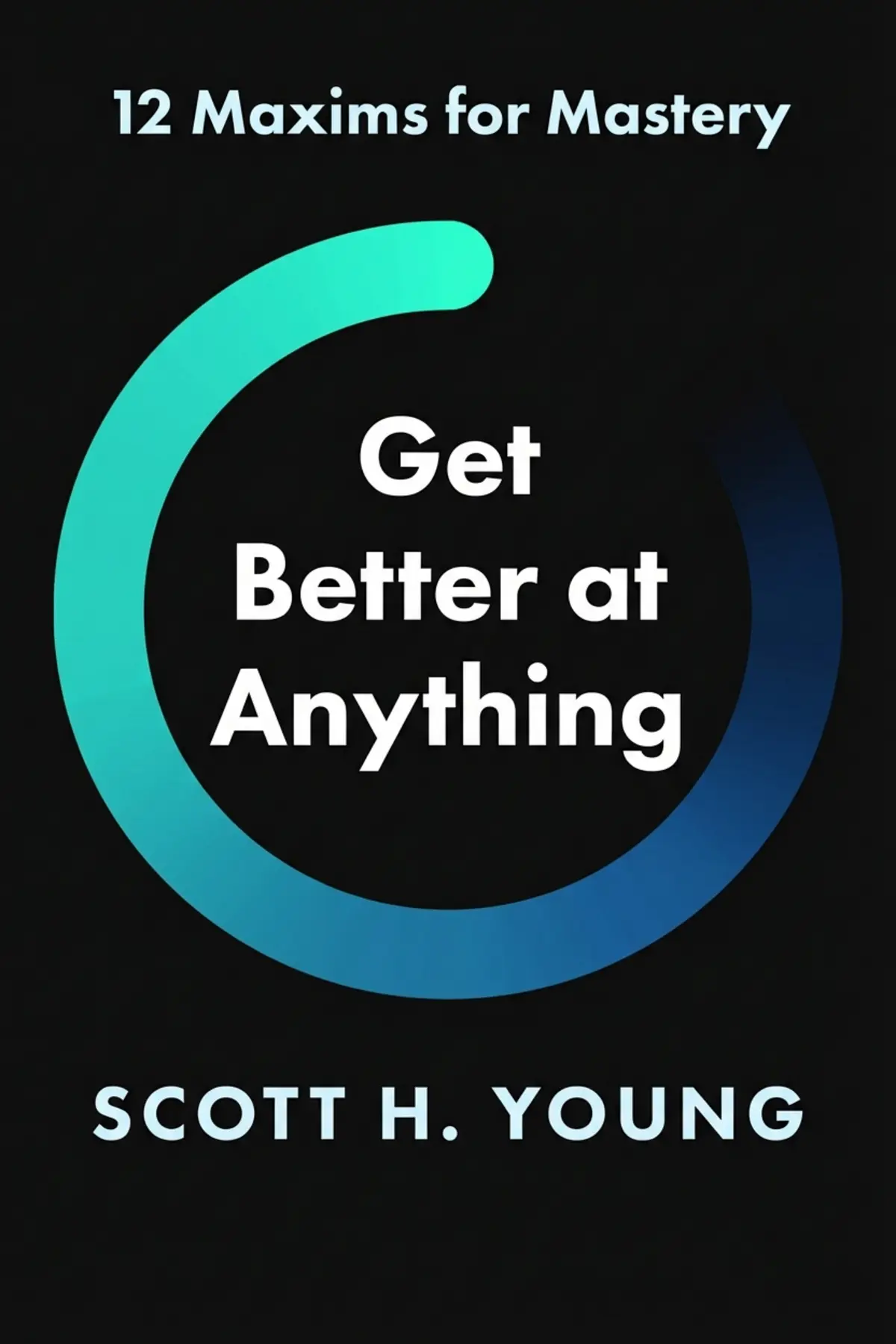
Get Better at Anything: 12 Maxims for Mastery
Scott H. Young
Master any skill with the high-intensity strategies of top performers. This summary explores nine core principles to accelerate learning, bypass traditional educational limits, and stay competitive in a rapidly changing world.
2 min 00 sec
Have you ever looked at someone who seems to master a new language every year, or someone who pivots their career into a completely different industry over a single weekend, and wondered how they do it? For most of us, the idea of picking up a complex new skill feels like a massive, multi-year commitment—something that requires expensive degrees and endless spare time. We tell ourselves that we’ll learn to code or speak French ‘someday’ when our schedule clears up. But the reality is that the world doesn’t wait for ‘someday.’ In our current era, the ability to learn quickly is more than just a hobby; it’s a vital professional necessity.
This is where the concept of ultralearning comes in. It is an aggressive, self-directed, and highly strategic approach to acquiring knowledge and skills. It isn’t about being a genius or having a photographic memory. Instead, it’s about a specific methodology that allows ordinary people to achieve extraordinary results. Think of it as the difference between a leisurely stroll through a park and a high-stakes sprint. Both get you from point A to point B, but the sprinter arrives while the stroller is still checking their map.
In this exploration, we’re going to look at the nine core principles that define this approach. We’ll see how people like Benny Lewis can learn a language in three months, or how independent developers can build hit games single-handedly. We will move beyond the idea of passive reading and toward a model of active, direct engagement.
By the end of this journey, you’ll understand that the limitations we place on our learning are often self-imposed. You’ll discover why your previous attempts at learning might have failed and how you can restructure your efforts to ensure that what you learn actually sticks. Whether you’re looking to climb the corporate ladder, switch careers, or simply fulfill a lifelong personal dream, the principles of ultralearning provide the toolkit you need to outsmart the competition and master the hardest tasks with ease.
2 min 45 sec
Before diving into a new subject, you must understand the architecture of the field. Discover why planning your learning is just as important as the learning itself.
2 min 44 sec
Distractions are the primary enemy of deep progress. Learn how to manage your environment and your mental energy to maintain peak concentration.
2 min 29 sec
Why do classroom learners often fail in the real world? The answer lies in the ‘transfer’ gap and the importance of practicing in the target environment.
2 min 38 sec
When progress plateaus, it’s often because one specific sub-skill is holding you back. Learn how to isolate and master these ‘rate-determining steps.’
2 min 48 sec
Reading and re-reading notes creates an illusion of competence. Explore why testing yourself is the only way to build long-term memory.
2 min 37 sec
Not all criticism is useful. Learn how to distinguish between different types of feedback and why ‘failing for feedback’ is essential for growth.
2 min 55 sec
The human brain is designed to forget. Discover the techniques of spaced repetition and overlearning to ensure your new skills don’t fade away.
2 min 38 sec
True mastery looks like magic, but it’s actually the result of deep understanding. Learn how to cultivate the ‘intuition’ of a world-class expert.
2 min 46 sec
Mastery is the starting point, not the finish line. Discover how to use constraints and hybridization to move from a practitioner to a creator.
2 min 24 sec
As we reach the end of this exploration into ultralearning, it’s worth reflecting on the central promise of this approach: that mastery is not a matter of luck or innate talent, but a matter of strategy. We’ve seen that by mapping out a subject through metalearning, focusing our attention with surgical precision, and embracing the ‘desirable difficulty’ of active recall, we can achieve in months what usually takes years. We’ve learned that the path to true proficiency requires us to step out of the comfortable environment of the classroom and into the direct, often messy reality of project-based practice.
The nine principles we’ve discussed—metalearning, focus, directness, drilling, retrieval, feedback, retention, intuition, and experimentation—form a cohesive framework. They aren’t just isolated tips; they are a lifestyle of continuous, aggressive improvement. When you combine the rigors of drilling with the creative freedom of experimentation, you become a formidable force in any field you choose to enter. You stop being a passive consumer of information and become an active architect of your own expertise.
If you’re feeling inspired to start your own ultralearning project, here is one final piece of actionable advice: before you commit to a major project, perform an ‘Expert Interview.’ Find someone who is already at the level of proficiency you desire. Ask them what the most important foundational concepts are and what resources they actually use in their daily work. This will ensure that your ‘map’ is accurate and that you don’t waste time learning outdated or irrelevant material.
Ultimately, the world is changing faster than our institutions can adapt. The most important skill you can ever possess is the ability to learn how to learn. By adopting the mindset of an ultralearner, you are not just acquiring a new skill; you are building the resilience and adaptability that will serve you for the rest of your life. The only question left is: what are you going to master next? The tools are in your hands, and the territory is yours to explore.
The modern economy moves faster than ever, and traditional educational methods are often too slow and expensive to keep up. This guide explores the world of ultralearning—a high-intensity, self-directed approach to skill acquisition that allows individuals to master difficult subjects in record time. Whether you want to learn a new language, master computer programming, or refine an artistic craft, the strategies provided here offer a roadmap for rapid improvement. Through a combination of research, expert interviews, and the author's personal experiences, this exploration breaks down the nine fundamental principles that separate mediocre students from elite learners. It promises a practical framework for anyone looking to optimize their cognitive performance, overcome professional plateaus, and achieve ambitious personal goals through disciplined, strategic effort. By shifting the focus from passive consumption to active, direct practice, you can unlock a level of proficiency that most people consider out of reach.
Scott H. Young is a writer, programmer and entrepreneur with a passion for self-mastery and career development. He’s spent years studying the lives and work of ultralearners, uncovering their incredible learning strategies and distilling them into easy-to-apply principles designed to optimize learning for everyone. But Young hasn’t just studied the ultralearners, he is one. Through the principles of ultralearning, he’s taught himself multivariate calculus to a university level and become proficient in Mandarin Chinese, among other languages.
Scott H. Young
Listeners find the writing clear and accessible, valuing the specific methodology for ultralearning and the practical advice included. The book offers a systematic framework reinforced by examples, and one listener points out that it is full of intriguing stories about remarkable learning endeavors. Listeners define it as a novel perspective on self-growth and commend its ability to produce real-world results.
As someone who has always enjoyed self-directed projects, this framework felt like a breath of fresh air compared to typical academic advice. Scott Young doesn't just theorize; he provides a structured roadmap through principles like Meta-learning and Directness that actually produce results in the real world. I particularly loved the case studies of 'ultralearners' who mastered languages or complex math in record time. It makes the daunting task of learning a new skill feel entirely manageable if you have the discipline. My only minor gripe is that the middle section can feel a bit repetitive at points, but the core message remains solid throughout. If you want to stop passive reading and start active doing, this is the guide you need for your next big goal. It’s an effective, well-organized manual for anyone looking to level up their life.
Show moreWow, what a refreshing take on self-improvement and skill acquisition! Unlike most books that focus strictly on academic success or test-taking, this one is geared toward real-world application and building things that actually matter. I found the chapter on 'Intuition' particularly enlightening, as it explains how to go beyond mere memorization to reach a state of true mastery through play and exploration of concepts. The layout is clean, the examples are diverse, and the 'Question Book' method for taking notes is a total game-changer for my retention. It’s rare to find a book that is both inspiring and deeply practical, but Young managed to pull it off perfectly. This will stay on my desk as a permanent reference for years to come. Simply brilliant.
Show moreI’ve read a lot of productivity books over the years, but few have given me as many 'aha!' moments as this one. The breakdown of how to handle different types of feedback—outcome, informational, and corrective—was a total revelation for my writing practice. It’s one thing to want to get better, but Young shows you exactly how to structure your environment to make improvement inevitable. I also appreciated that he included a step-by-step guide for starting your first project at the end of the book. It takes the abstract concepts and turns them into a concrete plan of action that anyone can follow. For anyone serious about lifelong learning and personal growth, this is essential reading. It’s one of the best books on learning I've ever found.
Show moreThis book is a fantastic companion for anyone who already follows Cal Newport’s 'Deep Work' philosophy. It takes the idea of intense concentration and applies it specifically to the acquisition of hard skills like programming or public speaking. I found the section on 'Drilling' especially helpful because it forced me to look at my weakest points instead of just practicing what I’m already comfortable with. The Feynman technique explanation was clear and actionable, which I really appreciated. Sometimes the tone gets a little too 'tech-bro' for my taste, and the examples of extreme learning projects feel out of reach for someone with a 9-to-5 job. However, the actual systems he proposes are undeniable. It's a practical, well-organized manual for anyone looking to efficiently level up their career or hobbies. Definitely worth your time.
Show moreEver wonder why some people seem to pick up new talents every few months while others struggle for years just to learn the basics? Scott Young attempts to deconstruct that mystery by analyzing high-intensity learning projects and distilling them into a repeatable system. I loved the emphasis on 'Directness'—the idea that if you want to learn to speak a language, you should actually speak it rather than just clicking through a gamified app. The book is well-written and the stories are genuinely fascinating, even if some of the projects feel a bit extreme for the average reader. It’s a great kick in the pants for anyone who has been 'meaning to learn' something for too long. The structure is logical, the tips are helpful, and the results speak for themselves.
Show morePicked this up to help with a coding project I've been stalling on, and the advice on 'Metalearning' alone was worth the price of admission. Spending time mapping out the core concepts before diving into the code saved me hours of frustration and aimless googling. Young’s writing is very accessible and the structure of the nine principles makes it easy to flip back to specific sections when you need a quick refresher. I do think he brushes over the sheer difficulty of maintaining this level of intensity, though. It's called 'ultralearning' for a reason—it’s exhausting! Still, the toolkit he provides for tackling complex subjects is top-notch and highly recommended for career changers. It’s refreshing to see a self-improvement book that focuses so heavily on hard work and evidence-based results.
Show moreThe chapter on Retrieval really changed the way I approach my daily study sessions. I realized I was spending way too much time passively reviewing my old notes and not enough time actually forcing my brain to recall the information from scratch. Scott Young does a great job of explaining the science behind why this 'difficult' way of learning is actually more effective in the long run. The book flows well and is filled with helpful tips throughout, though I felt the section on 'Retention' could have been a bit more comprehensive. Overall, it’s a solid 4-star guide that provides a very clear framework for anyone wanting to master a difficult skill efficiently. It’s well-written, easy to read, and packed with interesting case studies.
Show moreHonestly, the stories about the Polgar sisters and the MIT challenge were what kept me turning the pages during the slower parts. It's incredibly inspiring to see what human beings are capable of when they apply a rigorous, scientific system to their curiosity. While I don’t think I’ll ever be an 'ultralearner' in the sense of doing a four-year degree in one year, the principles are still incredibly useful for my more modest personal goals. The advice to 'attack your weakest point first' has already helped me make more progress on the guitar in two weeks than I did in the previous six months combined. It's a very well-organized book, even if it feels a little repetitive in the later chapters. A strong recommendation for anyone who loves to learn.
Show moreWhile I appreciate the framework Young has built here, I found the book to be a bit of a mixed bag in terms of original content. Many of the 'principles' he outlines—like Retrieval and Feedback—are concepts you'll find in almost any standard book on memory or cognitive science, such as 'Make it Stick.' The writing style also feels a bit like a giant, bloated blog post at times, which made it hard for me to stay fully engaged through the more granular chapters. To be fair, the specific focus on 'directness' is a great reminder to stop procrastinating by doing 'preparation' tasks and just start the actual skill you want to master. It's a decent 3-star read that definitely could have been fifty pages shorter without losing much value. Good for beginners, but perhaps redundant for seasoned self-help readers.
Show moreNot what I expected after seeing the massive amount of hype this book gets on social media. Look, the title 'Ultralearning' is way flashier than the actual content, which mostly consists of common-sense advice repackaged with new, fancy names. If you’ve spent any time at all researching learning science or reading educational blogs, you won't find many new insights here. I was hoping for deeper psychological dives into how the brain functions, but instead, I got a lot of anecdotes about people who seem to have way more free time than the average person. It’s not a 'bad' book per se, but it feels incredibly mediocre and over-hyped compared to the classics in this genre. I'd recommend sticking to 'Deep Work' or just looking up a summary of the nine principles online instead of buying the whole thing.
Show moreAUDIO SUMMARY AVAILABLE
Get the key ideas from Ultralearning by Scott H. Young, plus 5,000+ more titles in English and Thai.