
19 min 32 sec
University of Berkshire Hathaway: 30 Years of Lessons Learned from Warren Buffett & Charlie Munger at the Annual Shareholders Meeting
Explore thirty years of wisdom from Warren Buffett and Charlie Munger. This summary distills their legendary annual meetings into a guide on value investing, emotional discipline, and building a multi-generational financial powerhouse.
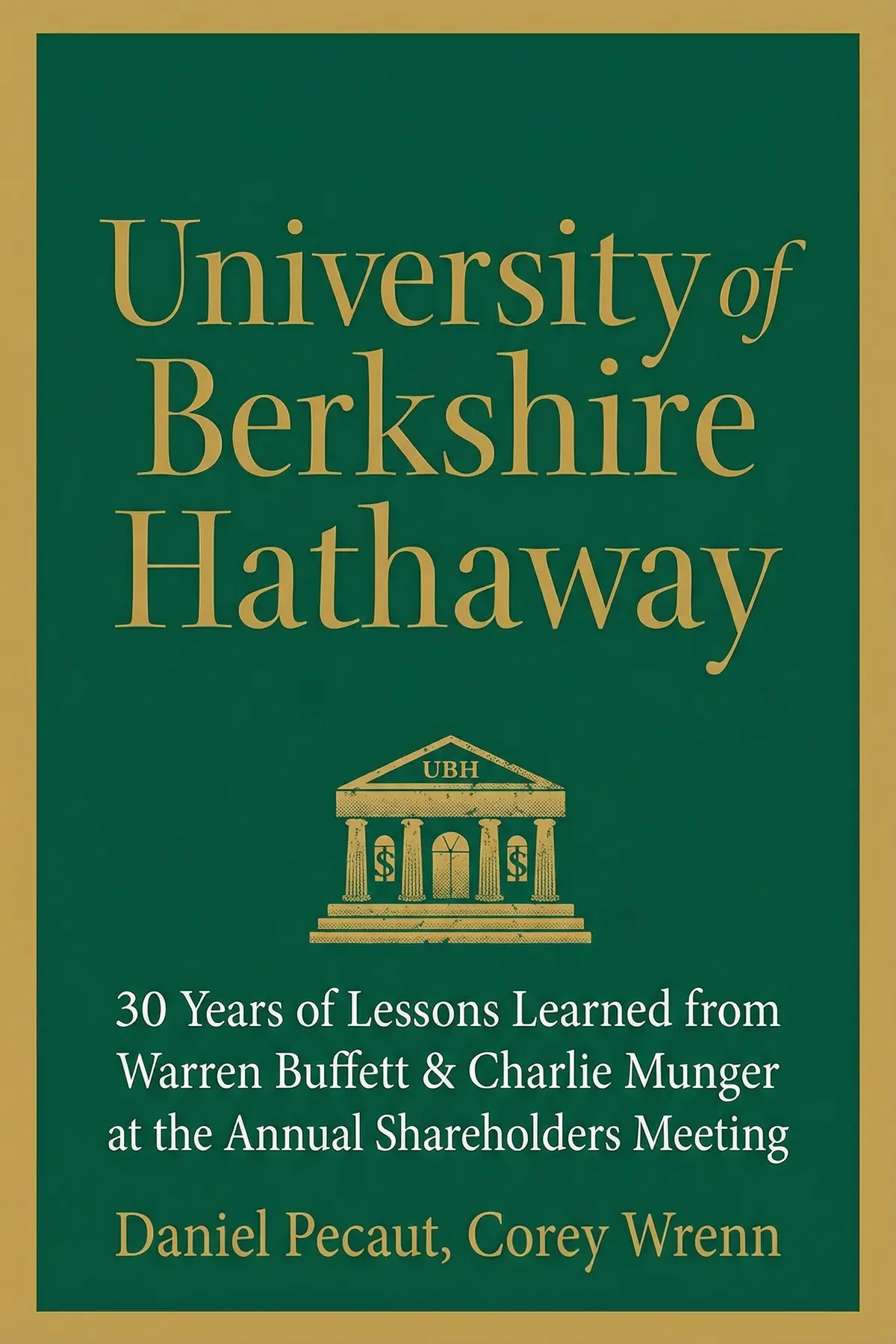
Table of Content
1. Introduction
1 min 38 sec
For over half a century, an extraordinary educational experiment has been taking place in Omaha, Nebraska. It has no ivy-covered walls, no formal application process, and no degree-granting ceremony. Yet, for those who have attended faithfully, it has provided a curriculum more valuable than any MBA program on the planet. This is the ‘University’ that exists within the annual shareholder meetings of Berkshire Hathaway. Led by two of the most formidable business minds in history—Warren Buffett and Charlie Munger—these gatherings have served as a masterclass in logic, patience, and the art of rational decision-making.
What makes this education unique is that it isn’t just about picking stocks. It is about developing a comprehensive way of seeing the world. It’s a philosophy that prioritizes character over cleverness and durable systems over short-term gains. Over thirty years of meetings, the throughline has remained consistent: wealth is not something you chase; it is something you build by adhering to a few deeply held principles and having the discipline to ignore everything else.
In the following journey, we will walk through three decades of these lessons. We will explore how Buffett and Munger evolved from simple bargain hunters to world-class capital allocators. We’ll look at the specific tools they used to measure value, the psychological traps they learned to avoid, and the unique financial engine they built to fuel their growth. By the time we finish, you’ll see that their success wasn’t the result of a secret formula, but the product of a relentlessly rational mental operating system that anyone can learn to apply.
2. The Distinction Between Price and Intrinsic Value
2 min 00 sec
Discover why the number you see on a stock ticker is rarely the same as the actual worth of the company, and how to use that gap to your advantage.
3. Mastering the Psychology of Mr. Market
1 min 46 sec
Learn how to treat the volatility of the stock market as a helpful servant rather than a scary master by understanding the parable of your irrational business partner.
4. The Evolution from Cigar Butts to Quality Businesses
1 min 45 sec
Trace the shift from buying cheap, dying companies to investing in high-quality enterprises that can grow for decades.
5. The Case Study of See’s Candies and the Power of Brands
1 min 41 sec
See how a simple chocolate company provided the blueprint for Berkshire’s most successful multi-billion dollar investments.
6. Insurance Float - The Engine of the Berkshire Empire
1 min 39 sec
Unpack the counterintuitive financial strategy that allowed Buffett to invest other people’s money for free—and even get paid to do it.
7. The Discipline of the Circle of Competence
1 min 51 sec
Find out why the secret to avoiding catastrophe is knowing exactly where your knowledge ends and having the courage to stay inside those boundaries.
8. Beware of Financial Complexity and Bad Incentives
1 min 46 sec
Discover the warning signs of corporate rot, from misleading accounting metrics to the ‘financial weapons of mass destruction’ that threaten the system.
9. The Power of Rationality in a Crisis
1 min 44 sec
Go behind the scenes of the 2008 financial collapse to see how decades of preparation allowed Berkshire to save iconic institutions and profit in the process.
10. Culture as the Ultimate Competitive Advantage
1 min 48 sec
Understand why the decentralized and trust-based environment at Berkshire is a ‘moat’ that competitors find impossible to copy.
11. Conclusion
1 min 54 sec
The journey through the ‘University of Berkshire Hathaway’ brings us back to a simple but profound truth: great success is rarely about doing extraordinary things. Instead, it’s about doing ordinary things extraordinarily well, and doing them consistently for a very long time. Warren Buffett and Charlie Munger didn’t invent a new branch of mathematics or discover a hidden law of physics. They simply took the foundational principles of value, discipline, and rationality and applied them with a level of persistence that is almost unheard of in modern life.
We’ve seen how they mastered the psychological game of the markets, treating volatility as an opportunity rather than a threat. We’ve explored how they moved from scavenging for cheap ‘cigar butts’ to partnering with world-class brands that possess deep economic moats. We’ve unraveled the mechanics of their insurance float, which provided the fuel for their growth, and we’ve witnessed how their commitment to staying within their circle of competence saved them from the wreckage of countless financial bubbles.
But perhaps the most important takeaway is the role of character. The Berkshire story is a testament to the fact that integrity, transparency, and trust are not just ‘nice-to-have’ virtues—they are essential components of a winning business strategy. By building a culture that prizes long-term thinking over short-term gratification, Buffett and Munger created a self-sustaining machine that has enriched thousands of shareholders and provided a roadmap for anyone seeking to build something of lasting value.
As you move forward, remember that the doors to this university are always open. The curriculum doesn’t require a finance degree; it only requires the willingness to think for yourself and the courage to act rationally when the rest of the world is losing its head. In an era of constant noise and fleeting trends, the lessons from Omaha remain a steady anchor, reminding us that the surest path to wealth and wisdom is paved with patience, discipline, and a relentless focus on the things that truly matter.
About this book
What is this book about?
University of Berkshire Hathaway offers a deep dive into the evolution of the world's most successful investment philosophy. Rather than a dry list of rules, it tracks three decades of annual shareholder meetings, revealing how Warren Buffett and Charlie Munger refined their approach through bull markets, crashes, and technological revolutions. The book promises a mental operating system for wealth creation. It moves from the foundational principles of Benjamin Graham to the sophisticated strategy of buying quality businesses with wide economic moats. It explains the mechanics of insurance float, the dangers of financial complexity, and the vital importance of temperament over raw IQ. Readers will learn how to identify intrinsic value, maintain a circle of competence, and remain rational when the rest of the world succumbs to panic or greed.
Book Information
About the Author
Daniel Pecaut
Daniel Pecaut is an investment advisor at Pecaut & Company. He began attending Berkshire Hathaway’s annual meetings in 1984, treating them as a core part of his continuing education. His analyses of Warren Buffett and Charlie Munger have been featured in publications like the New York Times and Money Magazine. Corey Wrenn is a partner at Pecaut & Company who previously worked in Berkshire Hathaway’s internal audit department.
Ratings & Reviews
Ratings at a glance
What people think
Listeners find this book highly engaging for studying Berkshire Hathaway and value the excellent assembly of notes and insights. Additionally, the work provides practical lessons on business and investing, with one listener highlighting the thoughtful curation of the material. Listeners also describe it as easy to follow, featuring dry and humorous banter, and feel it offers good value. However, several listeners mention its repetitive nature, resulting in mixed reviews regarding the redundancy found throughout the chapters.
Top reviews
Wachira
Ever wonder what it would be like to sit in the front row of the 'Woodstock of Capitalism' for three decades? Pecaut and Wrenn have done the hard work of distilling thirty years of Berkshire meetings into a single, cohesive volume. The wisdom from Buffett and Munger is timeless, especially the sections regarding market fluctuations and business valuation. I loved the dry humor and the folksy advice that somehow remains profoundly relevant in our modern digital world. While the formatting is essentially a collection of notes, the insights into their thought processes are incomparable. It feels like a masterclass in pragmatism and temperament, two things sorely lacking in today’s volatile trading environment. This is more than just a finance book; it’s a study of character and discipline. Highly recommended for any serious student of value investing.
Show moreKatya
The chapter on the 2014 meeting alone is worth the price of admission for its deep dive into the inner workings of Berkshire Hathaway. Pecaut and Wrenn provide a service to the investing community by archiving these moments that might otherwise be lost to time. I found the 'Ovarian Lottery' concept to be a profound way of looking at success and luck in the markets. The book is brimming with actionable advice disguised as simple common sense. It’s rare to find a business book that balances technical valuation tips with genuine life philosophy so effectively. Charlie Munger’s pragmatism shines through every page, urging readers to go to sleep a little smarter than they woke up. This really does feel like a university-level education in how the world actually works. If you want to understand the 'Omaha magic,' start here.
Show moreWoravit
Picked this up because I wanted a summary of the Berkshire meetings without watching hundreds of hours of grainy YouTube footage. This book delivered exactly what I needed. It’s a wonderful collection of notes that captures the essence of the Buffett-Munger partnership. Their 'enlightened common sense' approach is so refreshing compared to the complex algorithms used by Wall Street today. I loved the story about the 103-year-old owner of Nebraska Furniture Mart and her lack of 'peer pressure.' It's these little anecdotes that make the book so enjoyable to read. The authors have clearly put their hearts into this project, and it shows in how elegantly the information is presented. Whether you’re a seasoned pro or just starting out, there’s something here for you. It’s an investment in your own education that will likely pay dividends for years to come.
Show moreGame
Wow, what a goldmine of investment wisdom and life lessons! I didn't expect to find so much humor in a book about annual meetings, but the banter between Buffett and Munger is genuinely funny. The 'Newspaper Standard' is a rule I plan to live by from now on. This book truly earns its title; it really is like a university education packed into 300-something pages. The authors have a way of making complex topics like intrinsic value and margin of safety feel intuitive. I also found the physical quality of the book and the layout to be quite elegant. It’s the kind of book you can open to any random page and find a piece of advice that makes you think. For the price, you're getting decades of experience from the world's best. Absolutely great value for the money.
Show moreSue
Truth is, I wasn't expecting this to be such an easy read given the dense subject matter. The authors manage to capture the witty banter between Warren and Charlie perfectly, making the investment lessons feel like stories from a wise grandfather rather than a lecture. I particularly enjoyed the specific case studies on 'the good, the bad, and the ugly' investments, like the Dexter Shoes blunder. It’s fascinating to see how their strategy evolved while their core principles remained rock solid. My only gripe is that because the meetings happen annually, the book does get quite repetitive toward the middle sections. You can only hear the 'be greedy when others are fearful' mantra so many times before it loses its punch. Still, the curated nature of these notes makes it a valuable addition to any investor's shelf.
Show moreJiraporn
Looking back at thirty years of history through the lens of two of the world's greatest investors is a unique experience. This book isn't just about stocks; it’s about the evolution of the American economy from the mid-80s through the mid-2010s. The authors do a great job of highlighting the 'gems' while skipping over the more mundane corporate formalities of the meetings. I appreciated the inclusion of their failures, as hearing about their mistakes with airlines or Dexter Shoes makes the duo feel more human and relatable. However, the book does suffer from some minor typos and name misquotes that occasionally pulled me out of the narrative. Despite those small editorial slips, the content remains top-tier. It is a thoughtful, comprehensive guide that serves as a great companion to the official shareholder letters. Definitely worth the time for any fan of value investing.
Show moreRatchada
As someone who has followed Ajit Jain's career, I was thrilled to see so much focus on his contribution to Berkshire's success. The authors capture the high praise Buffett heaps on him, including the 'sinking boat' analogy, which was a highlight for me. The book serves as an excellent historical record, tracking the growth of the company from a few hundred attendees to the massive stadium event it is today. The dry humor is present on almost every page, particularly Charlie's short, punchy retorts. While the information on reinsurance and CDS might be a bit technical for some, the overall tone remains accessible. It’s a very practical book for those who want to understand the 'circle of competence' and how to stay within it. A few minor errors in CEO names didn't ruin the experience for me.
Show morePhimwan
After hearing so much about the 'Woodstock of Capitalism' for years, I finally got around to reading this summary. It’s a fantastic way to digest thirty years of wisdom without feeling overwhelmed. The authors did a great job of organizing the notes into chronological chapters, allowing you to see how the duo’s perspective changed over time. The advice on temperament being more important than intellect really hit home for me. We often get caught up in the math, but the psychology of the market is where the real battles are won. Not gonna lie, the middle section does feel a bit like a repeat of the first hundred pages, but that's the nature of these meetings. If you can push through the repetition, there are some incredible insights into how to build a business with integrity. It's a solid 4-star read for any aspiring capitalist.
Show moreTim
To be fair, this is a solid compilation of notes, but the repetitive nature of the meetings becomes a bit taxing after a few chapters. Because it covers thirty years of annual meetings, you hear the same stories about the Nebraska Furniture Mart and the importance of reading more times than necessary. Frankly, if you have already read Buffett’s letters to shareholders, a lot of this material will feel like a redundant retread of familiar ground. There are definitely some hidden gems and specific anecdotes about Ajit Jain that were new to me, but the editing could have been tighter to avoid the constant deja-vu effect. It is a decent reference for a library, though not necessarily a page-turner you’d want to read cover-to-cover in one sitting. It's okay, just a bit dry.
Show moreKwame
Look, I appreciate the effort it took to compile thirty years of notes, but this book feels a bit like reading someone else’s diary. While there are certainly some high-quality tidbits scattered throughout, the lack of a 'secret formula' might disappoint some readers looking for a shortcut to wealth. The reality is that Buffett and Munger succeed because they read all day and invest to the exclusion of everything else, which isn't exactly a replicable strategy for most people. The book is also incredibly repetitive, as the duo tends to answer the same questions year after year. To be honest, I think you could get the same value by reading a summary blog post or a shorter highlights reel. It’s a nice tribute to Berkshire, but it’s a bit of a slog to get through the whole thing.
Show moreReaders also enjoyed
AUDIO SUMMARY AVAILABLE
Listen to University of Berkshire Hathaway in 15 minutes
Get the key ideas from University of Berkshire Hathaway by Daniel Pecaut, plus 5,000+ more titles in English and Thai.
- 5,000+ titles
- Listen as much as you want
- 7-day free trial
- Cancel anytime







