Post Corona: From Crisis to Opportunity
Scott Galloway
Scott Galloway provides a data-driven examination of the systemic challenges facing modern America, from economic inequality to social isolation, while offering a roadmap for restoring the American Dream through collective action.
1 min 39 sec
Picture a ship that has lost its rudder in the middle of a vast, churning ocean. It isn’t sinking yet, but it’s no longer heading toward its intended destination. This is the central metaphor Scott Galloway uses to describe the current state of the United States. We find ourselves in a moment where the grand promises of the American Dream seem to be receding for a vast majority of the population, leaving a sense of being ‘adrift’ in a sea of technological disruption and economic volatility.
In this exploration, we aren’t just looking at a list of grievances. Instead, we are looking at the ‘why’ behind our current frustrations. Why does it feel like we are more divided than ever? Why does the ladder of economic mobility seem to have lost its lower rungs? And why, in an age where we are more digitally connected than any generation in human history, do so many of us feel profoundly alone?
Through a series of data-driven insights, we will navigate the complex terrain of modern life, from the classrooms of our universities to the boardrooms of Silicon Valley and the digital echo chambers of our smartphones. But there is a throughline here that isn’t purely pessimistic. By identifying the specific points where the system has broken down, we can begin to see the repairs that are necessary. The goal is to move from a state of passive drifting to one of intentional navigation. This journey requires us to look honestly at the numbers, challenge our assumptions about success, and reconsider what we owe to one another as members of a shared society. Let’s dive into the shifts that have brought us to this point and what it will take to find our way back to shore.
2 min 39 sec
Traditional social anchors are disappearing, leaving a void that digital connections simply cannot fill, leading to a crisis of isolation and declining empathy.
2 min 24 sec
The path to the middle class has become more expensive and restrictive, creating a bottleneck that threatens economic mobility for millions.
2 min 13 sec
Market valuations are increasingly driven by narrative and hype rather than fundamental business value, creating a fragile economic foundation.
2 min 01 sec
The digital revolution has decimated local journalism and replaced it with an attention economy that rewards outrage and division.
2 min 09 sec
Crises and upheaval, while difficult, serve as essential catalysts for innovation and necessary systemic resets.
1 min 25 sec
We find ourselves at a critical juncture in the American story. The data provided by Scott Galloway in Adrift doesn’t lie: our communities are lonelier, our economic ladder is harder to climb, and our information systems are under siege. It is easy to look at these trends and feel a sense of despair, as if the ship is already too far off course to be saved.
But the most important takeaway is that none of this was inevitable. The current state of our society is the result of specific policy choices, market incentives, and individual behaviors. Because we built this system, we also have the power to renovate it. We can choose to prioritize investment in vocational training and public education. We can choose to regulate the algorithms that profit from our division. We can choose to step away from our screens and rebuild the physical communities that give our lives meaning.
This isn’t just a call for government action; it’s a call for personal responsibility. It involves being a more critical consumer of information, a more engaged neighbor, and a more courageous innovator. The ‘American Dream’ was never a guarantee; it was a project that required constant maintenance and collective effort. By acknowledging how far we have drifted, we can finally begin the hard work of steering toward a future that is more equitable, more connected, and more hopeful. The rudder is in our hands, and the direction we take next is entirely up to us.
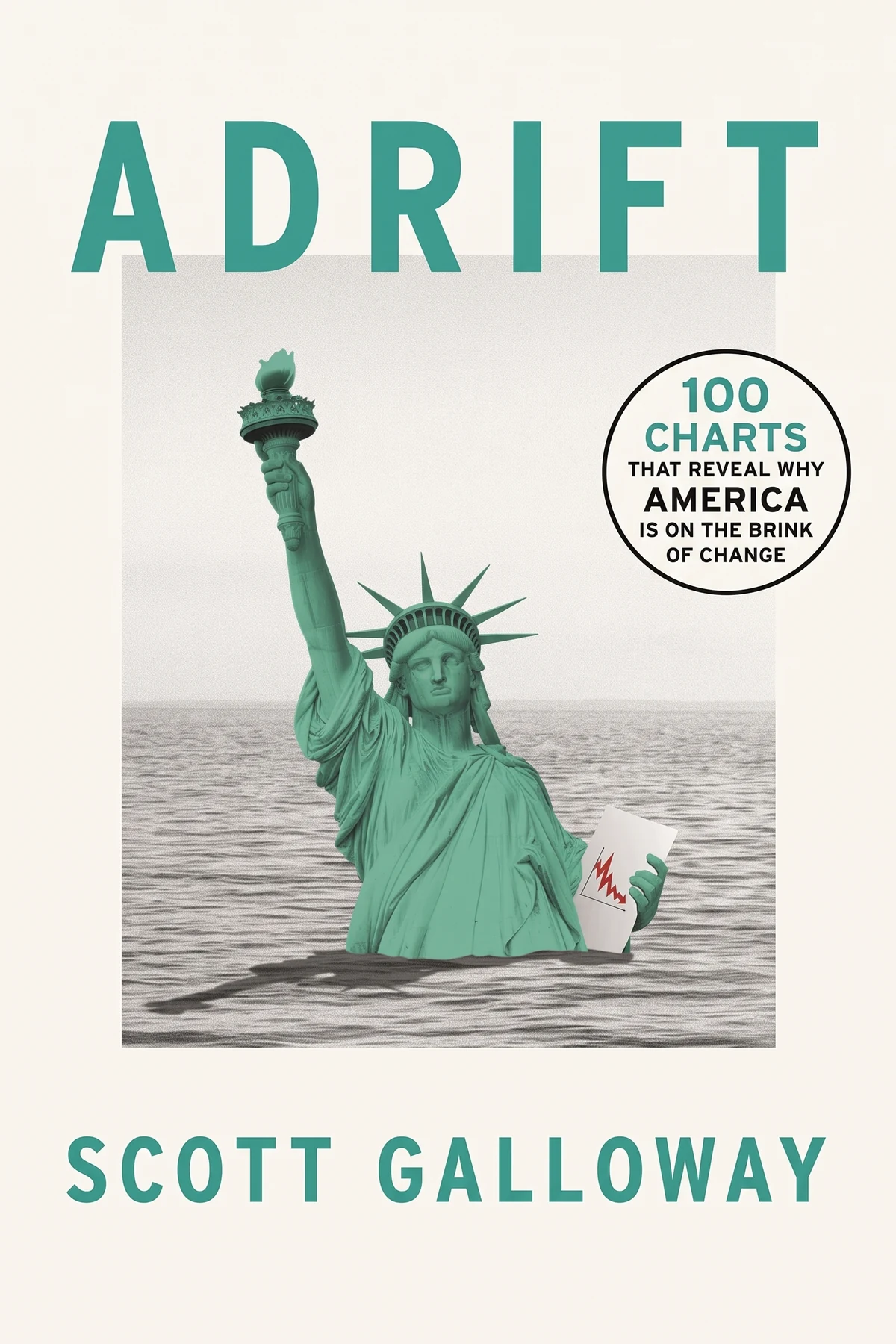
Adrift explores the turbulent state of American society through a lens of economic, social, and technological shifts. It examines how the nation has moved away from a period of shared prosperity and community cohesion toward a landscape defined by extreme wealth concentration, political polarization, and a loneliness epidemic. Using a series of provocative charts and data points, the book illustrates how the middle class is being squeezed, how the educational system is failing to keep pace with modern needs, and how social media algorithms are eroding the foundations of democratic discourse. Despite the sobering analysis, the book offers a promise of renewal. It suggests that by understanding the root causes of this drift—such as the breakdown of community institutions and the distortion of market incentives—citizens and policymakers can steer the country back toward a more equitable and connected future. It is a call to move past hype and outrage to focus on the fundamental pillars of a healthy democracy: education, innovation, and human connection.
Scott Galloway is an author, podcaster, YouTuber, and public speaker who teaches marketing at the New York University Stern School of Business. His best-selling books include The Algebra of Happiness, Post Corona, and The Four. He has founded nine companies, including L2 Inc. (now Gartner); Section 4, a business education company; and Prophet Brand Strategy. He also serves on the board of directors for multiple top companies, including Urban Outfitters, Panera Bread, and The New York Times Company.
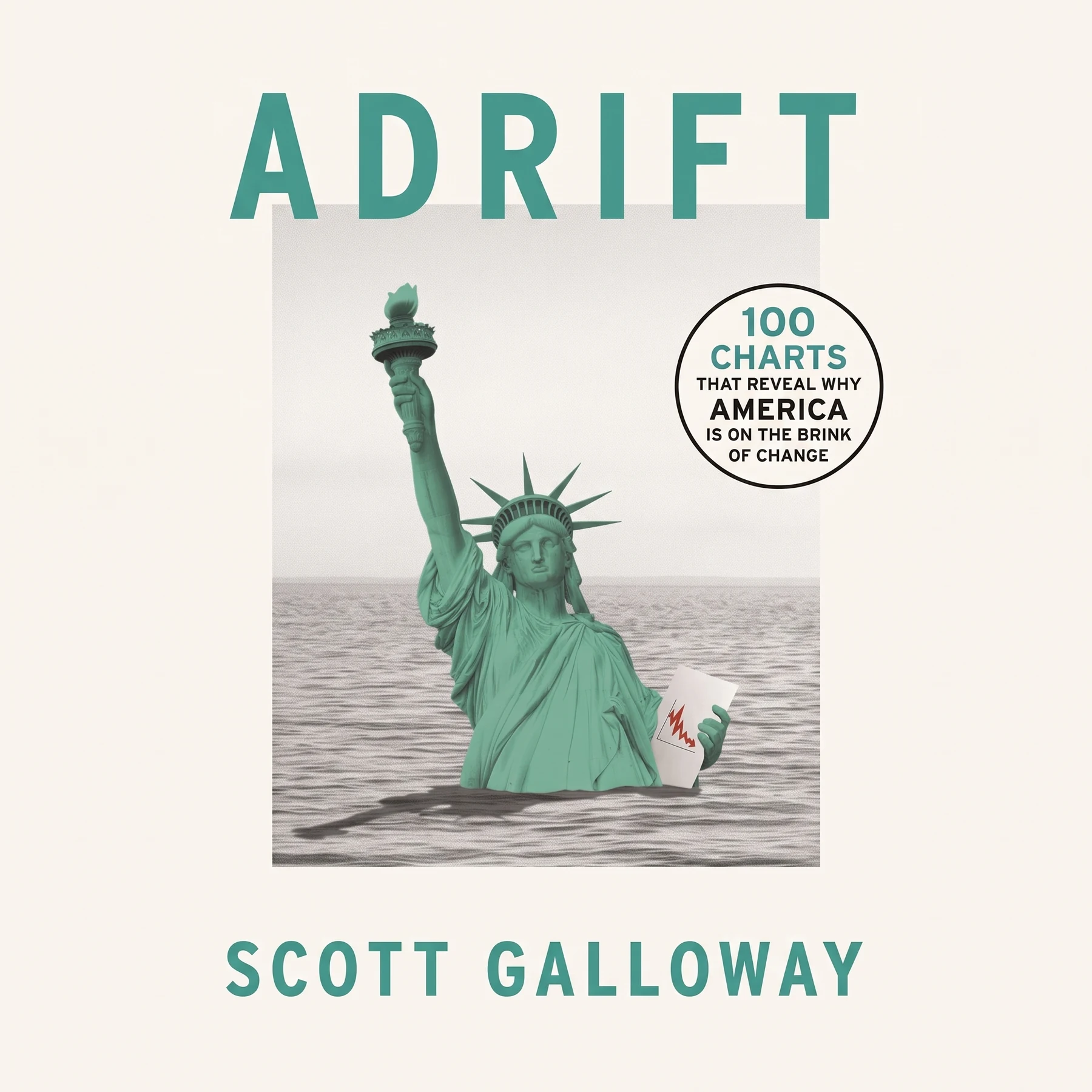
Listeners find the work both educational and straightforward, highlighting the high-quality charts and graphics that facilitate informed conversations. The prose is described as brief and engaging, with a presentation that is visually stimulating. Furthermore, they value the insights regarding economic policy, with one listener observing how the book demonstrates the real-world results of political actions. Nevertheless, reactions to the narrative's speed are divided.
Scott Galloway has a way of turning dense economic trends into something you can actually digest while drinking your morning coffee. This book is a visual autopsy. I loved how the 100 charts showed exactly where the middle class started to fracture. While some find the 'doom and gloom' tone overwhelming, it felt like a necessary wake-up call regarding our policy choices since the 1980s. These graphics are well-constructed. They make for an excellent reference during dinner party debates about wealth inequality. I do wish there were more solutions offered earlier in the book, but the clarity of the data makes it worth every penny. It’s a concise, visual history that every voter should flip through before the next election cycle.
Show moreFinally got around to reading this and I’m blown away by how effectively Galloway distills our national identity crisis into a single volume. Data is destiny. The sheer scale of how we've moved from a culture of investment to a culture of entitlement for the 1% is frankly staggering and deeply unsettling. I found the chapter on the loneliness of young men particularly haunting, as it connects economic stagnation to social decay in a way few other authors do. While the book is undeniably 'angry,' it feels like a righteous anger backed by cold, hard numbers. It’s concise, punchy, and provides a clear-eyed look at the consequences of our collective political choices. This should be required reading in every civics class across the country.
Show moreWhat a fascinating, if entirely demoralizing, look at the trajectory of our country over the last several decades. Galloway uses 100 distinct charts to map out our transition from a post-war powerhouse to a fragmented society struggling with historic levels of inequality. The visual representations of CEO compensation versus average worker pay were particularly striking and easy to understand. I appreciate that he doesn't shy away from blunt language or the messy reality of our current political climate. Some critics say it’s too negative, but I think we need this level of honesty to realize just how far off course we’ve drifted. It’s a quick read that packs a massive emotional and intellectual punch, leaving you with much to ponder.
Show morePicked this up after hearing Prof G on a podcast and it’s essentially a high-gloss, bound PowerPoint presentation of his best riffs. The pacing is a bit erratic because you’re jumping from the crisis of lonely young men to the skyrocketing costs of healthcare in just a few pages. However, the visual representations of our national drift are genuinely eye-opening, even if you’re already familiar with the general themes of income inequality. To be fair, some of the charts lack detailed unit labels or specific year-range explanations, which might frustrate the data nerds in the room. Still, it functions as a powerful summary of how specific political decisions led us to this stagnant moment. It’s a fast read that leaves you feeling significantly more informed, if slightly more depressed.
Show moreAs someone who usually avoids dry economic texts, I found this remarkably easy to get through without my eyes glazing over. The '100 charts' format is genius because it breaks down complex geopolitical shifts into bite-sized, visual chunks that tell a cohesive story. You can really see the outcomes of various tax codes and social policies over the last fifty years laid bare. I appreciated the sections on the 'billionaire boy's club' and how tech monopolies are reshaping our society in ways we haven't fully grasped yet. My only gripe is that it feels a bit cherry-picked at times to support a specific narrative, leaving out some of the more positive metrics of human progress. Regardless, it’s a fascinating look at where we are and how we might find our way back.
Show moreTo be fair, I didn't learn a ton of new information, but the way Galloway organizes the data makes it a fantastic reference for future discussions. He has this knack for taking a pile of messy statistics and turning them into eye-catching graphics that highlight the sheer scale of our current challenges. I particularly liked the focus on how we treat our veterans and the aging population compared to other developed nations. It’s a bit of a 'doom-scroll' in book form, which can be exhausting if you read it all in one sitting. However, the message about our failing infrastructure and the need for a stronger middle class is delivered with incredible clarity. It’s a sharp, visually appealing autopsy of the 21st-century American economy that hits hard.
Show moreAfter hearing so many polarized opinions about Scott Galloway, I wanted to see the data for myself. This book is a very concise guide to the current state of America, stripping away the rhetoric and focusing on what the numbers actually say about our health, wealth, and education. I liked that it wasn't just a dry list of facts but a narrative about how political choices have tangible outcomes for everyday people. The graphics are well-constructed, making the information accessible even to those who aren't usually 'math people.' While there is a definite slant to the interpretation, the underlying data points are hard to argue with. It’s an interesting, visually-driven read that successfully captures the anxiety of the current moment without being entirely hopeless.
Show moreDoes America really need another book telling us that the middle class is shrinking and college is too expensive? Galloway is a brilliant marketer, and it shows here; the book is a sleek, visually stunning product that somehow says very little that hasn't been said before. If you’ve been paying any attention to the news for the last decade, many of these 'revelations' will feel like common sense. The charts are pretty, but they often lack the deep-dive analysis I was hoping for, frequently offering just a paragraph of context. It's essentially a coffee table book for people who want to look smart while complaining about the economy. It’s not a bad resource for a younger reader, but for anyone well-versed in current events, it’s a lot of style over substance.
Show moreEver wonder why everything feels so broken lately? Galloway’s book tries to answer that with a series of graphs that are sometimes brilliant and sometimes just pointing out the obvious. The pacing is a bit hit-or-miss; some sections are deeply researched while others feel like filler to get to that magic '100 charts' number. I found myself wishing for a more in-depth look at the solutions, which are tucked away at the very end like a brief PR addendum. It’s a visually appealing book, no doubt, and it makes for a great conversation starter on your bookshelf. But if you’re looking for a rigorous economic thesis with flawless data labeling, you might want to look elsewhere. It’s more of a high-level summary than a deep dive.
Show moreThe title is a bit of a misnomer. Galloway claims we are 'adrift,' but he clearly has a very specific, biased destination in mind for the reader. Frankly, I was disappointed by the technical quality of the graphics throughout the entire volume. Some axes aren't labeled at all. Units are missing. The data seems transformed without any explanation of the methodology. It’s disrespectful to the reader’s time when a book built entirely around charts fails at basic data visualization standards. Furthermore, the author spends way too much time on his personal anecdotes and pro-immigration stance rather than letting the numbers speak for themselves. I expected non-obvious insights but got a partisan PowerPoint presentation instead. Avoid if you want real data.
Show more

Fay Bound Alberti

Daniel Goleman
Andrew Ross Sorkin

Virginia Woolf
Ha-Joon Chang
Tracy Rosenthal

Niall Kishtainy
AUDIO SUMMARY AVAILABLE
Get the key ideas from Adrift by Scott Galloway, plus 5,000+ more titles in English and Thai.