
22 min 05 sec
Why We Make Mistakes: How We Look Without Seeing, Forget Things in Seconds, and Are All Pretty Sure We Are Way Above Average
Explore the psychological and evolutionary roots of human error. This guide reveals why our brains are hardwired for blunders and how we can redesign our environments to make better choices.
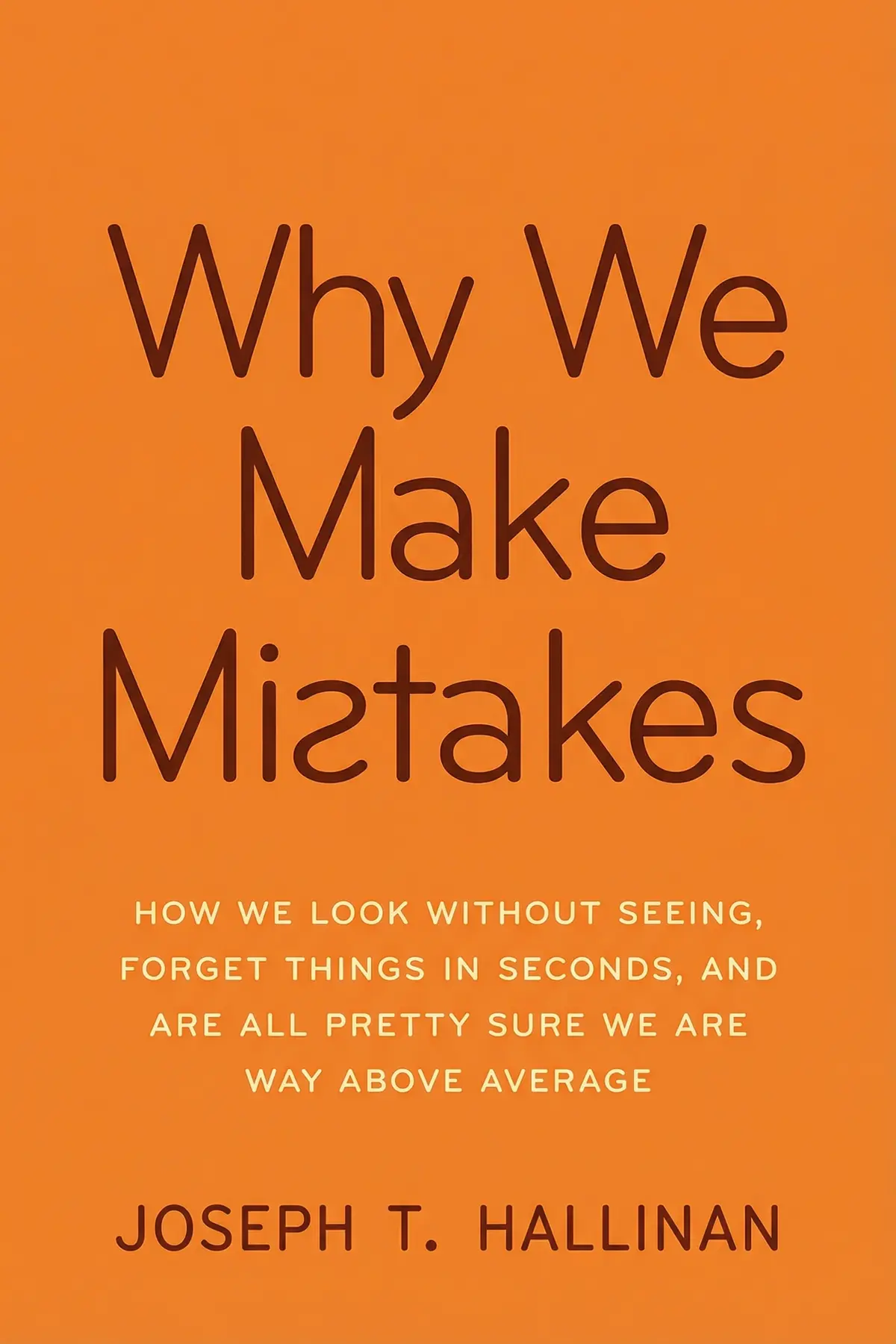
Table of Content
1. Introduction
1 min 50 sec
It happens to the best of us. We walk into a room and immediately forget why we went there. We misplace our keys for the third time in a week. Or, in much more serious scenarios, we make a judgment call at work that seems completely illogical in hindsight. Often, when these moments occur, we react with a mix of frustration and shame. We tell ourselves we should have known better, or we chalk it up to a momentary lapse in intelligence. But what if these errors weren’t actually flaws in our character? What if they were predictable, systematic, and actually built into the very hardware of our brains?
This is the central premise we are exploring today. Joseph T. Hallinan, a Pulitzer Prize-winning journalist, takes us on a journey through the psychology of fallibility. He suggests that we need to stop viewing mistakes as individual failures and start seeing them as the natural result of how we evolved to perceive the world. Our brains are designed for efficiency, not necessarily for absolute accuracy. They take shortcuts, they fill in gaps, and they prioritize speed over detail. While these traits helped our ancestors survive in the wild, they create some very modern headaches.
Throughout this discussion, we will look at the hidden mechanics of the mind. We will see how our vision is limited, why our memories are more like creative reconstructions than video recordings, and why we are almost always convinced that we are better-than-average drivers, thinkers, and partners. The goal isn’t just to point out where we go wrong, but to understand the ‘why’ behind the blunder. By the time we reach the end, you’ll have a new perspective on your own limitations and a set of practical strategies to help you navigate a world that is often more complex than our brains were built to handle. Let’s begin by looking at the literal and metaphorical ways we see the world.
2. Visual and Cognitive Blind Spots
2 min 09 sec
Discover how our physical limitations and psychological biases work together to hide what is standing right in front of us.
3. The Advantage of Meaningful Memory
2 min 02 sec
Explore why the brain rejects random data while effortlessly holding onto stories and associations that resonate with us.
4. The Hidden Power of Snap Judgments
1 min 47 sec
Our brains make decisions in the blink of an eye based on cues we don’t even realize we’re processing.
5. The Instinct to Simplify the World
1 min 51 sec
Learn why our mental maps and memories are often distorted versions of reality designed for ease of use.
6. Pattern Recognition as a Double-Edged Sword
1 min 48 sec
While patterns allow us to process information quickly, they also make us blind to obvious errors.
7. The Distortion of Hindsight
1 min 46 sec
Our memories are not objective records; they are self-serving stories that we rewrite to make ourselves look better.
8. The Myth of Effective Multitasking
1 min 45 sec
Understand why trying to do two things at once actually slows you down and increases your risk of failure.
9. The Overconfidence Trap
1 min 42 sec
Discover why we almost always overestimate our abilities and how this bias leads to poor financial and personal decisions.
10. Designing a World That Accounts for Error
1 min 53 sec
Since we can’t eliminate human error, we must redesign our systems to prevent small mistakes from becoming catastrophes.
11. Harnessing Awareness for Better Choices
1 min 45 sec
Learn how to use self-reflection and feedback loops to identify your biases and improve your future predictions.
12. Conclusion
1 min 47 sec
As we wrap up our exploration of human error, the most important takeaway is a shift in perspective. Mistakes are not a sign of personal failure or a lack of intelligence. They are the natural, predictable byproduct of a brain that evolved to prioritize speed, patterns, and simplicity. We are wired to look but not always see, to remember the ‘why’ but forget the ‘what,’ and to walk through life with a healthy—and sometimes dangerous—dose of overconfidence.
But understanding this isn’t an excuse to be careless. On the contrary, it’s a call to be more intentional. Now that you know about the multitasking mirage, you can choose to put your phone away while driving or while working on a complex project. Now that you know about the overconfidence trap, you can build in more time for your goals and seek out checklists to support your fallible memory.
Speaking of checklists, that is perhaps the most actionable piece of advice you can take away today. Whether you are packing for a trip or preparing a big presentation, don’t trust your brain to ‘just remember.’ Externalize your memory. Write it down. Similarly, if you find yourself drowning in data, stop. Limit your research. Remind yourself that more information doesn’t always lead to a better decision; often, it just leads to a slower one.
By embracing our fallibility rather than denying it, we can design lives and systems that are more resilient. We can be kinder to ourselves when we slip up, and more rigorous in our efforts to prevent those slips from becoming falls. The goal isn’t to be a perfect machine, but to be a more aware, more prepared human being. Thank you for joining us on this look into why we make mistakes—and how we can start making fewer of them.
About this book
What is this book about?
Have you ever wondered why you can remember a complex movie plot but forget your own phone number? Or why experts often miss the most obvious mistakes? In this summary of Joseph T. Hallinan’s work, we dive deep into the fascinating world of human fallibility. The book argues that our mistakes aren't just random accidents or signs of incompetence; rather, they are the byproduct of how our brains evolved to process information efficiently. From the visual limitations of our eyes to the overconfidence that plagues our decision-making, we explore the specific mechanisms that lead us astray. You will learn about the 'multitasking mirage,' the way we simplify complex memories, and why we are often convinced we are more skilled than the average person. By understanding these cognitive traps, we can move toward a more realistic view of our abilities. The promise of this journey is not perfection, but a practical set of tools to help us anticipate our errors and build systems—both in our personal lives and professional environments—that mitigate the impact of being humanly imperfect.
Book Information
About the Author
Joseph T. Hallinan
Joseph Hallinan is an accomplished journalist and author who has dedicated much of his career to investigative reporting. His excellence in the field was recognized with a Pulitzer Prize for his work at the Wall Street Journal. Beyond his analysis of human error in Why We Make Mistakes, he has explored complex social issues in books such as the award-winning Going Up the River: Travels in Prison Nation. More recently, he continued his exploration of the human mind in Kidding Ourselves: The Hidden Powers of Self-Deception.
Ratings & Reviews
Ratings at a glance
What people think
Listeners find the book accessible and engaging, providing valuable knowledge for their psychology practice and keen perspectives on decision making. Furthermore, the text is well-crafted, educational, and a worthwhile investment, with one listener mentioning it is chock-full of case studies. They also value its real-world utility, as one review highlights how easily it can be applied to everyday decision making.
Top reviews
Eye
Ever wonder why you can’t remember your own phone number while easily recalling a catchy jingle from twenty years ago? Hallinan dives into the quirks of the human brain with a style that is both accessible and startlingly insightful. He touches on everything from the inaccuracy of our memories to the way we skim information, highlighting that we are far more fallible than we'd like to admit. The section on how students learn better from summaries than from full textbook chapters was particularly counter-intuitive and changed how I approach my own reading habits. While the book is packed with research, it never feels like a dry academic text because the writing is so conversational. Honestly, it’s a bit humbling to realize how much we rely on "woolly-minded" tendencies in our daily lives. This is a must-read for anyone who thinks they are too smart to make a basic mistake.
Show moreBond
Finally got around to reading this, and it’s essentially a manual on how to be a bit more humble about our mental abilities. Hallinan explains that our brains are essentially skimmers that prioritize speed over accuracy, which leads to all sorts of preventable blunders. I loved the examples of how we reconstruct memories in self-flattering ways, like parents who swear they were perfect disciplinarians. The writing is incredibly engaging and keeps you on your toes with counter-intuitive facts about everything from wine tasting to political elections. Frankly, I was shocked to learn how much we are influenced by facial appearances when choosing who to vote for. It’s a quick read that packs a punch and makes you look at your own daily routines through a much more critical lens. It’s rare to find a book that is this informative while remaining so genuinely fun to get through.
Show moreAnna
It turns out that we are much worse at observing the world than we think we are, and Hallinan proves it with one fascinating study after another. I was captivated by the idea that we struggle to recognize people from different racial groups or ages because we only skim their features. The book is full of case studies that highlight our fallibility, from TSA screeners missing weapons to historians creating a false sense of inevitability around past events. Personally, I found the advice on getting enough sleep to be the most practical takeaway, even if it seems like common sense. The way the author connects these scientific findings to real-world consequences makes for a very compelling narrative. It is well-written, entertaining, and serves as a much-needed reality check for our often over-inflated egos. I've already recommended it to several colleagues in my psychology practice as a great resource.
Show moreRoo
As a clinician, I found the case studies regarding medical oversight both terrifying and incredibly necessary for our field. Hallinan points out that we are often blinded by our own expertise, leading to errors that could easily be prevented with simple checklists. The book does an excellent job of explaining why we cling to our first impressions, even when the evidence suggests we are completely wrong. I particularly appreciated the discussion on how doctors are influenced by drug company perks without even realizing the bias exists. It’s a sobering look at the limitations of the human mind, especially in high-stakes environments where gut feelings can be dangerous. My only real complaint is that the author tends to focus heavily on the failures of men while glossing over female-specific cognitive biases. Still, the practical value of understanding these mental traps makes this worth the purchase.
Show moreOtt
Joseph Hallinan manages to deliver a fascinating look at our cognitive blind spots without getting bogged down in academic jargon. He takes complex psychological studies and turns them into entertaining stories that stay with you long after you close the cover. I was especially surprised by the chapter on gender differences; the idea that men are generally over-confident while women tend to dwell on their mistakes was eye-opening. The book is chock-full of these little tidbits that explain why we buy things we don’t need or why we think we are better drivers than we actually are. It is well-written and flows smoothly, making it a perfect choice for a weekend read or a long flight. Some might find the tone a bit too science light, but for a general audience, it hits the right balance. You’ll definitely think twice the next time you try to text and drive simultaneously.
Show moreNattapong
Picked this up on a whim after forgetting my password for the third time in a week, and it was exactly what I needed. Hallinan explains that forgetting mundane details like PINs or names isn't just a sign of getting older; it’s actually a byproduct of how our brains are wired. The book provides great insights into decision making and why we often double down on bad choices instead of admitting we were wrong. I found the section on multi-tasking particularly useful, as it confirmed my suspicion that I'm actually just slowing myself down by trying to do too much at once. The author’s tone is friendly and not at all condescending, which makes the news of our general ineptitude easier to swallow. It’s informative, worth the purchase, and highly applicable to everyday life situations. Just don’t expect a deep academic treatise on the neurobiology of the brain.
Show moreOat
To be fair, I went into this thinking I was a pretty observant person, but Hallinan quickly disabused me of that notion. The chapter on how we perceive our own attractiveness versus how others see us was both hilarious and slightly painful to read. He has a knack for finding these specific, weird details—like how French music makes us buy French wine—that reveal how easily we are manipulated by our environment. The book is well-written and informative, offering a broad survey of the many ways our brains take shortcuts that lead to mistakes. I do wish there was more of an emphasis on how to actually fix these behaviors, as the conclusion chapter felt a bit rushed compared to the rest of the book. Still, the practical value of simply being aware of these biases is immense. It’s a great pick for anyone who wants to understand the hidden mechanics of their own decision-making process.
Show moreSuthida
The truth is, this felt more like a collection of interesting magazine articles than a deep dive into cognitive science. Hallinan is a journalist, and it shows in his focus on punchy stories and fast-paced delivery. While the case studies about medical errors and aviation accidents are genuinely gripping, I found some of the broader conclusions to be a little shallow. He identifies many of our flaws—like our inability to multitask or our overconfidence in our own attractiveness—but he doesn't provide enough concrete strategies for fixing these issues. To be fair, the book is incredibly easy to read and works well as an introduction to the topic of human bias. If you’ve already read authors like Daniel Kahneman or Dan Ariely, much of this material might feel like a repeat. It’s a decent entry-level book, but it lacks the analytical meat that some readers might be looking for in a science book.
Show moreRay
Not what I expected, but still worth a read if you are interested in the why behind human error. The book is very anecdotal, moving quickly from one story to the next without lingering too long on any single concept. While this makes it easy to digest, it also means that some of the more complex ideas aren't explored as deeply as they deserve. I was particularly interested in the part about how we are biased toward our first impressions, yet the author moves on to the next topic before really explaining how to combat that bias. To be fair, the writing style is very polished and the information is presented in a way that anyone can understand. It’s a good starting point for learning about cognitive limitations, but you’ll probably end up with a long list of other books to read afterward. It’s definitely science light, but it’s entertaining enough to keep you engaged until the end.
Show moreWatchara
Look, I wanted to love this, but the journalist’s approach often prioritizes a catchy anecdote over rigorous data interpretation. While the book is certainly entertaining and easy to follow, the logic used to support some of the conclusions felt a bit shaky to me. For instance, using the number of people who move out of California as proof of the grass is greener syndrome is a huge stretch without looking at economic factors. I also found the constant pull-out boxes with verbatim sentences from the text to be distracting and somewhat redundant for a book that is already quite short. It feels like Pop Psychology 101 where the goal is to stun the reader rather than educate them on the nuances of human cognition. If you want something light and conversational to chat about at a dinner party, this is fine. However, if you are looking for a serious study on why we make mistakes, you might find this a bit too shallow.
Show moreReaders also enjoyed
A Liberated Mind: How to Pivot Toward What Matters
Steven C. Hayes
Acting with Power: Why We Are More Powerful Than We Believe
Deborah Gruenfeld
Age of Propaganda: The Everyday Use and Abuse of Persuasion
Anthony Pratkanis
AUDIO SUMMARY AVAILABLE
Listen to Why We Make Mistakes in 15 minutes
Get the key ideas from Why We Make Mistakes by Joseph T. Hallinan, plus 5,000+ more titles in English and Thai.
- 5,000+ titles
- Listen as much as you want
- 7-day free trial
- Cancel anytime







