

15 min 27 sec
Work the System: The Simple Mechanics of Making More and Working Less
Learn how to replace chaos with order by viewing your life and business as a collection of systems. This guide reveals how documenting processes and focusing on efficiency can lead to lasting success.
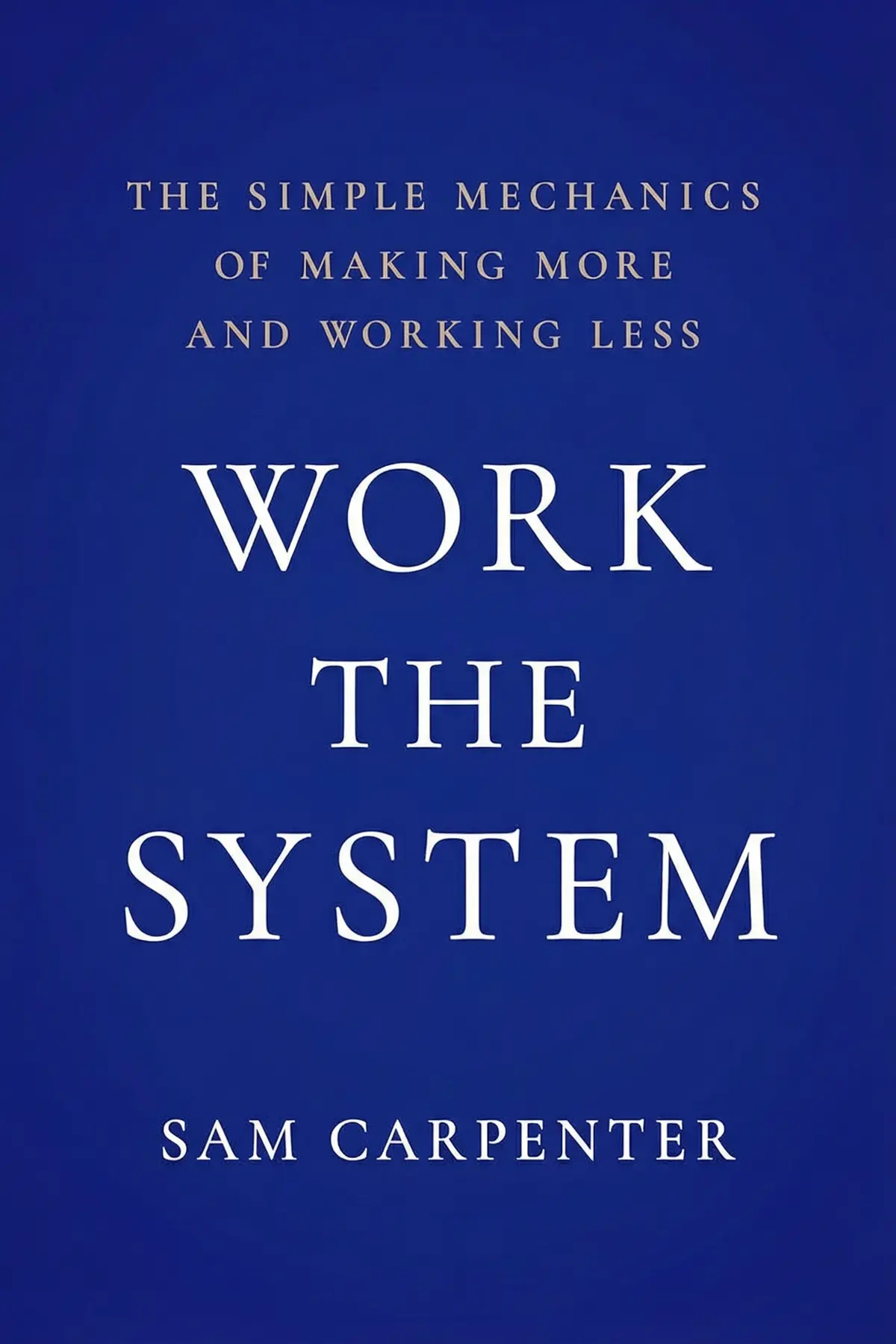
Table of Content
1. Introduction
1 min 34 sec
Imagine waking up every day and feeling like you are walking into a thick fog. You know you have goals, you know you have work to do, but everything feels disorganized, reactive, and ultimately exhausting. You might feel like a tiny boat in a massive ocean, tossed around by waves of luck, market fluctuations, or personal drama. We often label this feeling ‘chaos’ or ‘bad luck,’ but what if that entire premise is wrong? What if the world isn’t chaotic at all, but is actually a highly efficient, logical machine that is constantly running in the background, whether you notice it or not?
This is the core realization we are going to explore. Most of us are so busy doing the work that we never stop to look at how the work is being done. We are so focused on the individual trees that we completely miss the forest. This summary is about lifting that fog. It is about gaining what we call the ‘systems mindset’—a way of seeing the world as a collection of separate, manageable processes. When you stop looking at your life as one big, messy pile and start seeing it as a series of interconnected systems, everything changes. You stop being a person who reacts to problems and start being a person who engineers solutions. Over the next several segments, we are going to break down how to detach yourself from the day-to-day grind, how to identify the specific levers you can pull to change your outcomes, and how to build a life and a business that run smoothly and predictably. We are moving from the role of the worker to the role of the designer. Let’s dive in and see how the world really works.
2. Adopting the Systems Mindset
1 min 46 sec
What if the world isn’t a mess of random events, but a collection of processes working exactly as they should? Shift your perspective to see the logic behind everything.
3. Focusing on Your Sphere of Influence
1 min 37 sec
Stop wasting energy on things you cannot change and learn to master the systems within your direct control to produce the results you desire.
4. Gaining an Outsider’s Perspective
1 min 40 sec
Step back from the daily grind to see the components of your life. Understanding how the parts interact is the only way to fix the whole.
5. Becoming a Professional System Manager
1 min 32 sec
Don’t just fix problems—fix the flaws that caused them. Move from reactive troubleshooting to proactive design for long-term peace.
6. The Power of Strategic Leadership
1 min 30 sec
A leader’s job isn’t to do everything, but to ensure the systems are in place for others to succeed. Focus on the vision, not the tasks.
7. Operating Your Business Like a Machine
1 min 34 sec
Consistency is the key to scaling. By documenting every process into clear instructions, you ensure that success is predictable, not accidental.
8. The 98 Percent Rule for Efficiency
1 min 23 sec
Perfectionism is the enemy of progress. Learn why chasing that last two percent of quality often costs more than it’s worth.
9. Communication as the Ultimate System
1 min 27 sec
Misunderstandings and silence are the primary causes of system failure. Establish clear channels of dialogue to keep your machinery running smoothly.
10. Conclusion
1 min 24 sec
As we wrap up this journey through the world of systems, the most important takeaway is that you are no longer a passive observer of your own life. You have the tools to look past the surface-level noise and see the underlying structure of everything you do. Success is not a matter of working harder or putting in more hours; it is a matter of working on the right things. By adopting the systems mindset, you move away from the chaos of reactivity and into the calm of strategic management.
Remember that your life is a collection of processes. If you don’t like the results you are getting, don’t just complain about the outcome—look at the process that produced it. Document your tasks, delegate the subsystems, and stop chasing the ghost of 100 percent perfection. Focus instead on creating a reliable, 98-percent-perfect machine that runs consistently. When you shift your focus from ‘doing the work’ to ‘designing the way the work is done,’ you unlock a level of freedom and productivity that most people never experience. You have the power to engineer your environment, your business, and your personal habits to serve your goals. It’s time to stop fighting the chaos and start working the system. Now, take a look at your day tomorrow. What is one small subsystem you can document or improve? Start there, and watch how the rest of the machine begins to hum.
About this book
What is this book about?
Have you ever felt like you are constantly putting out fires, overwhelmed by the sheer volume of daily tasks and unexpected hurdles? Many people view the world as a chaotic place where luck or fate determines their outcomes. This book offers a radical shift in perspective, arguing that the world is not a mess of randomness but a logical arrangement of systems that work correctly nearly all the time. By learning to see the underlying mechanics of your environment, you can move from being a victim of circumstances to becoming a master of your reality. The promise is simple: by documenting your processes, identifying malfunctions at their root, and focusing on high-level management rather than manual labor, you can achieve better results with less effort. It is a blueprint for anyone looking to reclaim their time and scale their impact through the power of systemic thinking.
Book Information
About the Author
Sam Carpenter
Sam Carpenter is an entrepreneur and philanthropist who’s built a business documentation software product designed to help you apply the methods from this book.
Ratings & Reviews
Ratings at a glance
What people think
Listeners find that this book provides a life-changing outlook on boosting productivity through the decomposition of intricate operations into smaller, controllable subsystems. Though some find the prose somewhat redundant, they value how the outlined methods relate to professional workflows as well as individual routines like organization and sleep. Furthermore, they appreciate transitioning from a reactive "firefighting" approach toward a preemptive emphasis on documenting and maintaining systems. They also highlight the functional advantages for small business owners, with one listener suggesting that jumping ahead to chapter five offers the most direct guidance for defining and constructing systems.
Top reviews
Wit
Ever wonder why some people seem to breeze through life while you're constantly drowning in tasks? This book provides the answer. It’s not about working harder; it’s about 'working the system.' I found the perspective shift absolutely transformative. Before reading this, I viewed my problems as isolated events, but now I see them as flaws in a larger subsystem that can be adjusted and perfected. I’ve already applied this to my morning routine and my filing process at work, and the efficiency gains are real. It’s true that the author has a very strong personality and his anecdotes can be polarizing, but if you focus on the 'Outside and Slightly Above' philosophy, it will change how you operate. The idea that 99.9% of things work fine and we just need to manage the outliers is a beautiful way to view the world. Total game-changer for my productivity.
Show morePrayoon
Wow. I didn't expect a business book to help me fix my chronic insomnia, but here we are. The author’s premise that everything in life is a system—including our health and personal habits—pushed me to analyze my sleep patterns like a programming bug. I started documenting my caffeine intake, screen time, and room temperature, treating it all as a subsystem that needed refinement. Within weeks, the problem was solved. This book isn't just for CEOs; it's for anyone who feels like their life is a mess of loose ends. Frankly, the simplicity of the language is its strength. Carpenter doesn't use corporate buzzwords; he uses plain English to explain how to regain control. I’ve bought three copies now to give to friends who are constantly complaining about being 'busy.' If you actually implement the 'Work the System' mindset, you'll find hours of free time you didn't know you had.
Show moreHiroshi
Picking up this book felt like finding the missing manual for my life. I’ve always been a 'firefighter,' jumping from one crisis to the next and feeling exhausted by 5 PM. Carpenter’s 'system mindset' forced me to step back and look at the machine itself rather than the individual parts. The realization that most things work perfectly when left alone, and we only need to fix the broken links, was a massive weight off my shoulders. I particularly enjoyed the story of how he transformed Centratel from a failing business into a smooth-running machine that requires almost none of his time. It’s an empowering read that makes the dream of a four-day work week feel actually attainable. Some people might find his tone a bit rigid, but when you’re trying to escape total chaos, a little rigidity is exactly what’s required. I'm already seeing results.
Show moreOmar
Finally got around to reading this after hearing it mentioned at a business seminar. In my experience, most business owners spend their lives 'firefighting' rather than building, and Carpenter identifies this trap perfectly. The core message—shifting from a reactive mindset to a proactive, systems-focused one—is vital for anyone trying to scale a company without losing their mind. I appreciated the specific details about his message center business, Centratel, because it turned abstract concepts into tangible examples. Look, the writing isn’t Shakespeare, and he definitely repeats himself to ensure the message sticks, but the results are hard to argue with. By documenting every minor subsystem, you stop being a slave to the daily grind. It took me a few chapters to warm up to his style, but once I started thinking of my business as a machine rather than a series of emergencies, my stress levels dropped significantly.
Show moreOtt
As someone who runs a small firm with just a couple of employees, I found this incredibly relevant. We were stuck in a cycle of constant interruptions and redundant questions until I forced everyone to read the section on 'Working Procedures.' We’ve started documenting our most common client interactions, and the clarity it has provided is immense. Not gonna lie, the author’s 'my way or the highway' attitude is a bit much at times, and his views on social etiquette are definitely dated. However, the technical meat of the book—the focus on linear systems and the 'maintenance' mindset—is gold. It’s a very top-down approach that might not sit well in a flat corporate culture, but for a struggling entrepreneur, it’s a lifeline. It’s about moving from being a worker-bee to being the architect of your own business. It’s not revolutionary theory, but the practical application is top-tier.
Show moreEleanor
The author has a very specific way of viewing the world that is both fascinating and slightly unnerving. He treats business as an art form, a heroic undertaking where order and logic create value for everyone involved. I loved the chapters on the 'Dark Night of the Soul' where he describes his breakdown before his epiphany; it felt raw and honest compared to most polished business memoirs. While he can be a bit 'anal-retentive' (his own words), his obsession with detail is exactly why his business succeeded. I did find the sections on his personal politics and his weirdly specific restaurant tipping rules a bit distracting, as they didn't really add to the business advice. Still, the core takeaway—that you should spend your time managing systems rather than doing the work yourself—is a lesson I needed to learn. It’s a solid 4-star read for the practical value alone.
Show moreTen
While some of this feels like common sense—referencing the works of Deming or Taylor—the way Carpenter applies it to the modern small business is excellent. He demystifies the process of 'turnkeying' a business so it can run without the owner's constant supervision. I really appreciated the specific examples of what to discard, like his story about purging useless paper records that no one ever looked at. That kind of 'system purging' is something we all need to do more often. My only gripe is the author’s occasionally pretentious tone and his tendency to ramble about his personal philosophy of 'quiet competence.' It’s a bit old-school, and some of his comments about family dynamics made me roll my eyes. If you can filter out the man’s personality and just focus on the 'Systems Mindset,' you’ll find a very practical guide for scaling any operation.
Show moreKaen
Skip straight to chapter five if you want to save yourself several hours of frustration. The first section of the book is essentially a long-winded setup for an epiphany that most people will find fairly obvious: processes matter. To be fair, once Carpenter gets into the actual mechanics of creating 'Working Procedures,' the book becomes much more useful. He outlines how to document tasks so that anyone can perform them, which is the only way a small business owner can ever hope to take a vacation. I struggled with the author’s tone, though. He comes across as quite rigid and occasionally dismissive of others, particularly in his social interactions. While the technical advice on system maintenance and avoiding 'chaos' is solid, the delivery is weighed down by fluff and personal musings that don't always land. It’s a decent resource for organizational junkies, but it definitely needs a more ruthless editor.
Show moreTum
Not what I expected based on the rave reviews. This is basically a 250-page expansion of the idea that you should write down instructions for your job. Is it useful? Yes. Does it need to be this long? Absolutely not. The author’s writing style is incredibly repetitive, and he spends far too much time on tangential trips into topics like biological prime time and his distaste for certain social behaviors. I also found it hard to relate to some of his anecdotes, which often made him sound like a bit of a jerk to his staff and the people he encounters in public. That said, the actual methodology for 'Working Procedures' and 'Operating Protocols' is a great framework if you’re starting from zero. It’s a classic example of a good 20-page idea stretched into a full-length book. Read it, but feel free to skim the autobiographical filler.
Show moreNook
I wanted to love this, but the delivery makes it a chore to finish. Truth is, the author spends the first third of the book repeating the same 'epiphany' about systems over and over again, as if the reader won't grasp it without being hit over the head. He even admits he's being repetitive, which somehow makes it more frustrating! Beyond the redundancy, there’s an undercurrent of arrogance that’s hard to ignore. His story about docking tips for waitresses who use certain phrases felt petty and unnecessarily mean-spirited. If you can get past his bombastic tone and the outdated, occasionally sexist remarks about fathers and household roles, there is a decent lesson here about procedural documentation. However, you could honestly get the same value from a ten-minute blog post. It’s basic engineering logic wrapped in a thick layer of self-aggrandizement. Only read it if you have a high tolerance for filler.
Show moreReaders also enjoyed

7 Powers: The Foundations of Business Strategy
Hamilton Helmer

Alibaba: The House That Jack Ma Built
Duncan Clark

A Bigger Prize: How We Can Do Better Than the Competition
Margaret Heffernan
AUDIO SUMMARY AVAILABLE
Listen to Work the System in 15 minutes
Get the key ideas from Work the System by Sam Carpenter, plus 5,000+ more titles in English and Thai.
- 5,000+ titles
- Listen as much as you want
- 7-day free trial
- Cancel anytime







