
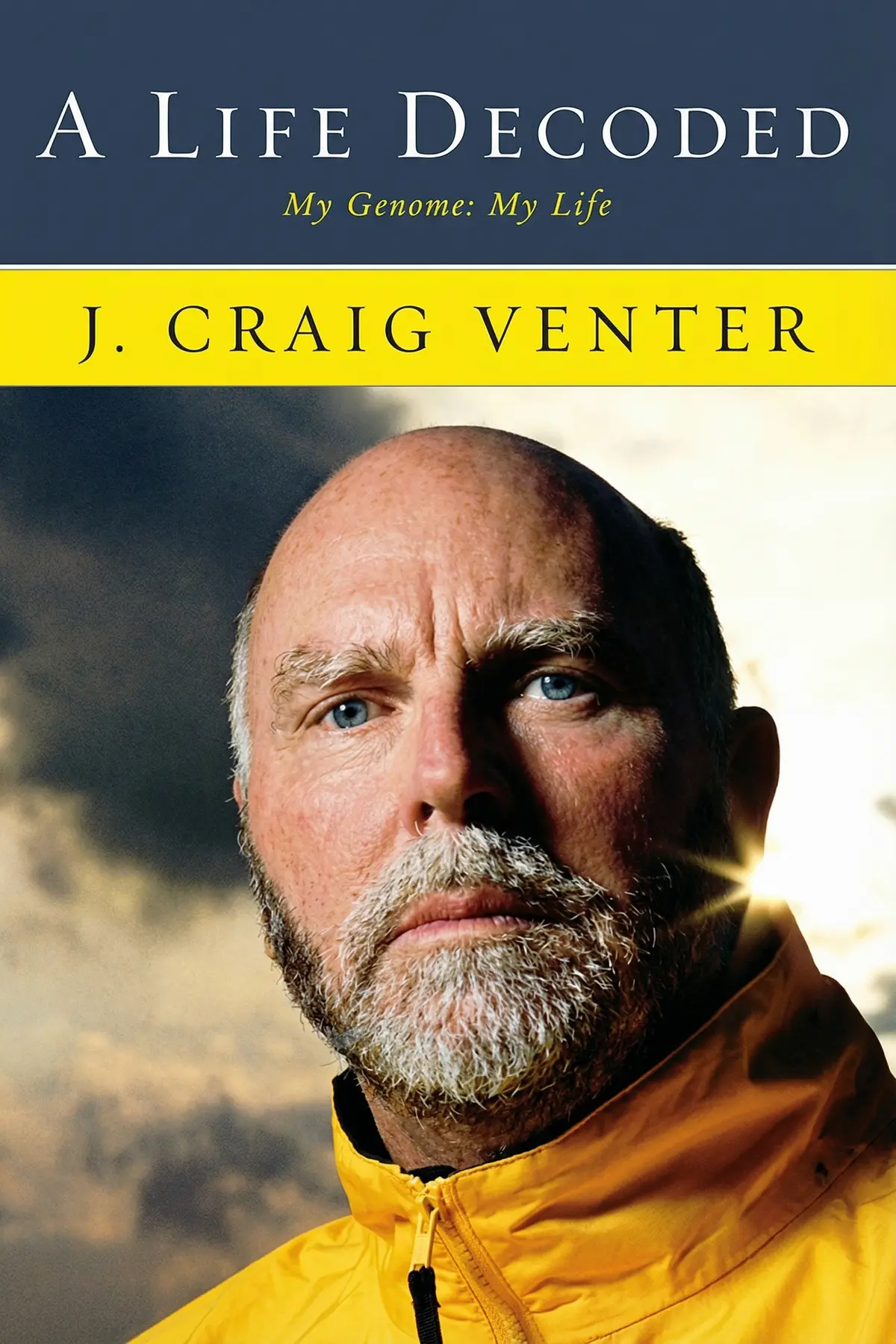
A Life Decoded: My Genome: My Life
J. Craig Venter
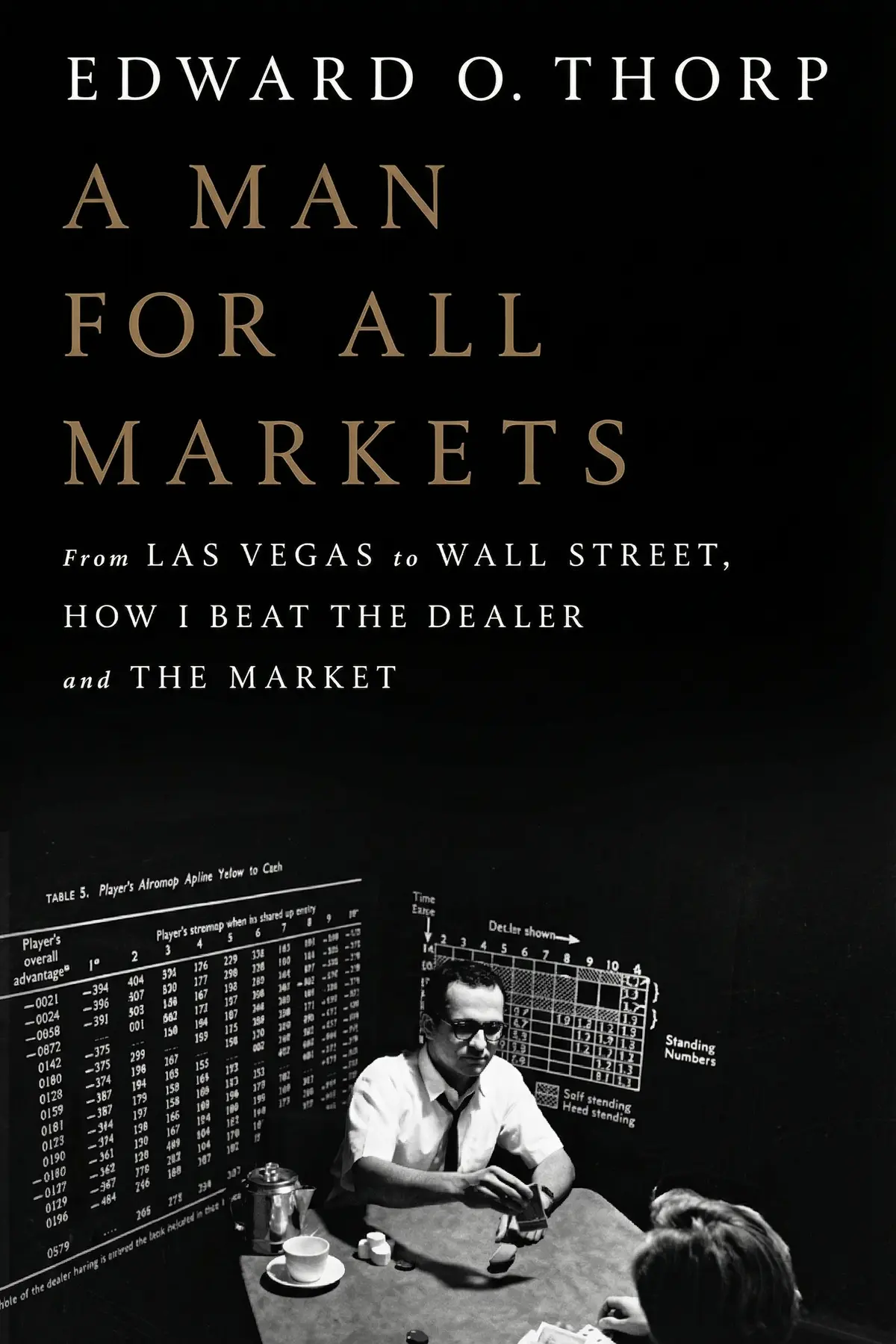
Follow the incredible journey of Edward O. Thorp, the mathematician who used statistical theory and logic to conquer the blackjack tables of Las Vegas and the complex markets of Wall Street.
1 min 34 sec
Imagine standing in the middle of a bustling casino, surrounded by the flashing lights and ringing bells of Las Vegas in the early 1960s. To almost everyone there, the games are a matter of luck, a series of random events controlled by the ‘house’ that always eventually wins. But for one university professor, the chaos of the casino floor was actually a puzzle made of numbers, waiting to be solved. Edward O. Thorp didn’t see gambling; he saw a mathematical system that could be analyzed, modeled, and exploited through pure logic.
In this exploration of Thorp’s life and work, we follow the throughline of a man who was never satisfied with being told that something was impossible. Whether he was trying to figure out how to count to a million as a small child or attempting to predict the trajectory of a roulette ball using a hidden computer, Thorp’s journey is one of relentless curiosity and rigorous testing. He represents a rare breed of thinker who bridged the gap between abstract academic theory and the high-stakes reality of the real world.
His story isn’t just about winning at blackjack or making a fortune on Wall Street. It’s about a fundamental way of looking at the world—one that prioritizes evidence over intuition and discipline over greed. We are going to look at how he developed his groundbreaking strategies, how he managed the incredible risks involved, and how he eventually translated his success in the casino into a career as one of the most successful investors in history. By the end, you’ll see how his principles of rational thinking and risk management can be applied to almost any area of life where the odds seem stacked against you.
1 min 57 sec
Explore how a childhood defined by self-reliance and small-scale experiments built the mental framework for a life spent challenging established wisdom and conventional limits.
1 min 57 sec
Witness the birth of card counting as Thorp uses early computer technology to find the mathematical ‘memory’ that exists within a deck of cards.
1 min 55 sec
Learn how Thorp and Claude Shannon applied the laws of physics to the roulette wheel, creating one of the world’s first wearable computers.
1 min 49 sec
Follow Thorp’s transition from the casino floor to Wall Street as he discovers that stock warrants and options follow the same logic as cards.
1 min 44 sec
Understand why knowing how much to bet is just as important as knowing who will win, and how a specific formula prevents financial ruin.
1 min 57 sec
Discover the challenges of running a high-performing fund and the decision to walk away when the environment turned toxic.
1 min 58 sec
Reflect on Thorp’s final philosophy of wealth, focusing on the value of time and the wisdom of simple, low-cost investment strategies for the average person.
1 min 44 sec
As we look back on the journey of Edward O. Thorp, the throughline becomes clear: the world is not as random as it appears to the untrained eye. From a Sears catalog to the floor of the MGM Grand, and finally to the boardrooms of Wall Street, Thorp proved that there is almost always a hidden structure that can be understood through mathematics and logic. He beat the dealer by recognizing that cards have a memory; he beat the market by finding the mathematical links between different securities; and he beat the cycle of boom and bust by never betting more than the math allowed.
But perhaps the most important lesson from Thorp isn’t about the numbers at all. It’s about the importance of intellectual independence. In every stage of his life, he was surrounded by ‘experts’ who told him that what he was doing was impossible or that the old way of doing things was the only way. By ignoring the consensus and looking at the data for himself, he found opportunities that others were literally standing on top of but could not see. He reminds us that being rational isn’t just about doing math—it’s about having the courage to act on what that math tells you, even when it goes against the grain.
The actionable takeaway here is to treat your own life and finances like a system that requires constant verification. Don’t take ‘market wisdom’ at face value. Understand the odds of the risks you are taking, whether in your career or your investments. Use the principle of compounding to your advantage, and never risk your entire bankroll on a single ‘sure thing.’ Most importantly, remember that the goal of winning the game is to eventually gain the freedom to stop playing by other people’s rules. Like Thorp, you can use clear thinking to build a life defined not by luck, but by deliberate, calculated success.
This narrative follows the life and intellectual evolution of Edward O. Thorp, a man who refused to believe that any system was truly unbeatable. From his early days as a curious child in the Great Depression to his career as a university professor and pioneering hedge fund manager, the story highlights how a deep understanding of probability can change the world. You will discover how Thorp revolutionized gambling by inventing the first legitimate system for card counting and how he teamed up with the father of information theory to build the first wearable computer. The promise of the book is a look into the mind of a rationalist who transitioned his skills to the stock market, creating early forms of arbitrage and market-neutral investing that still influence the financial world today. It is a guide to thinking clearly in a world of uncertainty.
Edward O. Thorp is a renowned mathematics professor, hedge fund manager, and a founding figure in the field of quantitative finance. He achieved international fame for developing the first scientifically proven system for card counting in blackjack, which he detailed in his classic bestseller Beat the Dealer. Thorp also wrote Beat the Market, which helped introduce the concept of arbitrage to securities trading. In the financial sector, he launched Princeton/Newport Partners, one of the earliest and most successful market-neutral hedge funds.
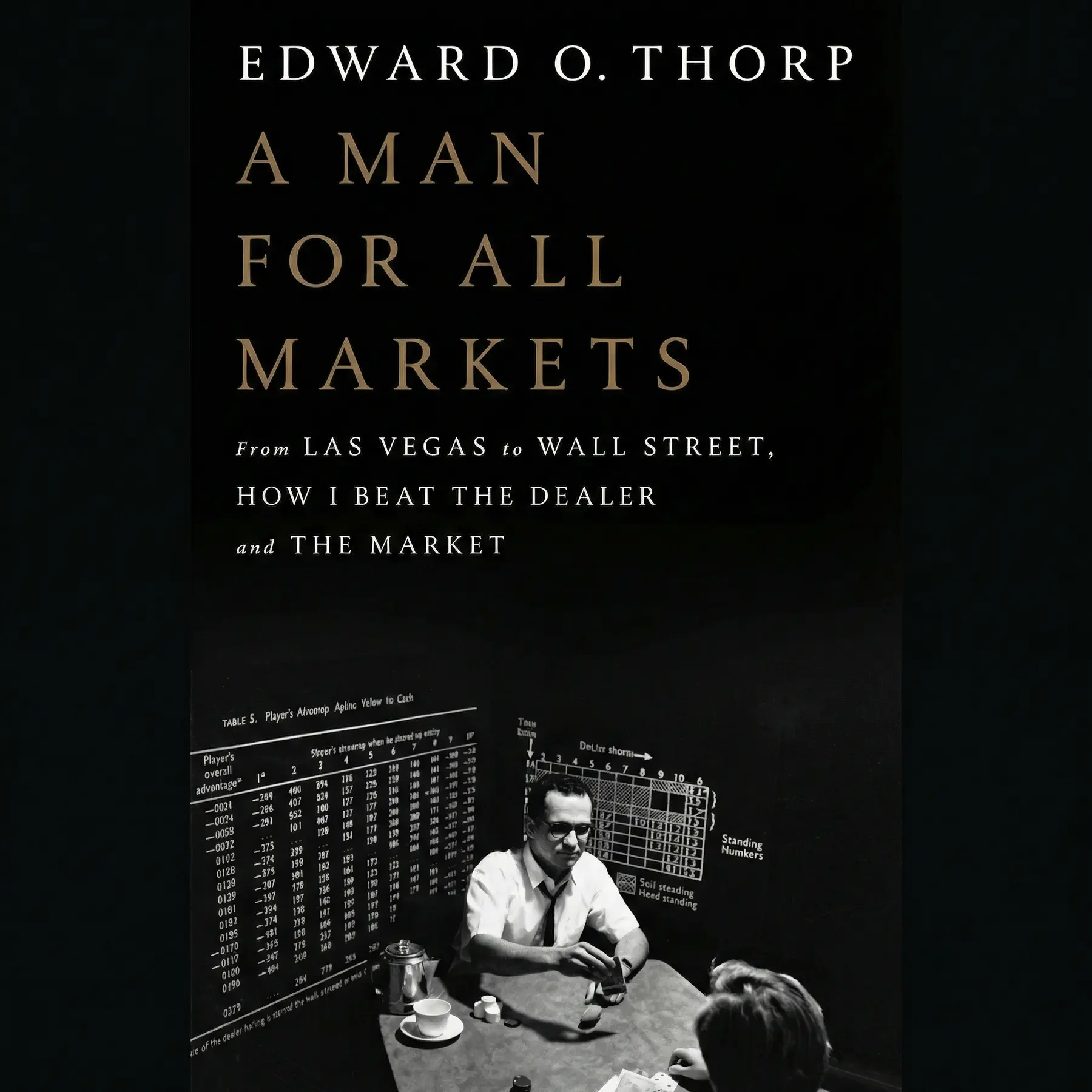
Listeners find this book to be a compelling read that offers useful wisdom for investors, with one person highlighting it as the most entertaining book produced by a mathematician. This memoir tracks Thorp’s journey from youth to the present, and listeners admire his exceptional character and genius. The writing is expertly crafted, and listeners value the profound intellectual content, with one listener characterizing the work as a textbook in how to think and invest.
This book is effectively a masterclass in applying scientific rigor to the chaotic worlds of gambling and finance. Thorp takes us from his humble childhood beginnings to the heights of Wall Street with a precision that only a mathematician could manage. I found the sections on the Kelly Criterion and his collaboration with Claude Shannon particularly illuminating, as they show how a systematic edge can overcome pure luck. Frankly, it’s refreshing to read a finance memoir that prioritizes logic over gut feeling or insider tips. While some might find his tone a bit dry, the sheer intellectual weight of his life story makes it an essential read for anyone interested in quantitative approaches. It isn't just a biography; it’s a blueprint for how to think about risk and survival in any market.
Show moreAs someone who usually finds financial memoirs incredibly dull, I was surprised by how much this one hooked me from the very first page. Thorp isn't just an investor; he's a polymath who views every challenge as a puzzle to be solved through experimentation and modeling. The way he describes his childhood and his path to becoming a professor provides great context for his later successes in the market. It’s basically a textbook on how to think about identify an edge and, more importantly, how to survive once you find it. Not gonna lie, I wish there was more about his specific algorithms, but I understand the need to keep it readable for a general audience. This is easily one of the most fascinating life stories I've encountered in years.
Show moreThe chapter on the Madoff discovery alone makes this entire book worth the price of admission. It reveals so much about Thorp's character—he wasn't just looking for profit; he was looking for the truth in a system full of noise and deception. His life is like a highlight reel of 20th-century quantitative finance, from early days at Berkshire to being a first-wave LP for Citadel. He writes with a straightforward, almost clinical clarity that makes complex derivative strategies understandable for the layperson. Some critics call him a braggart, but when you’ve actually done the things he’s done, I think a little pride is justified. It’s a remarkable journey of a self-taught man who decided to think for himself rather than follow the herd.
Show moreFew memoirs manage to bridge the gap between academic theory and practical application as effectively as Thorp does here. He treats the stock market like a giant laboratory, testing theories on warrants and options long before the Black-Scholes model became the industry standard. This book is a fascinating exploration of how being self-taught can lead to a massive edge, provided you have the discipline to follow the math where it leads. I especially liked his focus on the Kelly Criterion—it’s a concept many people talk about but few truly understand in practice. The writing is clear, the anecdotes are memorable, and the lessons on emotional control are essential for any serious investor. A definitive 5-star account of a pioneer’s life.
Show moreWow, what a wild ride through the history of gambling and high finance! Thorp comes across as the Forrest Gump of the quantitative world, appearing at every major turning point and meeting everyone from Claude Shannon to Warren Buffett. From his early days as a chemistry-loving kid to his later years spotting the Madoff fraud, his story is nothing short of incredible. I loved how he explained complex ideas like hedging and probability in ways that felt intuitive rather than intimidating. The book serves as an excellent guide for how to move through the world with a scientific mindset. It’s easily the most entertaining book I’ve read that was written by a mathematician, and I can't recommend it enough.
Show moreEver wonder how one man managed to break Las Vegas and then reinvent how we trade stocks? This autobiography provides the answer, mapping out Thorp’s journey from building primitive wearable computers to beat roulette to identifying Bernie Madoff as a fraud decades before anyone else. The narrative flows remarkably well through the first two-thirds, though the later chapters on general investment advice feel a bit tacked on. To be fair, his insights into the 2008 crash are still more valuable than most contemporary financial commentary I’ve seen. You get a real sense of his brilliant mind, even if he occasionally leans into his own legend a bit too much. It’s an incredibly entertaining look at a life lived at the intersection of math and money.
Show morePicked this up after hearing Thorp’s name mentioned in countless other finance books, and it did not disappoint. The early chapters detailing his experiments with card counting were a high-speed thrill ride, making the technical math behind it feel accessible and exciting. He captures the tension of the casino floors perfectly, showing the reality of being a pioneer in a world that didn't want him to win. However, the book does lose some steam toward the end when he pivots to more pedantic advice on index funds. The truth is, the biographical parts are the real gold here, especially his encounters with figures like Buffett and Shannon. It’s a solid 4-star read that offers a unique perspective on how the modern market was shaped.
Show moreFinally got around to reading this and I’m torn between being impressed and being slightly annoyed. On one hand, Thorp’s adventures with wearable computers and blackjack are legendary for a reason—they are genuinely exciting stories. On the other hand, the book is about 25% too long and the structure falls apart after he leaves the casinos behind. Personally, I found the 'how to think' aspect more valuable than the 'how to invest' advice, which felt a bit generic towards the end. It’s a capable delivery of a very unique life, but it definitely needs a more ruthless editor to trim the fluff. Still, his perspective on the efficient market hypothesis is priceless and makes the read worthwhile for anyone in the industry.
Show moreNot what I expected given the high praise it receives in most circles. While the first half of the book is an absolute page-turner about beating the house in Vegas, the second half feels like a different book entirely. Thorp starts jumping between various financial concepts and personal anecdotes with very little structure, which made the final 100 pages a bit of a slog for me. Look, he’s obviously a genius, but the way he presents his later achievements can come across as slightly self-aggrandizing. I appreciated the takeaways on risk management and avoiding ruin, but the delivery felt forced as the book dragged on. It’s worth reading for the history, but be prepared for the signal-to-noise ratio to drop significantly in the latter chapters.
Show moreTo be blunt, the author seems to take an immense amount of pleasure in describing what a special snowflake he is throughout these pages. Thorp is clearly a brilliant mathematician, but his self-aggrandizing tone made this a very painful read for me. Every success is framed as a stroke of his own unmatched genius, while failures are glossed over or blamed on external factors. The second half of the book is particularly messy, filled with plebian investment advice that you can find in any basic blog post. I was hoping for deep insights into his mathematical models, but instead, I got a long-winded list of how many famous people he knows. If you want a history of quant trading, read 'The Quants' instead of this ego trip.
Show moreJ. Craig Venter

James Herriot

Ishmael Beah
Barack Obama

Masaji Ishikawa
Ben Macintyre
AUDIO SUMMARY AVAILABLE
Get the key ideas from A Man for All Markets by Edward O. Thorp, plus 5,000+ more titles in English and Thai.







