
A Splendid Exchange: How Trade Shaped the World
William J. Bernstein
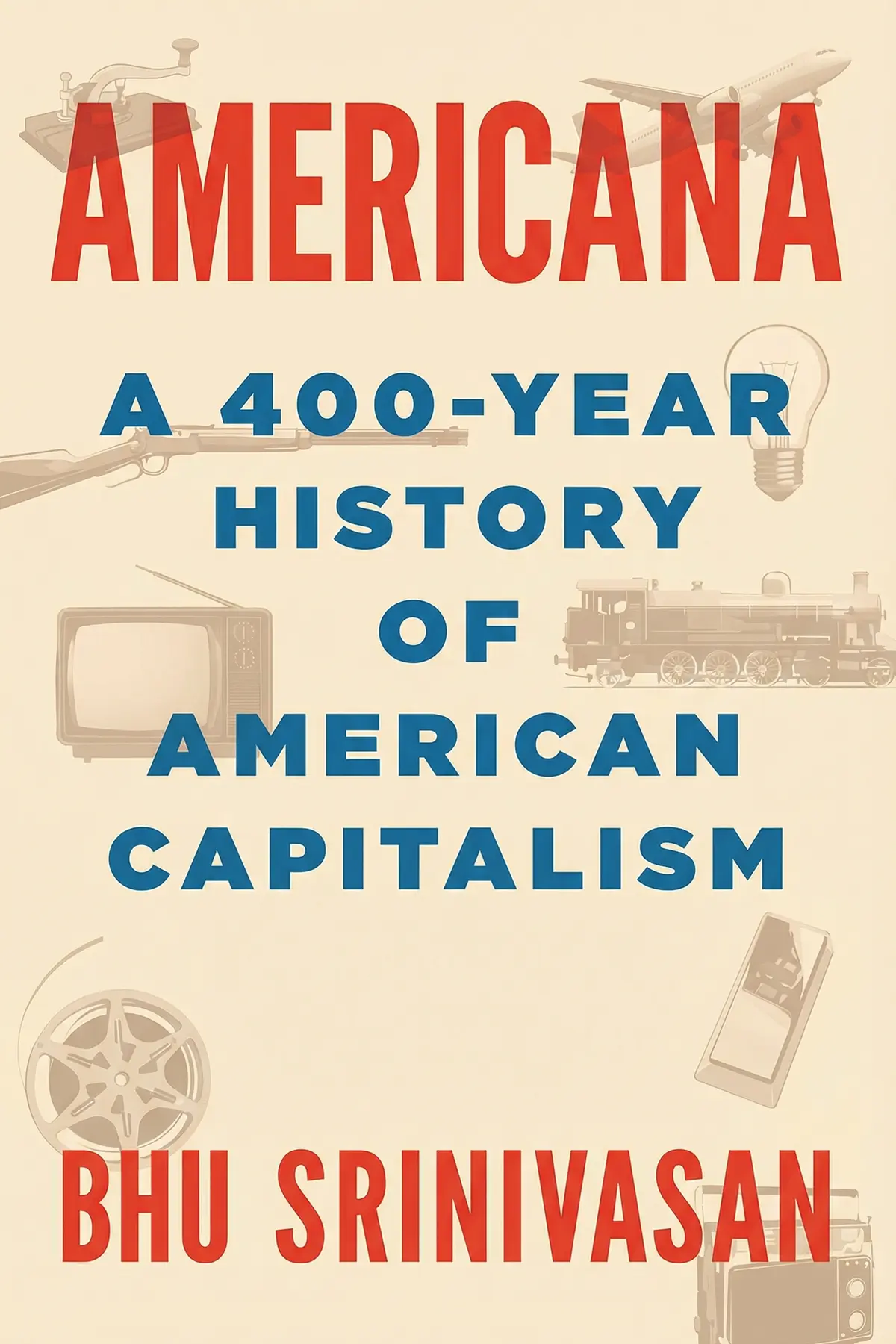
Americana offers a sweeping 400-year history of the United States, viewed through the lens of capitalism, exploring how commerce, innovation, and government intervention have uniquely shaped the American identity and global influence.
1 min 40 sec
When we think about the history of the United States, we often focus on the grand political gestures: the signing of the Declaration of Independence, the speeches of Abraham Lincoln, or the civil rights marches on Washington. But there is another way to view the American story—one that is perhaps more fundamental to the daily lives of its citizens. This is the story of capitalism. In Americana, Bhu Srinivasan invites us to look at the last four centuries through the lens of commerce, finance, and innovation. For Srinivasan, this isn’t just an academic exercise. As an immigrant who arrived from India at age eight, his own life was dictated by the search for economic opportunity, moving from state to state as his family chased the best prospects. This personal journey reflects the broader American experience: a nation built on the idea that commerce is the primary engine of progress.
Over the course of this exploration, we will see that the United States was never just a collection of political ideals; it was a business venture from the very beginning. From the high-risk financing of the Mayflower to the digital gold rush of the internet age, every major shift in American life has been underpinned by economic motives. We will discover how the brutal economics of slavery created a financial bubble that eventually burst in civil war, how the government stepped in to regulate the wild excesses of the Gilded Age, and how the infrastructure of highways and suburbs transformed the way we live and eat. This is a story of tension—between the drive for profit and the needs of democracy, between individual brilliance and state support. By the end, you will see that the identity of the United States is inseparable from the development of capitalism, and that understanding the money behind the history is the only way to truly understand the country today.
2 min 05 sec
Centuries before Silicon Valley, the first English settlers were funded by speculative investors looking for a massive return on a high-risk voyage across the ocean.
1 min 44 sec
The fight for American independence was driven as much by balance sheets and unfair taxes as it was by the abstract ideals of liberty and freedom.
2 min 06 sec
Overcoming the vastness of the American landscape required bold innovations in transit that forever changed the pace of commerce and the role of the state.
1 min 48 sec
Before the Civil War, the American South built a massive and fragile economy where human beings were treated as the most valuable financial assets in the nation.
1 min 46 sec
The discovery of gold and oil in the mid-19th century provided the raw materials that would fuel the next stage of American industrial dominance.
1 min 55 sec
In the late 1800s, a flood of new technologies—from the lightbulb to the typewriter—transformed how Americans worked, communicated, and spent their money.
1 min 50 sec
The era of Carnegie and Rockefeller saw American industry reach unprecedented heights, but it also created vast inequalities that forced a rethink of the government’s role.
1 min 30 sec
President Theodore Roosevelt fundamentally changed the relationship between the state and big business, arguing that the government must protect the public from corporate greed.
1 min 55 sec
The global shocks of the World Wars and the Great Depression forced the American government to take on a massive, permanent role in managing the national economy.
1 min 46 sec
Following World War II, a new kind of American capitalism emerged, focused on mass-produced housing, consumer credit, and the growth of the middle class.
1 min 39 sec
The creation of the Interstate Highway System transformed how Americans traveled and ate, while simultaneously leading the nation into a precarious dependence on foreign oil.
2 min 01 sec
From the first punch cards at the Census Office to the sleek devices of Steve Jobs, the story of American computing is one of constant reinvention and staggering wealth.
1 min 41 sec
As we have seen through this 400-year journey, American capitalism is not a static set of rules, but a dynamic and ever-evolving force. From its beginnings as a risky colonial venture to its current status as a digital powerhouse, the United States has been shaped by the pursuit of profit, the spark of innovation, and the constant tension between private interests and the public good. We have witnessed how tobacco, cotton, steel, oil, and silicon have each had their turn in the spotlight, and how each has left an indelible mark on the nation’s identity.
The throughline of this history is that capitalism and democracy in America are deeply intertwined. The market drives the innovation and growth that provide the resources for the nation to flourish, but it also creates excesses and inequalities that require the steadying hand of government. Whether it was Theodore Roosevelt breaking up the trusts, FDR’s New Deal rescuing the country from the Depression, or the creation of the interstate highway system, the state has always been a partner in the capitalist project.
The lesson of Americana is that the American story is one of constant reinvention. The challenges we face today—income inequality, global competition, and the power of big tech—are not new. They are the latest chapters in a long-running narrative. By understanding the economic forces that have driven us this far, we can better navigate the future. Capitalism has given America its greatest triumphs and its most difficult trials, and as long as the country exists, the two will remain inseparable. The most important takeaway is to recognize that we are all participants in this ongoing economic experiment, and that the future of the nation will be decided by how we balance the drive for prosperity with the ideals of a democratic society.
Americana explores the history of the United States not through political dates and battles, but through the evolution of its economy and business innovations. From the very first settlers who were funded like modern-day startups to the digital titans of Silicon Valley, the book argues that the American story is fundamentally a story of capitalism. It traces the rise of massive industries like tobacco, cotton, steel, and oil, showing how each wave of commerce reshaped the landscape and the lives of the people within it. Beyond just documenting growth, the narrative examines the complex relationship between private enterprise and the state. It highlights how government intervention—through infrastructure, regulation, and wartime mobilization—has been a constant, if sometimes invisible, partner in the market. The book promises a deep understanding of how financial motives drove westward expansion, fueled the tragedy of slavery, spurred technological breakthroughs, and created the modern consumer culture that defines much of the world today.
Bhu Srinivasan is a media entrepreneur who came to the USA from India at the age of eight, traveling widely around the country with his family. Early in his career, he founded a news aggregation startup, and went on to work in gaming, publishing, and data. He now lives in Connecticut with his wife and children. Americana is his first book.
Listeners find this work exceptionally accessible and expertly crafted, presenting a structured overview of U.S. commercial history packed with data. Furthermore, they value the narrative style, as one listener points out the way it integrates different financial eras. The title also earns praise for being informative for experts and beginners alike while maintaining a neutral stance on the capitalist system.
This book provides a masterclass in how to synthesize four centuries of economic evolution into a single, cohesive narrative. Bhu Srinivasan manages to take complex financial shifts and turn them into a series of gripping tales that feel more like a biography of a nation than a dry economic text. I was especially struck by the way he traces the line from early colonial tobacco exports all the way to the modern digital era. It’s rare to find an author who can balance cold facts and figures with such a fluid, engaging storytelling style. While some might argue it covers too much ground too quickly, I found the pace perfectly suited for a general reader looking to understand the 'why' behind the American experience. Truth is, the book offers an unbiased perspective that is sorely missing from most modern discussions about capitalism today.
Show moreEver wonder how a single plant like tobacco could lay the foundation for a global superpower? Srinivasan answers this and so much more in a book that feels incredibly relevant to our current technological age. He doesn't just list dates; he weaves together a tapestry of innovation, greed, and genius. I loved how he compared the Gilded Age's robber barons to the modern titans of Silicon Valley, making the past feel like a mirror to the present. The writing is punchy, with short, sharp sentences that keep the momentum high even when discussing tax codes or trust-busting. It’s an educational journey that doesn’t feel like schoolwork. Not gonna lie, I haven’t enjoyed a non-fiction book this much in years. It is a vital read for anyone trying to make sense of the modern American landscape.
Show moreFinally got around to reading Americana, and frankly, it changed how I view the 'American Dream' entirely. Srinivasan’s perspective as an immigrant who moved here at a young age adds a layer of appreciation for the system that a native-born author might take for granted. The way he explores the 'sharing economy' companies like Uber and Airbnb in the final chapters really ties the whole 400-year journey together. He shows that the spirit of venture has always been about disruption, for better or worse. The book is packed with data, yet it never feels bogged down by it because the narrative arc is so strong. It is an accessible, well-written, and deeply insightful look at how capitalism is baked into the very DNA of the United States. A must-read for any business enthusiast.
Show moreWow, Srinivasan really nailed the narrative arc here. This isn't just a book about money; it’s a book about the relentless drive to build something new. The author treats the founding of the colonies and the founding of a tech startup with the same level of intellectual curiosity. I found the section on the 'sharing economy' especially thought-provoking, as it forced me to reconsider the cost of convenience in our modern lives. The prose is elegant and the research is clearly extensive, yet it reads with the speed of a novel. It’s rare to find a book that can explain the mechanics of a market economy while keeping you emotionally invested in the people behind the trades. This is an essential addition to the library of anyone interested in American history or global economics.
Show moreWhat a refreshing and vivid exploration of the forces that actually built the modern world we inhabit. Srinivasan avoids the usual political bickering and instead focuses on the tangible innovations and economic structures that defined different eras. I loved the way he organized the book by industry—Food, Roads, Computing—as it made the progression of the country feel logical and inevitable. The storytelling is top-notch, turning what could have been a slog of statistics into a fascinating drama. Personally, I think this should be required reading for anyone in the tech industry to understand the historical shoulders they are standing on. It’s an excellent, unbiased overview that manages to be both educational and entertaining. A truly impressive debut that doesn't disappoint.
Show morePicked this up because the premise of looking at the Mayflower through the lens of venture capital seemed incredibly clever. For the most part, the author delivers on that promise by showing how money and markets have always been the silent engines of American history. The chapters on the Industrial Revolution and the rise of the automobile were particularly well-researched and full of little-known vignettes that kept me turning pages late into the night. My only real gripe is that the book occasionally glosses over the deeper sociological impacts of these economic shifts, especially regarding the workforce. To be fair, it’s a massive undertaking to condense 400 years into 500 pages, so some nuance is bound to be lost. Still, it is a highly readable account that makes the 'dismal science' feel anything but boring.
Show moreAs someone who usually finds economic history as dry as dust, I was pleasantly surprised by how much this felt like a collection of propulsive short stories. The author does a fantastic job of highlighting how government intervention and private enterprise have always been awkwardly danced together. I particularly enjoyed the sections on the Civil War and how it paved the way for the industrial boom that followed. Sometimes the transition between chapters feels a bit abrupt, and I wish he had spent more time on the environmental consequences of all this growth. Look, it’s not a perfect academic history, but it’s a fantastic overview for the average person. It manages to be pro-business without being a cheerleader, which is a very difficult line to walk. Definitely worth the time if you want a big-picture view.
Show moreThe chapter on Levittown and the post-war suburban boom was a particular highlight for me. It perfectly illustrated how economic policy and consumer desire combined to reshape the physical map of the country. Srinivasan has a knack for finding the human element within the macro-economic shifts. However, I did notice that some of the later chapters on the internet era seemed to lean heavily on existing narratives from other popular business books. While those sections were still informative, they didn't feel quite as fresh as the earlier colonial and 19th-century history. Still, the breadth of topics—from oil and steel to radio and TV—is staggering. It’s a great introductory text that makes the complex history of American business feel approachable and exciting. I’d recommend it to anyone looking for a solid historical foundation.
Show moreI’ll admit the concept is brilliant, but the execution felt a bit uneven in places. Srinivasan is clearly a gifted writer with a background in venture capital, and his personal reflections on the market add a nice touch to the early chapters. However, as the book progressed toward the 20th century, I felt the narrative became a bit jumbled and oversimplified. For instance, the section on the development of the Midwest retail scene contained a factual error regarding Target’s origins that pulled me out of the experience entirely. If you are already well-versed in US economic history, you might find yourself wishing for more depth instead of the quick 'punchline' style used here. It functions better as a gateway for novices than a definitive resource for history buffs. It's a decent effort, but it lacks the analytical bite I was hoping for.
Show moreTruth is, I have mixed feelings about how much ground this book tries to cover in just 500 pages. On one hand, the writing is lively and the author’s passion for the subject is undeniable. On the other hand, the 'big picture' approach often leaves the pixels a bit blurry. I was disappointed that certain social justice issues and the long-term impact of slavery on Northern industrialization were handled so briefly. The book is very confident in its delivery, but that confidence sometimes masks a lack of nuance in the more controversial periods of US history. It’s a good general history with a strong emphasis on entrepreneurial events, but it feels more like a collection of essays than a deep-dive analysis. If you want a quick, engaging overview, this is it, but don’t expect a definitive scholarly work.
Show moreWilliam J. Bernstein

Ishmael Beah



Yanis Varoufakis

Ben Macintyre
AUDIO SUMMARY AVAILABLE
Get the key ideas from Americana by Bhu Srinivasan, plus 5,000+ more titles in English and Thai.







