

18 min 51 sec
Amusing Ourselves to Death: Public Discourse in the Age of Show Business
By Neil Postman
Explore how the shift from a print-based culture to a television-dominated society has transformed our public discourse into mere entertainment, threatening our ability to engage in serious thought and meaningful democracy.
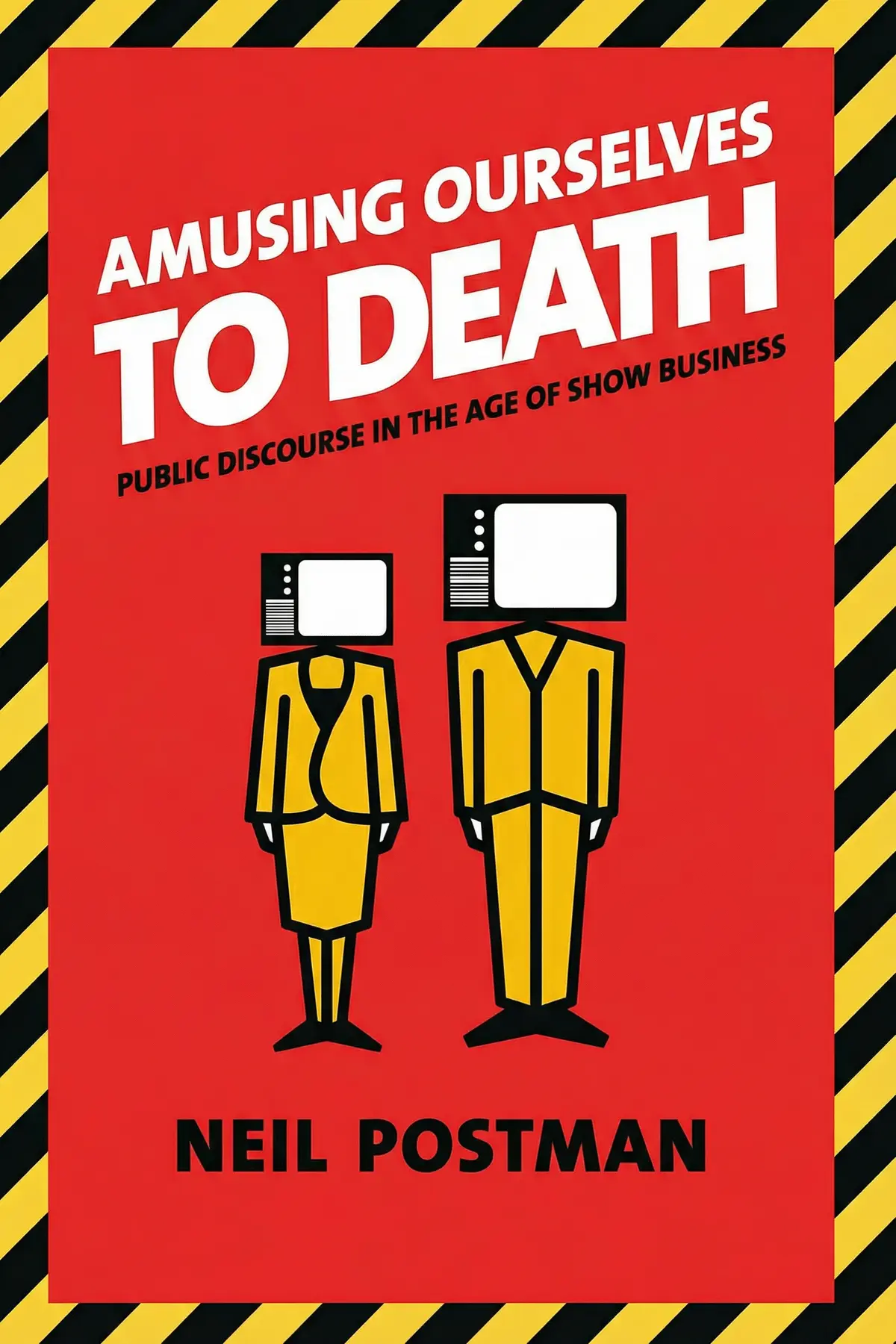
Table of Content
1. Introduction
1 min 39 sec
In the mid-twentieth century, two dark visions of the future competed for the attention of the public mind. One was George Orwell’s 1984, which warned of an oppressive state that banned books and used surveillance to crush the human spirit. The other was Aldous Huxley’s Brave New World, which proposed a far more subtle danger: a society so obsessed with pleasure and triviality that no one would want to read a book in the first place. As we look at the landscape of modern life, it becomes increasingly clear that while we feared the prison of Orwell, we may have actually walked willingly into the amusement park of Huxley.
This is the central concern we will explore today. We are living through a fundamental shift in how human beings process reality. For centuries, the printed word was the primary lens through which we understood politics, religion, and science. This medium demanded logic, sequence, and a high level of concentration. But with the rise of electronic media—specifically television—the rules of the game have changed. Today, the goal of communication is rarely to inform or to challenge; it is almost always to entertain.
In this journey, we will see how the move from a word-centered culture to an image-centered one hasn’t just changed what we talk about—it has changed how we think. We will trace the evolution from the rigorous debates of the 1800s to the era of the thirty-second soundbite. By the end, you’ll see that the greatest threat to a free society might not be a dictator who takes away our information, but a screen that makes us stop caring whether that information is true or meaningful. Let’s look at how our thirst for amusement is reshaping the world.
2. The Medium Shapes the Message
2 min 18 sec
Discover why the tools we use to communicate aren’t just neutral vessels, but actually dictate what kind of truths we are capable of expressing.
3. The Literary Peak of Early America
2 min 16 sec
Take a trip back to a time when Americans were obsessed with reading and complex ideas, setting a standard for discourse that seems impossible today.
4. The Revolution of Irrelevance
2 min 20 sec
See how the invention of the telegraph and the camera began the process of stripping information of its context and meaning.
5. Television and the Gospel of Entertainment
2 min 07 sec
Learn why the primary purpose of television is never to inform or educate, but to keep you watching at all costs.
6. The Secularization of the Sacred
2 min 18 sec
Explore how the medium of television strips religion of its mystery and turns the spiritual experience into a theatrical performance.
7. The Erosion of Learning
2 min 08 sec
Examine how the ‘education’ provided by screens is fundamentally at odds with the way the human mind actually learns and grows.
8. The Huxleyan Warning
2 min 00 sec
Understand why the biggest threat to our freedom isn’t a Big Brother who censors us, but a society that is too distracted to care about the truth.
9. Conclusion
1 min 45 sec
The journey from the printing press to the television screen has been more than just a change in technology; it has been a fundamental transformation of the human experience. We have moved from an age of reason, where discourse was grounded in the rigorous demands of the written word, to an age of show business, where our understanding of the world is shaped by a kaleidoscope of entertaining images.
As we have seen, this shift has touched every corner of our lives. It has turned our politics into a beauty contest, our religion into a theatrical performance, and our education into a passive amusement. The most chilling part of Neil Postman’s analysis is that this hasn’t happened against our will. We have embraced these changes because they are easy, because they are pleasurable, and because they make us feel informed without requiring us to do the hard work of thinking.
But the cost of this convenience is high. A society that cannot distinguish between a serious argument and an entertaining performance is a society that is ill-equipped to handle the challenges of the future. If we want to avoid the Huxleyan fate of being ‘amused to death,’ we must reclaim the virtues of the typographic mind. We must learn to value context over speed, depth over appearance, and logic over emotion.
The next time you find yourself in front of a screen, ask yourself: Is this informing me, or is it merely distracting me? Is it giving me the tools to understand the world, or is it just making me feel good while I ignore it? The health of our democracy and the quality of our culture depend on our ability to look away from the flashing lights and return to the serious, demanding, and ultimately rewarding work of truly engaging with ideas. The choice is ours, but the clock is ticking.
About this book
What is this book about?
Have you ever wondered why modern news feels like a performance or why political debates seem more like beauty pageants than intellectual exchanges? This summary dives into the profound arguments of Neil Postman, who suggests that the very medium we use to communicate determines the quality of our culture. By tracing the history of information—from the written word of the American founders to the flashing images of the television age—Postman reveals a startling truth: we are no longer being suppressed by an external force, but rather being distracted into submission by our own desire for amusement. The promise of this exploration is a deeper understanding of the "hidden curriculum" of modern media. You will learn how the transition from typography to the screen has eroded our attention spans, simplified our logic, and turned critical sectors like education, religion, and politics into branches of show business. Ultimately, it serves as a wake-up call to recognize the invisible influences of the technology in our living rooms and to reclaim our capacity for serious, contextualized discourse.
Book Information
About the Author
Neil Postman
Neil Postman was a distinguished social critic and a leading theorist in the fields of education and communication. For more than four decades, he served as a professor at New York University, where he influenced generations of thinkers. Over the course of his prolific career, he wrote more than 20 books, including notable works such as The End of Education and How to Watch TV News, cementing his reputation as a primary voice on the effects of technology on culture.
Ratings & Reviews
Ratings at a glance
What people think
Listeners find this work to be a fundamental read, especially for college students, and value its distinct viewpoint and stimulating illustrations. They also consider it highly applicable to the modern era, particularly in the age of the internet, and speak highly of the compelling prose and lucid, impactful writing. Additionally, the volume offers significant observations on the evolution of media, and listeners feel the book is a worthwhile investment.
Top reviews
Hang
This book should be required reading in every high school and college curriculum. Postman wrote this in the 80s, yet it feels more urgent in our TikTok-saturated world than it probably did during the Reagan era. He brilliantly explains why Aldous Huxley’s vision of a society numbed by pleasure is a much more accurate prediction of our current reality than Orwell's Big Brother. We aren't being forced to give up our thoughts; we are voluntarily surrendering them for the sake of 15-second sound bites and flashy visuals. Frankly, the chapter on how the telegraph changed the nature of news was a massive eye-opener for me. It transformed information from something local and actionable into a series of disjointed facts that have zero relevance to our actual lives. If you want to understand why our political debates have devolved into shouting matches, you need to read this immediately. It’s worth every penny.
Show moreMia
Wow. This is one of those rare books that completely shifts your perspective on how you consume information. Postman's opening comparison between Orwell and Huxley is easily the most famous part of the book, and for good reason. It perfectly encapsulates the terrifying reality that we are amusing ourselves to death rather than being oppressed by some external force. The truth is, we have become a culture preoccupied with trivialities, much like the "feelies" in Brave New World. His writing is engaging and surprisingly accessible for a work of social theory. I was particularly struck by the discussion of how news programs use "now... this" to transition between tragedies and commercials without any emotional weight. It makes the world feel chaotic and incoherent, just as he predicted. Even though it was written decades ago, it explains the current internet landscape better than most modern pundits ever could.
Show moreTaweesak
The chapter on the Lincoln-Douglas debates haunts me. It is almost impossible to imagine a modern audience sitting for seven hours to listen to complex political arguments without pictures or music. Postman argues that we have traded depth for speed, and the results are disastrous for our democracy. Gotta say, his prediction that we would eventually value a politician’s "image" over their intellect has come true in the most dramatic way possible. We live in a world of thirty-second sound bites where charisma outweighs content every single time. The book provides a vital framework for understanding how the shift from print to screens has fundamentally rewired our brains. It’s an essential purchase for anyone worried about the state of public discourse. Truly, it’s a masterpiece of cultural observation that remains incredibly relevant to our generation.
Show moreNathan
After hearing about the 'Orwell vs. Huxley' intro for years, I finally sat down with the full text. It lived up to the hype and then some. Postman doesn't just complain about TV; he provides a rigorous history of how our tools of communication dictate what we consider "truth." The way he describes the shift from the age of exposition to the age of show business is breathtakingly clear. Not gonna lie, I felt a bit attacked by his descriptions of how we seek out distractions to avoid thinking, but that’s the mark of a great book. It’s an engaging read with sentences that actually mean something, which is ironic considering the subject. For the price of a couple of movie tickets, you get a perspective that will last a lifetime. Absolutely essential for the internet age.
Show moreAkira
Ever wonder why our political discourse feels so hollow and superficial these days? Postman points to the transition from a typographic culture to a visual one as the primary culprit. He uses the Lincoln-Douglas debates—which lasted seven hours—to show how much our attention spans have withered under the influence of television. To be fair, some of his examples feel a bit dated now that we’ve moved past the era of three major networks, but the core logic remains unshakable. The idea that "the medium is the metaphor" helps explain why we care more about a candidate's appearance than their policy positions. I found his analysis of televised religion particularly biting, especially regarding how the medium strips away the sacredness of faith. It’s a dense read at times, but the clarity of his prose keeps you moving through the complex arguments. Highly recommended for anyone trying to navigate the noise of the internet age.
Show moreYongyut
Finally got around to reading this after hearing it cited in dozens of podcasts. It’s a remarkable piece of media history that offers a unique perspective on how we got to this point of total digital saturation. Postman is at his best when he’s deconstructing "show business" in places where it doesn't belong, like education and religion. The analysis of televangelists making "graven images" of themselves was particularly insightful and something I’d never considered before. My only real gripe is that he can be a bit repetitive with his "medium is the metaphor" mantra. However, the sentences are so well-crafted and meaningful that you don't mind the occasional retread of a concept. It’s a quick read but one that stays with you long after you’ve put it down. Every college student should have a copy of this on their shelf to help them navigate the modern media circus.
Show moreWipawan
As someone who spends way too much time on social media, this was a necessary reality check. Postman describes a "peek-a-boo world" where events pop into view and then vanish without context or history. That perfectly describes my Twitter feed. He shows how the telegraph and then television turned news into a commodity of amusement rather than a tool for informed action. In my experience, most of what I read online is just "irrelevant information" that makes me feel busy without actually teaching me anything. The writing style is punchy and direct, making it a relatively easy read despite the heavy subject matter. I wish he had lived to see the smartphone era, as his insights would have been even more devastating. This book is a must-buy for anyone looking to develop a better "bullshit detector" in the 21st century.
Show morePaiboon
Direct and devastatingly accurate. Postman’s critique of "educational" television like Sesame Street was particularly fascinating to me. He argues that such shows don't teach children to love learning, they just teach them to love television. It’s a provocative idea that makes you rethink everything you were told about media as a kid. The book is filled with these kinds of "aha!" moments that challenge your basic assumptions. While he focuses on TV, his logic applies perfectly to how we use apps today. Truth be told, it’s a bit depressing to realize how far we’ve fallen since the days of long-form debate, but awareness is the first step toward change. The writing is sharp, the arguments are logical, and the message is more important now than ever. A solid addition to any library.
Show moreWorawit
Not what I expected, though I can't deny the intellectual weight of the argument. While Postman is undoubtedly a brilliant writer with a sharp "bullshit detector," his disdain for visual media feels a bit elitist and one-sided at points. He champions the written word as the only true vessel for logic and truth, which feels reductive in an age where visual storytelling can be incredibly sophisticated. Look, I agree that television has turned everything into entertainment, but he almost completely ignores the potential for education within the medium. The section on the telegraph was fascinating, yet I found myself disagreeing with his assertion that context-free information is inherently useless. It’s a thought-provoking book that definitely makes you question your screen time, but it lacks the nuance I was hoping for. Still, it’s a foundational text for media studies and worth a look.
Show moreMeen
Picked this up for a media studies class and I have mixed feelings. On one hand, Postman’s core thesis about the "entertainment-ization" of everything is undeniably brilliant and prescient. On the other hand, the book is very much a product of 1985. His focus on network television feels a bit quaint in a world of algorithmic feeds and deepfakes. Personally, I found some of his arguments about the "logic" of the written word to be a bit romanticized. He treats the 18th century like an intellectual utopia, which I think ignores a lot of the propaganda that existed back then. That said, his warning about Huxley’s vision is still incredibly chilling. It’s worth reading for the historical context, but take some of his more extreme claims with a grain of salt. It’s a solid read that offers some great nuggets of wisdom if you can get past the dated examples.
Show moreFeatured in
Readers also enjoyed

A Biography of Loneliness: The History of an Emotion
Fay Bound Alberti
A Force for Good: The Dalai Lama's Vision for Our World
Daniel Goleman
A Room of One’s Own
Virginia Woolf
Abolish Rent: How Tenants Can End the Housing Crisis
Tracy Rosenthal
Abortion: Our Bodies, Their Lies, and the Truths We Use to
Jessica Valenti
AUDIO SUMMARY AVAILABLE
Listen to Amusing Ourselves to Death in 15 minutes
Get the key ideas from Amusing Ourselves to Death by Neil Postman, plus 5,000+ more titles in English and Thai.
- 5,000+ titles
- Listen as much as you want
- 7-day free trial
- Cancel anytime







