
16 min 08 sec
Anything You Want: 40 Lessons for a New Kind of Entrepreneur
By Derek Sivers
Anything You Want explores an unconventional path to business success, emphasizing that entrepreneurship should be a tool for personal fulfillment. Derek Sivers shares how keeping things simple and customer-focused leads to meaningful growth.
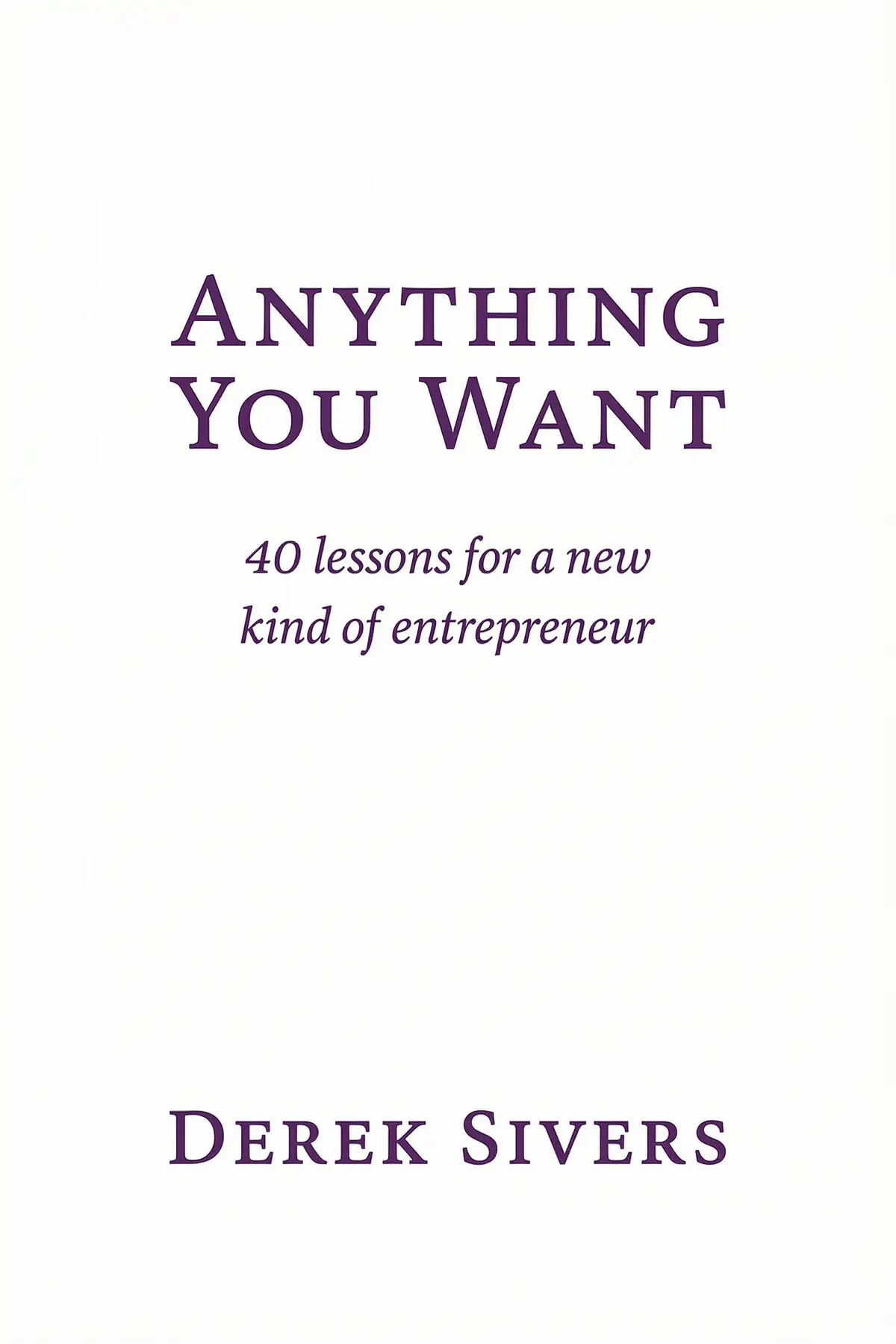
Table of Content
1. Introduction
1 min 19 sec
When we think about starting a business, we are often bombarded with a very specific set of images: high-stakes boardrooms, complex financial projections, and the endless pursuit of massive venture capital. We are told there is a ‘right’ way to do things—a path that involves rigid delegation, standardized roles, and a relentless focus on the bottom line. But what if all of that advice is actually a distraction from what really matters? What if you could build a company that doesn’t just make money, but also makes you genuinely happy?
This is the central question explored in Anything You Want. The journey began when Derek Sivers, a musician looking for a way to sell his own CDs online, accidentally founded a company that would change the independent music industry. CD Baby wasn’t the result of a grand corporate strategy; it was the result of a series of small, intentional choices made to solve real problems for real people.
In the following sections, we are going to explore a philosophy of entrepreneurship that prioritizes the human element over the technical one. We will look at why having no money can be your greatest asset, why refusing certain customers can be the best thing for your brand, and how to design a job that you actually want to wake up for every morning. This isn’t just a story about selling CDs—it’s a guide to creating a life and a career on your own terms. It’s about the realization that when you own the business, you get to make it anything you want.
2. Iterating Toward Success Through Simplicity
2 min 11 sec
Discover why the best business plans aren’t found in thick manuals, but in simple ideas that catch fire through constant refinement.
3. The Power of a Defined Audience
2 min 06 sec
Learn how choosing a specific group to serve allows you to stay flexible and true to your core principles.
4. Why Constraints Outperform Capital
2 min 12 sec
Explore the surprising reasons why starting with no money can actually lead to more creative and sustainable solutions.
5. Prioritizing the Problem Over the Profits
2 min 12 sec
Discover why the most successful entrepreneurs are willing to let their businesses go if the problem they solved no longer exists.
6. Mastering the Delicate Balance of Delegation
2 min 14 sec
Uncover the systems needed to share responsibility without losing control of your business’s direction.
7. Designing a Career Around Your Happiness
2 min 18 sec
Learn why you should ignore traditional business titles and build a role that matches your personal passions.
8. Conclusion
1 min 36 sec
As we wrap up this exploration of a different kind of entrepreneurship, it’s important to bring everything back to the core throughline: your business is yours to shape. Success isn’t found in a magic formula or a massive bank account; it’s found in the courage to stay simple, the dedication to be useful, and the willingness to do things your own way. We’ve seen that the most powerful ideas are often the ones that solve a small, personal problem for a specific group of people. We’ve learned that constraints can be the spark for incredible creativity and that a business that doesn’t make you happy is a business that needs to change.
Derek Sivers’ journey with CD Baby reminds us that the best business strategies are often the most human ones. It’s about being honest with your customers, trusting your team while maintaining clear systems, and refusing to be bullied into a conventional role that doesn’t fit your personality. You don’t need a boardroom full of experts to tell you how to run your life. You just need to listen to your customers and stay true to your own internal compass.
As a final thought, consider how you can apply this spirit of personal choice to your own work today. Take a look at the standard ‘rules’ you’ve been following. Maybe it’s the expectation that you must start your day at 9 a.m. because that’s what everyone else does. If you and your team are more productive starting at noon, why not change it? Make choices that align with your reality. The more your business reflects your true self, the more sustainable and enjoyable it will be. Don’t build a monument to corporate tradition; build something that you actually want. The power to create a new kind of success is entirely in your hands.
About this book
What is this book about?
Anything You Want is a refreshing departure from standard corporate manuals. It tells the story of how a simple project to help independent musicians sell their music transformed into CD Baby, a multi-million-dollar company. Instead of focusing on venture capital, complex exit strategies, or aggressive scaling, the book promises a different kind of success: one where you remain in control of your happiness and your principles. Through a series of short, punchy lessons, the book explains why you don't need a huge budget to start, how to identify your true audience, and why the most important person in your business is the one you are currently serving. It challenges the reader to reconsider what it means to be a CEO and provides a roadmap for building a business that reflects your personal values rather than industry norms. The ultimate promise is that by staying true to yourself and your customers, you can build a venture that is both profitable and deeply satisfying.
Book Information
About the Author
Derek Sivers
Derek Sivers began his professional journey as a musician who simply wanted to find a way to sell his own music on the internet. This personal need evolved into CD Baby, which grew to become the largest online distributor of independent music. By the time Sivers sold the company in 2008 for $22 million, he had revolutionized the way independent artists reached their fans.
Ratings & Reviews
Ratings at a glance
What people think
Listeners find that reactions to the content's depth are mixed—with some listeners perceiving the advice as common sense—though most value the "out of the box" and non-conformist perspective on entrepreneurship. They admire the author’s sincere accounts of starting CD Baby, noting that his tips favor personal fulfillment and consumer joy over conventional corporate scaling. Additionally, they highlight the perks of the short, efficient layout, with one listener describing the work as a "pragmatic guide" for individuals forging their own way. Furthermore, listeners are drawn to the author’s captivating delivery, with another recommending the audio format to truly appreciate his "simple, but genius" point of view.
Top reviews
Manika
This little manifesto is exactly what the startup world needs more of right now. Derek Sivers manages to pack more punch into a hundred pages than most business gurus do in their four-hundred-page doorstops. I love how he reframes the entire concept of success around personal joy and customer happiness rather than just mindless scaling. Truth is, his stories about CD Baby feel so authentic because he admits when he was just winging it or acting out of pure instinct. It’s refreshing to hear an entrepreneur say that if you aren't having fun, you’re doing it wrong. The 40 lessons are punchy, unconventional, and remarkably easy to digest in a single sitting. I especially appreciated the part about keeping your business small on purpose; it’s a total counter-narrative to the typical Silicon Valley 'growth at all costs' mindset. A simple, genius guide for anyone who wants to build something that actually matters to them.
Show moreAnucha
The frozen squid story alone makes this worth the price of admission. It perfectly encapsulates Sivers' philosophy: do the unexpected thing that makes people tell their friends about you. Most business books are dry and repetitive, but this one reads like a late-night conversation with a very smart, very successful friend. I’ve read a lot of entrepreneurship literature, and nothing else captures the spirit of 'creative independence' quite like this. He treats the business as a piece of art rather than a machine for printing money. In my experience, that is the only way to stay sane while building something from scratch. The lessons on delegating—and the mistakes he made there—were incredibly vulnerable and helpful. It’s a hug and a kick in the pants all at once. If you’re tired of the corporate grind, buy the audiobook and let Derek’s cadence run through your head. It’s transformative.
Show moreKwan
Wow. This isn't just a business book; it's a guide for living a more deliberate, honest life. I loved the way Derek justifies taking the 'long road' to learn things himself rather than outsourcing everything immediately. It’s a beautiful reminder that the process of building is often more rewarding than the result. I’ve already bought copies for three of my friends who are struggling with their own side projects. It’s indispensable advice for the soul. Truly a special piece of writing.
Show moreMuk
In my experience, most entrepreneurial advice is just a recipe for burnout, but this is the antidote. Sivers reminds us that we have the power to make our businesses anything we want. There is no 'right' way, only your way. I found the 40 lessons to be out-of-the-box and genuinely refreshing compared to the recycled garbage you usually find on the bestseller lists. He focuses on passion-driven profit, which feels much more sustainable than the typical 'hustle' culture nonsense. The book is short because it doesn't need to be long; he says what needs to be said and then gets out of the way. It’s an absolute hug for the creative professional. If you want to maintain your integrity while growing a brand, read this twice. It’s simple, pragmatic, and remarkably kind.
Show morePornpimon
Picked this up on a whim after seeing it mentioned in a web dev forum, and I found it surprisingly grounded. It isn't a technical manual by any means, but rather a collection of philosophical snapshots from Sivers' journey. The anecdote about his interaction with Steve Jobs was a highlight for me, illustrating the grit required when you’re caught in the gears of industry giants. Some might say the advice is common sense, but in a world where everyone overcomplicates business, stating the obvious is actually a radical act. I did feel like some of the lessons were a bit too specific to the late-90s tech landscape to be fully universal. However, the core message about prioritizing the human element over the bottom line is timeless. It’s a very quick read—perfect for a commute—and leaves you with plenty of mental food for thought regarding your own career path.
Show moreDome
As someone constantly drowning in MBA-style growth strategies, Sivers’ approach felt like a necessary exhale. He doesn't care about your five-year plan or your exit strategy; he cares about whether your customers are smiling. The way he describes coding the original 'Buy Now' button for his friends' bands makes the daunting task of starting a business feel accessible and almost playful. I found the section on 'hell yeah or no' to be particularly transformative for my own decision-making process lately. My only real gripe is that it’s so short that it leaves you wanting more depth on the harder days of CD Baby. He glosses over some of the stress, making success look a bit more effortless than it likely was in reality. Still, his voice is so infectious that it's hard not to feel inspired. This is a pragmatic guide for those who want to march to their own beat.
Show moreTaw
Ever wonder how a hobby accidentally turns into a multimillion-dollar company? This book provides the answer, and it’s much more chaotic than you’d expect. Sivers is incredibly candid about his failures, which makes his eventual success feel much more earned than the typical 'I am a genius' founder narrative. I particularly liked the chapter about how he eventually sold the company and gave the money to a charitable trust. It shows that he actually practices what he preaches regarding 'knowing what you want.' The writing is tight, with zero fluff, which I deeply appreciate in a genre known for being wordy. Sometimes the transitions between lessons feel a bit abrupt, and I wish he had elaborated more on the legal headaches he mentioned. However, for a quick jolt of inspiration, it’s hard to beat. It’s a pragmatic, heart-centered look at what it means to be an entrepreneur in the modern world.
Show moreOmar
Finally got around to this quick read, and I was pleasantly surprised by the 'un-business' logic. Sivers argues that your business should be your own personal utopia, which is a concept I haven't seen explored elsewhere. Why follow the rules of a game you didn't create? He challenges you to build a world that makes you and your employees happy first. I will say that his 'carelessness' at certain points in the story made me a bit anxious as a reader. Some of those mistakes could have been avoided with just a tiny bit more traditional structure. But then again, maybe he wouldn't have been as successful if he were more careful. It’s a fascinating case study in authenticity trumping imitation. Short, sweet, and definitely worth a re-read when you're feeling stuck in a rut. It’s a beacon for anyone navigating the messy world of self-employment.
Show moreViolet
Look, I appreciate the sentiment here, but it’s hard to ignore the heavy dose of survivorship bias that permeates these pages. Derek Sivers is a charming narrator, and his writing style is undeniably breezy and likable, yet I kept wondering if his 'accidental' success could ever be replicated today. Half the lessons felt like genuine wisdom, while the other half seemed like things that only worked because he was in the right place at the right time. Frankly, I think calling it a 'manual' for business is a bit of a stretch. It’s more of a memoir with some takeaways attached to the end of each chapter. If you’re looking for a step-by-step guide to founding a company, you’ll be disappointed. But if you want a short, quirky story about a guy who stayed true to himself while making a lot of money, it’s worth an hour of your time. Just don't expect it to shake your foundations.
Show moreWatchara
To be fair, I think I missed the memo on why this is considered a masterpiece. I found the '40 lessons' to be mostly anecdotes that don't translate well to anyone not running a niche CD store in 1998. It felt like he was blowing his own trumpet about how 'unconventional' he was, without acknowledging that he got incredibly lucky with the timing of the internet boom. Most of what he says is just basic decency or common sense disguised as revolutionary wisdom. 'Help people and be nice' isn't exactly a groundbreaking business strategy that requires a book. I finished it in forty minutes and felt like I had just read a series of blog posts that didn't quite hang together as a cohesive whole. It’s not a bad read, just very thin. I’d recommend skipping this and just watching his TED talks instead, as they cover the same ground with much more energy.
Show moreReaders also enjoyed
7 Powers: The Foundations of Business Strategy
Hamilton Helmer
Alibaba: The House That Jack Ma Built
Duncan Clark
Bad Blood: Secrets and Lies in a Silicon Valley Startup
John Carreyrou
Be A Free Range Human: Escape the 9 to 5, Create a Life You Love,
Marianne Cantwell
AUDIO SUMMARY AVAILABLE
Listen to Anything You Want in 15 minutes
Get the key ideas from Anything You Want by Derek Sivers, plus 5,000+ more titles in English and Thai.
- 5,000+ titles
- Listen as much as you want
- 7-day free trial
- Cancel anytime







