
25 min 59 sec
Brave New Work: Are You Ready to Reinvent Your Organization?
By Aaron Dignan
Brave New Work explores how modern organizations can shed stifling bureaucracy. Aaron Dignan provides a roadmap for building adaptive, human-centered workplaces that prioritize autonomy and evolutionary growth over rigid control.
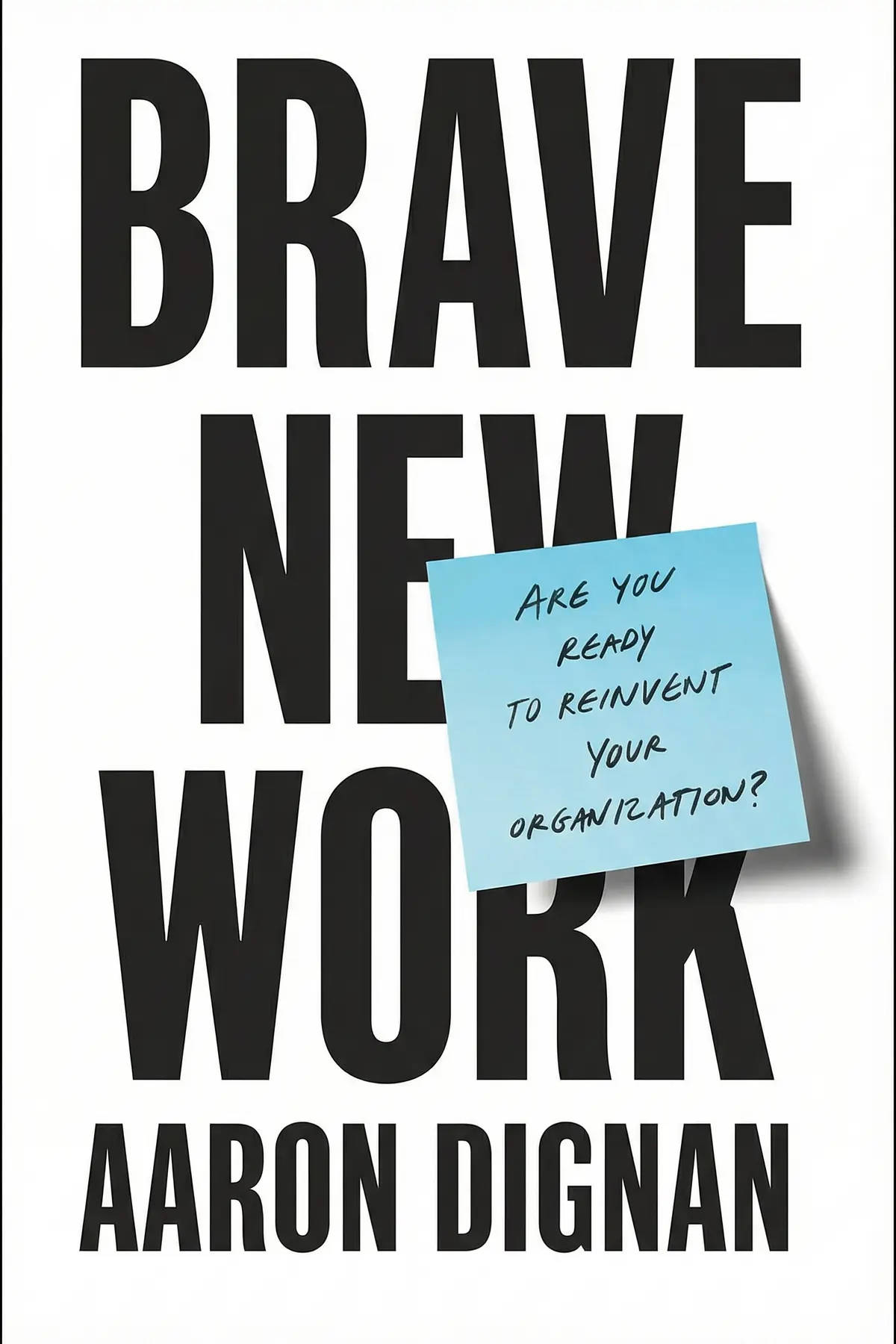
Table of Content
1. Introduction
1 min 44 sec
Have you ever sat in a meeting and felt like your potential was being slowly drained away by red tape? Have you ever looked at a company policy and wondered how it could possibly help anyone get anything done? If so, you are not alone. Most of us work in environments that feel like they were designed to stop us from being productive. We deal with endless layers of approval, rigid hierarchies, and a crushing weight of bureaucracy that seems to grow every year.
In this summary, we are diving into a radical rethinking of how we organize ourselves. We are looking at why the ways we used to run businesses—what we might call the ‘Legacy’ way of doing things—are no longer working in a world that moves as fast as ours. We will explore the idea that the structures holding us back aren’t just annoying; they are actually a form of ‘organizational debt’ that is dragging down our economy and our well-being.
The throughline of our journey today is a shift from control to trust. We are going to explore how to move from a system that treats people like parts in a machine to one that treats them like capable, creative humans. We’ll look at why top-down orders are often the least effective way to lead and how we can build ‘Evolutionary’ organizations that are ready for anything. This isn’t just about making minor tweaks to the employee handbook; it’s about a total system upgrade. By the end of this, you’ll see why the most successful companies of the future won’t be the ones with the most rules, but the ones that have the courage to get out of their own way. Let’s explore how to reinvent the way we work and finally start doing the best work of our lives.
2. The Modern Sabotage of the Workplace
2 min 23 sec
In 1944, a secret manual outlined how to sabotage enemy organizations through bureaucracy. Today, many modern offices unknowingly follow those exact same destructive tactics.
3. Identifying and Shedding Organizational Debt
2 min 33 sec
Rigid rules often stay in place long after their purpose has expired. Learn why ‘organizational debt’ is the hidden weight slowing down your company’s growth.
4. The Ghost of the Industrial Age: Legacy OS
2 min 27 sec
Most modern companies are still running on a ‘management operating system’ from the 19th century. Discover why this ‘Legacy OS’ is fundamentally broken.
5. Distinguishing Between Complicated and Complex
2 min 33 sec
Is your business like a watch or like the weather? Understanding this difference is the key to managing modern organizational challenges.
6. The Roundabout vs. The Traffic Signal
2 min 34 sec
Why do some systems rely on control while others rely on trust? Discover how the geometry of a roundabout explains the future of organizational efficiency.
7. Becoming Complexity Conscious and People Positive
2 min 36 sec
Transforming your company requires two fundamental shifts in mindset. Explore how a submarine captain changed a crew’s performance by simply changing his questions.
8. Rethinking the Core Domains of Work
2 min 39 sec
From how salaries are set to how teams are structured, the way we organize is changing. See how pioneers are reinventing the foundations of corporate life.
9. Fixing the Meeting and Membership Crisis
2 min 23 sec
Meetings are often where productivity goes to die. Learn how a ‘moratorium’ can help you reclaim your time and build a more effective culture.
10. The Art of Continuous Evolution
2 min 31 sec
Change isn’t a destination you reach; it’s a process you inhabit. Discover the ‘looping’ method for keeping your organization constantly adaptable.
11. Conclusion
1 min 36 sec
We have covered a lot of ground, from the sabotage of outdated bureaucracy to the freedom of the roundabout. The central message is clear: the way we have been taught to organize and lead is no longer fit for the world we live in. We are trapped in a Legacy OS that values control over trust, and it is costing us our productivity, our innovation, and our happiness.
But a different way is possible. By becoming Complexity Conscious and People Positive, we can start to dismantle the organizational debt that holds us back. We can move toward a model of work that is fluid, human-centered, and constantly evolving. This isn’t a transformation that happens overnight, and there is no single ‘right’ way to do it. Your organization is a unique, complex system, and you have to find your own path through the domains of structure, purpose, and practice.
As we wrap up, I want to leave you with a challenge. Don’t wait for a grand ‘change initiative’ from the top. Start where you are. Look for a tension in your own workday—something that feels slower or more difficult than it needs to be. Propose a small experiment to address it. Whether it’s changing how you run a single meeting or how you make a specific decision, every small loop counts. The future of work isn’t something that happens to us; it’s something we build, one agreement at a time. It’s time to stop sabotaging ourselves and start building the brave new work we all deserve.
About this book
What is this book about?
Brave New Work addresses the widespread frustration and inefficiency plaguing modern workplaces. Most organizations today operate on an outdated 'Legacy' system designed for a simpler, industrial age—one that prioritizes hierarchy, strict rules, and top-down control. This approach often leads to 'organizational debt,' where obsolete policies and bureaucracy hinder productivity and leave employees feeling disempowered. The book promises a path toward a more 'Evolutionary' way of working. It challenges the assumption that people need to be managed like machines, arguing instead that organizations are complex systems that thrive on trust and autonomy. By shifting toward a model that is Complexity Conscious and People Positive, leaders can create environments where workers are empowered to solve problems in real-time. Through practical examples and a framework of twelve organizational domains, Dignan provides the tools to reinvent how we approach structure, purpose, and daily operations, ultimately enabling individuals and companies to do their best work.
Book Information
About the Author
Aaron Dignan
Aaron Dignan is the founder of The Ready, a coaching and organization-design company with clients such as Microsoft, Airbnb, and Johnson & Johnson. He is also an angel investor and has sat on advisory boards for PepsiCo, American Express and GE.
Ratings & Reviews
Ratings at a glance
What people think
Listeners view this book as a fundamental resource for any professional, providing hands-on tools for reinventing the workplace. It is filled with deep insights that turn complex theories into simple, applicable techniques, resulting in a read that is both intelligible and evocative. They value the way it introduces research-supported foundations for evolving organizations, and one listener mentions it offers step-by-step implementation guidance.
Top reviews
Oat
Finally got around to reading this after seeing it on every "future of work" list for years. Dignan doesn't just complain about the soul-crushing bureaucracy we all hate; he actually builds a comprehensive roadmap to dismantle it. The "Operating System" framework is brilliant because it breaks down the messy reality of office politics into twelve manageable dimensions like authority and compensation. I found the section on being "People Positive" particularly refreshing in a world that usually assumes employees are lazy or incapable. It’s a dense read, but the plain language makes the complex systems theory feel accessible to anyone with a job. Even if you only implement five percent of the advice, your team will thank you for the breathing room.
Show morePop
Picked this up during a particularly frustrating week at the office and it completely shifted my perspective on what leadership actually means. Dignan challenges the outdated notion that we need to control people to get results, advocating instead for autonomy and radical trust. The book is jam-packed with research-backed principles that move far beyond the usual corporate fluff you see in the airport business section. I especially loved the idea of the "User Manual to Me," which seems like a simple way to improve team dynamics instantly. Transitioning to a decentralized model isn't easy, but the step-by-step guidance provided here makes the mountain seem much easier to climb. If you’re a leader who struggles with letting go of the reins, consider this your intervention.
Show moreChatchai
This book is essentially a manifesto for anyone who believes that work shouldn't have to suck so much. Dignan writes with a level of clarity and passion that makes you want to go into your office tomorrow and set the policy manual on fire. I loved the emphasis on "continuous participatory change" because it acknowledges that transformation is a journey, not a destination. The writing style is punchy and energetic, making even the denser parts about "liminal spaces" feel exciting and relevant. It’s rare to find a business book that is both intellectually stimulating and emotionally resonant regarding our human need for purpose. If you work for a living, you need to read this book, period.
Show moreSuda
Frankly, I wish I had read this ten years ago before I started my first management role. It would have saved me so much time and energy spent trying to "optimize" systems that were fundamentally broken from the start. The book does an amazing job of explaining why "scientific management" is a relic of the past that we need to leave behind. While it does reference a lot of other thinkers like Senge and Gladwell, it synthesizes their ideas into a cohesive "Operating System" that actually feels actionable. It’s a call to arms for a more humane and effective way of organizing ourselves that feels both inevitable and urgent. Five stars for the courage to imagine a better way to spend forty hours a week.
Show moreCarlos
As someone who has survived three corporate "re-orgs" in five years, this book felt like a cold glass of water in a desert of middle management. The distinction between complicated and complex systems is something every executive needs to understand before they draw another flowchart. We keep trying to solve human problems with engineering solutions, and Dignan correctly identifies why that fails every single time. Truthfully, the first hundred pages felt a bit like a sales pitch for his consulting firm, which got a little repetitive after a while. However, once you get into the actual "OS Canvas" and the patterns for change, the value is undeniable. It’s not just theory; it's a toolkit for anyone tired of the status quo.
Show moreVilaiporn
The chapter on meetings alone is worth the price of admission because it targets the biggest time-sink in modern business. We’ve all been trapped in those endless "update" calls that could have been an email, and Dignan provides a framework to kill them off forever. I appreciate how he translates high-level organizational theory into plain language that doesn't require a PhD in management to understand. Look, the book isn't perfect, and some of the case studies feel a bit cherry-picked to suit his specific narrative. But the overarching message about being "Complexity Conscious" is something that resonated deeply with my daily struggles. It’s a thought-provoking guide for anyone who wants to stop being a cog and start being a human at work.
Show morePruet
After hearing several colleagues rave about the "Brave New Work" philosophy, I finally decided to see if the hype was actually justified. It’s a very practical handbook that goes beyond the "why" and really digs into the "how" of organizational transformation. I found the section on "Authority" and how to share power particularly challenging in a good way, as it forces you to confront your own ego. Some parts of the middle section dragged a bit when he went into the weeds of the "OS Canvas," but the information is essential for implementation. The truth is, most companies are still running on organizational software from the 1920s, and this book provides the necessary upgrade. Definitely a solid read for anyone in a position to influence company culture.
Show moreSombat
Wow. I didn't expect a book about organizational design to be this gripping or this useful for my day-to-day life. Dignan has a gift for taking abstract concepts like "Cynefin" and making them feel like common sense for the average worker. The layout is great, with plenty of diagrams and summaries that make it easy to use as a reference guide later on. In my experience, most business books are one good idea stretched over three hundred pages, but this one is genuinely jam-packed with info. It’s clear, direct, and provides a clear path forward for those of us drowning in red tape and "Taylorist" micromanagement. This is one of the more important business books I've picked up recently.
Show moreElla
Ever wonder why your weekly status meetings feel like a slow descent into madness? This book identifies the symptoms perfectly, but I'm not entirely convinced it has the only cure for what ails us. While the concepts of "Complexity Conscious" leadership are valid, I felt like the author spent far too much time trying to convince me that the sky is blue. I already know my workplace is broken, so I didn't need eighty percent of the book to be a historical autopsy of Frederick Taylor. To be fair, the last few chapters offer some solid conversation starters and tactical advice for "looping" and "priming" change. It’s a decent summary of other books like "Reinventing Organizations," but it lacks a bit of original spark.
Show moreOlivia
Not what I expected given the glowing praise from the tech community. To be honest, it felt like a massive exercise in megalomania where the author pretends he discovered "systems thinking" for the first time. If you have ever read Peter Senge or even basic Agile manifestos, there is absolutely nothing new for you in these pages. The tone felt incredibly condescending at times, as if the reader has never considered that bureaucracy might be inefficient or annoying. It's a shiny, over-produced version of ideas that have been circulating in the industry for decades without adding much depth or nuance. I'm honestly shocked this is considered a revolutionary text when it’s mostly just a collection of recycled blog posts and consulting jargon.
Show moreReaders also enjoyed
7 Powers: The Foundations of Business Strategy
Hamilton Helmer

A Bigger Prize: How We Can Do Better Than the Competition
Margaret Heffernan
A Year with Peter Drucker: 52 Weeks of Coaching for Leadership Effectiveness
Joseph A. Maciariello
AUDIO SUMMARY AVAILABLE
Listen to Brave New Work in 15 minutes
Get the key ideas from Brave New Work by Aaron Dignan, plus 5,000+ more titles in English and Thai.
- 5,000+ titles
- Listen as much as you want
- 7-day free trial
- Cancel anytime







