
20 min 06 sec
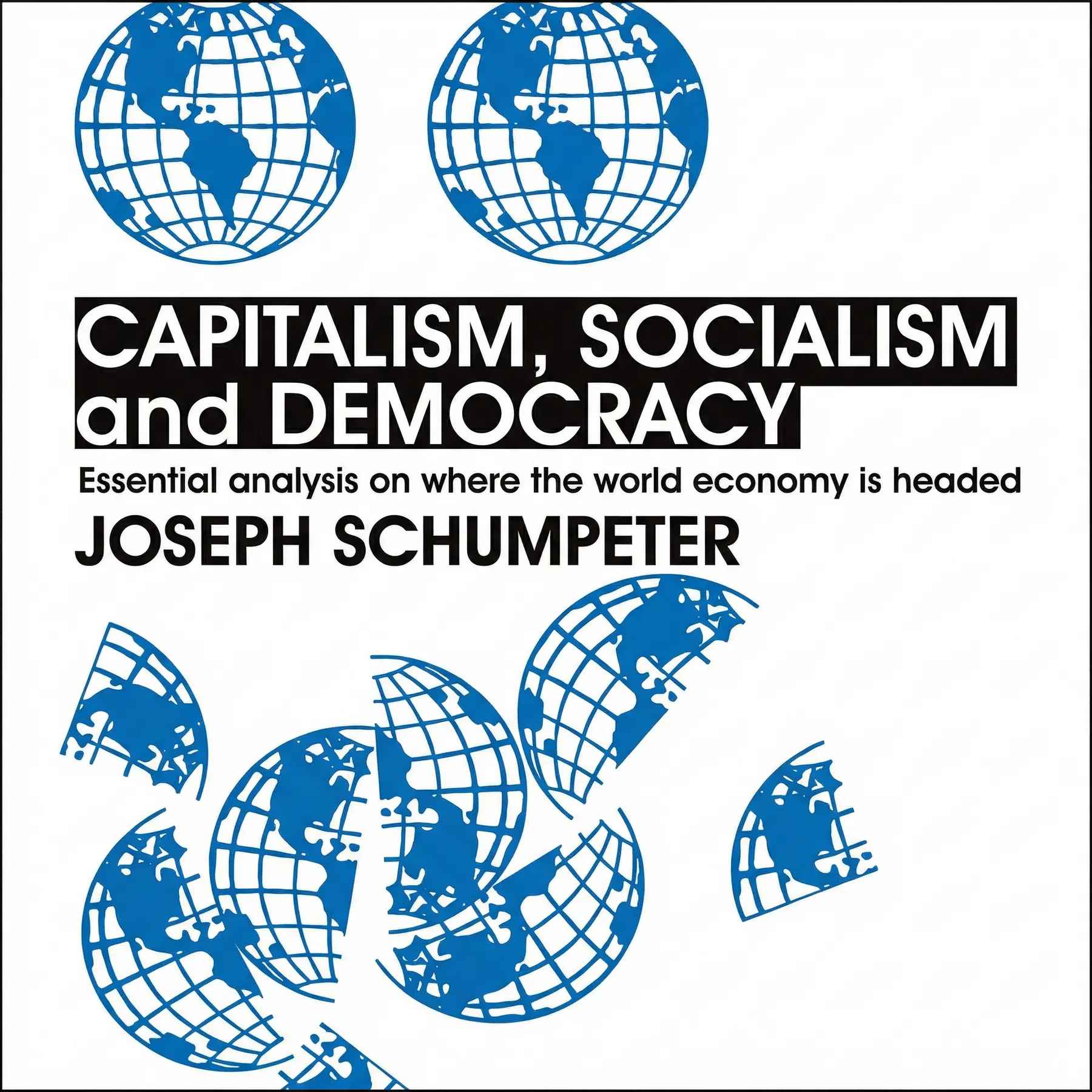
Capitalism, Socialism and Democracy
Joseph Schumpeter examines the internal contradictions of capitalism, suggesting that its very triumphs lead toward a socialist future while redefining our understanding of democracy and the role of the entrepreneur.
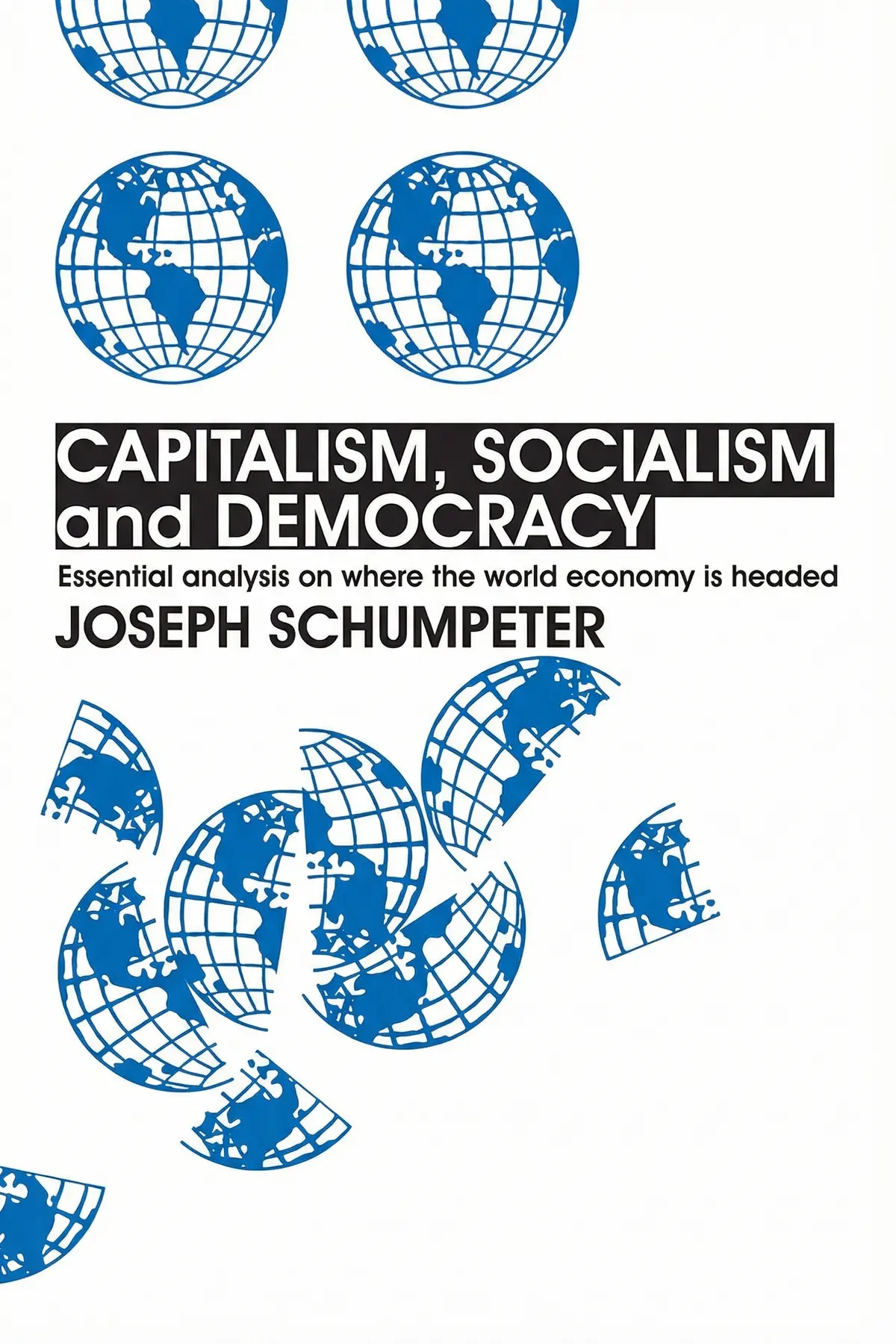
Table of Content
1. Introduction
1 min 46 sec
For decades, it felt as though the debate between different ways of organizing society had been settled. The global market seemed to have won the day, leaving other ideologies in the rearview mirror. However, recent years have brought a resurgence of fundamental questions. We find ourselves wondering if the current system is sustainable, if it is destined to last forever, or if there is another path forward. These are not new anxieties. In the middle of the twentieth century, an economist named Joseph Schumpeter was already peering into the future, and his conclusions were nothing short of revolutionary.
Schumpeter’s perspective was unique. He didn’t just look at balance sheets; he looked at the soul of the economic system. He saw capitalism as a magnificent, self-transforming engine, but he also saw a ticking clock. His central thesis was startling: he believed that capitalism’s greatest successes would eventually lead to its disappearance. He argued that the very qualities that make the market thrive—rationality, innovation, and progress—would eventually erode the social structures that support it.
In the following exploration, we will dive into Schumpeter’s core arguments. We’ll look at his critique of Karl Marx, his famous concept of creative destruction, and his strikingly modern definition of democracy. We will see how he viewed the entrepreneur as the hero of the story and why he believed the rise of a managed, bureaucratic society would pave the way for socialism. By the end, you’ll have a clear view of a theory that remains one of the most cited and influential frameworks in the social sciences, offering a roadmap for understanding the deep currents that move our world economy today.
2. The Legacy and Limits of Marx
2 min 30 sec
Schumpeter examines how the prophetic insights of Karl Marx shaped our understanding of history and economics while identifying a crucial missing element in the Marxist framework.
3. A Record of Material and Intellectual Gain
2 min 25 sec
Discover how the capitalist engine has driven unprecedented social progress, from rising incomes to the rationalization of the human mind.
4. The Perennial Gale of Creative Destruction
2 min 08 sec
Capitalism is never at rest. Explore the core concept of ‘creative destruction’ and why the system’s survival depends on constant internal revolution.
5. The Theoretical Possibility of Socialism
2 min 15 sec
Is a socialist economy actually workable? Schumpeter breaks down the mechanics of a centrally planned system and addresses common economic doubts.
6. Redefining the Democratic Process
2 min 16 sec
Schumpeter challenges the romanticized ‘rule by the people’ and offers a more realistic model of democracy based on political competition.
7. Can Socialism and Democracy Coexist?
2 min 27 sec
Exploring the essential conditions that allow a democratic system to survive, regardless of whether the economy is capitalist or socialist.
8. The Paradox of Success: Why Capitalism Fades
2 min 39 sec
Schumpeter presents his most famous prediction: that the very triumphs of the market will eventually render the capitalist system obsolete.
9. Conclusion
1 min 40 sec
Joseph Schumpeter’s analysis offers a profound and somewhat unsettling look at the trajectory of modern life. He shows us that the economy is not just a collection of trades, but a living, breathing process defined by constant change. Through the lens of ‘creative destruction,’ we can see why our world is in a state of perpetual upheaval—it is the price of the progress we enjoy every day.
However, his most important takeaway is the reminder that no system is permanent. Capitalism, for all its brilliance in lifting people out of poverty and fostering a rational world, carries the seeds of its own transformation. By making innovation a routine and fostering a culture that questions its own foundations, it naturally moves toward a more managed, socialist-style existence. Whether this transition leads to a stable, democratic future or something more restrictive depends on our ability to maintain the qualities that Schumpeter valued: strong leadership, an efficient bureaucracy, and a culture of mutual respect.
As you think about the world today, notice how many of Schumpeter’s predictions are visible. We see the rise of the managerial class, the influence of intellectuals on public policy, and the ongoing debate over the role of the state in our economic lives. The ‘perennial gale’ continues to blow. The challenge for the future is not just to survive the storm of change, but to ensure that the systems we build next are capable of preserving the freedom and prosperity that the capitalist engine first made possible.
About this book
What is this book about?
Capitalism, Socialism and Democracy is a foundational text in political economy that challenges conventional views on market stability and societal evolution. Joseph Schumpeter argues that capitalism is not a static system but a dynamic process driven by a 'perennial gale of creative destruction.' He examines the historical contributions of Karl Marx, while identifying the critical role of the entrepreneur—a figure he believes Marx overlooked. The book explores the possibility of a functional socialist state and re-evaluates the definition of democracy, moving away from the 'will of the people' toward a model of competitive leadership. Ultimately, Schumpeter presents a provocative thesis: capitalism is so successful at rationalizing society and automating progress that it eventually undermines its own foundations. This summary explores his predictions on how the rise of an intellectual class and the decline of the entrepreneurial spirit create a natural transition toward socialism, offering a profound analysis of where modern economies are headed.
Book Information
About the Author
Joseph Schumpeter
Joseph Schumpeter was one of the most influential political economists of the twentieth century. After briefly serving as the Finance Minister of German-Austria, he emigrated to the US in 1932 and became an economics professor at Harvard. Capitalism, Socialism and Democracy is regarded as his most important and most profound work. It’s the third-most-cited book in the social sciences.
Ratings & Reviews
Ratings at a glance
What people think
Listeners find this work to be an essential resource that offers useful insights for modern debates and significantly alters how one perceives economic structures. Furthermore, they value the persuasive economic frameworks presented and regard it as a foundational masterpiece in the field. On the other hand, opinions on the prose are divided; one listener highlights how the clever writing clarifies intricate ideas, while others find it difficult to read.
Top reviews
Hugo
Schumpeter’s magnum opus is a wild ride through economic history that manages to be both deeply cynical and strangely hopeful. While most people associate him strictly with 'creative destruction,' the real value here is his nuanced, almost respectful critique of Marx. He doesn't just dismiss socialist theory; he treats it as a serious developmental stage that capitalism might naturally evolve into due to its own successes. The writing is incredibly witty, though you have to be prepared for some very dense passages regarding the Soviet model. It’s a transformative look at how innovation functions as the heartbeat of our world. Even if his predictions about the inevitability of socialism haven't fully materialized in the West, his analysis of how big business stifles the entrepreneurial spirit remains chillingly relevant. Every student of political economy needs this on their shelf.
Show morePui
Picking up this classic felt like finally understanding the hidden blueprints of the modern global economy. Schumpeter’s ability to articulate the role of the entrepreneur as a disruptor is simply unmatched. He captures the drama of capitalism—the way it constantly births new worlds while ruthlessly destroying the old ones. I was particularly struck by his discussion of 'disaffected intellectuals' and how they eventually turn the public against the very system that provides their standard of living. This is more than just an economics book; it's a work of sociological genius that explains why we feel so much cultural tension today. Some might find the prose difficult, but I found his biting wit to be a refreshing change from the jargon-heavy nonsense found in contemporary academic writing. Truly a foundational text.
Show morePiyanart
Ever wonder why capitalism feels so chaotic yet so productive? Schumpeter explains it better than anyone else ever has. This book is a classic for a reason—it doesn't just look at numbers; it looks at the soul of the system. He identifies the entrepreneur as the hero of the story, but also the person who ultimately makes themselves obsolete as firms grow into giant, soulless bureaucracies. His take on democracy is equally bracing; he argues it's just a market for votes, which explains so much about our current political gridlock. Despite being written decades ago, his observations about the power of 'Dark Money' and elite influence are basically happening in real-time. It’s a dense, challenging, and occasionally frustrating book, but it’s easily one of the most important things I’ve ever read.
Show moreRungtip
Wow, this is easily the most intellectually stimulating book on political economy I’ve picked up this year. Schumpeter is such a unique thinker because he refuses to fit into a neat box. He’s a bourgeois economist who actually understands Marx, and a democrat who is deeply skeptical of 'the people.' His theory that capitalism's very success leads to its demise is a haunting thought that stays with you long after you close the cover. While I didn't agree with his optimism regarding the efficiency of a planned economy, his logic is so sharp that you have to respect the argument. The writing style is surprisingly punchy for such a complex subject, though you definitely need a dictionary and a history book nearby. It is a compelling, transformative guide to the forces that shape our lives.
Show moreGin
The concept of 'creative destruction' is the one thing everyone remembers, but the real meat of the book lies in the author's brutal assessment of democracy. Schumpeter offers a Machiavellian exposé that strips away the romanticism of 'the will of the people.' He argues that democracy is merely a mechanism for elites to compete for votes, which feels incredibly prophetic when looking at today’s political landscape. My only gripe is that he occasionally seems to favor this elitist structure over true popular participation. The book is definitely colored by its 1942 publication date, yet it provides a critical guide for understanding how economic systems and political power are inextricably linked. It’s a challenging read that will definitely force you to question your own ideological assumptions.
Show moreSavannah
After hearing about this in my graduate seminars, I finally dove into the source material and was pleasantly surprised by the depth. Schumpeter isn't just a cheerleader for capitalism; he's more like a coroner performing a very detailed autopsy on it. He explains how the very success of the capitalist system creates a class of managers and intellectuals who eventually undermine the foundations of private property. It’s a fascinating, almost Hegelian way of looking at progress. The book does drag in the later sections concerning the history of socialist movements, which feels a bit like a history lesson no one asked for. Still, his definition of democracy as a competitive struggle for leadership is one of the most honest things I've ever read. It's a heavy lift, but it will change how you view the news.
Show moreIsaiah
To be fair, reading this in the 21st century requires a bit of mental time travel to the WW2 era. Schumpeter was writing at a time when the future of the free market was genuinely in doubt, and that tension is palpable on every page. I found his analysis of the 'creative destruction' process to be a perfect explanation for why companies like Kodak or Nokia disappear. However, I think he was far too charitable toward the idea that a socialist state could maintain the same level of innovation without the profit motive. He seems to think we can have the efficiency of a machine without the grease of human ambition. It’s a brilliant intellectual exercise, even if his ultimate predictions fell flat. Definitely a compelling read for anyone interested in the intersection of sociology and wealth.
Show moreTalia
Is this book a masterpiece or just a convoluted mess of wartime anxieties? To be fair, Schumpeter is a brilliant writer, and his prose is far more engaging than your average dry economics textbook. However, I found his section on the 'efficiency' of a central planning board to be almost laughably naive given what we know now about the 20th century. He discounts human acquisitiveness far too easily, assuming that a bureaucratic machine can replace the organic chaos of the market. The middle chapters on the history of socialist parties felt entirely superfluous and could have been trimmed significantly. While the 'creative destruction' section is obviously genius, the rest of the book feels like a series of fascinating but disjointed lectures. It’s worth a skim for the big ideas, but don't feel guilty about skipping the more repetitive historical segments.
Show moreSau
Look, the prose is witty enough at times, but the sheer volume of 1940s-era political debating can make your head spin. I appreciate Schumpeter’s attempt to bridge the gap between Marx and modern economics, but he gets bogged down in technicalities that haven't mattered for fifty years. The first half of the book is genuinely transformative, especially the parts dealing with how big corporations eventually socialise the mindsets of their employees. But then the book shifts into a very strange defense of socialist administration that feels totally disconnected from the reality of human nature. It's a strange mix of genius and delusion. I’d recommend reading the first hundred pages and the chapter on democracy, then calling it a day. It’s too long for what it actually delivers to a modern reader.
Show moreWin
Not what I expected given the massive hype surrounding Schumpeter’s name in business circles. Frankly, the book is incredibly dated and his central thesis—that capitalism will inevitably fail and be replaced by socialism—has been proven wrong by history. He spent way too much time theorizing about the efficiency of a planned economy while ignoring the authoritarian reality of the Soviet experiment that was happening right in front of him. While the five pages on creative destruction are great, the other 350 pages are a slog through obsolete debates from the 1940s. He also has a very elitist tone that assumes the average citizen is too irrational to participate in a real democracy. If you want to understand modern innovation, just read a summary of his ideas online and save yourself the headache of this dense, dry volume.
Show moreReaders also enjoyed
Abolish Rent: How Tenants Can End the Housing Crisis
Tracy Rosenthal

Abortion: Our Bodies, Their Lies, and the Truths We Use to
Jessica Valenti
21 Lessons for the 21st Century
Yuval Noah Harari
Age of Anger: A History of the Present
Pankaj Mishra

A Different Kind of Power: A Memoir
Jacinda Ardern

Age of Propaganda: The Everyday Use and Abuse of Persuasion
Anthony Pratkanis
1929: Inside the Greatest Crash in Wall Street History--and How It
Andrew Ross Sorkin
AUDIO SUMMARY AVAILABLE
Listen to Capitalism, Socialism and Democracy in 15 minutes
Get the key ideas from Capitalism, Socialism and Democracy by Joseph Schumpeter, plus 5,000+ more titles in English and Thai.
- 5,000+ titles
- Listen as much as you want
- 7-day free trial
- Cancel anytime







