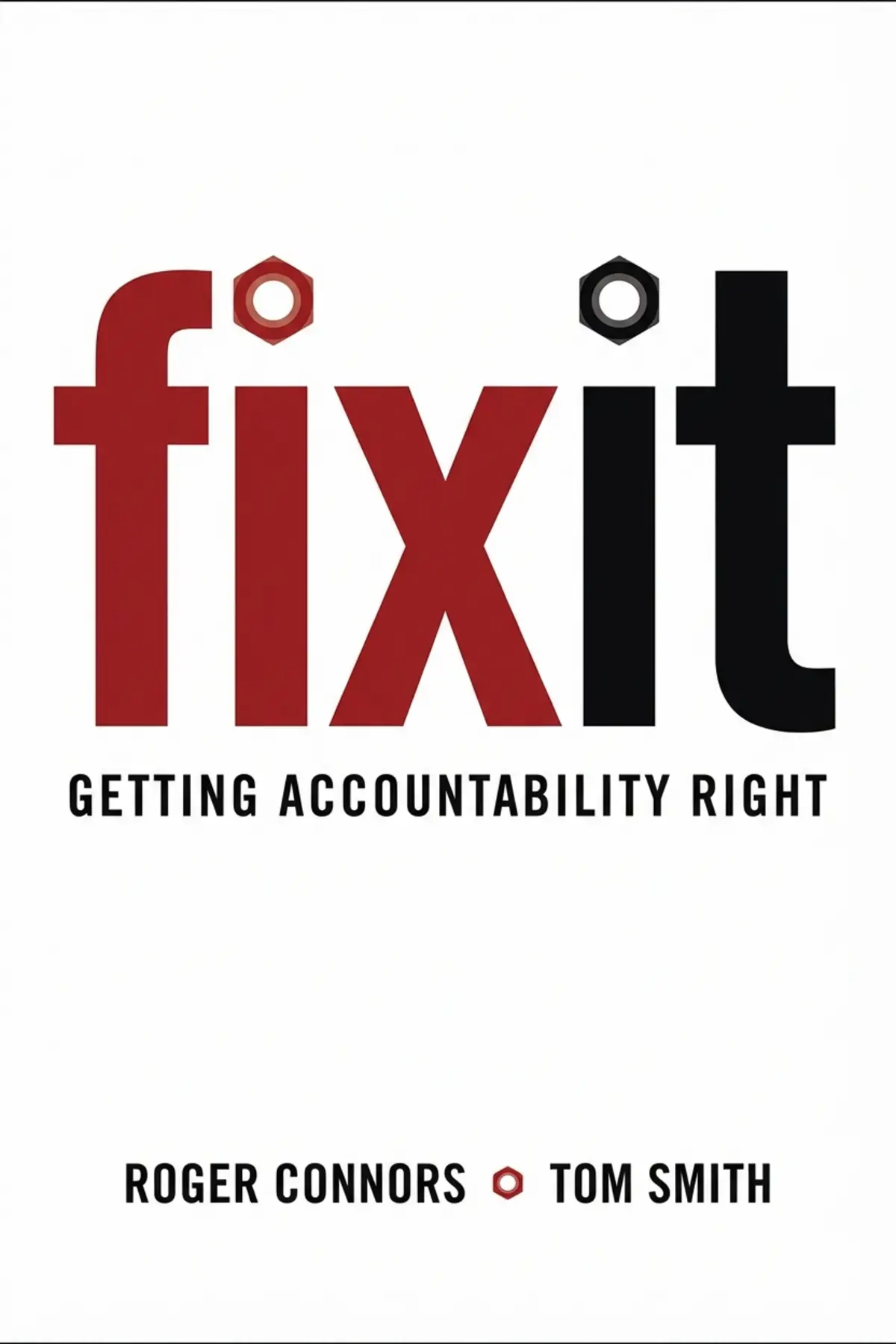
Fix It: Getting Accountability Right
Roger Connors
Transform your organization by shifting from a culture of blame to one of accountability. This guide provides a strategic framework to change employee beliefs and experiences, driving consistent and powerful business results.
1 min 40 sec
Have you ever wondered why some organizations seem to hum with a natural energy, while others feel bogged down in bureaucracy and blame? Many leaders believe they can fix a struggling company simply by issuing new orders or demanding better profit margins. They treat business results like a dial they can just turn up. But as anyone who has lived through a failed corporate initiative knows, it rarely works that way. If you want to see a real change in the numbers, you have to look deeper than just the numbers themselves. You have to look at the people, their mindset, and the environment they work in every day.
This summary explores a systematic approach to organizational transformation that moves beyond quick fixes. It introduces a powerful framework for understanding how the collective experiences of your workforce shape the ultimate success of your company. By focusing on the concept of accountability, we can see how high-performing teams separate themselves from the rest. We will explore how major players like General Motors navigated massive shifts and how even a simple bookstore can create a thriving environment through small, intentional practices.
The central message is clear: if you want to change the game, you have to change the culture. This isn’t about a one-time workshop or a catchy slogan; it’s about a deep, sustained transition in how everyone—from the executive suite to the front lines—thinks and acts. Let’s dive into how you can start reshaping your organization’s future by mastering the internal dynamics that drive external results.
2 min 32 sec
Explore why simply demanding better results often fails and learn how the hierarchy of experiences, beliefs, and actions actually determines organizational success.
2 min 33 sec
Discover the distinction between accountability as a burden and accountability as an empowering tool that moves teams above the line of performance.
2 min 09 sec
Learn why cultural transformation should be viewed as a transition and how focusing on the right beliefs leads to sustainable change.
1 min 57 sec
Understand how clear communication and shared goals prevent the confusion that often kills momentum in organizational change.
2 min 12 sec
Examine the three key skills leaders must develop to facilitate a cultural shift: responsibility, responsiveness, and facilitation.
2 min 07 sec
Learn how to make cultural change permanent by integrating it into existing meetings, systems, and social practices.
1 min 36 sec
In the end, the message of Change the Culture, Change the Game is both a challenge and an opportunity. It challenges leaders to stop looking for shortcuts and start doing the hard work of building a foundation of accountability. It reminds us that if we aren’t getting the results we want, the problem isn’t just in what people are doing, but in what they believe and what they’ve experienced. By utilizing the Results Pyramid, we can systematically trace our way back from disappointing outcomes to the root causes in our workplace environment.
But the opportunity here is even greater. When you move your team above the line, you aren’t just improving your profit margins; you are creating a workplace where people feel empowered, heard, and responsible for their own success. You are replacing the draining cycle of blame with an energizing culture of ownership. Remember that this is a transition that requires alignment, dedicated leadership, and consistent integration into your everyday systems.
As you move forward, start small. Look for the ‘below the line’ behaviors in your next meeting and find ways to gently guide the conversation back toward personal ownership. Ask yourself what experiences you are creating for your team today and whether those experiences are fostering the beliefs you need for tomorrow. Cultural change doesn’t happen overnight, but by consistently focusing on experiences, beliefs, and accountability, you can truly change the game for your organization.
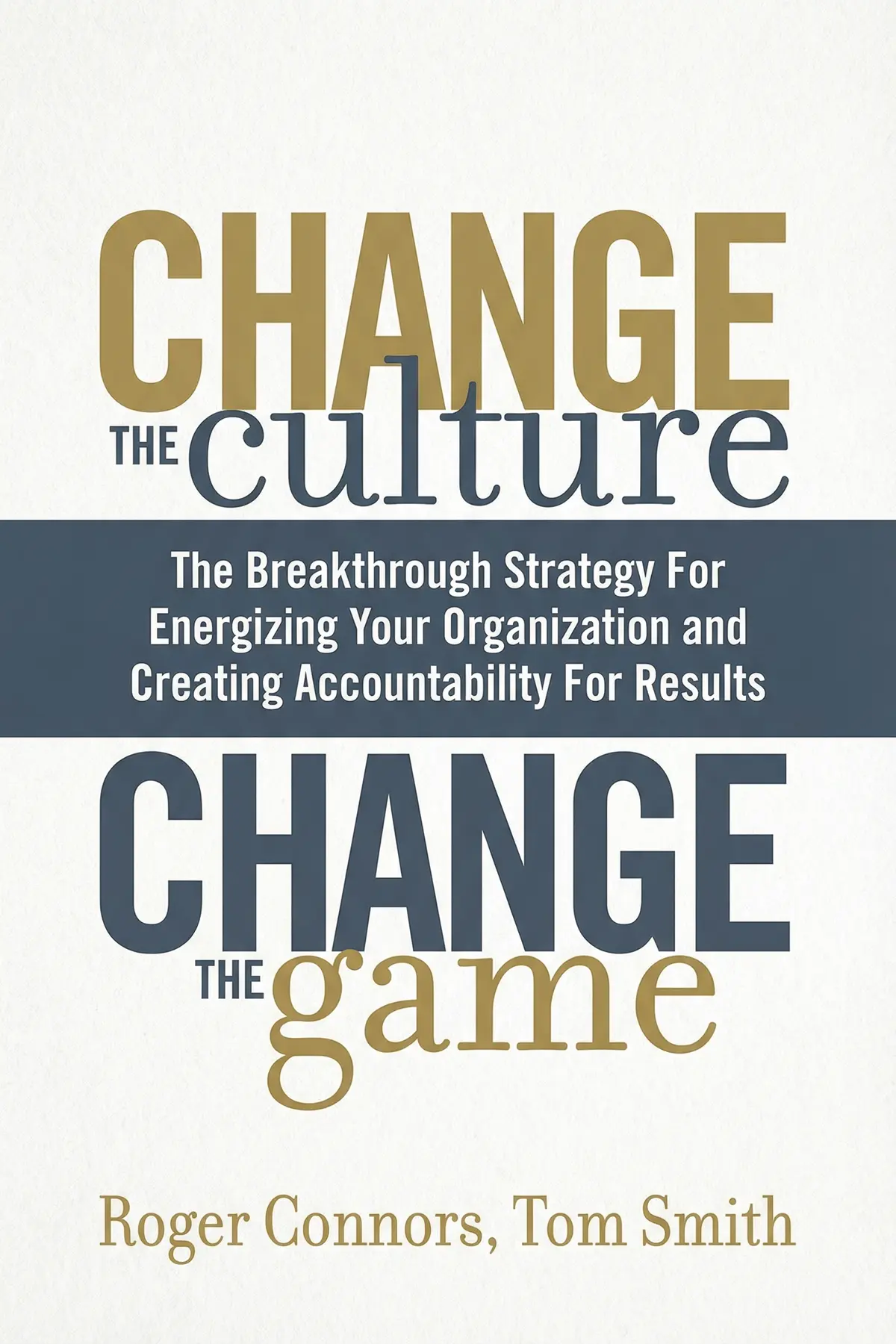
What happens when an organization stalls? Many leaders respond by issuing new mandates or demanding better numbers, but they often ignore the invisible force driving those numbers: the company culture. In Change the Culture, Change the Game, Roger Connors and Tom Smith provide a comprehensive framework for shifting that culture from the ground up. The book centers on the idea that culture is not an abstract concept but a direct result of the experiences employees have and the beliefs those experiences foster. By mastering the authors’ Results Pyramid, leaders can move beyond simply managing actions to truly influencing the mindset of their workforce. The core promise of this work is a practical strategy for creating a high-performance organization where accountability isn’t a burden, but a shared value. Through detailed case studies ranging from automotive giants like General Motors to healthcare providers, the authors illustrate how to align a team’s daily efforts with the company’s most critical objectives. This summary explores how to move your team above the line and ensure that cultural transformation isn’t just a temporary initiative, but a permanent shift in how your organization operates and achieves its goals.
Roger Connors and Tom Smith are the co-founders of Partners In Leadership, Inc., a globally recognized leadership training and management consulting firm. Together, they have authored three New York Times bestselling books focused on accountability and organizational culture. Their extensive experience in consulting for top-tier corporations has made them leading voices in business management, specializing in helping leaders drive significant cultural shifts and achieve sustainable competitive advantages.
Listeners describe this as a high-quality listen that offers practical insights into transforming organizational culture, featuring straightforward and actionable advice on shifting mindsets to reach specific objectives. Additionally, the content is praised for its accessible style and structured framework, and one listener makes special mention of the cultural pyramid model. On the other hand, opinions on the tempo are divided; while some find the narration captivating, others feel it becomes redundant.
After hearing so much about the 'Results Pyramid,' I decided to dive in, and it did not disappoint in terms of clarity. Building on the foundation of their previous work, Connors and Smith explain exactly why typical management 'fixes' fail because they ignore the belief systems of the employees. I found the R1/R2 and B1/B2 notation extremely helpful for visualizing the gap between current state and desired future state. Some people might find the repetition annoying, but in my experience, that’s exactly what it takes to drive these concepts home in a corporate setting. The step-by-step instructions for creating accountability are worth the price of admission alone.
Show moreThis book provides a roadmap for anyone tasked with turning around a toxic or underperforming department. The focus on 'The Results Pyramid' changed how I view my interactions with my direct reports every single day. Instead of just barking orders about actions, I now think about what experiences I am providing to shape their beliefs about our goals. It’s a simple shift, but the impact on our output has been significant since we started implementing these strategies. Yes, the authors repeat themselves, but that repetition serves to reinforce the mental models needed for real change. This is essential reading for leaders who are serious about accountability.
Show moreThe cultural pyramid concept is definitely the standout feature of this guide, offering a visual way to understand how beliefs drive actions. I appreciated the pragmatic approach to organizational evolution, even if the authors tend to lean heavily on their previous work for context. By focusing on changing experiences to alter underlying mindsets, the book offers a clear path toward sustainable results that many tactical projects miss. It can feel a bit like a sales pitch for their consulting firm at times, which slows the momentum. However, the core logic is sound and easy to translate into real-world management. It’s a solid resource for anyone struggling with a stagnant team dynamic.
Show moreFinally got around to reading this one after it sat on my shelf for months, and I’m glad I did. It’s rare to find a business book that addresses the 'how' of culture change rather than just the 'why.' The authors break down the barrier between leadership theory and actual frontline implementation by focusing on specific cultural beliefs. While the tone is a bit academic and dry, the case studies help to illustrate how these shifts look in different industries. My only real gripe is that it feels a bit dated in its examples, yet the logic remains remarkably relevant for today’s fast-paced work environments.
Show moreIn my experience, most business books dodge the hard work of culture change because it’s messy and hard to measure. This book is the exception, as it provides a very structured—if slightly mechanical—process for aligning a team toward specific results. I found the sections on 'joint accountability' particularly enlightening, as they move past the blame game and toward a shared ownership of outcomes. The writing style is definitely more functional than flashy, which might bore some readers, but the information is undeniably useful. It’s the kind of book you keep on your desk to reference during quarterly planning rather than reading it once and forgetting it.
Show moreEver wonder why your team keeps hitting the same roadblocks even after you change your strategy? This book argues that the problem isn't your strategy, but the cultural beliefs that haven't caught up to your new direction. I liked the focus on 'creating experiences' as the primary tool for leadership, which feels much more actionable than just having a company retreat. While it can be a slow read, the cumulative effect of the examples helps you see the patterns in your own organization. It’s not a perfect book—it could have been 50 pages shorter—but it offers a level of pragmatism that is rare in the genre.
Show moreTo be fair, the framework presented here is robust, but it gets bogged down by an overly complex system of lists and variables. I really liked the idea that you have to change the experiences people have to shift their culture, but the exponent-based formulas felt unnecessary. It seems like the authors tried to make a simple human concept look more 'scientific' than it needed to be. Truth is, if you already have a leadership system in place, trying to integrate this specific terminology might just confuse your staff. It’s a decent read for the reminders on clear measures of success, though it isn't something I’d call a page-turner.
Show moreLook, I appreciated the focus on shifting beliefs to get better results, but the pacing of this book is all over the place. Some chapters are dense with useful theory, while others feel like they are just spinning their wheels to meet a word count. I listened to the audiobook version first, which was a mistake because the R1/R2 and B1/B2 terminology is much easier to grasp when you can see the diagrams. It’s a 1.5 or 2-star experience if you’re looking for entertainment, but as a technical manual for business culture, it’s a solid 3. The content is good, but the presentation is just incredibly tedious.
Show moreWhile the core message about accountability is valuable, the delivery is incredibly dry and repetitive to the point of frustration. It felt like the authors took a twenty-page white paper and stretched it into a full-length book by restating the same three points in every chapter. Frankly, if you have read the introduction and the first few case studies, you have already absorbed about 90% of the actionable content. I also found the constant self-promotion of their earlier book, The Oz Principle, to be quite distracting. It’s hard to stay engaged when the writing feels more like a transcript of a corporate seminar than a cohesive piece of literature.
Show moreNot what I expected given the high praise I had heard from colleagues. The book is filled with corporate jargon that makes simple concepts feel buried under layers of unnecessary 'consultant-speak.' I honestly felt like I was being marketed to for 200 pages, with constant reminders of the authors' previous successes and their available training programs. The 'Game' they refer to seems to be a very rigid, top-down approach that might not work for modern, agile startups. It lacks the warmth or human-centric approach that I prefer in leadership books. If you want a quick summary, just look up the pyramid diagram online and save your time.
Show more
Hamilton Helmer

Margaret Heffernan
Joseph A. Maciariello
AUDIO SUMMARY AVAILABLE
Get the key ideas from Change the Culture, Change the Game by Roger Connors, plus 5,000+ more titles in English and Thai.