
Zone To Win: Organizing to Compete in an Age of Disruption
Geoffrey A. Moore
Discover the essential framework for navigating the treacherous gap between early tech enthusiasts and the mainstream market. This guide provides a strategic roadmap for achieving sustainable, high-volume success with disruptive innovations.
1 min 38 sec
In the fast-paced world of high technology, many products arrive with a burst of excitement, only to vanish into obscurity before they ever reach the hands of the general public. Why do some innovations revolutionize the world while others—equally brilliant—simply fade away? The answer lies in a phenomenon known as the chasm. This is a critical gap that exists between the people who love technology for its own sake and the people who use technology to get things done.
Crossing the Chasm provides the strategic blueprint for navigating this dangerous territory. It moves beyond the idea that marketing is just about making noise; instead, it argues that marketing is about understanding the psychological evolution of a market. As a product moves through its lifecycle, the types of people who buy it change, and if a company doesn’t change its approach to match those buyers, it will fail.
Throughout this summary, we will explore the Technology Adoption Life Cycle and identify the specific point where most companies lose their footing. We will look at how to identify a target niche, how to build a product that customers actually feel safe buying, and how to position yourself as a leader even when you are just starting out. This isn’t just a guide for sales; it’s a manual for survival in a world where disruption is the only constant. By the end, you’ll understand the specific mechanics of the ‘invasion’ required to win over the mainstream market and ensure your innovation doesn’t just spark a brief flame, but builds a lasting fire.
2 min 00 sec
Understand the five distinct groups of customers that every new product must win over, from the risk-taking enthusiasts to the skeptical laggards.
1 min 44 sec
Discover why the gap between visionaries and pragmatists is a graveyard for many innovative startups and high-tech products.
1 min 33 sec
Learn why a great core technology isn’t enough to win the mainstream and why you must provide a complete ecosystem to succeed.
1 min 40 sec
Explore the military-style approach of picking a single niche to conquer before attempting to take over the broader market.
1 min 35 sec
How to use informed intuition to select the ideal customer segment that will lead you through the chasm.
1 min 40 sec
Learn how to define your product’s value by comparing it to existing alternatives in a way that resonates with pragmatists.
1 min 41 sec
Why the way you sell is just as important as what you sell when trying to gain mainstream traction.
1 min 37 sec
Understand why bridging the chasm is significantly more difficult when selling to individuals rather than businesses.
1 min 45 sec
Discover how a company must fundamentally change its culture and priorities once it successfully reaches the mainstream.
1 min 30 sec
Traversing the distance between a brilliant idea and a mainstream success is the most significant challenge any high-tech venture will face. The chasm is real, and it is unforgiving, but it is not impassable. By understanding the psychological differences between the early market and the mainstream, you can stop guessing and start strategizing.
The core of the strategy is focus. You must resist the temptation to be everything to everyone and instead become everything to a specific someone. By conquering a small niche, building a complete ‘whole product’ solution, and positioning yourself as the only logical leader for that segment, you create the momentum necessary to jump the gap.
As you move forward, remember that the goal isn’t just to cross the chasm once, but to build an organization that can sustain itself on the other side. This means shifting from a culture of pioneering breakthroughs to a culture of reliable service and profitability. High-tech marketing is a game of evolution. Your product must evolve, your message must evolve, and your company must evolve. If you can master the bridge between the visionary and the pragmatic, you won’t just survive the chasm—you will dominate the landscape that lies beyond it. Use the beachhead, build the whole product, and lead the way into the mainstream.
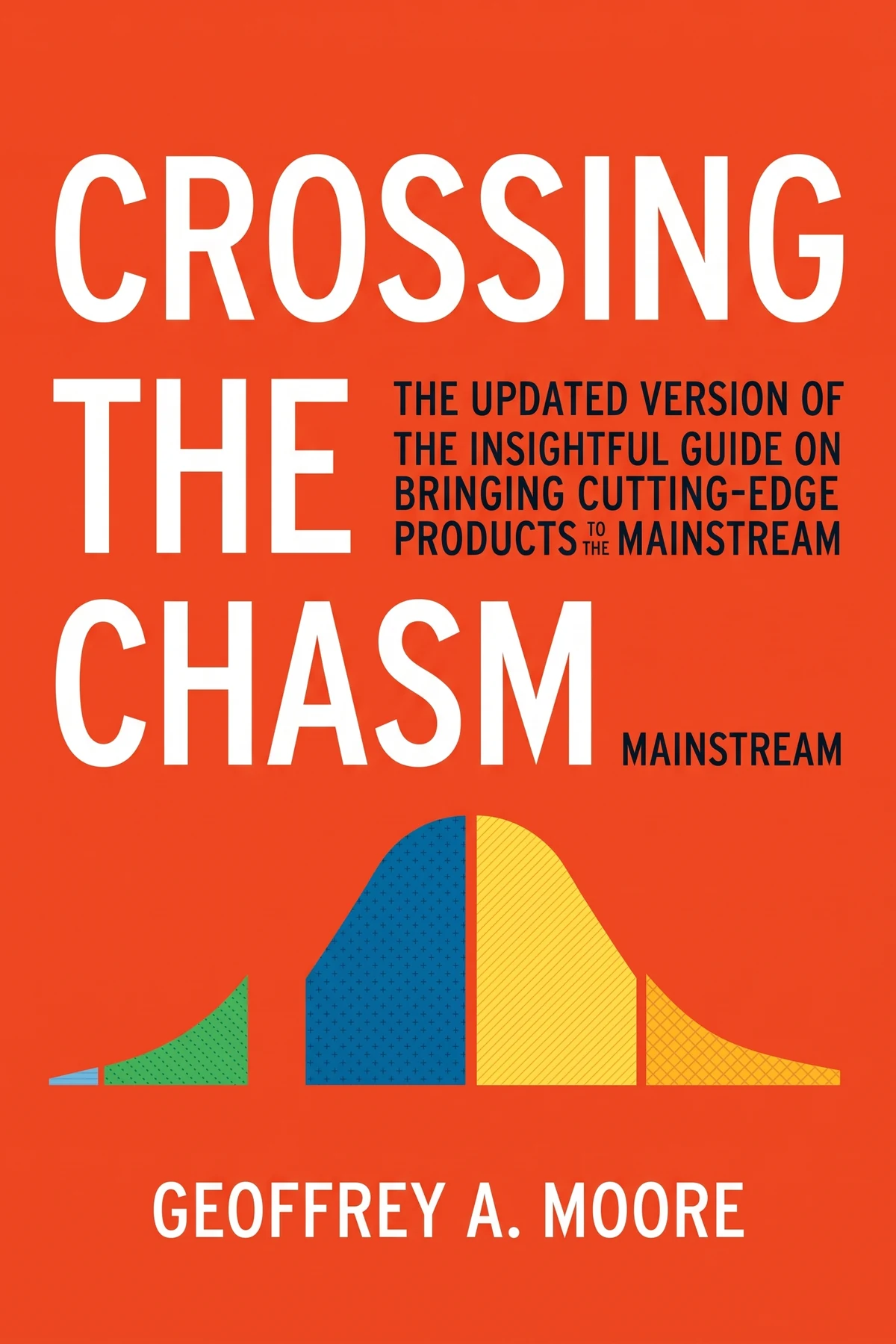
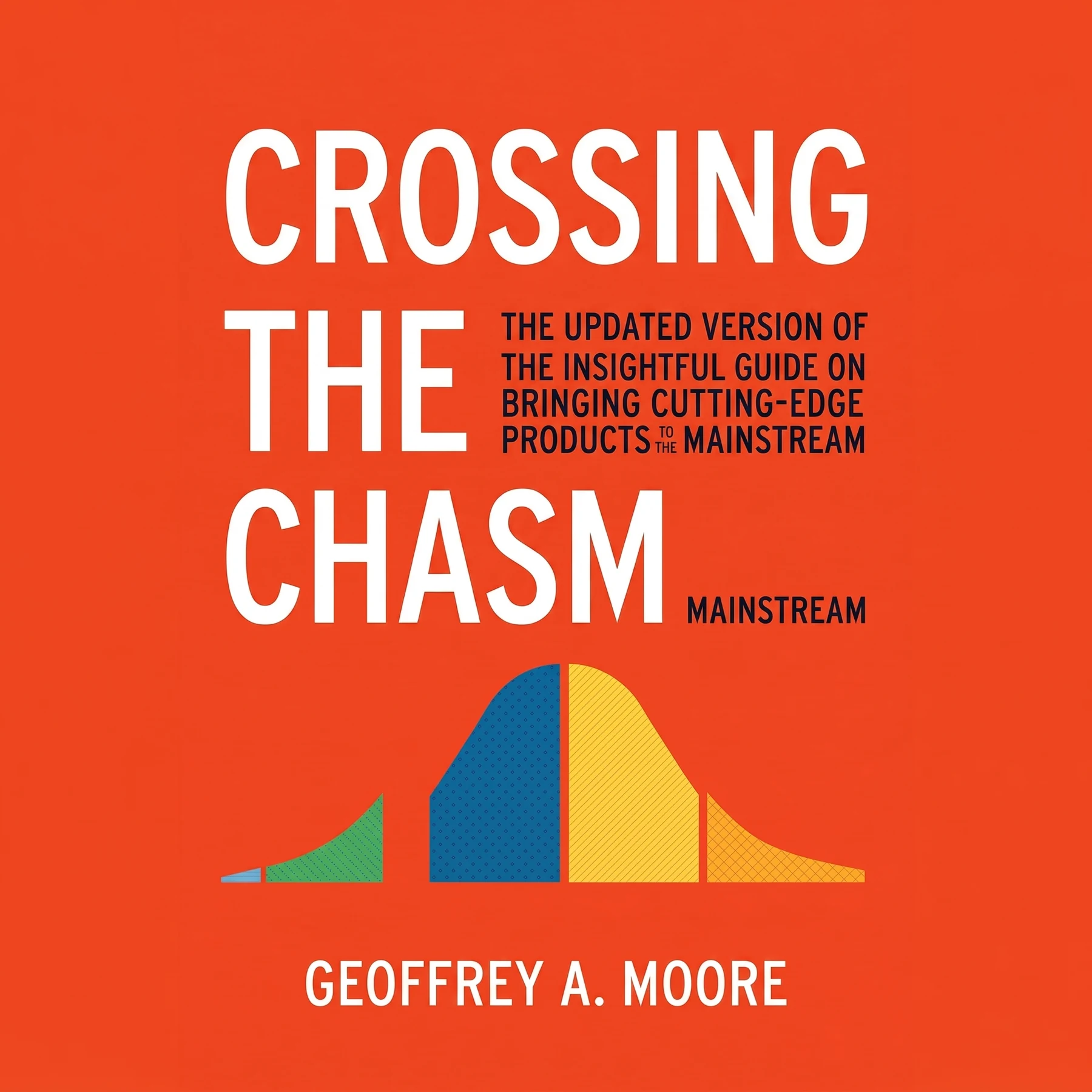
Crossing the Chasm is a foundational text in high-tech marketing that addresses a specific, recurring failure in the lifecycle of innovative products. Most new technologies find initial success with early adopters but fail to gain traction with the larger, more cautious mainstream market. This phenomenon is known as the chasm, a gap created by the fundamentally different expectations of visionary buyers versus pragmatic ones. The book offers a detailed tactical plan for moving beyond niche success. It introduces the Technology Adoption Life Cycle and explains how to pivot marketing, distribution, and product development strategies to appeal to the pragmatists who dominate the market. By treating the transition as a focused military-style invasion, Moore provides a blueprint for securing a market foothold, building a comprehensive solution, and eventually dominating an entire industry. It is a promise of how to turn a fragile startup into a resilient, market-leading enterprise.
Geoffrey A. Moore is a highly regarded author, consultant, and venture partner who has spent decades working within the high-tech ecosystem of Silicon Valley. His insights are drawn directly from his hands-on experience helping companies navigate the complexities of technological growth. Moore has authored several influential bestsellers in the field, including Inside the Tornado, The Gorilla Game, and Living on the Fault Line. While originally intended for a small, specialized audience, his work on market dynamics has achieved massive global recognition, selling hundreds of thousands of copies.
Geoffrey A. Moore
Listeners find this title to be a vital resource for business professionals, offering deep perspectives and useful wisdom. They also value how relevant it remains as a modern update to a classic, and one listener notes how it provides in-depth knowledge of marketing and analytics practices. The writing is high-quality and easy to grasp, with one listener highlighting its clear description of different phases. However, the pacing gets mixed reviews, as some find the material engaging while others feel it can be quite dense.
Wow, I really wish I had picked this up during my first startup attempt years ago. This book completely reframed how I view my role in product marketing by emphasizing the power of referenceability. Look, if you don't understand that mainstream customers need other mainstream customers to vouch for you, you're going to fail. Moore’s instructions on building a 'whole product' strategy are incredibly insightful and offer a deep dive into analytics practices that I hadn't considered before. The book is well-written and easy to understand, even for those of us who aren't marketing veterans. To be fair, some of the concepts take a minute to sink in, but the D-Day strategy for attacking a niche is just masterfully explained. It’s a classic for a reason and a must-read for business professionals.
Show moreThis book changed my life and the way I approach every single client project I take on now. I bought it years ago and skimmed it, but it wasn't until I truly dug into the 'secrets' of the chasm that I understood marketing. If marketing touches any part of your professional life, you must buy, read, and then re-read this until the D-Day strategy is second nature. The author gives examples of real-world products and how the model applies to them with such clarity that it’s almost startling. Frankly, until you understand why a pragmatist won't buy from you without a reference, you are basically clueless about high-tech growth. It’s a well-written, thoughtful explanation of why some companies scale while others vanish as passing fads. Truly a masterpiece of the genre.
Show moreTo be fair, I went into this expecting a dry, academic textbook but came away with a tactical field manual. The instructions and concrete steps to take to make use of the chasm model are surprisingly practical for a book first written decades ago. I loved the breakdown of what technology enthusiasts want versus what the pragmatist majority actually requires. It’s a classic for a reason—it’s fascinating, competent, and gives a fresh set of tools to help navigate complex product lifecycles. One customer highlight I agree with is that it provides a very clear description of different phases. It was exactly what I wanted in a book I’m reading for work. The bowling pin analogy alone has completely shifted how our team views our Q3 roadmap. Highly recommended for anyone in the tech space.
Show moreAfter hearing colleagues rave about this for years, I finally dove into the updated edition. The way Moore breaks down the transition from early adopters to the pragmatic mainstream using the D-Day analogy is nothing short of brilliant for anyone in high-tech sales. Frankly, it can get a bit dense during the middle chapters, and some of the newer company examples feel a little tacked on compared to the core theory. However, the underlying logic regarding the technology adoption life cycle remains an essential framework. It provides a clear description of different phases that most startups ignore at their own peril. If you are struggling to move past the 'enthusiast' phase, the strategies here regarding market niches are worth the price of admission alone. It’s a competent, usable guide that actually delivers on its reputation.
Show moreEver wonder why great tech products fail while mediocre ones dominate the market? This book answers that question by focusing on the 'chasm'—that terrifying gap where startups die because they can't appeal to pragmatists. Personally, I found the bowling pin analogy for niche market expansion to be the most usable part of the whole text. It’s to the point and concise, providing a tactical field manual for attacking a point of entry. Not gonna lie, the pacing is a bit uneven, and I found myself skimming some of the repetitive sections in the latter half. But the first 20% of the book is absolutely vital for anyone interested in building high-tech products. It gives a fresh and powerful set of tools to help navigate the stages of product life effectively.
Show moreMoore’s framework has aged surprisingly well, especially with the more recent case studies added to the newer editions. I particularly enjoyed the chapter on target customer characterization and the scoring scenarios for niche selection. Gotta say, the pharmaceutical company example regarding document management really helped clarify how to solve specific niche issues before expanding. The book provides in-depth knowledge of marketing that transcends just selling features; it’s about understanding human psychology in the face of innovation. Some of the instructions on making money from day one felt a bit aggressive for today's VC-heavy world, but the logic holds up. It’s a rather short book, yet it carries a lot of weight for those interested in making technology sustainable. Definitely a solid addition to any professional’s bookshelf, despite some dense sections.
Show morePicking a target customer isn't just about who likes your tech; it's about who actually needs it to survive. I found the checklist for the target market selection process on page 126 to be worth the price of the book alone. It’s a very good guide about transitioning between selling to early adopters and winning over the mainstream customers. The truth is that this transition doesn’t happen smoothly, and Moore covers the hard decisions that must be made with brutal honesty. While I enjoyed the scene-setting chapters, I did feel that some of the later sections on pricing and distribution were a bit less engaging. Still, it’s a-must-get-familiar-with for anyone in the industry. The clear implications of adopting this model were presented and well-organized for immediate use in my current project.
Show moreAs someone who works in a crowded SaaS space, the concept of the 'small pond' was a total game-changer for me. Moore explains that fighting your way into the mainstream requires a focused point of attack rather than a broad, unfocused launch. I appreciated the specific details on targeting a small market to gain that vital foothold before attempting to cross the chasm. In my experience, the book is a bit repetitive in its middle sections, but the core strategy is absolutely solid. The updated version includes some great recent company examples that help bridge the gap between 90s hardware and modern software services. It’s a fascinating business book about running startups that actually provides usable, concise advice for the real world. Despite the pacing issues, it remains a vital read for anyone in product development or marketing roles.
Show moreFinally got around to finishing this, though I’ll be the first to admit it was a bit of a slog in the middle. The concept presented is very interesting and vital, particularly the sections on targeting a 'small pond' to build a big reputation. In my experience, the parts worth the greatest attention are the first 20% and a small chunk in the middle; the rest is a bit boring. It took me nearly four months to get through because the writing can be quite dry and repetitive at times. That said, the model describing high-tech marketing is well-articulated and the 2010s updates keep it from feeling completely outdated. It’s an okay business book, but maybe more of a 'must-get-familiar-with' than a 'must-read' from cover to cover. I'd recommend it with some reservations about the pacing.
Show moreThe advice here feels incredibly anecdotal and lacks the scientific rigor I expect from a modern business text. Truth is, many of the stories Moore uses to back up his points feel cherry-picked to fit his specific model after the fact. I’m not saying his directions are necessarily wrong, but I wasn't convinced they were based on anything more than gut feeling and a few high-profile successes. Researching the author's track record only made my skepticism increase because it feels more like a collection of opinions than a proven methodology. For a book that is so famous in the tech world, I expected more evidence-based research rather than just clever analogies like the bowling pin model. It’s a dangerous error to implement these steps without questioning the lack of data behind them. It just wasn't for me.
Show more

Hamilton Helmer


Duncan Clark
AUDIO SUMMARY AVAILABLE
Get the key ideas from Crossing the Chasm by Geoffrey A. Moore, plus 5,000+ more titles in English and Thai.







