
16 min 54 sec
A Thousand Brains: A New Theory of Intelligence
By Jeff Hawkins
A deep dive into Jeff Hawkins's theory that intelligence arises from thousands of independent models within the neocortex, fundamentally changing our understanding of how we perceive reality and think.
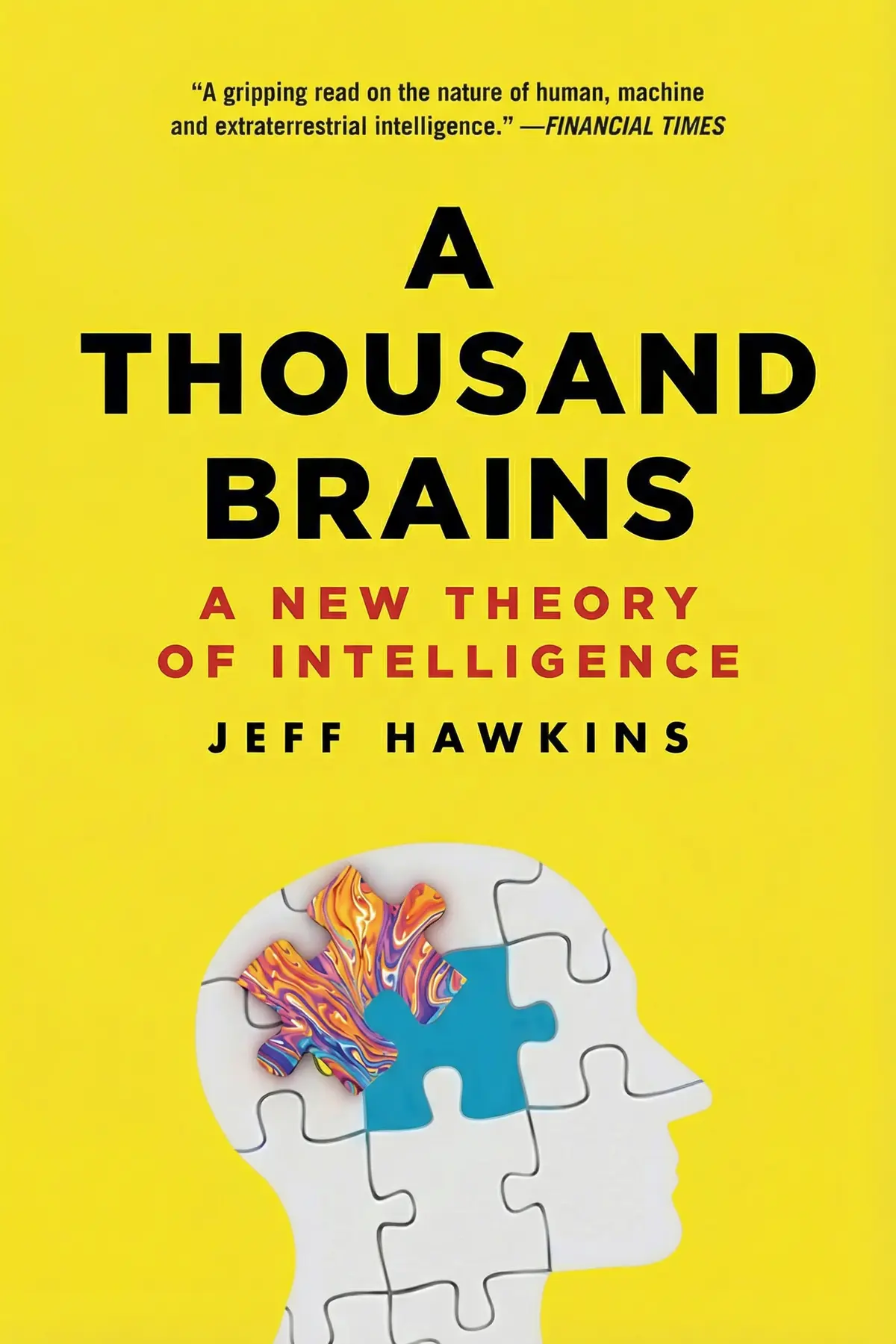
Table of Content
1. Introduction
1 min 40 sec
Have you ever paused to consider the sheer complexity occurring within your own skull? For centuries, the human brain has remained one of the most elusive frontiers of science. We have mapped its regions, identified its chemical messengers, and observed its electrical storms, yet the fundamental bridge between biological cells and the spark of intelligence has remained shrouded in mystery. We see the world, we solve problems, and we experience a sense of self, but how do billions of tiny neurons coordinate to produce these miracles?
In this exploration of Jeff Hawkins’s groundbreaking work, we are going to dive into a perspective that turns traditional neuroscience on its head. It is called the Thousand Brains Theory. This isn’t just a minor tweak to our current understanding; it is a sweeping, majestic framework that suggests our brains are not the singular, centralized computers we once thought they were. Instead, we are looking at a system that is radically decentralized, highly repetitive, and fundamentally built on the art of prediction.
Imagine a theory so stimulating that it changes how you perceive every interaction, every thought, and every movement. By the end of this journey, you’ll see why leading thinkers have found this model so exhilarating. We will unpack the hidden architecture of the neocortex, explore the brain as a master simulator, and discover how a process of internal democracy allows us to make sense of a chaotic world. This is a story about how we navigate reality, not just through our eyes and ears, but through a vast network of thousands of tiny, independent minds working in concert inside your head.
2. The Uniform Architecture of the Neocortex
2 min 25 sec
Discover why the most complex part of our brain looks surprisingly similar throughout, regardless of whether it’s processing a beautiful sunset or a complex mathematical equation.
3. The Brain as a Prediction Machine
2 min 24 sec
Your brain isn’t passively watching the world—it’s constantly predicting what comes next. Discover how this prediction machine builds reality itself and why getting it wrong is actually how you learn.
4. A Decentralized Intelligence of Thousands
2 min 15 sec
Consider a radical shift in perspective where the brain isn’t one single computer, but a collection of 150,000 independent learning units working in parallel.
5. Mapping Reality Through Reference Frames
2 min 02 sec
Learn how the brain uses internal coordinate systems to understand where objects are and how they behave, repurposing ancient navigation skills for modern thought.
6. Thinking as a Form of Navigation
2 min 13 sec
Understand how the same mechanisms used to find your way home are the very tools your mind uses to navigate through abstract concepts like language and politics.
7. The Brain’s Internal Democracy
2 min 13 sec
Find out how thousands of independent models reach a single, unified conclusion about the world through a fascinating process of neural voting.
8. Conclusion
1 min 42 sec
The Thousand Brains Theory offers more than just a new way to study the brain; it offers a new way to understand ourselves. We have seen that the neocortex is a masterpiece of biological engineering, built on the simple yet profound principle of repetition. By packing 150,000 identical cortical columns together, evolution created a machine capable of modeling the entire universe, from the smallest physical object to the most abstract philosophical idea.
This journey has shown us that our intelligence is fundamentally rooted in prediction and navigation. We are constantly building and refining maps of our world, using ancient brain structures to chart the territory of modern thought. We’ve discovered that our minds are not centralized processors but vibrant democracies, where a unified sense of reality emerges from the consensus of thousands of independent models. This realization shifts our focus from looking for the ‘seat of consciousness’ to appreciating the collaborative power of a massive, parallel network.
As you move forward from this summary, take a moment to notice the models your brain is running. When you pick up a pen, recognize a face, or follow a complex train of thought, remember the thousands of mini-brains working behind the scenes. You are not just a passive observer of the world; you are an active creator of it, constantly voting on what is real and navigating the vast landscapes of your own internal simulations. The Thousand Brains Theory reminds us that intelligence is not a mysterious gift, but a beautiful, logical consequence of how our neurons are wired to learn, map, and collaborate.
About this book
What is this book about?
A Thousand Brains introduces a transformative perspective on neuroscience, challenging the long-held belief that the brain is a centralized processor. Instead, Jeff Hawkins proposes that the neocortex is composed of roughly 150,000 cortical columns, each acting as an independent learning machine. These columns build complex models of the world using reference frames—a system originally evolved for physical navigation but now repurposed for abstract thought. The book explains how these thousands of individual models reach a consensus through a process akin to biological democracy, or voting. By understanding this decentralized architecture, we gain a clearer picture of how humans perceive the world, learn new skills, and potentially how we might one day develop truly intelligent machines. It is a journey into the mechanics of the mind that suggests our consciousness is far more distributed and collaborative than we ever imagined.
Book Information
About the Author
Jeff Hawkins
Jeff Hawkins is a neuroscientist, entrepreneur, and computing pioneer. He cofounded Palm Computing and Handspring, where he invented the PalmPilot and the Treo smartphone. He now runs Numenta, a company and research lab which studies how the brain works, and is coauthor of the book On Intelligence.
Ratings & Reviews
Ratings at a glance
What people think
Listeners find the book offers intriguing concepts regarding the brain and is exceptionally easy to read, with one listener highlighting how it clarifies the neocortex's organization through fundamental building blocks. Furthermore, the quality of the prose is well-regarded, and the text explores a vast range of topics. Nevertheless, the stimulating material gets varied responses, as some consider it thought-provoking whereas others do not share that view. Pacing also draws differing opinions; while one listener characterizes it as a brilliant look at the old brain/neo-cortex, another perceives it as being filled with flaws.
Top reviews
Grace
This book is a landmark for anyone trying to grasp how our minds actually model the world. Jeff Hawkins proposes a breathtakingly elegant theory—the Thousand Brain Theory—which suggests our neocortex is comprised of 150,000 identical columns. Instead of one central processing unit, we have a massive parallel system of reference frames. The prose is remarkably accessible, breaking down complex neurobiology into digestible concepts without losing the scientific weight. I found the section on how we 'vote' on reality particularly illuminating. While some might find the later chapters on AI safety a bit speculative, the core neurological insights are worth the price of admission. It completely shifted how I perceive my own sensory experiences.
Show moreVipawan
Ever wonder why current 'AI' feels so hollow compared to human intuition? Hawkins answers this by bridging the gap between his engineering roots and decades of brain research. He argues that intelligence isn't just about processing data, but about building spatial models. I was hooked by his explanation of grid cells and how they allow us to navigate both physical rooms and abstract ideas. The writing is clear, confident, and persuasive. To be fair, he spends a lot of time on his own company's findings, but the logic is sound enough to stand on its own. This is a must-read for tech enthusiasts who want a biological blueprint for the future of machine learning.
Show moreEmily
Finally got around to reading this, and it sparked a total brain renaissance for me. I’ve always been frustrated by how academic labs focus on tiny slivers of the brain instead of the whole system. Hawkins takes the opposite approach, providing a unified framework that actually makes sense. His theory about 150,000 cortical columns creating a 'society' of models is the first time I've felt like I understood how I perceive a coffee cup or a conversation. Look, the stuff about uploading brains and space satellites is wild, but it’s the kind of big-picture thinking we need. It’s a provocative, beautifully written, and deeply ambitious piece of work.
Show moreChloe
Not what I expected, but in the best way possible. Hawkins compares his work to Darwin’s discovery of evolution, and while that sounds boastful, the framework he provides is incredibly sturdy. He moves past the 'input-output' computer model of the brain and shows us something much more organic and complex. The writing style is punchy and direct, which keeps the pacing fast despite the heavy subject matter. I especially appreciated his level-headed take on AI safety; he successfully dismantles the 'killer robot' trope with logic. Whether or not he's 100% right, this book forces you to think about thinking in a way few other authors can.
Show moreFilm
Wow, what a rollercoaster of a science read. The first half is a masterclass in explaining the neocortex’s organization through fundamental building blocks called cortical columns. Hawkins has a gift for making you feel like you're on the verge of cracking the code of consciousness. However, the pacing stumbles slightly when he moves into the more philosophical territory of the 'old brain.' He blames our evolutionary instincts for modern social ills, which felt a bit oversimplified compared to the rigorous neuroscience earlier on. Despite that, the idea that our brains are essentially 150,000 mini-brains working in concert is a total game-changer. It’s a brilliant look at how we learn.
Show moreKiattisak
As someone who has always been intimidated by neuroscience, I found this remarkably readable. The author avoids the dense jargon that usually kills my interest in these topics. He frames the brain's evolution as a struggle between the 'old brain' (survival) and the 'new brain' (intelligence), which explains so much about human behavior. Personally, I think his take on the future of humanity is a bit polarizing. He suggests we should prioritize preserving knowledge over our own genes, which is a tough pill to swallow. Still, the technical explanation of how we use reference frames to understand democracy or mathematics is pure genius. A solid addition to any science shelf.
Show morePairot
The chapter on cortical columns and 'voting' mechanisms alone makes this book worth your time. Hawkins presents a 'Middle Out' approach that feels much more realistic than pure bottom-up analysis. Frankly, his confidence can be a bit much, especially when he ignores previous giants in the field like Minsky. He writes with the certitude of an engineer who believes he’s solved a puzzle everyone else missed. While the second half drifts into some fairly obvious prognostication about AI risks, the central theory is incredibly thought-provoking. It’s a highly readable exploration of what makes us intelligent, even if it ignores the deeper social complexities of human nature.
Show morePooja
After hearing so much hype about the 'Thousand Brains' theory, I had to see if it lived up to the noise. The core idea is simple: we don't have one brain; we have thousands of them working together. Hawkins explains this using the concept of reference frames, which is a great way to visualize how we store information. I found his distinction between intelligence and the 'old brain' instincts to be very useful for understanding why humans act so irrationally. My only gripe is that the book feels a bit repetitive at times. However, for a general reader, it’s an excellent and highly accessible introduction to modern brain theory.
Show moreLuke
Picked this up hoping for a deep dive into AI, but I ended up with a mixed bag of brilliant science and questionable social theory. The explanation of the neocortex and how it uses movement to build models is genuinely fascinating. I loved the analogy of the partygoers seeing an empty room. But then, things take a turn for the weird. The author spends way too much time talking about launching our knowledge into orbit to impress future aliens. It felt less like a science book and more like a personal manifesto toward the end. If you want the meat, read the first 150 pages and then maybe skim the rest.
Show moreMichael
This started as a fine popular science piece, but it quickly devolved into what I'd call 'populist science.' Hawkins is clearly a brilliant engineer, but he seems to think a background in the PalmPilot qualifies him to solve climate change and social injustice. He dismisses the 'old brain' as the source of all our problems without acknowledging a single page of sociology or history. To be fair, the neuroscience parts are interesting, but the arrogance of the second half is hard to stomach. He ignores the 'hard problem' of consciousness entirely, pretending it doesn't exist. It’s a disappointing example of a scientist stepping way outside his expertise.
Show moreFeatured in
Readers also enjoyed
A Life Decoded: My Genome: My Life
J. Craig Venter
A Planet of Viruses
Carl Zimmer

A Short History of Nearly Everything
Bill Bryson

Alien Earths: The New Science of Planet Hunting in the Cosmos
Lisa Kaltenegger

AUDIO SUMMARY AVAILABLE
Listen to A Thousand Brains in 15 minutes
Get the key ideas from A Thousand Brains by Jeff Hawkins, plus 5,000+ more titles in English and Thai.
- 5,000+ titles
- Listen as much as you want
- 7-day free trial
- Cancel anytime







