
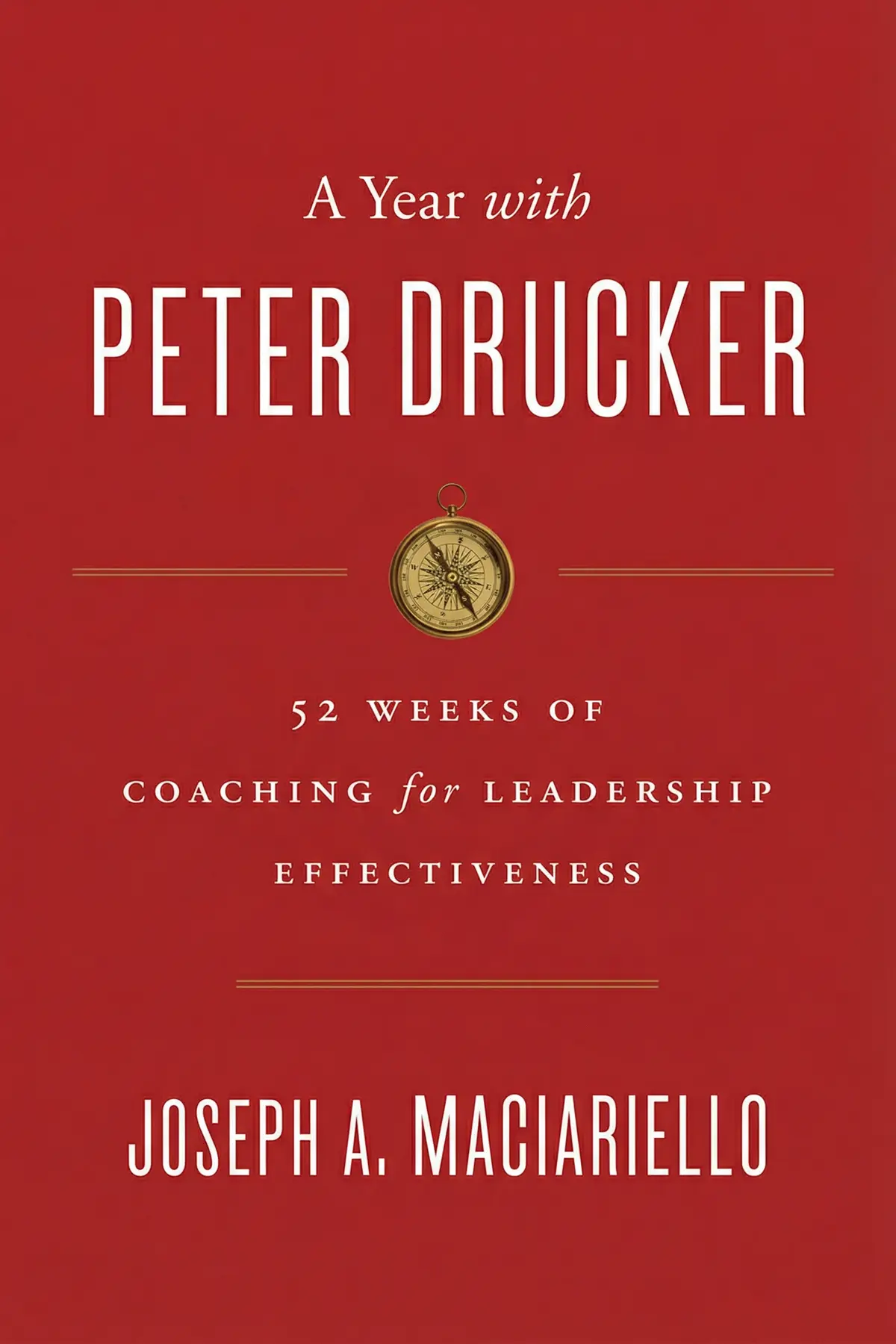
A Year with Peter Drucker: 52 Weeks of Coaching for Leadership Effectiveness
Joseph A. Maciariello
Culture Renovation offers a detailed blueprint for revitalizing corporate environments through eighteen strategic leadership actions. It explores how top-tier organizations rebuild their internal foundations to drive sustained growth and innovation.
1 min 55 sec
When we think about the most successful corporate turnarounds in history, we often look at the balance sheets or the launch of a revolutionary new product. But if you look closer at a company like Microsoft, you’ll find that its astronomical rise in market value during the mid-2010s wasn’t just about software updates or cloud computing. It was about a fundamental shift in how people within the company interacted, competed, and collaborated. This transformation represents what it means to perform a true cultural renovation.
Most leaders recognize that culture is the lifeblood of their organization, yet a staggering eighty-five percent of culture change initiatives eventually fail. Why? Because they are often approached as ‘re-branding’ exercises or top-down mandates that lack a strategic foundation. A renovation, however, is different from a mere change. It implies that you are building on a pre-existing structure—preserving the solid foundation while tearing down the walls that no longer serve a purpose. It is a disciplined, multi-step process that requires more than just a new set of values printed on a breakroom poster.
In this exploration of the roadmap developed by Kevin Oakes, we will look at the essential phases of turning a stagnant or toxic workplace into a thriving engine of innovation. We will move beyond the theory to look at how global leaders identify what’s broken, how they leverage the hidden influencers within their ranks, and how they use storytelling to make a new vision stick. The goal is to provide you with the same framework used by the world’s most resilient companies to ensure their culture isn’t just a buzzword, but a competitive advantage that is virtually impossible for rivals to replicate.
2 min 23 sec
Traditional annual surveys often fail to capture the true heartbeat of an organization. Discover how leading companies use real-time sentiment analysis and daily check-ins to stay ahead.
2 min 01 sec
True renovation isn’t about starting from scratch. Learn why the most successful cultural shifts focus on protecting the heritage and values that already work.
1 min 52 sec
A mission statement is just words unless it guides difficult decisions. Explore how a clear purpose can redefine an entire industry and drive social impact.
1 min 56 sec
Cultural aspirations often fail because they are too abstract. Learn how to turn vague values into specific, observable behaviors that define daily work.
2 min 06 sec
The most important people in your company might not be the ones with the highest titles. Discover how to find and engage the informal leaders who drive change.
2 min 07 sec
Change is a marathon, not a sprint. Explore how consistent storytelling and relentless communication keep the momentum of a renovation alive for the long haul.
1 min 42 sec
The journey of cultural renovation is not a quick fix or a simple project to be checked off a list. As we have seen, it is a comprehensive process that begins with the humility to listen, the wisdom to preserve what is working, and the courage to define a purpose that transcends profit. By moving from abstract values to concrete behaviors and engaging the hidden influencers who actually move the needle, an organization can transform itself from the inside out.
Remember that the goal of this renovation is to create an unshakeable foundation that can withstand the pressures of a rapidly changing world. Whether it is through the silent, data-driven meetings at Amazon or the bold ethical stands taken by CVS, the common thread is a commitment to authenticity and consistency. Culture is the ultimate competitive advantage because it is the only thing a competitor cannot buy or copy. It is built through thousands of small interactions, reinforced by leadership, and sustained by the stories a company tells about itself.
As you think about your own organization, ask yourself: What are the walls that need to come down? What are the foundations that must be protected? And most importantly, who are the people who will help you rebuild? By following this roadmap of listening, defining, and storytelling, you can ensure that your organization doesn’t just survive the future, but thrives in it. The work of culture is never truly finished, but with a solid renovation plan, you can build a company that is truly built to last.
The corporate world is littered with failed attempts at cultural change, often because leaders treat the process like a surface-level makeover rather than a deep structural renovation. This summary explores the specific framework necessary to successfully overhaul an organization's identity and habits without losing the elements that made it successful in the first place. Drawing on extensive research and real-world case studies from industry giants like Microsoft, 3M, and Amazon, the book outlines a phased approach to cultural transformation. It moves from initial listening and strategy to the hard work of behavioral change and long-term sustainability. The promise is clear: by following a disciplined, data-driven roadmap, leadership can move beyond vague mission statements to build an unshakeable company culture that powers performance and employee engagement for years to come.
Kevin Oakes is the CEO and co-founder of the Institute for Corporate Productivity (i4cp). He is a leading global expert on human capital management, organizational culture, and strategic talent development. Prior to his work at i4cp, Oakes was CEO of Click2learn, which merged with Docent to form SumTotal Systems.
Listeners find the writing very accessible, and one notes that it is appropriate for business leaders regardless of their organization's size. They value the information provided, with one listener highlighting it as a perfect blueprint for renovating organizational culture.
Finally got around to reading Kevin Oakes' latest, and the structure alone makes it worth the price of admission. It breaks down the messy process of cultural change into three logical phases: planning, implementing, and maintaining. I particularly enjoyed the second section. Why? Because it provides a blueprint of proven tactics rather than just vague theory. While some might find the focus on massive publicly traded companies a bit narrow, the underlying principles are universal. It is an inspiring and timely read for any leader. Truth is, we need more books that provide a structured playbook instead of just philosophical fluff.
Show moreThis book is a masterclass in organizational design for the modern era. Oakes moves past the 'culture eats strategy for breakfast' clichés to provide a genuine, actionable blueprint. When employees love their jobs, the positivity ripples through the entire organization, and this book shows you exactly how to foster that environment. I appreciated the emphasis on retention and recruitment, which are such massive pain points right now. Not gonna lie, I’ve already highlighted half of the chapters for my upcoming leadership retreat. It is rare to find a business book that is both this readable and this data-heavy.
Show moreWow, Kevin Oakes really hit the nail on the head regarding the 'renovation' vs. 'transformation' mindset. This isn't just another dry business text; it's a call to action for leaders to care for their people. The positivity described in the case studies is contagious, and it makes me want to implement these changes immediately. The 18 steps provide a level of clarity that most culture books simply lack. In my experience, most organizations fail because they skip the 'maintaining' phase, so I'm glad that was included here. This is a must-read for anyone who wants to build a high-performance team that actually enjoys their work.
Show moreA well-structured playbook is exactly what the business world needs right now. I've been searching for something that moves beyond theory and into the actual 'how-to' of cultural evolution. Oakes delivers with a clear-eyed look at what successful companies are doing to stay competitive and keep their talent happy. The 'blueprint of proven tactics' phrasing in the description is very accurate. It is an ideal guide for business leaders of any size, despite the heavy focus on larger corporations in the examples. Personally, I think this should be required reading for every MBA student and HR director in the country.
Show moreEver wonder why some corporate pivots feel like a disaster while others soar? Oakes argues that it’s all about the renovation, not just a surface-level coat of paint. I found the 18 action steps quite helpful, even if they don't always seem to build on each other in a perfectly linear way. My only real gripe is that the author relies heavily on testimonies from personal friends and big-name CEOs. It starts to feel a bit like name-dropping after a while. Still, the data-driven approach from i4cp is hard to argue with. It's a readable, insightful guide for HR professionals and executives alike.
Show moreThe case studies provided here are genuinely fascinating, offering a rare glimpse into the boardrooms of massive publicly traded companies. I found the distinction between a 'renovation' and a 'transformation' to be a very helpful mental model for our leadership team. Some chapters felt a little repetitive, and the name-dropping of personal friends was a minor distraction. However, the core 18-step framework is sturdy enough to carry the weight of the book's thesis. It is a well-structured read that puts researched knowledge into actionable steps for both HR and non-HR leaders. If you need a playbook for change, this is a very strong contender.
Show moreAs someone who has navigated three major mergers, I can say this is the guide I wish I had five years ago. Kevin Oakes understands that you can’t just scrap a culture; you have to renovate what already exists to keep the foundation strong. The insights on empowering team members to feel good about their jobs are especially timely. I did find the final section on maintaining systems to be less structured than the earlier chapters, which was a bit of a letdown. Nevertheless, the tactical advice in the planning phase is worth the read alone. It’s a solid addition to the library of any business leader.
Show moreLook, most business books are just long-form articles, but Oakes manages to provide a comprehensive framework that feels substantive. The writing style is professional yet accessible. This makes it an easy read for a busy executive. I liked the focus on listening to employees and using data to drive cultural shifts. There were a few moments where the tone felt a bit self-congratulatory regarding the author’s network. However, the actionable steps at the end of the chapters make it a very practical resource. It’s a well-written, structured piece of work that addresses the critical issues of retention and recruitment facing us today.
Show moreTo be fair, there is a mountain of research packed into these pages, yet I found it difficult to fully immerse myself in the narrative. It feels like a consolidation of many other business books you’ve probably already read over the last decade. The first two sections on planning and implementation are solid, but the final section on maintenance felt like a loose collection of ideas. I was hoping for more variety in the types of businesses profiled beyond the usual Fortune 500 giants. Frankly, the insights are there, but the delivery lacked the 'wow' factor I was anticipating.
Show moreNot what I expected given the high praise from my professional network. The book is incredibly heavy on examples from large, publicly traded companies, making it feel less applicable to small or mid-sized business owners. I honestly struggled to pull away many specific takeaways because the author relies so heavily on testimonials and name-dropping. It felt more like a showcase for i4cp’s connections than a universal guide for cultural change. While the three-section structure makes sense on paper, the execution felt disjointed and lacked a strong, unifying thesis. If you aren't leading a Fortune 500 company, you might find this one hard to relate to.
Show moreJoseph A. Maciariello
Deborah Gruenfeld
Mike Michalowicz
Hamilton Helmer
AUDIO SUMMARY AVAILABLE
Get the key ideas from Culture Renovation by Kevin Oakes, plus 5,000+ more titles in English and Thai.







