
20 min 59 sec
Do I Make Myself Clear?
By Harold Evans
In a world drowning in jargon and clutter, legendary editor Harold Evans provides a masterclass on writing with impact. Learn to strip away the fluff and communicate with undeniable clarity.
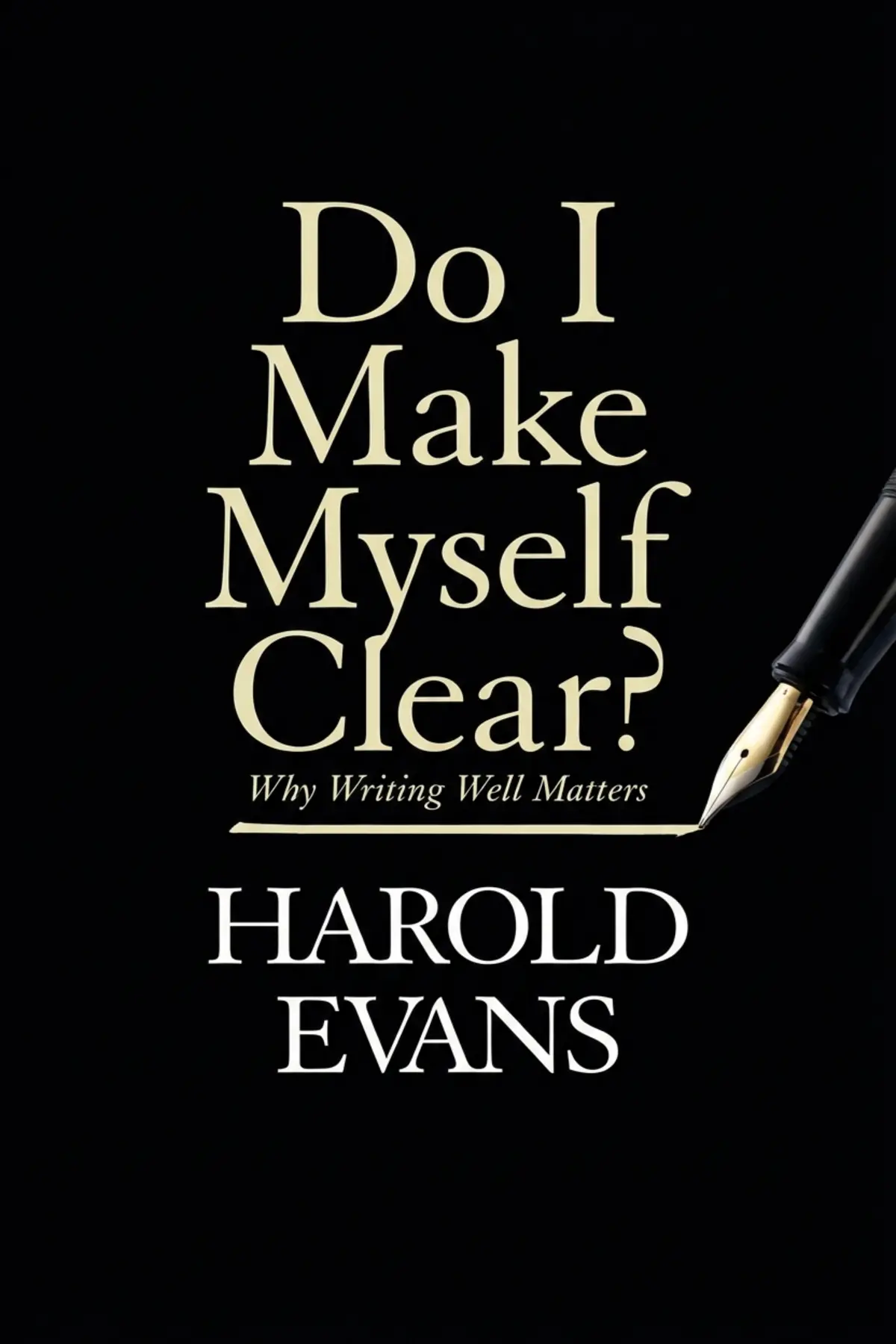
Table of Content
1. Introduction
1 min 38 sec
Have you ever found yourself trapped in the middle of a legal contract, feeling like you were drowning in a sea of ‘heretofores’ and ‘whereases’? Or perhaps you’ve tried to navigate a corporate memo that used five hundred words to say absolutely nothing at all. In our modern digital landscape, we are surrounded by more text than ever before, yet strangely, we seem to be communicating less effectively. The constraints of the past, where the physical size of a newspaper page forced writers to be brief and punchy, have vanished. In their place, we have an infinite digital canvas that often rewards volume over value.
This is where Harold Evans steps in. As a legendary editor who has spent decades at the helm of major publications, Evans believes that the art of clear writing is being lost—and that the consequences are far more serious than just a few boring emails. When we lose clarity, we lose the ability to hold power to account, to understand the risks we take, and to connect with one another on a human level.
In the pages ahead, we are going to explore a blueprint for better communication. We will look at the specific habits that clutter our sentences and the mental shifts required to put the reader first. This isn’t just about grammar or punctuation; it’s about a commitment to being understood. We’ll learn why the passive voice is often a hiding place for the timid, how ‘zombie nouns’ can suck the energy out of a story, and why the fight for clear prose is actually a fight for the truth itself. By the time we’re finished, you’ll have a toolkit to transform your writing from a dense thicket into a clear path that leads your reader exactly where you want them to go.
2. The Evolution of Prose in the Digital Age
2 min 15 sec
Explore how the shift from print to digital media has affected the quality of our communication and why writing remains a skill that anyone can master with dedication.
3. Balancing Rules with Readability
2 min 16 sec
While grammar rules and readability scores provide a useful foundation, they should never come at the expense of a writer’s rhythm and engagement.
4. The Dangers of Front-Loading and the Passive Voice
2 min 06 sec
Learn how to give your writing more energy by choosing the active voice and placing your most important information at the beginning of the sentence.
5. Interrogating Every Word
2 min 41 sec
Every word in your sentence should earn its keep. Discover how to identify and remove the ‘parasites’ that add bulk without adding value.
6. The Power of Positive Phrasing and Rhythmic Variety
2 min 12 sec
Writing is as much about music as it is about meaning. Learn how to use positive assertions and varied sentence structures to keep your readers hooked.
7. Exposing Zombies and Flesh-Eaters
2 min 16 sec
Understand how certain linguistic habits, like ‘nominalization’ and clichéd phrasing, can drain the life out of your story and how to avoid them.
8. The Moral Imperative of Clarity
2 min 02 sec
In a ‘post-truth’ world, clear writing is more than just a professional skill; it is a vital defense against the manipulation of facts and language.
9. The High Cost of Muddy Communication
2 min 06 sec
Examine the real-world consequences of bad writing, from the 2008 financial collapse to the gridlock in modern environmental and healthcare policy.
10. Conclusion
1 min 27 sec
As we have seen, the path to clear writing is not about memorizing a set of obscure grammar rules; it is about adopting a mindset of service to the reader. Harold Evans reminds us that every time we pick up a pen or sit down at a keyboard, we have a choice. We can hide behind the ‘mumbo jumbo’ of our industry, or we can do the hard work of distilling our thoughts into something sharp and useful.
We’ve explored the ‘zombie nouns’ that drain our energy and the ‘flesh-eaters’ that clutter our sentences. We’ve seen how the passive voice can make us sound timid and how front-loading can exhaust our audience. Most importantly, we’ve recognized that in a world of political spin and financial complexity, clarity is a moral necessity. It is the primary tool we have to protect the truth and ensure that we are not being manipulated by those who use language to obscure their intentions.
As you move forward, start by being an ruthless editor of your own work. Look for the ‘pleonasms’—those redundant phrases like ‘collaborate together’ or ‘new beginning’—and cut them out. Ask yourself if there is a simpler, more active way to say what you mean. If you can make your writing cogent and concise, you aren’t just improving your career prospects; you are contributing to a more honest and transparent world. Remember, the ultimate goal of any communication is to be understood. Don’t let your message get lost in the fog. Make yourself clear.
About this book
What is this book about?
Do I Make Myself Clear? is a comprehensive guide to rescuing the English language from the depths of obfuscation. Harold Evans, drawing on decades of experience at the highest levels of journalism and publishing, argues that clear writing is more than just a stylistic choice—it is a civic duty. The book serves as both a practical manual and a philosophical defense of the truth. Readers will discover the specific linguistic traps that weaken our messages, from the passive voice and redundant adverbs to the more sinister 'zombie nouns' that drain the life out of prose. By examining everything from the 2008 financial crisis to the rhetoric of modern politics, Evans demonstrates how muddy communication can have devastating real-world consequences. This summary promises to give you the tools to sharpen your sentences, engage your audience, and ensure your meaning is never lost in translation.
Book Information
About the Author
Harold Evans
Harold Evans was one of the most respected editors of his time. Over the course of his illustrious career, he spent 14 years working for the Sunday Times and seven years as president and publisher at Random House, US. In 2004, he was awarded a knighthood in recognition of his outstanding work as a newspaper editor.
Ratings & Reviews
Ratings at a glance
What people think
Listeners find this title to be essential for anyone who writes, highlighting the outstanding tips on composition and the plentiful humor. Additionally, the caliber of content is highly rated, with one listener pointing out how it is filled with perspectives on written language. However, the tempo is criticized for being pretentious, and views on the quality of vocabulary are divided.
Top reviews
Weera
The chapter on 'zombies'—those lifeless nouns that devour perfectly good verbs—is worth the price of admission alone. Harold Evans writes with the precision of a master craftsman who has spent decades in the trenches of Fleet Street and New York publishing. To be fair, he isn't just teaching you where to put a comma; he's teaching you how to think with clarity and purpose. I found his analysis of 'lethal language' particularly sobering, showing how murky prose can actually lead to real-world disasters. While some might find his constant use of political examples a bit much, I thought they provided essential context for why clear communication is a civic duty. It's a bulky read, but every page feels packed with insights that you just don't get from standard grammar guides. If you want to strip away the fluff and make your sentences move with actual muscle, this is the book for you.
Show moreMingkwan
Wow, what an absolute education in the power of the English language. This isn't just a grammar book; it’s a passionate defense of truth and clarity in an era of 'pure wind' and political obfuscation. Evans follows in the footsteps of George Orwell, arguing that how we write directly reflects how we think and govern. I loved his section on 'zombie' nouns—those words like 'implementation' or 'utilization' that suck the life out of active prose. Truth is, his rewrites are masterclasses in themselves, showing how a 150-word paragraph of bureaucratic nonsense can be distilled into twenty powerful words. While he is certainly opinionated, his wit makes the medicine go down easily. This book should be required reading for every journalist, lawyer, and student in the country. It’s a dense, rich, and ultimately necessary guide for the 21st century.
Show moreKob
Not what I expected, but exactly what I needed. I picked this up thinking it would be a standard 'how-to' on grammar, but it’s more of a philosophical deep dive into why clarity matters for a healthy society. Evans is a word craftsman of the highest order, and his passion for the craft is infectious on every page. From his hilarious takedowns of 'shadow banks' jargon to his deep respect for the legacy of Shakespeare, the book is a treasure trove of linguistic history and practical tips. Look, if you’re looking for a quick cheat sheet, this isn't it. This is a book for people who truly love language and want to understand its mechanics from the ground up. It’s an entertaining romp that makes you look at every sentence you write with a more critical, editorial eye. Truly a gem for the aspiring word-smith.
Show moreCarlos
As someone who makes a living through words, I found Evans' insights into journalistic prose incredibly refreshing. He doesn't just preach about brevity; he demonstrates it through sharp, side-by-side comparisons of bloated original texts and his own streamlined versions. Look, the book is definitely long, and the author's voice can occasionally come across as a bit curmudgeonly or even pretentious when he's railing against modern jargon. However, his wit keeps the instruction from ever feeling dry or academic. I especially appreciated the sections on 'flesh-eaters' and prepositional parasites. My only real gripe is that the audiobook format makes it hard to digest the more technical lists. Still, for anyone looking to refine their craft, Evans offers a wealth of experience that is hard to find elsewhere. It’s a deep dive into what makes language actually function.
Show moreSuthinee
Ever wonder why modern news and corporate memos feel so incredibly dull and difficult to parse? Harold Evans answers that question with biting humor and a career’s worth of expertise. He takes aim at the 'flesh-eaters' of language—those unnecessary words and pompous phrases that clutter up our communication. I found the 'Ten Shortcuts' chapter to be an absolute goldmine for practical tips. In my experience, most writing books are either too dry or too vague, but Evans provides concrete examples of how to inject energy into your sentences. He does lean heavily on his background in journalism, which might not appeal to fiction writers, but the core principles of clarity remain universal. It’s a bit of a slog in the middle due to the sheer volume of examples, but the insights are undeniably valuable for anyone who wants their words to carry weight.
Show moreWacharapol
Finally finished this beast of a book, and I have to say, my writing is better for it. Evans has an incredible knack for spotting the 'pleonasms' and redundancies that we all fall into without thinking. The chapter on lethal language was a standout for me, illustrating how poor communication in high-stakes environments like the military or medicine can have tragic results. It’s a sobering reminder that clear writing isn't just about aesthetics; it's about accuracy and safety. To be fair, the pacing is a bit uneven, and some of the chapters feel more like a collection of essays than a cohesive guide. However, the sheer density of information makes it a fantastic reference to keep on the shelf. I’ll definitely be going back to his lists of 'good-word' glossaries. It’s a must-read for writers, even if you have to skim some of the more self-indulgent anecdotes.
Show moreGrace
Direct and punchy, this book serves as a clarion call for anyone tired of clotted, lifeless prose. Evans uses his decades of experience as a top-tier editor to dismantle the bad habits we learn in school and the workplace. I particularly enjoyed his 'Ten Shortcuts' and his insistence on 'razing adverbs' to let the verbs do the heavy lifting. The book is infused with a dry, British wit that kept me smiling, even when the subject matter got a bit technical. Some readers might find the journalistic focus a bit narrow, but the lessons on clarity and rhythm apply to almost any form of communication. It’s a bit pretentious in places, sure, but when you’ve been knighted for your services to journalism, I suppose you’ve earned a little swagger. A very helpful addition to my writing library.
Show moreWittaya
After hearing so much praise for Harold Evans, I finally got around to reading this, but my feelings are decidedly mixed. On one hand, the man is clearly a legend in the world of editing, and his advice on favoring active verbs is solid. On the other hand, the book is way too long and suffers from the very lack of brevity it critiques. He includes massive, multi-page quotes just to show a minor edit, which makes for a very tedious reading experience. Personally, I found the constant political barbs distracting; they dated the book and felt more like 'Trashing Trump' than teaching craft. There's a good 150-page book hidden inside this 400-page one. If you have the patience to dig through the repetitive examples and the author's personal venting, there is great advice here, but it’s definitely an exercise in endurance.
Show moreDarawan
Picked this up hoping for a masterclass in editing, but I was instead greeted by a mountain of political commentary that felt entirely out of place. Frankly, I didn't sign up for a critique of the Trump administration when I bought a book on writing style. Evans spends so much time using political speeches as 'bad' examples that the actual advice on prose gets buried under his personal biases. The structure is repetitive, often circling back to the same points about active verbs without offering much new depth after the first hundred pages. While there are a few gems regarding clarity, the 'zombie' concept is better explained in shorter essays by others. It's frustrating because Evans clearly knows his stuff, but his delivery is so focused on his own political leanings that it alienates a huge portion of the audience. I'd stick with Zinsser or Strunk and White for a more objective guide.
Show moreFinn
This book is a total disappointment for anyone looking for actual, accurate grammatical instruction. Not gonna lie, I lost all respect for the author's credibility when I hit his definitions of sentence structures on page 34. He completely butchers the difference between simple and compound sentences, claiming a simple sentence can't have a compound verb, which is just fundamentally wrong. If you're going to write a 400-page tome on 'making yourself clear,' the least you can do is get basic middle-school grammar right. The rest of the book is mostly a platform for him to boast about his past editorial triumphs and air his grievances against politicians he dislikes. It’s more of an ego-trip than a writing manual. Don't waste your time or money on this when there are much more reliable resources available for authors.
Show moreFeatured in
Readers also enjoyed
AUDIO SUMMARY AVAILABLE
Listen to Do I Make Myself Clear? in 15 minutes
Get the key ideas from Do I Make Myself Clear? by Harold Evans, plus 5,000+ more titles in English and Thai.
- 5,000+ titles
- Listen as much as you want
- 7-day free trial
- Cancel anytime







