
17 min 22 sec
Hope Is Not a Strategy: The 6 Keys to Winning the Complex Sale
By Rick Page
Hope Is Not a Strategy provides a rigorous framework for navigating complex, multi-stakeholder sales. It replaces guesswork with a strategic process called RADAR to identify, qualify, and win high-stakes business deals.
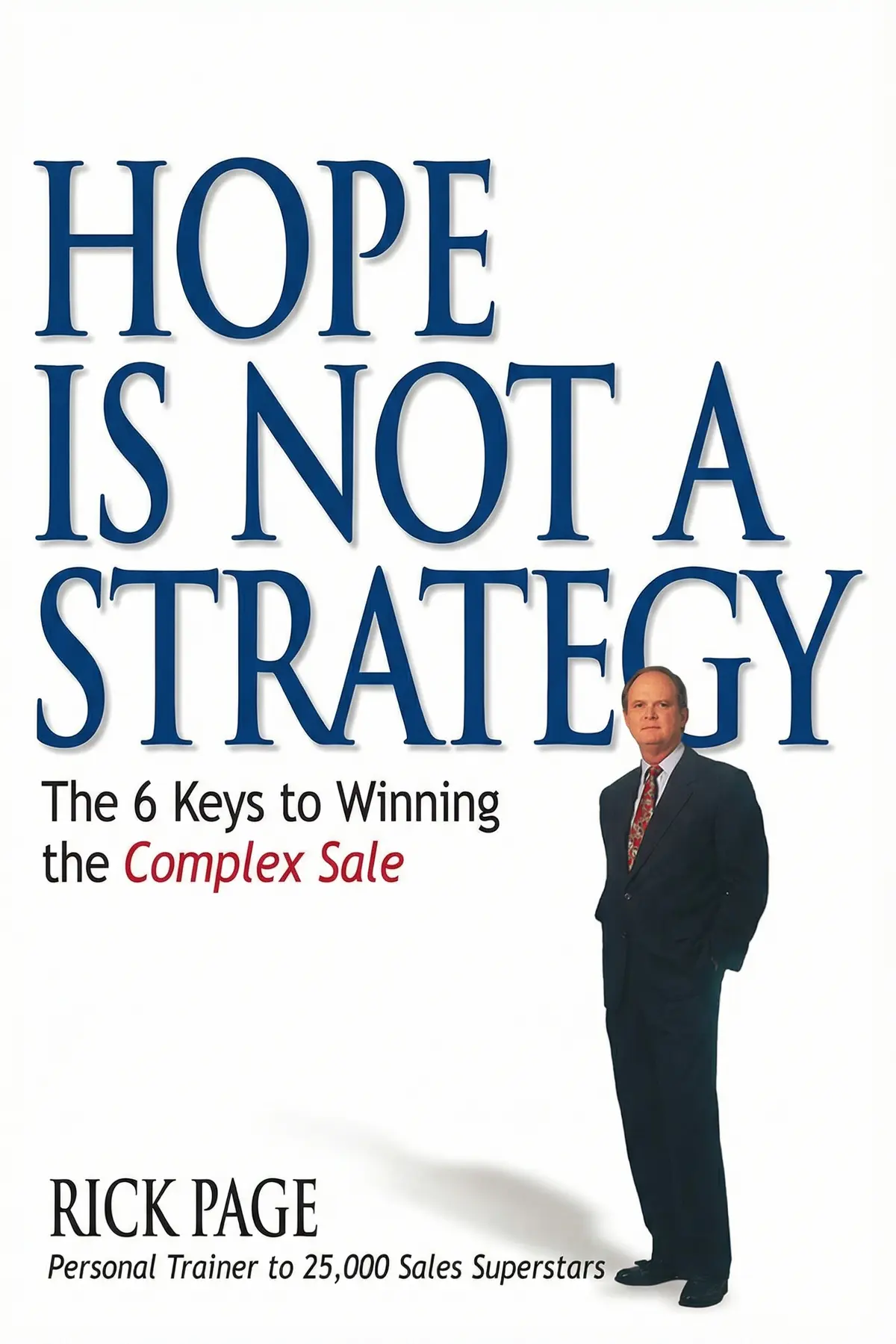
Table of Content
1. Introduction
2 min 06 sec
Every sales professional has experienced that sinking feeling when a massive deal starts to wobble. For weeks, or even months, everything seemed to be going perfectly. The initial meetings were promising, the product demos were well-received, and the internal champions seemed enthusiastic. But suddenly, the momentum shifts. A new executive enters the picture with a different set of priorities. A competitor whispers a lower price in the client’s ear. Or worse, the entire project stalls because no one can agree on the next step. In these moments, many salespeople fall back on hope—hoping the client calls back, hoping the value proposition is clear enough, or hoping that their relationship will carry the day.
But as this summary explores, hope is not a strategy. Winning the complex sale requires a level of tactical discipline and strategic foresight that goes far beyond traditional selling techniques. The modern sales landscape has evolved. We are no longer just selling products; we are selling solutions to intricate business problems within organizations that are politically charged and risk-averse. To succeed here, you need a map and a compass. This is where the RADAR process comes in—a system designed to help you read the landscape of an account and deploy your resources with surgical precision.
Over the next several chapters, we will break down the six keys to mastering these high-stakes environments. We’ll look at how to move past the surface-level features of what you sell to find the deep-seated business pain that drives action. We’ll discuss the importance of qualifying your prospects so you don’t waste your most valuable asset—time—on deals that were never winnable. We will also dive into the murky waters of internal politics and power structures, learning how to find the people who actually hold the keys to the budget. By the end of this journey, you’ll have a framework to turn chaotic sales cycles into predictable, winning strategies.
2. Solving Business Pain Over Selling Features
2 min 16 sec
Discover why the best product doesn’t always win and how identifying deep-seated organizational pain is the only way to create real urgency in a complex sale.
3. The Power of Rigorous Qualification
2 min 05 sec
Learn why the most successful sales teams are those that know when to walk away, focusing only on the opportunities where they have a clear path to victory.
4. Establishing Competitive Preference
2 min 09 sec
Explore how to influence a client’s requirements early in the process so that your solution becomes the only logical choice for their unique needs.
5. Navigating the Decision-Making Process
2 min 05 sec
Uncover the hidden mechanics of how organizations actually buy, and why understanding the ‘who’ and ‘how’ is more important than the ‘what.’
6. Identifying and Selling to the Real Power
2 min 17 sec
Go beyond titles and org charts to find the true power brokers within a company and learn how to secure their sponsorship for your deal.
7. The Strategic Plan and Account Management
2 min 25 sec
Learn how to coordinate your team for a flawless execution and why the sale is only the beginning of a long-term, profitable relationship.
8. Conclusion
1 min 59 sec
As we wrap up this look into Hope Is Not a Strategy, the core message should be clear: the complex sale is not won by accident or by mere persistence. It is won through a disciplined, analytical approach to the entire sales environment. By using the RADAR framework, you move from being a reactive salesperson who ‘hopes’ for the best to a proactive strategist who controls the narrative of the deal.
We’ve covered the six essential keys that make this possible. We started by looking at the necessity of linking your solutions to genuine business pain—because without pain, there is no motivation for a client to change. We discussed the vital importance of qualification, reminding ourselves that our time is too valuable to spend on deals that lack budget or political support. We explored how to build competitive preference by influencing the client’s needs early on, and how to navigate the complex decision-making processes and power structures that define large organizations. Finally, we looked at the need for a unified strategic plan and the long-term value of becoming a trusted account partner.
The world of business will only continue to become more complex. Decision-making units will grow, risks will be scrutinized more heavily, and competition will remain fierce. In this environment, the traditional ‘pitch’ is dead. What remains is the need for deep partnership and strategic insight. If you take away only one thing from this summary, let it be this: don’t leave your success to chance. Analyze your accounts, understand the politics, align with the power, and execute your plan with precision. When you replace hope with a strategy, you don’t just close more deals—you build a career defined by consistent, high-level success. Now, go out there, look at your pipeline, and start applying these keys to turn your biggest opportunities into your biggest wins.
About this book
What is this book about?
In the world of high-ticket sales, relying on luck or a good personality is a recipe for failure. This book introduces a disciplined approach to the complex sale—the kind where multiple decision-makers, long timelines, and shifting priorities are the norm. It argues that success isn't about the product itself, but about the strategy used to position it. The core of the book is the RADAR framework, which stands for Reading Accounts and Deploying Appropriate Resources. This system guides sales professionals through six critical keys: identifying business pain, qualifying leads, building competitive preference, understanding the decision-making process, selling to the true power players, and executing a unified strategic plan. By following these steps, you can move away from reactive selling and toward proactive account management, ensuring that you don't just close a deal once, but build a lasting, profitable partnership.
Book Information
About the Author
Rick Page
Rick Page is a highly respected sales consultant and the founder of The Complex Sale, a global consulting firm specialized in high-level business development. He is a premier authority on managing complex sales environments and has personally trained more than 35,000 sales professionals across 50 countries. Page is also the author of Make Winning a Habit, another influential work focusing on sales management and sustainable success.
Ratings & Reviews
Ratings at a glance
What people think
Listeners find this book to be an excellent refresher for mid to senior business development experts, commending its high-quality writing and readability. They value its perspective, with one listener emphasizing the effective use of stories to back up the strategies discussed. The title earns praise for its sales techniques, as one listener points out its pragmatic approach to consultative selling.
Top reviews
Rin
Rick Page hits the nail on the head by reminding us that a great product is merely the entry fee in today’s market. This book is a masterclass for mid-to-senior business development pros who need to move beyond transactional selling and into the realm of true partnership. I found the RADAR framework especially helpful for organizing the chaos of a multi-stakeholder deal. The truth is, most of our losses come from a lack of control, not a lack of features. By focusing on the client’s internal politics and identifying those informal power brokers, the strategy becomes proactive rather than reactive. The writing is incredibly pragmatic, using real-world stories that make the concepts stick. While some of the corporate examples feel slightly dated, the underlying principles of building trust and linking solutions to genuine business pain are timeless. It’s an essential refresher for anyone tired of 'hoping' for a signature.
Show moreMay
Wow. A business book that actually respects my time! No endless filler or repetitive chapters here. Page gets straight to the point with what he calls the 'keys' to winning. I absolutely loved the focus on the 'Pain or Gain' link—it’s the heart of every deal. We often get so caught up in our own technical features that we forget the client is just trying to survive a specific business problem. This book forces you to look at the deal through their eyes. The RADAR steps are intuitive and easy to explain to a team, which is half the battle in sales management. Winning against competitors requires more than a great product; it requires a strategy for the people involved. It is a timeless, customer-centric guide that makes the complex feel manageable. Such a refreshing read for any sales professional.
Show moreEmma
Ever wonder why high-value deals suddenly go cold right at the finish line? Page argues that our biggest competitor isn’t another firm, but the client’s own hesitation to act. This book shifts the focus from 'selling stuff' to 'solving pain,' which is a distinction many reps still miss. Personally, the chapter on 'Selling to Power' changed how I view organizational charts; titles are often a smokescreen for who actually holds the influence. I appreciated the emphasis on qualifying prospects early because wasting time on a dead-end lead is the fastest way to miss your quota. The RADAR steps provide a clear, six-step roadmap that keeps the team aligned. My only gripe is that the framework can feel a bit rigid for smaller, faster sales cycles. However, for complex B2B environments, it is gold. It’s concise, punchy, and cuts through the usual management fluff found in most sales guides.
Show moreSuphan
Picked this up after a mentor mentioned the RADAR method during a particularly difficult quarter. Frankly, I wish I’d read it years ago. The concept of 'Building Competitive Preference' early in the cycle is something most of us overlook until it’s too late to influence the narrative. Page teaches you how to control the sales environment so you aren't just a victim of the client's shifting demands. I liked the pragmatic approach to 'Selling to Power'—it's not about sucking up to the CEO, but about finding the internal advocates who have the most to lose if the problem isn't fixed. The book is remarkably readable for a business text and avoids the trap of repetitive anecdotes. It does lean heavily into 'complex' scenarios, so if you're in a high-volume, low-touch role, move on. But for those of us in the trenches of long-cycle B2B, this is a vital tool.
Show moreSombat
As someone who has navigated the B2B landscape for over a decade, I found this to be an excellent reality check. We often fall into the trap of 'selling to the title' rather than 'selling to the power.' Page reminds us that the person with the biggest office isn't always the one making the decision. I particularly enjoyed the section on flanking strategies—changing the scope or the process when you're losing on price is a move every pro should have in their pocket. The book is dense with insight but remains readable thanks to the clear structure. One minor criticism is that the focus on 'repeat business' felt a little like an afterthought compared to the hunt for the initial deal. Still, the pragmatic advice on building trust and ensuring the client sees you as a partner is spot on. Definitely worth a spot on the shelf.
Show moreAlice
Finally got around to reading this classic, and I'm impressed by how well it has aged. Selling is still selling, regardless of how much the technology changes. The focus on 'Qualified Prospects' is a lesson I have to re-learn every year; it's so easy to chase every shiny object. Page’s advice on identifying the decision-making process is crucial. You can’t win if you don’t know the rules of the game the client is playing. I found the distinction between 'flanking' and 'frontal' attacks to be a very helpful way to visualize competition. The book is a wonderful refresher for anyone who has gotten a bit lazy with their pre-call planning. It challenges you to be more disciplined and less reliant on charisma alone. Not every chapter is a hit, but the hits are powerful enough to make this a must-read.
Show moreSuvannee
After hearing so much about the 'Hope Is Not a Strategy' mantra, it was great to see the substance behind the slogan. The book is remarkably concise for the amount of ground it covers. I especially liked the focus on 'Competitive Preference'—it's not just about being better, it's about being perceived as the only viable option early in the game. Page understands that organizational politics are often the deciding factor in six-figure deals. My team started using the RADAR checklist for our weekly reviews, and it has already highlighted gaps in our current pipeline. It forces you to be honest about whether you've actually reached the 'Power' or if you're just talking to a gatekeeper. It’s a very pragmatic, customer-focused vision of how sales should work. High-quality writing and very little fluff. Highly recommended for senior BD roles.
Show moreKwame
The truth is, this is a heavy lift for anyone not working in enterprise-level sales. While the mantra 'Hope is not a strategy' is iconic and necessary, the actual RADAR methodology feels like a tease for a much larger, more expensive consulting package. I found the sections on 'Linking Solutions to Pain' to be very insightful, particularly the advice on asking the right questions to uncover hidden organizational needs. But let’s be fair: some of these strategies are overkill for 90% of sales jobs out there. The book excels when it talks about the psychology of the buyer, yet it drags when describing the formal communication of a strategic plan. It’s a solid 3-star read—useful as a reference guide for navigating complex corporate hierarchies, but it lacks the modern digital-first perspective I was looking for. Good as a refresher, but not exactly a revolution.
Show moreBun
Look, the core concepts here are definitely solid, but the writing style is a bit stiff in some places. I appreciated the use of stories to illustrate how the RADAR framework functions in a real-world scenario, but I found myself skimming the sections on 'Communicating the Strategic Plan.' It felt a bit like reading a manual for a software update rather than a strategic guide. That said, the emphasis on identifying 'business pain' is something every rookie needs to hear. Most deals stall because there is no urgency, and Page explains how to create that urgency without sounding desperate. It’s a decent book for a mid-level professional, but it lacks the 'spark' of some other sales classics. It's functional, helpful, and provides a good structure, but it’s not exactly a page-turner. A safe, 3-star choice for your professional development.
Show moreYuki
Not quite what I expected given the glowing recommendations from my management team. While the title is catchy, the content feels like a relic from a different era of business. In my experience, the modern buyer is much more informed and cynical than the stakeholders Page describes. The RADAR framework is fine on paper, but in practice, it feels too bureaucratic and slow. I found the writing style a bit dry, and the constant 'tease' of his consulting firm’s broader services was distracting. To be fair, the advice on qualifying prospects is solid—knowing when to walk away is an underrated skill. However, I didn’t feel like I gained many new tactics that haven't been covered more effectively in newer sales literature. It’s a bit too much 'strategy' and not enough 'action' for my taste. If you love process maps, you'll like it; if you want modern tactics, look elsewhere.
Show moreFeatured in
Readers also enjoyed
AUDIO SUMMARY AVAILABLE
Listen to Hope Is Not a Strategy in 15 minutes
Get the key ideas from Hope Is Not a Strategy by Rick Page, plus 5,000+ more titles in English and Thai.
- 5,000+ titles
- Listen as much as you want
- 7-day free trial
- Cancel anytime







