

17 min 28 sec
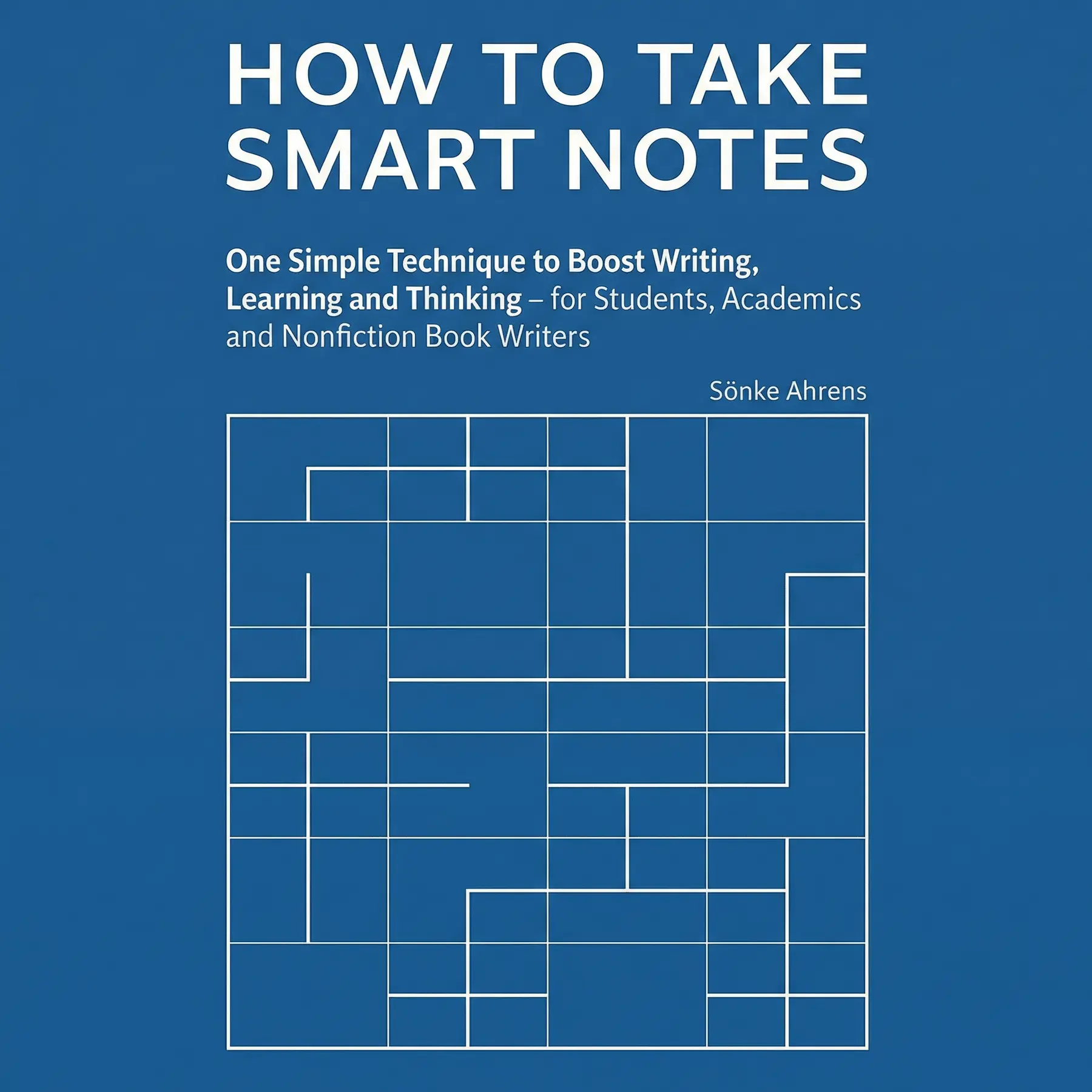
How to Take Smart Notes: One Simple Technique to Boost Writing, Learning and Thinking
By Sönke Ahrens
Discover the Zettelkasten method, a transformative note-taking system designed to boost productivity, enhance critical thinking, and simplify the writing process for students, researchers, and nonfiction authors through organized, connected ideas.

Table of Content
1. Introduction
1 min 56 sec
The blank screen is perhaps the most daunting adversary for anyone involved in the world of writing or research. Whether you are a student staring at a term paper, a researcher beginning a dissertation, or an author trying to structure a complex nonfiction book, that blinking cursor can feel like a judgment on your creativity. The traditional approach to writing often involves a top-down struggle: you pick a topic, you research it, and then you try to force those facts into a coherent structure. But what if there was a way to make writing feel less like a heavy lift and more like a natural conversation with yourself? What if the ideas for your next project were already waiting for you, pre-structured and ready to be assembled?
This is the promise of the Zettelkasten, or the slip-box system. It is a method of taking smart notes that does more than just store information; it creates an external brain. Instead of just highlighting text or scribbling in margins, this system focuses on the relationships between ideas. It treats every piece of information as a potential building block in a larger, evolving web of knowledge. When you adopt this workflow, you stop working against the limitations of your memory and start working with a system that actually gets smarter the more you use it.
In this summary, we are going to explore how a simple administrative clerk used this technique to become one of the most productive sociologists in history. We will break down the specific hierarchy of notes that makes the system work, and we will look at the cognitive science behind why this method is so much more effective than traditional studying. By the end, you’ll see that productivity isn’t about working harder or having a higher IQ—it’s about having a system that allows your thoughts to compound over time, ensuring that you never have to face a truly blank page ever again.
2. The Power of a Productive System Over Natural Genius
2 min 47 sec
Explore the incredible life of Niklas Luhmann, a man who transformed from an ordinary office worker into a prolific scholar by relying on a unique system rather than raw talent.
3. Categorizing Thoughts into Three Essential Note Types
2 min 51 sec
Learn how to distinguish between fleeting, literature, and permanent notes to ensure your best ideas are captured and developed for the long term.
4. Building a Web of Knowledge Through Linking and Indexing
2 min 50 sec
Understand why traditional filing systems fail and how an interconnected network of notes can serve as a powerful engine for new ideas.
5. Writing as a Continuous Process Rather Than a Final Hurdle
2 min 39 sec
Discover how a well-maintained slip-box eliminates the fear of the blank page and allows your research to practically write itself.
6. Enhancing Memory and Learning Through Active Elaboration
2 min 41 sec
Uncover the science of why traditional study methods fail and how the slip-box method creates lasting knowledge through deep reflection.
7. Conclusion
1 min 44 sec
Adopting the Zettelkasten method is more than just changing your filing system; it is a fundamental shift in how you relate to information and the creative process. We have seen how Niklas Luhmann used this simple workflow to achieve a level of productivity that most would consider superhuman. But his success wasn’t due to some secret talent; it was the result of a system that respected the way the human brain actually functions. By moving away from the top-down, high-pressure model of writing and toward a bottom-up, organic model of note-taking, you can turn the act of research into a powerful engine for discovery.
Remember that the strength of this system lies in its consistency. It doesn’t require hours of grueling labor every day. It simply requires you to be intentional about what you capture and how you connect it. Start by making it a habit to never read without a pen or a digital equivalent at hand. Capture those fleeting thoughts before they vanish, summarize the books you read in your own words, and most importantly, take the time to turn those observations into permanent, connected notes.
As your slip-box grows, it will stop being a mere storage unit and start being a conversation partner. It will surprise you with connections you hadn’t considered and provide you with a solid foundation for any project you choose to undertake. You will find that the blank page no longer holds any power over you, because you will always be starting from a position of strength, supported by a web of your own well-developed ideas. The path to smarter thinking and effortless writing isn’t about working harder; it’s about taking smart notes and letting the system do the heavy lifting for you.
About this book
What is this book about?
Many people struggle with the creative and academic writing process, often facing the paralyzing sight of a blank page or losing track of the vast amounts of information they consume. This book introduces a revolutionary workflow based on the Zettelkasten, or slip-box system, popularized by the prolific social scientist Niklas Luhmann. The core promise is that by changing how you capture and connect ideas, you can move away from forced brainstorming and toward a natural, bottom-up approach to generating insights. Rather than simply archiving information, this method focuses on creating a web of interrelated thoughts that grows more valuable over time. You will learn to distinguish between temporary reminders, literature summaries, and permanent ideas that serve as the building blocks for your work. By externalizing your memory and focusing on the connections between concepts, you can transform note-taking from a passive chore into an active engine for learning, thinking, and producing high-quality written work with far less stress and effort.
Book Information
About the Author
Sönke Ahrens
Sönke Ahrens is an established author and a dedicated researcher specializing in the fields of education and social science. Beyond his influential work on note-taking systems, he is recognized for his academic contributions, including his award-winning publication, Experiment and Exploration: Forms of World-Disclosure.
Ratings & Reviews
Ratings at a glance
What people think
Listeners find the book effective for improving writing, studying, and cognition, especially for academic professionals, and value its comprehensive manual on structured note-taking using the Zettelkasten method. The material receives praise for being easy to follow, with one listener remarking that it can be read over and over, and listeners characterize it as simple yet powerful. While many listeners describe the prose as brief, some suggest it is unnecessarily long-winded, and views on the writing standard remain divided.
Top reviews
Clara
As an academic who has spent years drowning in disorganized PDFs and half-finished drafts, Sönke Ahrens’ exploration of the Zettelkasten method felt like a genuine life raft. The core argument—that writing is not the end product of thinking but the medium in which it happens—completely reframed my workflow. I particularly appreciated the distinction between fleeting notes, literature notes, and the elusive permanent notes that form the backbone of the slip-box. While the author spends significant time on the philosophy of Niklas Luhmann, the psychological insights into avoiding 'ego depletion' and building a virtuous circle of productivity are where the book truly shines. Truth is, you won't find a step-by-step software tutorial here, but the mindset shift is far more valuable than a simple manual. It’s a dense read that demands attention, yet it promises a scalable system for lifelong learning.
Show moreFah
Picked this up after seeing the massive stir it caused in the digital gardening community, and it definitely lived up to the hype. The genius of the 'Smart Notes' system is how it transforms reading from a passive activity into an active dialogue with the text. I’ve started implementing the 'one idea per note' rule, and the connections appearing in my personal database are already sparking insights I never would have found using folders. Not gonna lie, the writing style is a bit dry and leans into academic jargon, but the clarity it provides regarding the writing process is unmatched. It’s not just about taking notes; it’s about building an external brain that actually helps you think. This is easily the most influential book on productivity I’ve read in the last five years.
Show moreSuvannee
Look, this isn't just a book about filing index cards; it's a fundamental rethink of how we process information in the digital age. Ahrens masterfully connects the dots between cognitive psychology and the physical act of writing. I found the segments on 'bottom-up' topic development particularly eye-opening because they relieve the pressure of having to decide on a thesis before you even start researching. By the time you’re ready to write, the book argues, the paper has basically already written itself in your slip-box. It’s a brilliant concept that turns the chore of studying into a series of small, manageable, and even fun tasks. While the tone is a bit stiff, the impact on my personal organization has been nothing short of transformative.
Show moreKob
This is the ultimate guide for anyone who wants to stop just 'collecting' information and start actually 'processing' it for real-world use. Ahrens explains that an idea kept private is as good as one you never had, and he provides the tools to make those ideas visible. The workflow he describes—moving from fleeting notes to a networked slip-box—is the most logical approach to intellectual work I’ve ever encountered. In my experience, the book is best read slowly, perhaps twice, to fully grasp how the feedback loops work. It’s a game-changer for my technical articles. I no longer fear the blank page because my notes provide a ready-made string of arguments. It’s an essential addition to the library of any lifelong learner.
Show moreSook
This book is essentially a deep dive into the philosophy of networked thought rather than a technical guide for Obsidian or Roam Research. Ahrens does a fantastic job explaining why traditional, hierarchical note-taking fails us as our knowledge grows more complex over time. I found the sections on the Zeigarnik effect and how 'smart notes' reduce the burden on our working memory to be absolutely fascinating. However, I must agree with other reviewers who noted a frustrating lack of concrete examples for practitioners in technical fields like medicine or engineering. To be fair, the text can feel quite repetitive as it hammers home the same few principles across different chapters. If you can move past the academic tone and the occasional verbosity, the underlying system is undeniably powerful for anyone serious about nonfiction writing.
Show moreTaweesak
Ever wonder why some researchers seem to publish high-quality work effortlessly while others struggle for years on a single paper? Ahrens argues that the secret lies in a smart working environment that avoids the need for raw willpower. I loved the discussion on how the slip-box acts as an external scaffold for our thoughts, allowing us to pick up exactly where we left off. My only real gripe is that the 'how-to' aspect of 'How to Take Smart Notes' is buried under layers of learning theory and repetitive arguments. You have to do a bit of digging to extract the actual workflow, but once you do, it’s incredibly rewarding. It is a simple technique that yields complex results, provided you have the patience to stick with the dry prose.
Show moreNan
After hearing about the legendary 90,000 index cards of Niklas Luhmann, I expected a dry historical biography, but I was pleasantly surprised. This is a robust manual for anyone who wants to turn their reading into a permanent knowledge base. The author is right to emphasize that highlighting is a waste of time; we need to translate ideas into our own words to truly understand them. My only criticism is the occasional elitism regarding 'standard' students versus 'experts,' which felt a bit unnecessary. Also, the lack of screenshots or diagrams makes the initial setup of a Zettelkasten feel more daunting than it actually is. Still, the principles of non-hierarchical organization and cross-referencing are life-changing for long-term projects.
Show moreAstrid
Wow, the psychological insights into writer's block and the 'virtuous circle' of feedback were actually more valuable to me than the filing system itself. Sönke Ahrens understands the friction points of the creative process and offers a structural solution that feels sustainable. The book successfully argues that our brains are for having ideas, not for storing them, which is a massive relief for anyone feeling overwhelmed by information. I do wish the author had included more diverse examples outside of sociology to show how this works for different types of learners. To be fair, it’s a bit wordy and could have benefited from a tighter edit to remove some of the redundancy. Regardless, the core message is powerful enough to earn a high recommendation from me.
Show moreJoseph
A bit of a mixed bag, if I’m being frank. On one hand, the concept of the Zettelkasten is a total game-changer for anyone struggling with writer's block or information overload. On the other hand, Ahrens takes about 200 pages to explain a system that could have been summarized in a twenty-minute YouTube video or a concise blog post. The book is heavily geared toward social science researchers and often ignores the practical realities of students in more 'dense' data-driven disciplines. I felt like I was reading the same three anecdotes about Niklas Luhmann over and over again. It’s a useful introduction to the slip-box, but you’ll likely find yourself heading to the internet to find actual visual examples of how to link these notes in practice.
Show moreFatou
The chapter on the actual mechanics of the slip-box is frustratingly vague for a book that purports to be a guide. I was looking for a precise explanation of how to apply Luhmann’s method to my own studies, but instead, I got a long-winded compilation of over-explained ideas. Frankly, the author spends 95% of the time telling you WHY you should use the method and almost no time showing you HOW to do it with real-world examples. If you are in a field with dense, factual information like medicine, you might find the 'one idea per note' advice nearly impossible to implement without getting lost in the weeds. It’s an interesting theory, but the execution of the book itself is repetitive and lacks the practical depth I expected for the price.
Show moreFeatured in
Readers also enjoyed

AUDIO SUMMARY AVAILABLE
Listen to How to Take Smart Notes in 15 minutes
Get the key ideas from How to Take Smart Notes by Sönke Ahrens, plus 5,000+ more titles in English and Thai.
- 5,000+ titles
- Listen as much as you want
- 7-day free trial
- Cancel anytime







