
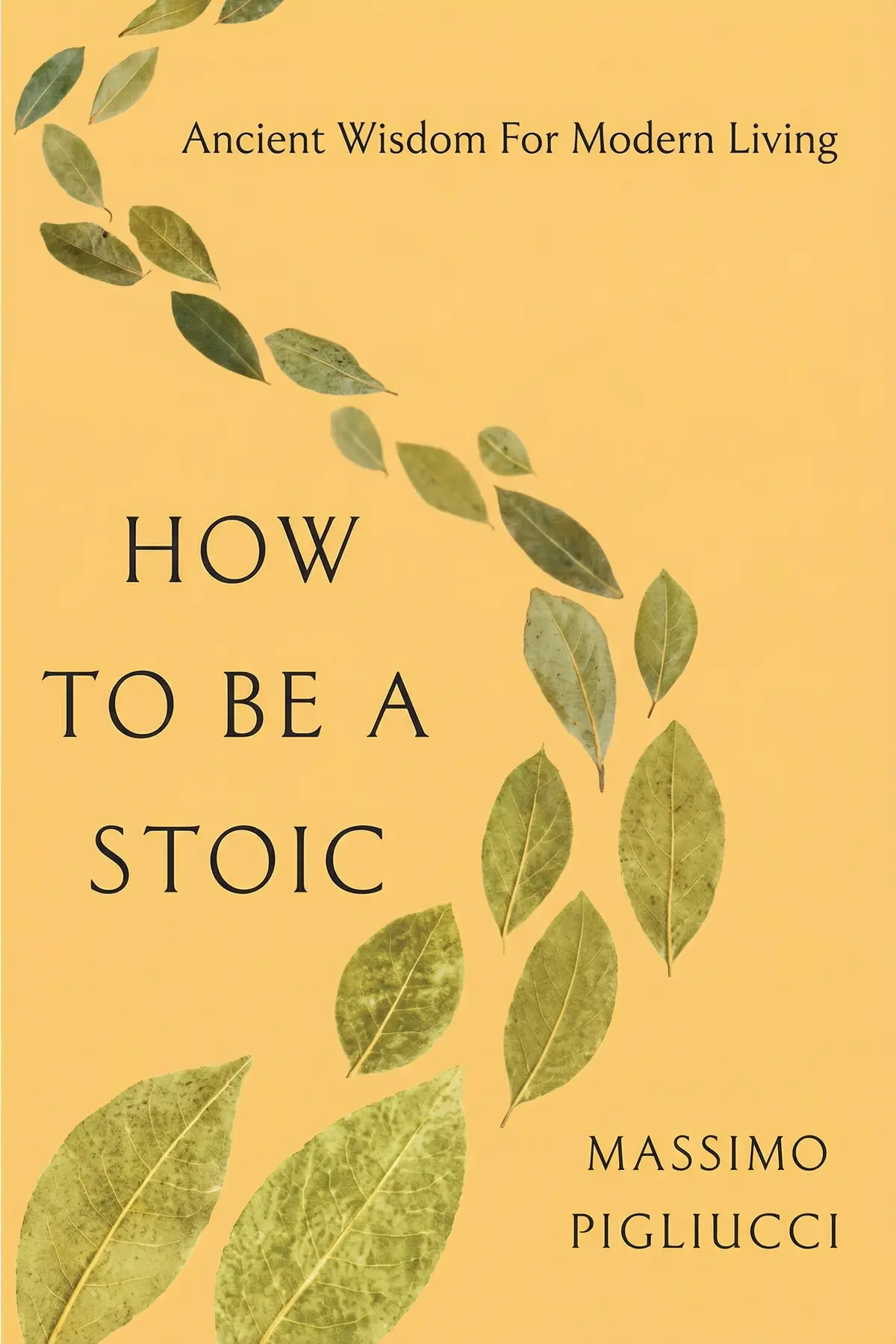
How to Be a Stoic: Using Ancient Philosophy to Live a Modern Life
Massimo Pigliucci
Discover a modern approach to ancient wisdom. This summary provides practical Stoic exercises to build resilience, master your emotional responses, and find lasting tranquility by focusing on what you can truly control.
2 min 11 sec
Imagine for a moment that you are standing in the middle of a torrential downpour. You have no umbrella, your clothes are soaking through, and you are miles from home. Most of us would feel a surge of frustration, perhaps even anger at the weather or ourselves for forgetting a coat. But what if there was a way to stand in that rain and remain perfectly calm, recognizing that while you cannot stop the clouds from opening, you have absolute power over how you interpret the experience? This is the heart of Stoicism, an ancient philosophy that is as relevant today in our high-stress, digital age as it was in the marble corridors of ancient Greece and Rome.
Over the centuries, Stoicism has occasionally been misunderstood. People sometimes hear the word and think of a cold, emotionless figure—someone who simply grins and bears it through a ‘stiff upper lip.’ But that is a surface-level caricature. The real Stoic path is one of deep engagement with life, fueled by reason and a commitment to personal excellence. It is about building a mental fortress that allows you to engage with the world more effectively, not less.
In this exploration of a practical handbook for modern living, we are going to walk through a systematic approach to developing this inner strength. We will look at how Stoicism provides a reliable framework for those who want to live with virtue and serenity. We live in a world designed to distract us, to make us crave unrewarding pleasures, and to keep us worrying about things we cannot change. By revisiting the wisdom of the Stoics, we find a way to navigate these modern pitfalls using logic and clear-headedness.
The journey we are about to embark on isn’t just about reading words on a page; it’s about a throughline of practical application. We will see how three specific disciplines—the way we desire things, the way we act toward others, and the way we process our thoughts—come together to create a life of balance. This isn’t just about surviving the day-to-day; it’s about thriving in a world that is often outside of our control. Let’s begin by looking at why this ancient school of thought remains one of our best bets for finding genuine happiness.
2 min 56 sec
Uncover why ancient wisdom is still the most reliable tool for modern mental health and how focusing on control is the ultimate secret to a peaceful life.
2 min 45 sec
Explore the first pillar of Stoic practice and learn how to recalibrate your wants to align with your inner character rather than external rewards.
2 min 41 sec
Learn why acknowledging that nothing lasts is not a morbid obsession, but a powerful gateway to gratitude and emotional stability.
2 min 46 sec
Master the art of social navigation by preparing for difficult interactions and learning to maintain your composure in a chaotic world.
2 min 42 sec
Discover why the ancient habit of journaling is the most effective way to close the gap between the person you are and the person you want to be.
2 min 33 sec
Learn the most advanced Stoic skill: how to pause and interrogate your snap judgments before they turn into destructive emotions.
2 min 52 sec
Transform your emotional landscape by learning to stop labeling external events and focusing solely on the quality of your own choices.
1 min 56 sec
As we come to the end of this journey through the principles of modern Stoicism, it is clear that this ancient philosophy is not about achieving a state of frozen perfection. Rather, it is an ongoing, daily commitment to personal growth. We have seen how the three disciplines—Desire, Action, and Assent—work together to create a robust psychological framework. By learning what to value, how to act toward others, and how to master our own thoughts, we move closer to a life of true equanimity.
The throughline of all these ideas is the dichotomy of control. It is the golden thread that connects every exercise, from the morning premeditation of difficulties to the nightly review in a journal. When we stop struggling against the things we cannot change, we finally have the energy and clarity to work on the things we can: our own character and our own judgments.
Stoicism reminds us that while we cannot control the cards we are dealt, we have total authority over how we play the hand. It encourages us to live in the present moment, because the past is gone and the future is not yet ours. Today, right now, is the only time you have to practice virtue. Every interaction you have and every challenge you face is an opportunity to be patient, to be brave, and to be reasonable.
In your daily life, try to implement the actionable advice of watching your labels. When something happens that would usually upset you, pause and remind yourself that the event itself is indifferent—it is only your reaction that counts. By shifting your focus from ‘Why is this happening to me?’ to ‘How can I respond to this with virtue?’, you begin the path of the New Stoic. It is a path that leads away from anxiety and toward a steady, enduring happiness that is built from the inside out.
Living in a world that often feels chaotic and unpredictable can leave us feeling drained and anxious. A Handbook for New Stoics offers a structured, year-long path to reclaiming your inner peace by drawing on the timeless principles of Stoicism. This guide breaks down the complex philosophy into three core disciplines—Desire, Action, and Assent—providing a framework for aligning your life with nature and reason. The promise of this work is not just theoretical understanding, but practical transformation. By engaging with specific exercises like the dichotomy of control, the contemplation of impermanence, and the practice of nightly journaling, you learn to distinguish between external events and your internal reactions. The result is a more resilient character, improved decision-making, and the ability to remain calm even when faced with difficult people or challenging circumstances. It is a roadmap for anyone seeking to move from being a victim of external factors to becoming the master of their own character and contentment.
Massimo Pigliucci is a professor of philosophy at New York’s City College and a fellow with the American Association for the Advancement of Science. As a dedicated practitioner of Stoicism, his work has been featured in the New York Times and the Wall Street Journal. Gregory Lopez is the editor-in-chief of the Examine Research Digest and founder of the New York City Stoics Meetup. Together, they run Stoic Camp New York.
Massimo Pigliucci
Listeners find this guide to Stoicism effective for learning principles through brief summaries and actionable tasks. The content is simple to grasp and navigate, featuring an organized system that explores Stoic concepts in detail. They value its clarity and find it intellectually stimulating, with one listener remarking that it keeps them consistently involved in personal reflection.
Finally, a guide that doesn't just talk about Marcus Aurelius but actually tells you what to do with his advice. It isn't a lecture. Instead, the authors provide a year-long roadmap of fifty-two specific exercises that force you to confront your own reactions to the world in real-time. I found the succinct summaries of ancient wisdom incredibly easy to digest during my morning coffee. Some chapters felt more relevant than others, but the overall structure is brilliant for anyone who finds pure theory a bit too dry. Truth is, I’ve spent years reading about the Stoa without ever actually 'doing' Stoicism until I picked this up. It’s an effective teaching tool that turns abstract concepts into a physical habit. Highly recommended for those who want to move beyond just reading quotes on Instagram.
Show moreThis book arrived at exactly the right moment in my life when my anxiety was starting to feel like an unmanageable weight. I wasn’t even looking for a philosophy book, but the practical nature of the 52 lessons hooked me immediately. I’ve been reading passages to my husband, who tends to fret about the future and veer toward negativity when he’s left to his own thoughts. We both found ourselves nodding along to the clear, easy-to-understand explanations. It’s a very positive book that doesn't demand you change your whole life overnight. You just take one exercise a week and sit with it. Not gonna lie, I was skeptical about the 'homework' aspect, but manually inputting my thoughts into the pages has been a game-changer for my mental clarity. Truly life-changing stuff if you actually do the work.
Show morePigliucci and Lopez have managed to turn a dusty academic subject into a living, breathing exercise routine for the mind. I’ve been following the weekly prompts for about three months now and the shift in my perspective is palpable. The truth is, most of us know we shouldn't worry about things outside our control, but we do it anyway. This book gives you the actual tools to stop that cycle. The exercises are effective because they are succinct and don't take up hours of your day. It’s well-structured and perfect for someone who wants a deeper delve into Stoic practice without getting bogged down in dense, archaic language. This is how philosophy should be taught. It’s engaging, challenging, and immensely practical.
Show morePicked this up on a whim after seeing it mentioned in a discussion about mental resilience. I didn't expect to actually do the 'homework,' but the way the book is laid out makes it almost impossible not to join in. It’s a very good, positive book to read if you struggle with daily stress. Every week has a new theme that keeps you reflecting on your habits. I love the physical act of manually inputting my notes into the exercises. It makes the lessons stick in a way that just reading a normal book never does. In all honesty, it’s the most useful thing I’ve read all year. If you want to improve your mindset, just buy it and start Week 1 tomorrow.
Show moreAs someone who has dabbled in Cognitive Behavioral Therapy before, I found the parallels in this handbook absolutely fascinating. The authors clearly lean into the connection between ancient logic and modern psychology, which makes the lessons feel grounded and scientific rather than mystical. It’s a very well-structured curriculum that breaks the year down into manageable weekly bites. Personally, I appreciated that each section begins with a quote from a philosopher followed by a modern interpretation that actually makes sense in a 21st-century context. My only minor gripe is that some of the exercises feel a bit repetitive after the first few months. However, the discipline of writing in the book itself keeps you engaged in constant reflection. It’s a solid 4-star resource for practical living.
Show moreThe 52-week curriculum approach is brilliant because it prevents you from just speed-reading the wisdom and then immediately forgetting it ten minutes later. Pigliucci and Lopez have crafted a thought-provoking guide that demands consistency above all else. Each theme is presented with a succinct summary that gets straight to the point without unnecessary fluff. Frankly, some of the weekly tasks seemed almost too simple at first, like just observing your initial impulses, but they are deceptively difficult to master. I liked the focus on practical living over academic debate. While I would have liked a bit more historical context regarding the different schools of Stoicism, the focus on 'how to live' is what most people are actually looking for. It’s a great curriculum for the modern world.
Show moreEver wonder how ancient philosophy could possibly apply to a modern office job or a messy breakup? This handbook provides the answer through very direct, actionable steps. It’s a really good practical curriculum for those who want to try living Stoicism rather than just debating it in a classroom. I found the formatting to be excellent—it’s easy to follow and the lessons build on one another logically. In my experience, the biggest hurdle to philosophy is how abstract it feels, but this book kills that problem entirely. It’s very readable and the tone is encouraging without being overly 'preachy.' I did find a few of the middle weeks to be a bit of a slog, but pushing through the curriculum is part of the discipline, I suppose. A very solid, helpful read.
Show moreNot what I expected from a philosophy book, but in a mostly positive way. Instead of long-winded essays, you get short, punchy lessons that are very easy to understand. It’s clearly influenced by the authors' backgrounds in science and CBT, which gives it a very modern, rational feel. Some might say it’s a bit too 'self-help,' but for a beginner, it’s an ideal entry point. I appreciated the varied exercises, though I’ll admit I skipped a couple that felt a bit too mundane. Still, the overall curriculum is strong and keeps you engaged with the core principles of Stoicism. It’s a thought-provoking journey that actually requires you to participate. Definitely worth the time if you're looking for a structured way to improve your emotional regulation.
Show moreLook, if you want a deep dive into the complex metaphysics of the ancient Stoa, this isn't going to satisfy that itch. It is basically self-help for people who don't have a defined complaint, and it misses a massive percentage of what the actual philosophy is about by ignoring the logic and physics. To be fair, it’s meant for beginners, but I think beginners are capable of handling more than just 'Stoicism-lite.' The book essentially treats the philosophy as a precursor to CBT and ignores the rest. That said, the exercises are okay if you just want to be a bit calmer during your commute. It’s a banal take on a rich tradition, but useful enough as a daily planner for mindfulness. Just don't expect a masterclass in philosophy.
Show moreTo be fair, I might not be the target audience, but I found this incredibly banal and repetitive. It feels like the authors took a few interesting exercises and stretched them out to fill a whole year just for the sake of the '52 weeks' gimmick. There is so much missing here regarding the actual depth of Stoic thought. They’ve basically stripped the soul out of the philosophy and turned it into a generic productivity hack. If you want a self-help book with a Stoic coat of paint, you might like it. But if you actually want to understand what Epictetus or Seneca were talking about, you’re better off reading their original letters. It’s way too simplified. Not much here to write home about if you’ve read even one other book on the subject.
Show more
William B. Irvine
Andrew D. Thompson
Deepak Chopra
Nigel Warburton
John Rawls
AUDIO SUMMARY AVAILABLE
Get the key ideas from A Handbook for New Stoics by Massimo Pigliucci, plus 5,000+ more titles in English and Thai.







