

14 min 12 sec
Ideaflow: The Only Business Metric That Matters
Ideaflow introduces a revolutionary way to measure and master creativity. Jeremy Utley and Perry Klebahn explain why the volume of ideas is the ultimate metric for driving business innovation and success.
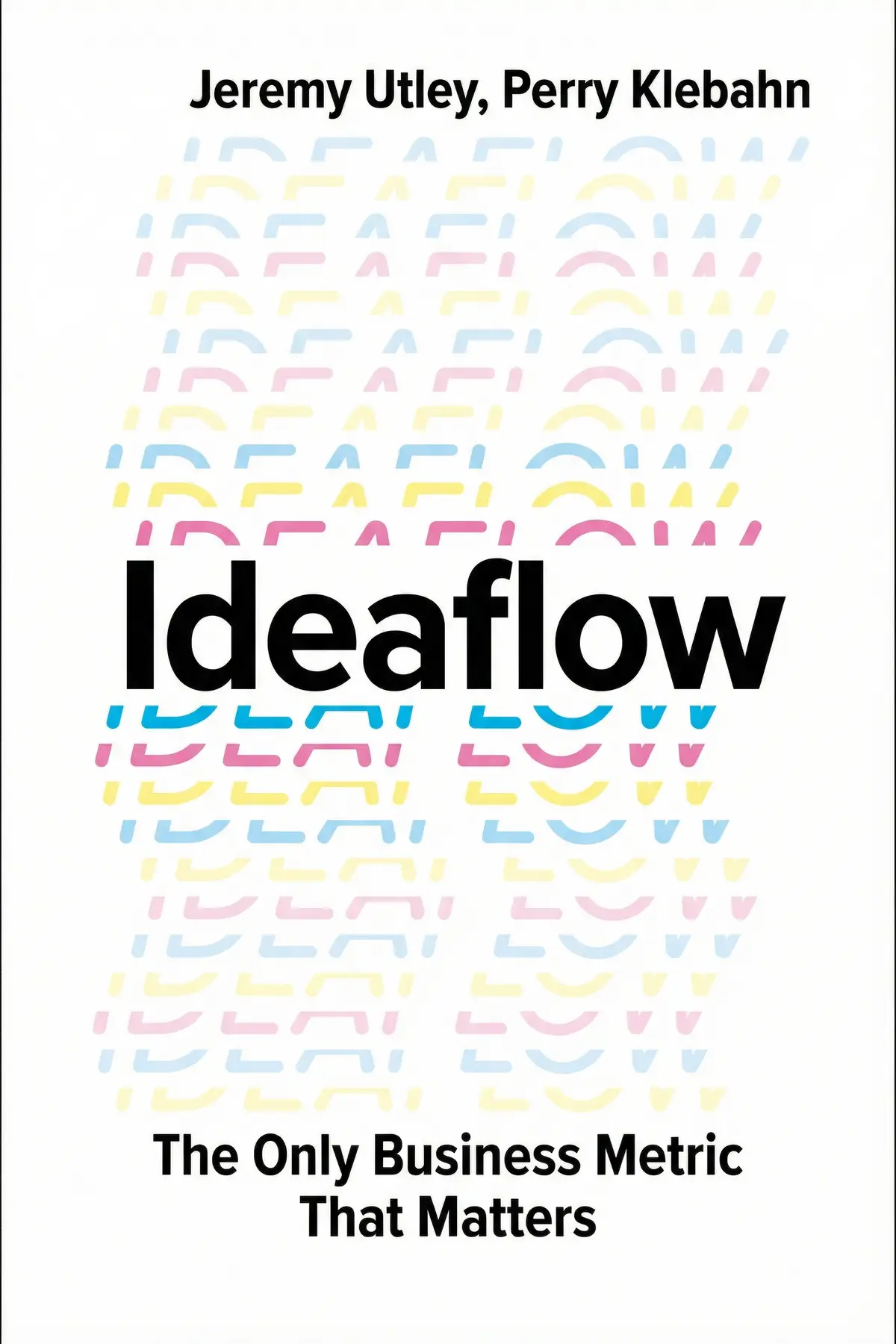
Table of Content
1. Introduction
1 min 42 sec
In the modern business landscape, we are obsessed with metrics. We track quarterly earnings, customer acquisition costs, and employee turnover with surgical precision. Yet, there is one vital engine of growth that most organizations leave entirely to chance: the creative process. Many people still believe that a great idea is like a lightning strike—something that happens by accident or to people with special ‘creative’ jobs. But Jeremy Utley and Perry Klebahn argue that this perspective is fundamentally flawed. Creativity isn’t magic; it is a discipline that can be measured, optimized, and taught.
The core of their philosophy is a single, powerful metric called ideaflow. This metric measures the sheer volume of ideas you or your team can generate in response to a specific challenge. The logic is simple but profound: to find one truly great solution, you must be willing to produce hundreds of mediocre ones. When a company stops prioritizing this flow, it stagnates. It stops taking risks and starts relying on what worked yesterday, even if yesterday’s solutions no longer fit today’s problems.
In this summary, we are going to explore how to turn your workplace into an innovation factory. We will look at why the most successful companies in the world prioritize quantity over quality in the early stages of development and how you can use simple cognitive hacks to get unstuck. We will dismantle the myths of traditional brainstorming and see why silence is often more productive than a room full of people shouting. By the end of this journey, you’ll see that innovation isn’t about being the smartest person in the room—it’s about having the best system for letting ideas flow.
2. The Power of the Ideaflow Metric
2 min 03 sec
Discover why measuring the volume of your ideas is the most accurate predictor of your team’s future success and innovative potential.
3. Practical Habits to Stimulate Creative Thought
2 min 35 sec
Learn a step-by-step cognitive routine that bypasses your inner critic and helps you generate a high volume of potential solutions.
4. A Better Blueprint for Group Brainstorming
2 min 05 sec
Break free from the frustration of unproductive meetings by shifting to a ‘sandwich’ approach that balances group and individual work.
5. The Lifecycle of an Idea through Iteration
2 min 05 sec
Understand why flowing ideas into real-world tests is essential to distinguish between a theoretical success and a practical breakthrough.
6. Designing Effective and Low-Cost Experiments
2 min 21 sec
Master the art of the ‘quick and dirty’ test to validate your boldest concepts without breaking the bank.
7. Conclusion
1 min 21 sec
Ultimately, the message of Ideaflow is one of empowerment. Innovation is not a lottery that you either win or lose; it is a volume game that you can control. By tracking your ideaflow, you take the mystery out of creativity and turn it into a manageable part of your daily routine. We’ve seen that the best ideas don’t come from a flash of insight, but from the wreckage of a thousand failed attempts. Whether you are using the ‘Seed, Sleep, Solve’ method to break through a personal block or implementing an ‘innovation sandwich’ to fix your team’s meetings, the key is to keep the pipeline moving.
Remember the lesson of the Sea of Galilee: flow is life. Do not let your ideas sit stagnant in your mind or in a drawer. Get them out, test them quickly, and don’t be afraid to fail cheaply. If you can lower the cost of experimentation and increase the volume of your output, success becomes a statistical certainty rather than a stroke of luck. As you move forward, challenge yourself to meet an idea quota every single day. Stop looking for the ‘perfect’ answer and start looking for the next twenty possibilities. In the world of business, the person who has the most ideas is usually the one who ends up with the best one. It’s time to stop waiting for inspiration and start building the flow.
About this book
What is this book about?
Have you ever wondered why some companies seem to effortlessly churn out innovative products while others stay stuck in the past? Ideaflow suggests that the secret isn’t a mysterious spark of genius, but a measurable process that anyone can master. This summary explores the concept of the 'ideaflow' metric—the number of novel ideas you can produce to solve a specific problem. By treating creativity as a learnable skill rather than an innate talent, you can transform your professional output. You will discover why traditional brainstorming often fails and how to replace it with a more effective 'innovation sandwich.' The book promises to provide actionable techniques to boost your creative volume, refine your testing methods, and lower the stakes of failure. Whether you are a solo entrepreneur or part of a massive corporate team, this guide offers a roadmap for moving past the fear of bad ideas and toward the breakthrough solutions that truly matter.
Book Information
About the Author
Jeremy Utley
Jeremy Utley is a former management consultant and investment analyst who has transitioned into a world-renowned expert on innovation. He currently serves as an adjunct professor at Stanford University, where he advises founders and CEOs on how to unlock their creative potential. Perry Klebahn is a seasoned entrepreneur and professor who co-founded the famous Stanford d.school. He is perhaps best known in the business world as the founder of the Atlas Snow-Shoe Company, a venture that exemplifies his expertise in design and entrepreneurial strategy.
Ratings & Reviews
Ratings at a glance
What people think
Listeners find that this work clarifies the creative thinking process and offers a straightforward roadmap for innovation. The book is also seen as highly actionable; one listener highlights that it provides concrete illustrations for putting the shared concepts into practice. Additionally, listeners characterize the material as both motivating and a delight to experience, with one noting it reignited their passion. They value how approachable the text is, with one listener commenting that it is relevant to a diverse audience.
Top reviews
June
As someone who has spent years in stifling corporate environments, I found this book incredibly refreshing. Utley and Klebahn really demystify the creative process here. It's not about being a rare genius; it's about the volume of ideas you allow to circulate. The d.school approach is so much more engaging compared to the usual jargon-heavy business manuals. Frankly, it reignited my passion for problem-solving in a way I didn't expect. I loved the practical exercises, though I must admit some of the examples felt a bit lengthy. Still, the accessibility makes it a must-read for any team leader looking to spark change.
Show moreCooper
Wow, I didn't expect a business book to be such a joy to read. Most innovation guides are dry and academic, but Utley and Klebahn bring a sense of playfulness to the table. The emphasis on psychological safety as a prerequisite for ideaflow is a point that many managers miss. It’s not just about asking for ideas; it’s about creating a culture where people aren’t afraid to suggest something 'stupid.' The specific examples of rapid prototyping and testing were eye-opening for me. In my experience, the shift from 'what is the best idea' to 'how many ideas can we get' changes the entire energy of a room.
Show moreJoseph
The chapter on 'creative friction' was exactly what I needed to hear this month. After a decade in product management, I’d started to feel like my creative well was running dry. This book helped me realize that the problem wasn't a lack of talent, but a clogged idea pipeline. It’s incredibly practical and provides specific examples that you can implement tomorrow morning. I’ve already started using their brainstorming formats with my team, and the difference in engagement is night and day. Frankly, it’s one of the few business books that actually feels like it was written by practitioners rather than theorists. It’s an inspiring read I’ll be keeping for reference.
Show moreNoi
Innovation isn't a lightning strike; it's a plumbing problem. That’s the takeaway from Ideaflow, and it’s a perspective shift that every executive needs to experience. The authors provide a simple path to scaling creativity by treating ideas as a flow system rather than a scarce resource. I found the emphasis on 'bad ideas' being necessary for 'good ideas' to be incredibly liberating for my staff. Look, the book isn't perfect—it's definitely wordy in places—but the central framework is transformative. It demystifies the creative process in a way that feels both rigorous and fun. It’s rare to find a book that is this practical while also being genuinely inspiring.
Show moreWitthaya
This book makes a compelling case for quantity over quality during the initial stages of innovation. The concept of 'ideaflow' as a primary metric is brilliant, even if the title’s claim that it’s the only metric feels a bit hyperbolic. The authors provide a simple path to breaking through creative blocks by focusing on the 'idea pipeline.' It’s highly practical, giving specific techniques for brainstorming that I’ve already started using with my R&D team. My only gripe is that it gets a bit repetitive around the middle chapters. Truth is, you could probably get the core message in half the pages, but the anecdotes are mostly engaging.
Show moreNook
Ever wonder why some teams seem to churn out breakthroughs while others just spin their wheels? Ideaflow suggests it’s not talent, but the velocity of your idea generation system. I appreciate how the authors, both from the d.school, take these lofty concepts and turn them into a simple path for the rest of us. The book provides very clear instructions on how to cultivate high-quality ideas through systematic filtering. While the 'Silicon Valley' tone can be a bit much at times, the underlying mechanics of the creative process are sound. Not gonna lie, I was skeptical about the quantity over quality argument at first, but the evidence is hard to ignore.
Show moreCherry
Finally got around to reading this after seeing it recommended on several leadership blogs. The accessibility of the writing is its greatest strength; it makes complex design thinking concepts feel achievable for the average manager. Utley and Klebahn do a great job of breaking down the 'lone genius' myth and replacing it with a repeatable system. I particularly enjoyed the section on how to winnow ideas without crushing the spirit of the team. To be fair, some of the case studies feel a little cherry-picked to fit the narrative, and the pacing slows down significantly in the second half. However, the actionable takeaways regarding idea quotas make it worth the investment.
Show moreSatit
After hearing Jeremy Utley speak on a podcast, I was curious if his book would live up to the hype. For the most part, it does. Drawing on their experience at Stanford’s d.school, the authors offer a high-energy look at how to build an innovative culture. The book is filled with specific examples of how they’ve applied these principles in their consulting work, which adds a layer of credibility. I appreciated the focus on speed and rapid iteration over perfectionism. My only real critique is that the book ignores the role of capital and risk in certain industries—not every company can afford to test twenty ideas a week. Still, as a guide to mindset, it’s remarkably effective.
Show moreGame
The core thesis that innovation is a numbers game is well-argued, but the execution of the book itself is a mixed bag. On one hand, the techniques for increasing ideaflow—like structured quotas and better questioning—are genuinely useful for any professional. On the other hand, the book suffers from significant redundancy and feels a bit managerially optimistic. It assumes that culture alone can fix systemic issues, ignoring the political realities of most large organizations. Personally, I found the chapter on measuring ideaflow to be the most unique contribution, yet it lacked the depth needed for actual implementation. It’s a light, accessible read that demystifies creativity, but seasoned designers might find it a bit elementary.
Show moreHemp
Picked this up hoping for a deep dive into innovation strategy, but I left feeling underwhelmed. To be fair, the central premise is solid: you need a lot of bad ideas to find the gems. However, like so many business books from the Stanford ecosystem, it’s bloated with fluff. The authors spend too much time on self-selected success stories, including a case study on SVB that really hasn't aged well given recent events. I found myself skimming huge chunks of filler that didn't add much value beyond the first few chapters. It really feels like a great 2,000-word article stretched into a 300-page book.
Show moreReaders also enjoyed

AUDIO SUMMARY AVAILABLE
Listen to Ideaflow in 15 minutes
Get the key ideas from Ideaflow by Jeremy Utley, plus 5,000+ more titles in English and Thai.
- 5,000+ titles
- Listen as much as you want
- 7-day free trial
- Cancel anytime







