
19 min 16 sec
Know Thyself: The Science of Self-Awareness
An exploration of metacognition that reveals how thinking about our own thoughts can sharpen decision-making, enhance learning, and help us navigate a world of biases and digital echo chambers.
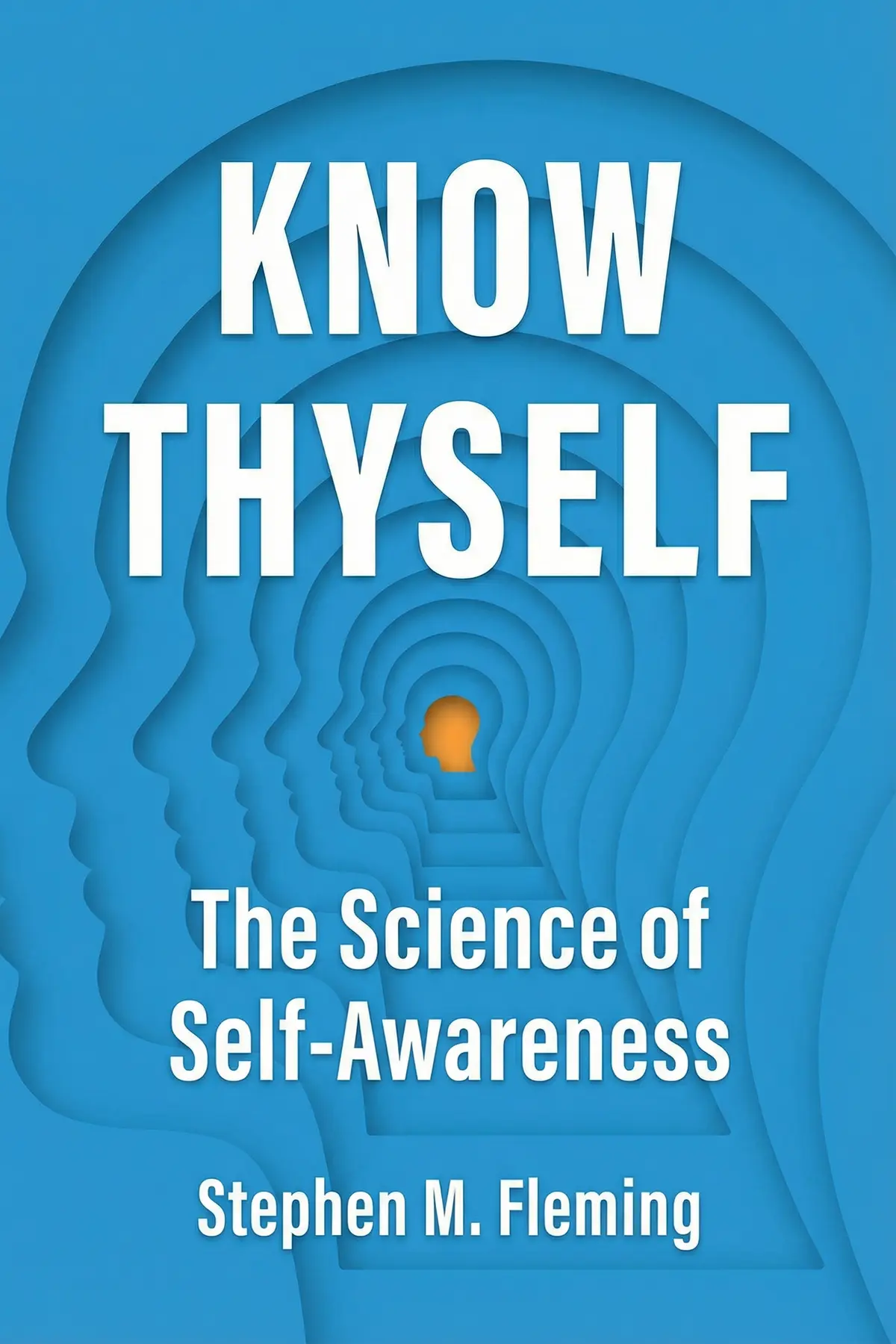
Table of Content
1. Introduction
1 min 40 sec
In an era where we are surrounded by technology that can mimic human speech and logic with startling accuracy, a fundamental question arises: what is it that truly makes us human? While artificial intelligence can process mountains of data and neural networks can predict patterns, there is a distinct internal quality that remains uniquely ours. This is our capacity for self-reflection—the ability to not only have a thought but to turn our attention inward and examine that thought as it happens. This concept isn’t just a philosophical curiosity; it is a rigorous field of scientific study known as metacognition.
At its core, metacognition is simply thinking about thinking. It is the mental monitor that tells you when you’ve forgotten a name that’s on the tip of your tongue or when you feel an intuitive sense of certainty about a difficult choice. Since the era of ancient Greek philosophy, we have been told that the highest form of wisdom is to understand ourselves. Today, modern neuroscience is proving that this isn’t just a poetic ideal—it’s a hardwired biological survival mechanism. By unlocking the secrets of how this internal monitoring system works, we can learn to refine our judgment, master new skills with greater efficiency, and navigate a world increasingly prone to polarization. This journey isn’t just about understanding the brain’s anatomy; it’s about discovering how to use our own self-awareness as a tool for a better life. Over the next few sections, we’ll explore how this biological hardware functions and how you can sharpen your own metacognitive skills to think more clearly and act more effectively.
2. The Nature of the Internal Monitor
1 min 57 sec
Discover the hidden layer of your mind that watches you think, helping you recognize what you know and identifying the gaps where your memory fails.
3. Survival Through Self-Monitoring
1 min 58 sec
Learn how the stakes of self-awareness rise from simple daily tasks to life-and-death challenges where knowing your limits is the ultimate survival skill.
4. Metacognition as a Learning Catalyst
2 min 01 sec
Unlock the secrets of efficient learning by shifting your focus from the subject matter to the way your own mind processes information.
5. The Teacher’s Mirror
1 min 54 sec
Explore why the best way to truly master a concept isn’t through more study, but by attempting to explain it to someone else.
6. The Trap of Post-Decision Logic
1 min 51 sec
Uncover how your brain tricks you into believing you’ve made the right choice, even when your preferences have been secretly swapped.
7. Finding the Balance of Confidence
2 min 02 sec
Discover how the level of certainty you bring to a problem changes the way you think, and why a little doubt can actually lead to better results.
8. The Power of the Collective Mind
2 min 01 sec
Learn why collaborating with others isn’t just a social necessity, but a vital safeguard against the fatal flaws of individual self-awareness.
9. Metacognition in the Digital Age
1 min 56 sec
See how your self-awareness skills—or the lack thereof—determine how you interact with different viewpoints and why dogmatism is a mental blind spot.
10. Conclusion
1 min 56 sec
As we have traveled through the intricate pathways of the human mind, a clear theme has emerged: our self-awareness is not just a passive trait, but a dynamic and vital skill. We’ve seen how this internal monitor allows us to sense the limits of our bodies, refine the way we learn, and navigate the tricky waters of decision-making. We have also seen the dangers of when this system fails—how overconfidence can lead to errors in judgment and how a lack of self-reflection can trap us in dogmatic thinking. The science of metacognition teaches us that while our brains are hardwired with these abilities, they are also incredibly plastic and can be improved with conscious effort.
To bring this home into your daily life, consider the balance between being a student and being an expert. When you are first starting to learn a new skill—whether it’s mastering a musical instrument or a new professional software—lean heavily into your metacognition. Monitor your progress, identify your gaps, and be strategic about your effort. However, there is a fascinating caveat: once a skill becomes automatic, like riding a bike or playing a veteran game of tennis, too much self-awareness can actually get in the way. At that point, the best move is to step back and let your ‘cognition’ take the wheel while your ‘metacognition’ simply enjoys the ride.
Ultimately, knowing yourself is about knowing when to trust your confidence and when to listen to your doubts. It’s about recognizing that you are a work in progress and that your mind is a tool that requires regular calibration. By staying curious about your own thoughts and remaining open to the perspectives of others, you can navigate a complex and changing world with a sharper mind and a more empathetic heart. The journey of self-awareness never truly ends; it is a lifelong practice of looking inward so that we can act more effectively in the world outside.
About this book
What is this book about?
Know Thyself examines the hidden machinery of the human mind, focusing on the sophisticated process of metacognition. It explores how our ability to reflect on our own thoughts—essentially thinking about thinking—defines us as a species and influences every aspect of our lives, from basic motor skills to complex social judgments. The book bridges the gap between high-level neuroscience and practical everyday application, showing how self-awareness acts as a vital compass in an increasingly automated world. The promise of this exploration is a roadmap for cognitive enhancement. By understanding the biological roots of self-awareness, readers can learn to calibrate their confidence, avoid the traps of confirmation bias, and improve their learning efficiency. Ultimately, it offers a guide to becoming a more flexible and precise thinker, providing the tools necessary to navigate uncertainty with greater clarity and collaborate more effectively with others in a polarized age.
Book Information
About the Author
Stephen M. Fleming
Stephen M. Fleming is a prominent figure in the academic world, serving as a professor of cognitive neuroscience at University College, London. His prolific career includes authoring over 75 scientific papers. His contributions have been recognized with prestigious honors, including the Wiley Award from the British Academy and the Philip Leverhulme prize in psychology, awarded by the Leverhulme Trust.
Ratings & Reviews
Ratings at a glance
What people think
Listeners find that perspectives on the prose are split, with some identifying it as too academic while others value the approachable, narrative style; nevertheless, most value the extensive exploration of metacognition. They emphasize how the work examines self-awareness and its role in decision-making, with one listener remarking that the book is successful in explaining "how we know what we know." Moreover, they observe that while it differs from a typical self-help book, it provides a stimulating analysis of the future of human intuition within the landscape of Artificial Intelligence.
Top reviews
Bae
This book provides a masterclass in understanding the mental machinery that allows us to reflect on our own thoughts. Fleming manages to bridge the gap between high-level laboratory research and practical daily existence without ever feeling like he’s talking down to the reader. I particularly enjoyed the sections exploring how our unique human self-awareness stands up against the rising tide of artificial intelligence. It’s not your typical self-help manual, so do not go in expecting quick life hacks; instead, it offers a profound scientific framework for how we know what we know. The prose is dense in parts, but the 'huh, that's cool' moments are frequent enough to keep the momentum going. Truth be told, it shifted my perspective on how I approach my own decision-making process.
Show moreAnucha
Stephen Fleming has achieved something rare here by making the current state of cognitive science feel both accessible and deeply compelling. He explores how our sense of autonomy and responsibility is rooted in our ability to monitor our own mental states. He has succeeded. The writing style is engaging and conversational, peppered with enough humor to balance out the more intensive scientific theories. It was fascinating to see how our internal 'monitor' influences everything from learning to our social interactions. Look, this isn't a quick fix or a list of 'ten steps to a better you,' but it is popular science at its absolute best. Highly recommended for anyone curious about the mechanics of the human mind.
Show moreManika
Picked this up on a whim and was completely engrossed within thirty pages. The way Fleming explains 'how we know what we know' is simply brilliant, turning complex neuroscience into a narrative that feels personal and relevant. I loved the 'huh, that's cool' moments that seemed to pop up in every chapter, especially regarding how we perceive our own strengths and weaknesses. The style is surprisingly conversational for such a heavy topic, which helped me stay focused throughout the more technical passages. Personally, I think this should be required reading for anyone interested in psychology or cognitive science. It is a refreshing departure from the fluffy self-help books that usually dominate this shelf.
Show moreThida
Wow, what a fascinating look at the 'inner eye' of human cognition. Stephen Fleming manages to explain the science of self-awareness in a way that feels both vital and intellectually stimulating. The exploration of how our metacognitive abilities might be the final frontier that separates us from Artificial Intelligence was particularly gripping. It is a dense, information-rich book, yet it maintains an engaging tone that kept me coming back for more. In my view, it is one of the best popular science books I have read in years because it challenges the reader to look inward with a more critical, scientific lens. If you want to understand the boundary between knowing and just thinking you know, this is the book for you.
Show moreTawee
Ever wonder why we are so certain when we are actually wrong? Fleming dives deep into the science of metacognition to answer exactly that, though he occasionally wanders into some fairly thick academic weeds. The distinction between being aware and being aware of that awareness is fascinating, even if the language gets a bit technical for a casual Sunday afternoon read. To be fair, the book is incredibly well-researched, and the chapters on how we teach new skills through self-reflection were eye-opening. It lacks the punchy experimental results some might want, leaning more toward a philosophical essay at times. Still, it is a solid pick for anyone who wants to move beyond surface-level self-help.
Show moreMoo
The chapter on Artificial Intelligence alone makes this worth the purchase. Fleming provides a very nuanced look at why human self-awareness is still essential in an era where algorithms are taking over decision-making. I appreciated that the book did not dumb things down, even when the concepts of error-monitoring and confidence became quite abstract. Gotta say, it is a bit of a dense read, and I had to go back and re-read a few sections to really grasp the distinction between consciousness and metacognition. However, the payoff is a much clearer understanding of your own mental limitations. It is a thought-provoking journey for anyone willing to put in the effort.
Show moreKru
Finally got around to finishing this, and I have to say, it is a very rewarding read if you are patient. The author takes us on a journey through the mechanics of self-awareness and how it shapes our sense of responsibility for our actions. It is a fascinating look at the 'meta' layer of our brains that most of us take for granted every single day. While some of the language is a bit intensive and suited for those with a background in psychology, the insights into decision-making are top-notch. Truth is, I feel much better equipped to understand my own cognitive biases now. Just don't expect a fast-paced thriller; it is a book meant to be chewed on slowly.
Show moreFrida
After hearing several recommendations, I finally dove into this exploration of the mind. While the core subject of metacognition is undeniably interesting, the prose often felt a bit too 'ivory tower' for my liking. The author clearly knows his stuff, but the intensive, complicated language makes it a slow burn that requires a lot of mental energy to digest. I was hoping for more practical applications regarding self-improvement, but this is strictly a scientific deep dive. In my experience, the chapters on AI and the future of human intuition were the highlights, whereas the earlier sections on experimental theory dragged significantly. It is a decent read, but be prepared for a heavy academic lift.
Show moreTantipat
As someone who has read a lot of neuroscience, I found this to be a bit of a mixed bag. On one hand, Fleming is an excellent writer who makes the concept of metacognition very clear for a general audience. On the other hand, the book feels quite light on specific experimental results, often reading more like a theoretical essay than a hard science text. There is a certain amount of conflation between self-awareness and general consciousness that might bother more rigorous readers. Not gonna lie, I expected more data-driven conclusions instead of the broad strokes presented in the later chapters. It is a fine introduction to the topic, but seasoned science readers might find it a bit elementary.
Show moreKasemsan
Not what I expected at all. While the title promises a deep dive into the self, the actual content feels more like a collection of redundant information wrapped in overly complex language. I found the author’s attempt to link metacognition with the core of human consciousness to be quite weak and logically self-contradictory. For instance, he mentions monkey experiments to prove points about self-awareness but then glosses over the actual procedures and data. Frankly, it reads more like a long-form essay for elementary students than a groundbreaking scientific text. If you are looking for meaningful truths to improve your introspection, you might find this a frustrating waste of time.
Show moreFeatured in
Readers also enjoyed
A Liberated Mind: How to Pivot Toward What Matters
Steven C. Hayes
Acting with Power: Why We Are More Powerful Than We Believe
Deborah Gruenfeld
Age of Propaganda: The Everyday Use and Abuse of Persuasion
Anthony Pratkanis

59 Seconds: Change Your Life in Under a Minute
Richard Wiseman
AUDIO SUMMARY AVAILABLE
Listen to Know Thyself in 15 minutes
Get the key ideas from Know Thyself by Stephen M. Fleming, plus 5,000+ more titles in English and Thai.
- 5,000+ titles
- Listen as much as you want
- 7-day free trial
- Cancel anytime







