
18 min 28 sec
Leaving Microsoft to Change the World: An Entrepreneur's Odyssey to Educate the World's Children
By John Wood
Follow the journey of John Wood as he leaves a high-powered career at Microsoft to combat global illiteracy, applying corporate strategy to build thousands of libraries and schools in developing nations.
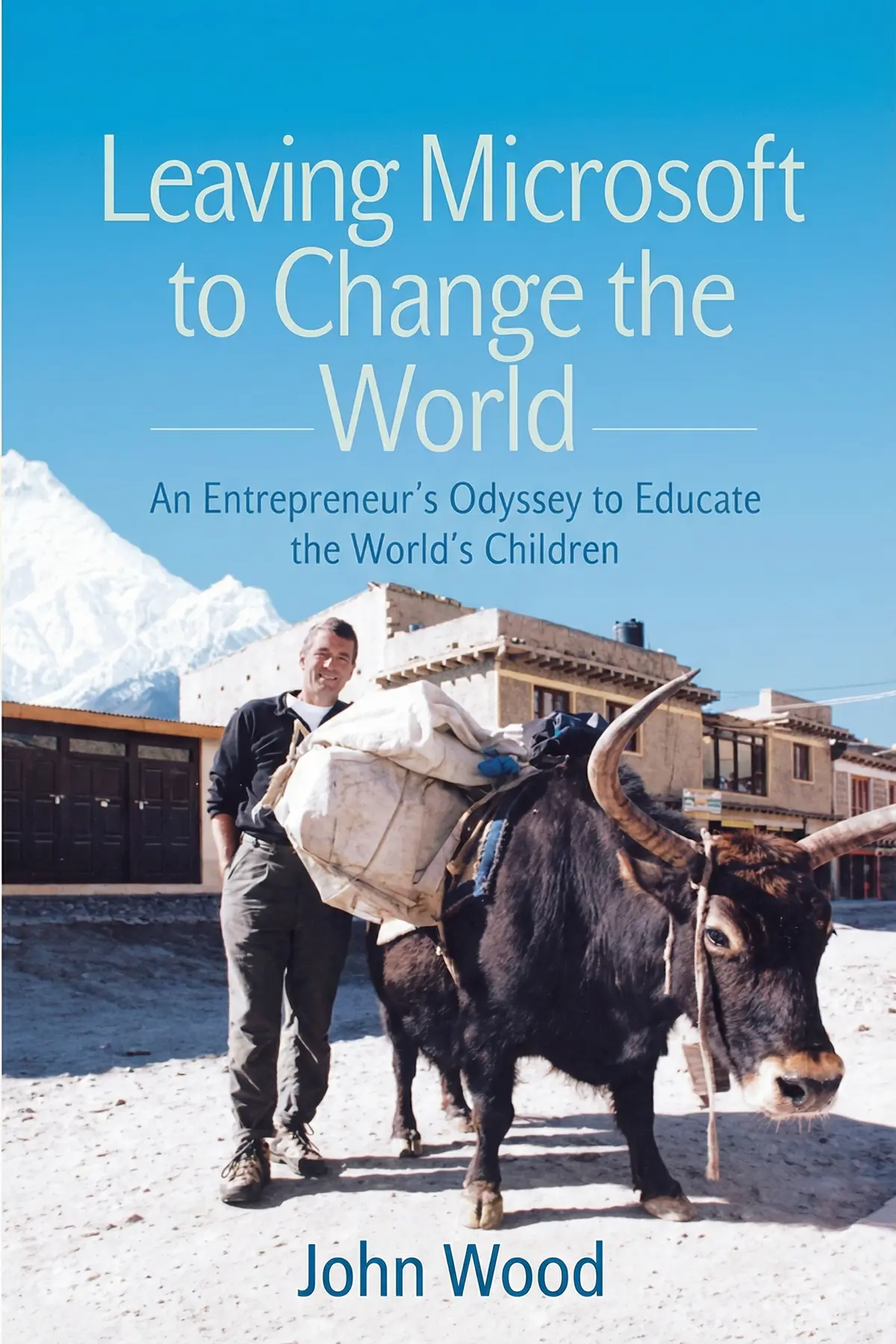
Table of Content
1. Introduction
1 min 45 sec
Imagine reaching the absolute pinnacle of corporate success. You have the title, the stock options, the driver, and the prestige that comes with being an executive at one of the most powerful companies on the planet. For John Wood, this was his reality at Microsoft during the 1990s. He was a man who lived and breathed growth targets and market share. But a single vacation to the mountains of Nepal changed everything. It wasn’t just the scenery that stayed with him; it was the realization that while he was busy helping the world connect through technology, millions of children were being left behind because they didn’t even have access to basic books.
In this summary of Leaving Microsoft to Change the World, we follow Wood’s transition from a high-flying tech leader to a dedicated social entrepreneur. This isn’t just a story about charity; it’s a story about the intersection of business efficiency and humanitarian heart. Wood discovered that the same skills he used to build a global software empire—rigorous data analysis, aggressive scaling, and a focus on results—could be the very tools needed to dismantle the cycle of illiteracy.
Through this journey, we will explore the birth of Room to Read, an organization that sought to treat philanthropy not as a hobby, but as a high-stakes enterprise. We’ll see how Wood navigated the terrifying leap of faith required to leave his comfortable life, how he pitched his vision to skeptical donors, and why he eventually realized that educating girls is the single most powerful lever for changing a community’s future. It’s an odyssey that proves one person’s decision to step off the corporate ladder can create a bridge to a better life for children across the world.
2. A Life-Changing Realization in Nepal
2 min 06 sec
A routine hike in the Himalayas leads to a shocking discovery about the state of global education and a promise that would change everything.
3. The Leap from Corporate Security to Social Impact
1 min 54 sec
Discover the internal struggle and external consequences of walking away from a dream job to pursue an even bigger dream.
4. Applying a Business Mindset to Philanthropy
1 min 59 sec
Learn the five core principles Wood used to convince wealthy investors that his nonprofit was a high-return venture for humanity.
5. The Importance of Local Partnerships and Scaling
1 min 46 sec
Scaling an organization globally requires more than just money; it requires a deep-rooted connection to the local community.
6. Inspiration and Expansion into Vietnam
1 min 45 sec
A chance encounter with a dedicated teenager and a volunteer with a heart for Southeast Asia paved the way for a new chapter.
7. Lessons from the Microsoft Playbook
1 min 54 sec
Wood reflects on how the high-pressure environment of the tech industry provided the perfect training ground for social change.
8. The Transformative Power of Educating Girls
1 min 38 sec
Why focusing on female literacy is the most effective way to improve public health, the economy, and the future of entire nations.
9. Thinking Big in the Face of Adversity
1 min 55 sec
A devastating natural disaster serves as a test of the organization’s agility and Wood’s philosophy of bold, ambitious goals.
10. Conclusion
1 min 46 sec
The journey from a Microsoft boardroom to the remote villages of the Himalayas is more than just a career change; it is a testament to the power of a single, focused vision. John Wood’s story illustrates that you don’t have to choose between having a sharp business mind and a compassionate heart. In fact, the most effective way to tackle the world’s greatest problems is to combine the two. By applying the principles of scalability, accountability, and data-driven results to the nonprofit sector, Wood transformed the lives of countless children and set a new standard for global philanthropy.
Room to Read and Room to Grow stand as living proof that the cycle of poverty and illiteracy can be broken when we treat education as a fundamental right rather than a luxury. Wood’s emphasis on local empowerment and girls’ literacy has created a sustainable model that continues to thrive long after his initial leap of faith. His legacy is not just the thousands of libraries built or the millions of books distributed, but the shift in how we think about social change.
As you reflect on this odyssey, consider the lessons it offers for your own life. You may not be in a position to leave a high-powered executive role today, but you have skills, networks, and resources that can be mobilized for a cause you believe in. Wood’s experience reminds us that the world’s problems are vast, but they are not insurmountable. It starts with a promise, a willingness to step into the unknown, and the courage to believe that one person’s contribution, when executed with excellence, can indeed change the world. The locked cabinets of the world are waiting for someone with the key; perhaps that person is you.
About this book
What is this book about?
This book chronicles the transformative journey of John Wood, who walked away from a lucrative executive position at Microsoft to found Room to Read. After witnessing the dire lack of educational resources in rural Nepal, Wood realized that his professional skills could be better used to solve a global crisis than to sell software. He shares the challenges of transitioning from the corporate world to the nonprofit sector, emphasizing that the same principles of efficiency, scale, and data-driven results can be used to drive massive social change. The narrative serves as both a memoir and a blueprint for social entrepreneurship. Wood outlines how he built a sustainable organization that prioritizes local partnership and focuses on long-term impact, particularly through the education of young women. It is a story of how passion, when combined with business acumen, can create a ripple effect that changes the lives of millions of children across the globe.
Book Information
About the Author
John Wood
John Wood is a philanthropist, entrepreneur, and best-selling author. He is the founder of Room to Read and Room to Grow, two highly influential nonprofit organizations dedicated to ending childhood illiteracy and promoting gender equality in education. Before dedicating his life to social causes, Wood was a senior executive at Microsoft, where he helped lead the company’s expansion into various global markets.
Ratings & Reviews
Ratings at a glance
What people think
Listeners find this memoir inspiring, with one listener describing it as a touching exploration of the author's personal path. The book is widely suggested for its accessibility, and listeners appreciate the compelling narrative and refined writing style. They also value the professional guidance, with one listener emphasizing the author's work in founding schools and computer labs, while others commend the emphasis on practical results and the book's superb organization.
Top reviews
Watchara
Wow. What a massive shift in perspective this memoir provides. John Wood manages to weave his high-stress Microsoft background with the sheer simplicity of a library in Nepal beautifully. I appreciated the focus on measurable results, which makes this more than just a feel-good story. Personally, the way he translated corporate efficiency into a non-profit model was fascinating to see in action. While some might find his drive bordering on intense, his dedication to girl’s education and literacy is undeniably life-changing. It is a heartwarming walk through a journey that most of us are too scared to take ourselves. The book is an easy read that leaves you questioning your own career path and contributions to the world. If you want to see how one person can leverage their skills for global good, look no further.
Show moreWipada
This book is essentially a blueprint for how to build a world-class organization from the ground up using business principles. John Wood’s transition from software executive to literacy advocate is nothing short of breathtaking. I was particularly moved by the stories of the girls receiving scholarships in the second half of the book. It’s rare to find a memoir that is both emotionally resonant and practically useful for leaders. The author’s ability to mobilize resources and refuse to 'sell' poverty as a marketing tool is a refreshing change of pace. Frankly, we need more leaders who approach global issues with this level of organizational genius and heart. Every chapter felt like a lesson in how to stop talking about problems and start solving them through action. Highly recommended for anyone who wants to see real-world results.
Show moreRapee
John Wood shows us that passion, when combined with professional discipline, can create a massive ripple effect across the globe. The story begins with a simple promise to a headmaster in Nepal and grows into a movement involving millions of books. I was deeply inspired by his commitment to girls' education, realizing that educating a woman changes an entire family's trajectory. The book is exceptionally organized, moving from his personal epiphany to the global expansion of his NGO. Some might find his relentless drive a bit exhausting to read about, but the children’s smiles in the libraries make it all make sense. It’s a powerful reminder that our careers can serve a much higher purpose if we are willing to take the risk. This is easily one of the most motivating memoirs I’ve read in years.
Show moreAdam
After hearing about Room to Read for years, it was great to finally dive into the origin story. Wood writes with a sense of urgency that is contagious, making you want to go out and start your own project immediately. The way he describes the empty libraries and the children’s hunger for knowledge is genuinely moving. I think the book excels at showing the 'how' of philanthropy, not just the 'why.' He provides excellent career advice for those looking to transition into the social sector without losing their professional edge. It’s an easy, engaging read that avoids the typical traps of being overly preachy or sentimental. Wood stays grounded in the reality of the work while maintaining a hopeful outlook for the future. A must-read for anyone who believes that literacy is a fundamental human right.
Show moreSofia
Ever wonder what happens when a high-level executive trades a corner office for a Himalayan trail? This book answers that question with a mix of corporate grit and genuine altruism. Wood’s story of bringing books to Nepal on the back of a yak is a striking image that stays with you long after the chapter ends. I found the parallels between his time at Microsoft and the scaling of Room to Read to be the most compelling parts. Look, the guy is clearly driven by metrics, but in the world of non-profits, that might be exactly what is needed for sustainable change. Some sections felt a little repetitive regarding his travel schedule, but the impact he has on those children’s lives is undeniable. It’s a solid choice for anyone looking for career inspiration or a new look at philanthropy.
Show moreMaksim
The chapter on Wood’s final days at Microsoft really sets the tone for the rest of the book. His interactions with leadership illustrate the high-pressure environment he left behind to pursue something more meaningful. I enjoyed the fast-paced nature of the story, as it reflects the urgency of his mission to build libraries across Asia. While the writing isn't overly complex, the message is clear: education is the greatest equalizer we have. Not gonna lie, some of the corporate jargon he brings to the non-profit world was a bit much at first. However, seeing the sheer number of books and schools he has established makes it hard to argue with his methods. It’s a very practical look at how to make a difference without losing your head in the clouds. Definitely a worthwhile read for aspiring social entrepreneurs.
Show moreCholada
As someone working in the corporate world, I found Wood’s journey incredibly relatable and motivating. He doesn't just tell you to quit your job; he shows you how to apply your existing skills to a cause you care about. The way he built Room to Read into a global powerhouse is a testament to the power of a clear vision and a workable business plan. My only minor gripe is that he glosses over some of the deeper systemic issues in the countries he visits. He stays fairly surface-level when it comes to the politics of education in places like Vietnam or Sri Lanka. Still, his focus on results and accountability in the charity sector is a breath of fresh air. It’s an inspiring narrative that proves you don't have to be a saint to change the world. You just need to be dedicated.
Show morePita
It’s hard to knock the mission, but the prose is admittedly a bit clunky at times. The writing style feels somewhat simplistic, almost like a corporate report dressed up in a high-school-level narrative. Truth is, Wood seems relentlessly positive, likely because he’s still in fundraising mode throughout the book. This makes some of his interactions, especially with figures like Ballmer or Gates, feel a bit filtered for the audience. I struggled with the business-first approach to charity, which occasionally felt a bit 'oogy' and sterile. To be fair, his results are incredible and the expansion of Room to Read is a feat of logistics. However, as a literary work, it lacks the depth of character I usually look for in a memoir. It is a decent guide for non-profit management, but don't expect a masterpiece of storytelling.
Show moreAey
Truth is, the author’s 'business-like approach' to charity is a bit of a double-edged sword for the reader. On one hand, you have to admire the efficiency and the incredible numbers Room to Read has achieved in such a short time. On the other hand, the narrative feels a bit like a long pitch deck for a venture capital firm. I missed the human element that makes memoirs like this truly sing; everything felt a bit too calculated and polished. To be fair, Wood is honest about his drive and his desire for measurable achievement. He admits to having no life outside of his mission, which is both admirable and a little sad. If you’re looking for a manual on how to fundraise effectively, this is five stars. If you want a poetic journey into the heart of the developing world, it’s closer to two.
Show moreKwame
Picked this up expecting a deep dive into the cultural heart of Nepal, similar to 'Three Cups of Tea,' but found something entirely different. Wood focuses heavily on the mechanics of his own success and his previous life at Microsoft rather than the people he is helping. The personal connection to the actual communities on the ground felt secondary to the logistics of fundraising and scaling up. I wanted to feel the heartbreak of the parents who can’t afford school, but instead, I got a lot of talk about business plans. He hires locals to do the ground work, which is efficient, but it leaves the narrative feeling disconnected from the local culture. It’s a book about how to run a charity like a business, not a book about the people of Nepal. If you want a soulful story about developing nations, this isn't it.
Show moreReaders also enjoyed


A Year in the Life of William Shakespeare: 1599
James Shapiro

7 Powers: The Foundations of Business Strategy
Hamilton Helmer

Agent Sonya: The Spy Next Door
Ben Macintyre
AUDIO SUMMARY AVAILABLE
Listen to Leaving Microsoft to Change the World in 15 minutes
Get the key ideas from Leaving Microsoft to Change the World by John Wood, plus 5,000+ more titles in English and Thai.
- 5,000+ titles
- Listen as much as you want
- 7-day free trial
- Cancel anytime







