
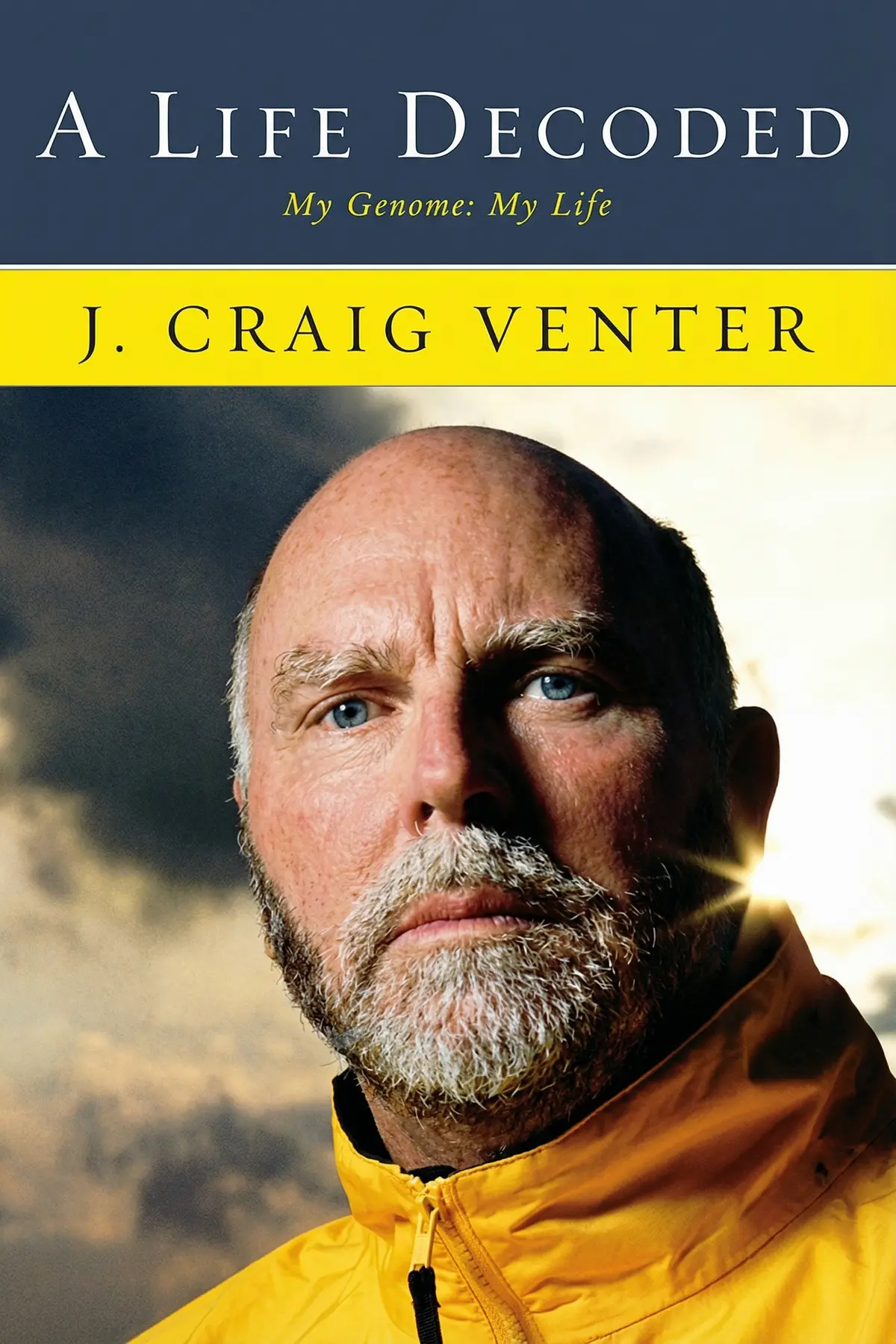
A Life Decoded: My Genome: My Life
J. Craig Venter
An exploration of the history and future of genomics, tracing the path from the discovery of DNA to the creation of the world’s first synthetic organisms and the potential for biological teleportation.
1 min 32 sec
Imagine a world where the boundary between hardware and flesh completely dissolves. For centuries, we have viewed life as something mysterious, perhaps even divine—a spark that exists outside the realm of simple chemistry and physics. But what if life is actually more like a computer program? What if the instructions for every living thing, from the tiniest microbe to the most complex human, are simply code that can be read, written, and even sent across the vacuum of space at the speed of light?
This is the world J. Craig Venter introduces us to. As one of the most influential scientists of our era, Venter hasn’t just watched the genomic revolution happen; he has been the one driving the bulldozer. In this exploration, we are going to trace the history of how we learned to speak the language of DNA. We will move from the early days of identifying the double helix to the controversial and groundbreaking moment when a living, breathing organism was created with a computer for a parent.
This journey isn’t just about lab equipment and petri dishes. It’s about a fundamental shift in our identity. We are moving from a phase of human history where we merely observed nature to a phase where we can design it. We’ll look at the ethical firestorms this creates, the technical hurdles that nearly broke the brightest minds in the field, and a future where medicine and life itself can be teleported across the stars. This is the story of how biology became digital, and what that means for the future of our species.
2 min 05 sec
Discover how a physicist’s bold questions paved the way for modern genetics, challenging the idea that life is anything more than chemical reactions.
2 min 16 sec
Explore the centuries-old tension between those who see life as a sacred mystery and the scientists who prove it can be manufactured in a lab.
2 min 00 sec
Learn how scientists found the tools to cut and paste DNA, transforming genetics from an observational science into an engineering feat.
2 min 04 sec
See how the marriage of biology and high-speed computing allowed scientists to move from decoding single genes to mapping entire organisms.
2 min 04 sec
Witness the first time a virus was brought to life using nothing but instructions from a computer, proving that biological software is real.
2 min 08 sec
Go behind the scenes of the monumental effort to synthesize a living genome 20 times larger than anything previously attempted.
2 min 17 sec
Discover the high-stakes world of genomic transplantation, where a single missing letter of code stood between failure and a scientific revolution.
2 min 12 sec
Examine the global reaction to synthetic life, from the excitement of scientific progress to the chilling fears of bioterrorism.
1 min 54 sec
Step into a future where medicine and even life forms are transmitted as digital signals across space, revolutionizing healthcare and exploration.
1 min 42 sec
As we reach the end of this journey through the world of synthetic genomics, it is clear that we have crossed a point of no return. We began by asking what life is, moving from the philosophical musings of Schrödinger to the molecular breakthroughs of Watson and Crick. We saw how the simple act of synthesizing urea in the 19th century eventually led to the 21st-century creation of JCVI-syn 1.0—a cell with a computer parent.
The overarching lesson of J. Craig Venter’s work is that life is information. It is software that runs on the hardware of the cell. Once we accept this, the possibilities become both exhilarating and sobering. We have the power to edit our own blueprints, to create new species that can solve environmental crises, and to transmit the essence of life across the stars. However, we also bear the responsibility of managing this power. The same technology that can teleport a vaccine to Mars can be used to manufacture a pathogen in a basement.
The future of biology is not just in the hands of scientists, but in the hands of everyone who must decide how these tools are used. As we move into this new era, the most important takeaway is that we are no longer just passengers in the story of evolution; we have become the authors. The code of life is now ours to write, and the speed at which we do so is only limited by our imagination and our ethics. The transition from the double helix to the dawn of digital life is complete, and the next chapter of the human story is about to be printed.
Life at the Speed of Light examines the profound evolution of biological science, moving from the conceptualization of life as a physical process to the modern ability to manufacture it using digital code. It details the historic milestones of genetics, including the discovery of the double helix and the decoding of the human genome, before diving into the revolutionary work of J. Craig Venter and his team. The book promises a look at the dawn of the digital-to-biological revolution. It chronicles the painstaking process of synthesizing chromosomes, the ethical debates surrounding artificial life, and the breathtaking possibility of transmitting genetic information across planets at lightspeed. Readers will understand how life is being redefined as a form of software that can be written, edited, and transported.
Craig Venter is a world-famous biochemist and geneticist. Author of his own autobiography, A Life Decoded, Venter has also been included twice on the TIME 100, a list of the world’s most influential people as chosen by Time magazine editors.
J. Craig Venter
Listeners find the book to be educational and well-crafted, with one review noting how the author explains intricate concepts using accessible language. Furthermore, the text provides a deep look at our biological future and offers an excellent history of genetic engineering. Listeners also value the captivating storytelling and consider it a significant scientific milestone. However, feedback on readability is mixed, as one listener found the material incomprehensible to a non-expert.
Wow, what an incredible journey through the blueprint of existence. Reading this made me realize just how close we are to a total revolution in how we interact with the natural world. Venter’s account of creating the first synthetic cell, Mycoplasma laboratorium, reads like a modern-day Prometheus story, minus the tragic ending. I loved the way he describes the transition from reading the code of life to actually writing it, effectively turning biology into an information science. Some people might find his mechanistic view of "cells as assembly lines" a bit cold, but personally, I find it empowering because it suggests we can actually solve problems like antibiotic resistance and climate change. The prose is sharp and clear, making even the most complex genomic concepts feel accessible to someone with a basic interest in science. This is easily one of the most important books I’ve picked up this year.
Show moreAfter hearing Venter speak on a podcast, I knew I had to read his full account of the synthetic biology revolution. This book is a masterpiece of scientific storytelling that manages to bridge the gap between hard data and philosophical inquiry. The way he describes the "booting up" of a synthetic genome into a host cell is nothing short of miraculous; it’s like watching the dawn of a new era in real-time. Venter doesn't shy away from the ethics either, advocating for a thoughtful conversation about what it means to "play God" without falling into the trap of hysterical anti-science rhetoric. To be honest, I was riveted by the potential applications for vaccines and environmental cleanup mentioned in the latter half. This is a top scientific achievement in book form and offers a profound preview of a future where we are no longer victims of our genetic luck but masters of our own biological code.
Show moreFinally finished this deep dive into the digital nature of biology. Venter’s central argument that life is essentially software being "booted" up into cellular hardware is a paradigm shift for anyone used to more mystical views of nature. He takes us through the gritty details of sequencing the human genome, which, frankly, feels like a high-stakes engineering project rather than just quiet lab work. While the middle sections on synthetic genomics get a bit bogged down in nomenclature, the payoff comes when he discusses "biological teletransportation." I found the idea of beaming genetic code across space to reassemble organisms on other planets absolutely mind-blowing, even if it borders on science fiction. It’s a dense read that demands your full attention, but the glimpse into a future where we print vaccines and microbes is worth the effort.
Show moreThe concept of "biological teletransportation" sounds like pure sci-fi, yet Venter makes a convincing case for its eventual reality. This book offers an excellent history of genetic engineering, starting from the discovery of the double helix and moving rapidly into the age of synthetic organisms. I was particularly struck by the "software of life" metaphor; it really clarifies how modern researchers view the relationship between DNA and the physical cell. Although the author’s tone can be a bit self-congratulatory at times, his contributions to the field are undeniable and his vision for the future is genuinely inspiring. If you can get past some of the more turgid descriptions of lab protocols, you’ll find a fascinating narrative about how we are learning to command the very building blocks of life itself. A solid 4-star read for any science enthusiast.
Show moreEver wonder what the transition from "natural" to "synthetic" life actually looks like on a molecular level? Venter provides a front-row seat to this transformation, treating the cell as a biological machine that can be programmed and optimized. I found his mechanistic view refreshing and logically sound, especially his rejection of vitalism in favor of a digital understanding of genetics. The book does a pretty good job of explaining the "read, write, boot" process, though it definitely expects the reader to keep up with some heavy terminology. My only real complaint is that the author sometimes gets sidetracked by personal grievances or overly technical minutiae that distracts from the overarching theme of "life at the speed of light." Still, it’s a vital read for anyone trying to understand where medicine and agriculture are headed in the next fifty years.
Show moreThis book provides a fascinating look at the "on the ground" reality of genetic research. Venter successfully chronicles the evolution of the field from the early days of ESTs to the current era of synthetic life forms. I was especially impressed by the discussion on accelerated vaccine production and the potential for designing custom microbes to solve global health crises. The writing is generally accessible, though Venter’s mechanistic perspective—viewing DNA as the "software of life"—might rub some people the wrong way. Personally, I think it’s a useful framework for understanding how far we’ve come since Watson and Crick. While the book has a slight anti-religious slant and some unnecessary detours into Star Trek territory, the core scientific narrative is top-tier. It's a profound preview of what is coming next in our biological evolution.
Show moreIs it possible for a book to be both visionary and incredibly tedious? Venter is undoubtedly a titan in the field of genetics, but his prose often struggles to keep pace with his ego and his complex ideas. The first half of the book provides a solid, albeit dry, historical account of the breakthroughs in DNA sequencing and the competitive race to map the human genome. However, once he shifts into the realm of synthetic biology and those bizarre Star Trek teleportation analogies, the narrative loses its grounding. To be fair, his technical explanations of how we can now "write" DNA are enlightening, but the jump to quantum entanglement felt unnecessary and likely confuses the core message for the public. It’s an informative read for those with a background in science, though the casual reader might find themselves drowning in a sea of acronyms and mechanistic jargon.
Show moreAs someone who appreciates the history of science, I had high hopes for this one. Unfortunately, Venter’s writing style often feels more like a technical manual than a popular science book meant for the general public. While the achievements he describes—like the digitization of DNA—are objectively stunning, the way he presents the data can be incredibly dense and difficult to parse. Look, I understand that the process of sequencing and synthesizing genomes is a painstaking endeavor, but does the reader need a play-by-play of every bureaucratic hurdle and minor lab error? The later chapters regarding Martian exploration and the "speed of light" transmission of life are certainly more engaging, yet they feel disconnected from the rigorous science of the earlier sections. It’s a mixed bag that provides a profound preview of our biological future but fails to make the journey there particularly enjoyable for the average reader.
Show moreDid the author really need to spend so much time on quantum teleportation? While I enjoy the "speed of light" concept, the middle section of the book felt like it was grasping at straws to justify the title’s catchy name. Venter is at his best when he’s describing the down-to-earth challenges of modern researchers—the sheer craftsmanship required to synthesize a genome is staggering. But then he pivots into these futuristic ruminations that feel more like pure speculation than grounded science. Not gonna lie, I preferred the historical chapters about the race to sequence the human genome over the "beaming Martians" stuff. It’s an informative and well-written book in parts, but the uneven tone and the dense, turgid narration in the technical chapters make it a bit of a slog to get through entirely. It’s worth a selective reading if you're interested in genomics.
Show moreI really wanted to like this, but I found the writing to be almost entirely incomprehensible for a layperson. Venter is clearly a brilliant scientist, but he lacks the ability to translate his complex work into a narrative that flows for those of us without a PhD in molecular biology. The book oscillates between incredibly dry accounts of lab procedures and wild, speculative leaps into the future that don't seem grounded in the preceding chapters. Frankly, the analogies to Star Trek were more confusing than helpful and felt like a desperate attempt to spice up a very "crunchy" technical text. I appreciated the brief history of the Human Genome Project, but even that was overshadowed by a dense writing style that made it hard to stay engaged for more than a few pages at a time. This one just wasn't for me, despite the interesting premise.
Show moreJ. Craig Venter
Carl Zimmer
Bill Bryson
Jeff Hawkins

Lisa Kaltenegger
AUDIO SUMMARY AVAILABLE
Get the key ideas from Life at the Speed of Light by J. Craig Venter, plus 5,000+ more titles in English and Thai.







