

Age of Propaganda: The Everyday Use and Abuse of Persuasion
Anthony Pratkanis
Explore a groundbreaking psychological framework that adds a third dimension—psychological richness—to the traditional pursuit of happiness and meaning, offering a more vibrant and varied approach to living a truly fulfilling life.
1 min 49 sec
What does it actually mean to live a good life? If you asked a room full of people, you’d likely get two main types of answers. Some would say it’s about happiness—having a loving family, a comfortable home, and plenty of moments of joy. Others would argue it’s about meaning—dedicating yourself to a cause, raising children, or leaving a legacy that outlasts your own time on earth.
For decades, the field of psychology has operated on this exact binary. We’ve been told that well-being is a balance between feeling good and doing good. But have you ever felt like something was still missing? Perhaps you’ve achieved happiness and found your purpose, yet life still feels a bit… flat? Or maybe your life has been messy, difficult, and full of change, leaving you wondering if you’ve somehow failed the ‘good life’ test because you aren’t always smiling.
In this exploration of Shigehiro Oishi’s work, we are going to challenge that two-dimensional view. We’re moving into a world where a life well-lived is measured by a third, essential dimension: psychological richness. This isn’t just about being happy or being useful; it’s about the texture of your experiences. It’s about the curiosity that drives you to see what’s around the next corner and the perspective-shifting moments that change the way you see the world.
Through the lens of cutting-edge research and human stories, we will see why the most fulfilling lives aren’t necessarily the smoothest ones. We’ll learn why a little bit of discomfort, a healthy dose of variety, and a willingness to be surprised are the secret ingredients to a life that feels deep, vibrant, and three-dimensional. By the end of this journey, you’ll have a new framework for evaluating your own experiences—one that finds value not just in the peaks of joy, but in the complexity of the climb itself.
3 min 02 sec
Two men from the same town lead vastly different lives—one rooted in tradition and the other defined by global movement. Which one truly found the secret to a better existence?
2 min 48 sec
Why does the direct pursuit of joy often lead to frustration, and what role does our inner ‘psychological immune system’ play in handling life’s inevitable downs?
2 min 51 sec
Is a meaningful life only for the greats like Steve Jobs? Discover why the search for purpose can sometimes be as stifling as it is inspiring.
2 min 50 sec
What if the best experiences aren’t ‘happy’ or ‘purposeful,’ but simply interesting? Explore the personality traits that lead to a life of depth.
2 min 43 sec
You don’t have to quit your job to find variety. Discover three simple shifts to make your ordinary days feel more extraordinary.
2 min 45 sec
How can a disaster lead to a better life? Explore how the stories we tell about our hardest moments can turn trauma into transformative richness.
1 min 59 sec
As we come to the end of our journey through Life in Three Dimensions, it’s worth returning one last time to the father and the son from Kyushu. As you may have guessed, the son in that story is the author himself, Shigehiro Oishi. His career as a happiness researcher was sparked by that very question: Was his life better because it was full of travel and change, or was his father’s life better because it was rooted and meaningful?
What Oishi eventually realized is that the question itself was flawed because it assumed there was only one way to win at life. By discovering the third dimension of psychological richness, he found a way to bridge the gap. He realized that a good life isn’t a single point on a map; it’s a space created by the intersection of three different paths.
You don’t have to choose between being happy, being meaningful, or being ‘rich.’ The most fulfilling lives are the ones that weave all three together. There will be seasons of your life where happiness is the priority—times of rest, celebration, and simple joy. There will be seasons where meaning takes center stage—times of sacrifice, hard work, and building something for others. And there will be seasons of psychological richness—times of upheaval, curiosity, and perspective-shifting change.
The takeaway is to stop judging your life by a single metric. If you’re going through a period of transition or difficulty, don’t see it as a lack of happiness; see it as an increase in richness. If you’re feeling a bit bored with your comfortable life, don’t see it as a failure of meaning; see it as a call to inject a little more variety and curiosity.
Start small. Be a little more spontaneous tomorrow. Ask a deeper question. Say yes to something unfamiliar. Life is not a flat surface to be navigated as quickly as possible; it is a vast, three-dimensional space to be explored. By embracing the complex, the varied, and the challenging, you aren’t just making your life better—you’re making it fuller. You’re making it a story worth telling.
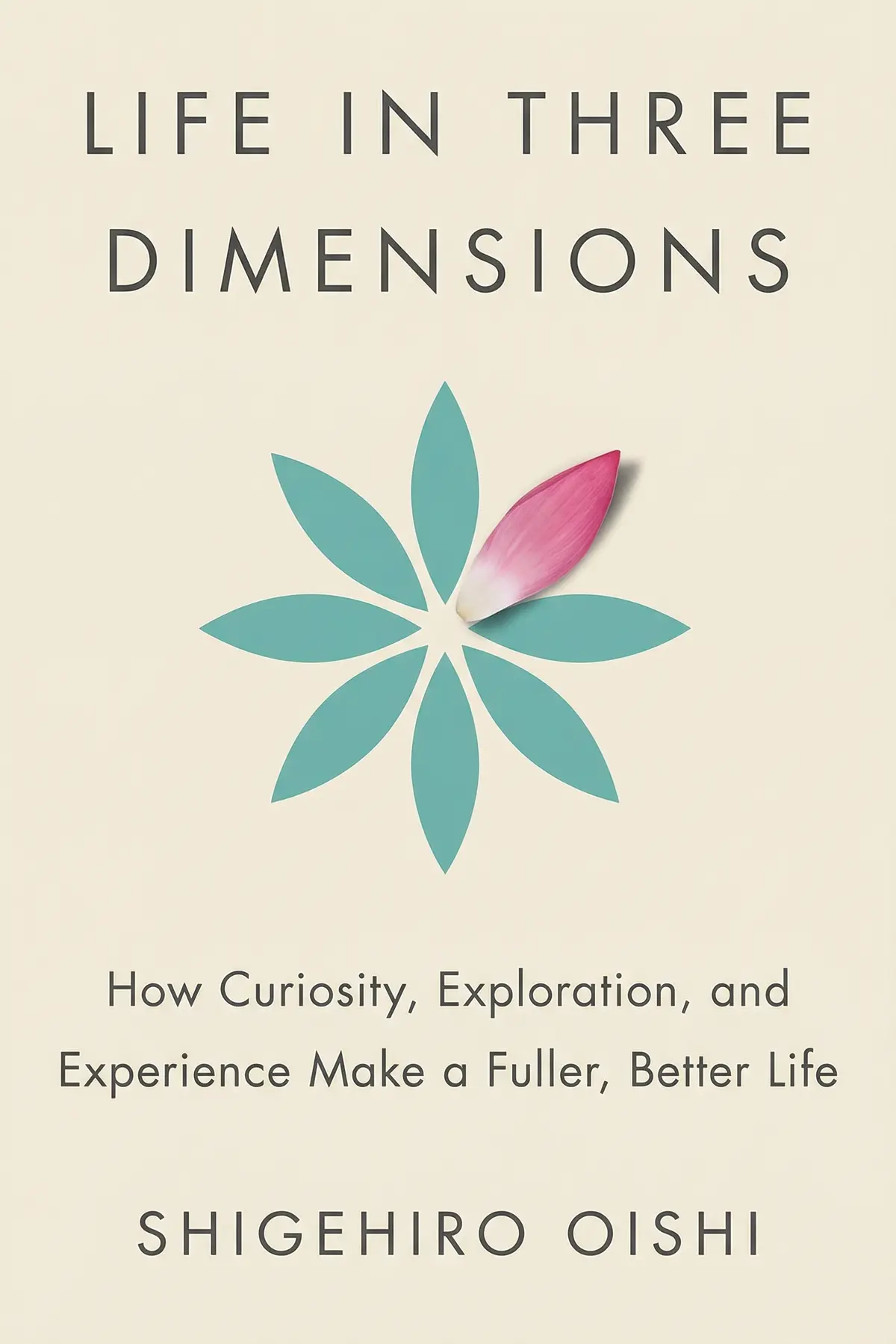
For generations, the quest for a good life was seen as a choice between two paths: chasing personal happiness or seeking a deeper sense of purpose. In Life in Three Dimensions, Shigehiro Oishi introduces a vital third element that has long been missing from the conversation: psychological richness. This dimension isn't about feeling good or being productive; it’s about the depth and variety of our experiences, ranging from the curiosity that leads us to explore new cultures to the resilience we develop through life’s inevitable challenges. This summary breaks down why the relentless pursuit of happiness can sometimes backfire and how a narrow focus on meaning can lead to unnecessary pressure. By understanding the roles of personality, openness, and even adversity, you will learn how to weave variety and perspective into your daily routine. The promise of this book is a more nuanced understanding of well-being—one that celebrates the complex, the unexpected, and the transformative moments that make a life truly worth living in all its dimensions.
Shigehiro Oishi is the Marshall Field IV Professor of Psychology at the University of Chicago, renowned for his research on happiness, meaning, and culture. His work delves into how cultural and ecological factors influence well-being, offering insights into the complexities of human satisfaction. He is also the author of The Psychological Wealth of Nations: Do Happy People Make a Happy Society?, examining the relationship between individual happiness and societal well-being.
Listeners find the notion of "psychological richness" to be a captivating and evocative broadening of conventional perspectives on joy and meaning. While some listeners feel the tempo can occasionally be redundant or drawn-out, they value the author's skill in merging scientific inquiry with approachable personal stories. Furthermore, they note the book’s power to spark internal reflection by analyzing how a commitment to curiosity and new experiences enriches one's life. Additionally, they remark on the narrative’s inherent kindness, with one listener highlighting that the parallel drawn between the author’s life and his father’s choices provides a uniquely deep examination of how people evolve over time.
Ever wonder why a life of stability and comfort doesn’t always feel like enough? This book provides the missing piece of the puzzle. Oishi’s comparison between his own adventurous path and his father’s more traditional life in Japan was deeply moving and helped me understand my own restless nature. I loved the idea that even failed ventures—like the author’s disastrous attempt to build a deck—add essential 'richness' to our personal stories. The writing is warm and inviting, making complex psychological theories accessible to anyone. It’s a liberating read that gave me permission to value my own curiosity and occasional missteps as much as my successes. I’ve already recommended this to three friends who are feeling stuck in their routines. Truly a life-changing perspective.
Show moreShigehiro Oishi has managed to articulate something I’ve felt for years but could never name, and for that alone, this book deserves five stars. The framework of three dimensions transforms how you look at your past; suddenly, the difficult times don't just look like 'unhappy' periods, but like 'rich' ones that added depth to your character. I was fascinated by the discussion on how even introverts can cultivate richness through small acts of curiosity. The prose is clear and the research feels rigorous without being inaccessible. This isn't just another self-help book; it's a serious philosophical inquiry into what it means to be human in a complex world. I came away feeling much more at peace with my own unconventional life path.
Show moreAs someone who moves cities every few years, this book felt like a validation of my entire existence and the 'less safe' road I've taken. Oishi’s writing is incredibly non-judgmental, presenting happiness, meaning, and richness as equally valid paths without forcing the reader into one. The cultural insights, particularly the differences between Western and Eastern views on achievement, were eye-opening and added a layer of depth I didn't expect. I found the book to be perfectly paced, blending personal narrative with scientific data in a way that kept me engaged from start to finish. It’s rare to find a book that is both intellectually rigorous and emotionally resonant. I’ll be thinking about the 'father and son' comparison for a long time to come. Essential reading for the curious soul.
Show moreAfter hearing so much about the 'happiness trap' in modern psychology, I found Oishi’s argument for a third dimension—psychological richness—to be incredibly refreshing. The book does a fantastic job of explaining why we shouldn't just chase pleasure or grand purpose, but also seek out variety and perspective-shifting experiences. I particularly enjoyed the section on the OCEAN personality model and how traits like openness influence our desire for a complex life. To be fair, the middle chapters lean a bit heavily into academic research, which slowed my momentum, but the personal anecdotes kept me grounded. The author’s own journey from Japan to America provides a touching, real-world contrast to the more data-driven sections. It’s a thoughtful read that made me reconsider my own life choices through a much wider lens.
Show morePicked this up because I’ve always felt like my life didn't fit neatly into the 'happy' or 'meaningful' boxes, and Oishi’s 'three dimensions' model finally gave me the vocabulary I needed. The distinction between the hedonic approach and the eudaimonic approach was well-explained, but the introduction of psychological richness is where the book shines. I found the analysis of how adversity and even sadness can contribute to a 'rich' life to be particularly profound and comforting. My only real gripe is that the book feels a bit uneven, occasionally swinging between deep philosophy and very dry statistics. Still, the insights regarding openness and extraversion were fascinating for someone like me who loves personality frameworks. It is a well-researched, thought-provoking addition to any self-reflection bookshelf.
Show moreThe deck-building anecdote really hit home for me because it perfectly illustrates how we can value a 'bad' experience for the richness it brings to our lives. Oishi manages to balance his role as a serious researcher with a very human, relatable voice. I found the exploration of how people high in 'Openness' seek out perspective-changing events to be particularly enlightening for my own self-growth. To be fair, there are sections where the academic jargon gets a bit thick, and the structure felt a little disjointed in the final third. But the overall message—that a life of color and depth is just as valid as a life of joy or purpose—is something I really needed to hear. It’s a refreshing take on the 'good life' genre.
Show moreThe core premise here is brilliant, but I struggled with the delivery at times. Oishi is clearly a brilliant researcher, and the idea that curiosity and novelty are as vital as happiness is a perspective I haven't seen explored this deeply before. However, the pacing dragged for me because the case studies began to feel quite repetitive by the halfway point. Frankly, I think this could have been about fifty pages shorter without losing any of the impact. I did appreciate the 'good vacation' thought experiment, which helped me realize why I often prefer adventurous trips over relaxing ones. It’s a solid book for fans of popular psychology, though you might find yourself skimming some of the more long-winded sections to get to the real nuggets of wisdom.
Show moreTruth is, I wanted to love this more than I actually did, though I still think it's worth a read for the central concept alone. The idea that a good life includes novelty and complexity is a great counter-narrative to the pressure of being 'happy' all the time. However, I found the writing style a bit too academic and dry for a leisure read. Some of the stories felt like they were there just to pad the page count rather than drive the point home. I was hoping for more concrete, actionable steps on how to cultivate this richness in a daily routine. While it’s intellectually stimulating, it didn’t quite hit the emotional notes I was expecting. It's a 3.5 for me, rounded down because the pacing was just too slow for my taste.
Show moreWait, so how do I actually *do* it? I loved the theory behind this book, but I left feeling like I didn't have a clear roadmap for change. Oishi does a great job of identifying the 'what' and the 'why' of psychological richness, but the 'how' felt a bit thin. He mentions things like taking risks or trying new foods, but it didn't feel as substantial as the research sections. Look, the information is definitely valuable and the distinction between happiness and richness is a total 'lightbulb' moment. It just lacked the practical application I usually look for in these kinds of non-fiction books. It’s an interesting intellectual exercise, but perhaps not the most helpful guide for someone looking to overhaul their life immediately.
Show moreFinally got around to reading this, but it felt like a long-winded academic paper stretched into a full-length book. I actually agree with the author's main point—that psychological richness is an ignored part of a good life—but the repetition was exhausting. He makes the same argument using slightly different case studies over and over again. Not gonna lie, I found my mind wandering during the more data-heavy chapters about cultural differences in happiness. There were a few bright spots, like the father-son narrative, but they were buried under mountains of repetitive research summaries. If you've read a summary of Oishi's work online, you've probably already gotten the best parts of this book. It just didn't hold my interest for the duration.
Show moreAnthony Pratkanis
William B. Irvine
Andrew D. Thompson
Deepak Chopra
AUDIO SUMMARY AVAILABLE
Get the key ideas from Life in Three Dimensions by Shigehiro Oishi, plus 5,000+ more titles in English and Thai.







