


18 min 18 sec
A Liberated Mind: How to Pivot Toward What Matters
A Liberated Mind introduces the concept of psychological flexibility, offering a path to overcome mental blocks by embracing difficult emotions and aligning your actions with what truly matters most for a fulfilling life.
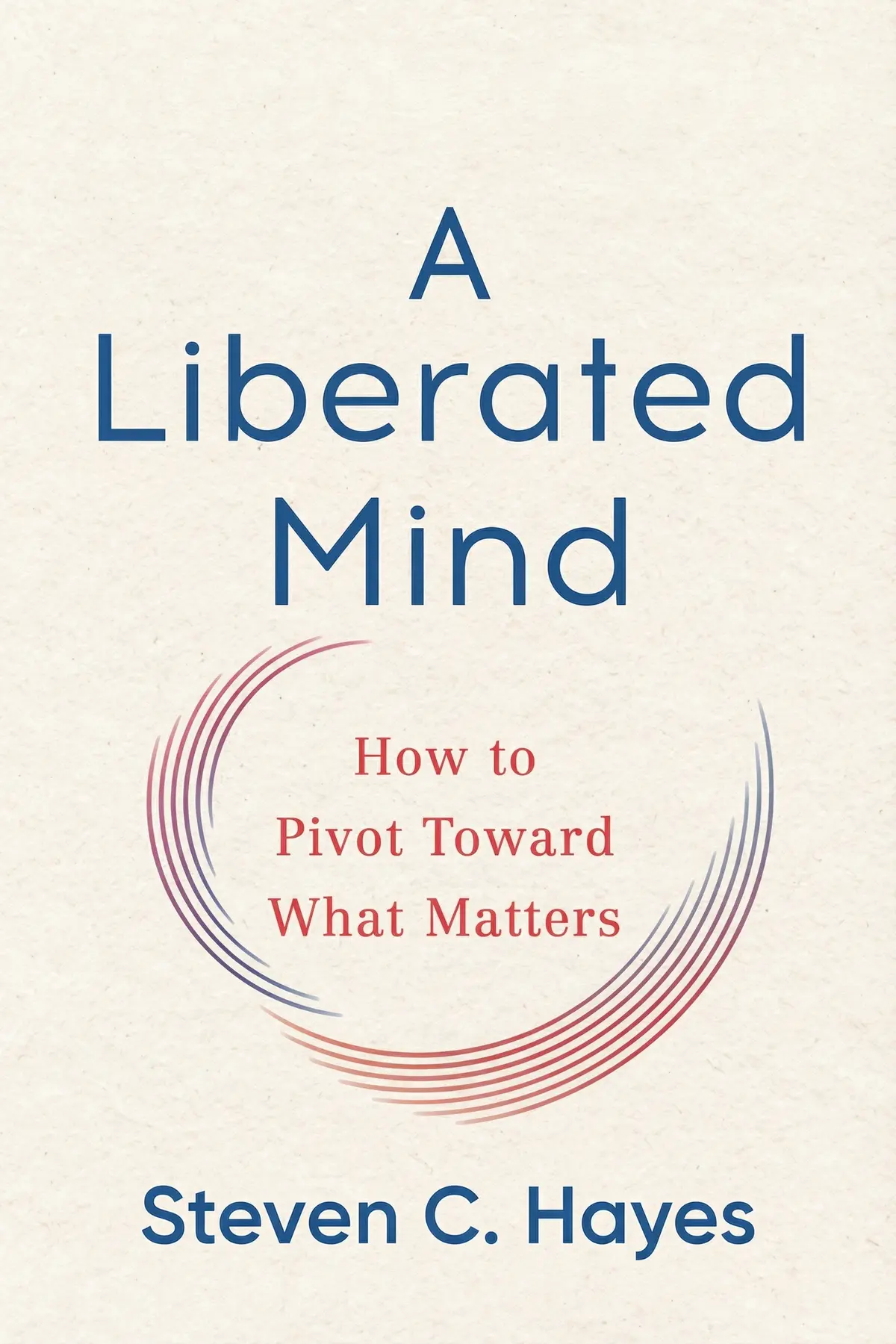
Table of Content
1. Introduction
1 min 38 sec
Have you ever felt like your own mind was an adversary? For many of us, the internal landscape is a battlefield where we are constantly trying to defeat anxiety, silence self-doubt, or ignore the echoes of past mistakes. We operate under the assumption that we cannot be happy or productive until these difficult internal experiences are finally conquered. We wait for the day when the clouds of negativity disappear so that we can finally step out into the sun. But according to the psychological research explored in this work, this very battle is what keeps us stuck. The harder we try to push away our pain, the more space it takes up in our lives.
There is a different way to live, one that doesn’t involve winning the war with your thoughts, but rather ending it altogether. This is the path of psychological flexibility. It is the ability to stay present, open up to your experiences, and do what matters, even when your mind is telling you to hide or run. It’s about shifting from a state of mental rigidity—where we are pushed around by our fears—to a state of liberation.
Throughout this exploration, we will look at how the principles of Acceptance and Commitment Therapy, known as ACT, can help you navigate life’s inevitable storms. You will learn how to change your relationship with your inner world so that your thoughts and feelings no longer have the power to dictate your choices. By the end, you’ll see that a fulfilling life isn’t one that is free from pain, but one where pain is no longer an obstacle to purpose. Let’s begin the journey toward a more flexible and liberated way of being.
2. Stepping Back from the Mental Stream
2 min 21 sec
Discover why treating your thoughts as absolute truths can leave you stuck and how a simple shift in perspective can help you untangle from the inner dictator.
3. Finding the Steady Ground of Awareness
2 min 30 sec
Learn to distinguish between the ever-changing stories you tell about yourself and the stable, observing presence that remains constant through every life event.
4. Opening the Door to Difficult Experiences
2 min 30 sec
Explore why the fight against pain is often more damaging than the pain itself and how willingness can transform your relationship with suffering.
5. Returning to the Living Present
2 min 25 sec
See how our minds act as time machines that pull us away from our lives and how to ground yourself in the only moment where action is possible.
6. Choosing Your True North
2 min 14 sec
Understand the vital difference between achieving goals and living your values, and how to identify the principles that give your life lasting meaning.
7. Moving with Purpose and Persistence
2 min 27 sec
Learn how to turn your values into tangible actions and why the secret to a liberated life lies in your willingness to keep moving despite your doubts.
8. Conclusion
2 min 13 sec
As we come to the end of this journey, it’s worth reflecting on what it truly means to have a liberated mind. Liberation isn’t the absence of difficult thoughts or painful emotions. It isn’t a state of perpetual calm or the achievement of every goal you’ve ever set. Instead, liberation is a change in the relationship you have with yourself. It is the realization that you are not your thoughts, you are not your pain, and you are not the limited story your mind tells about you. You are the vast, open awareness that can hold all of those things and still move in the direction of your choosing.
The throughline of these six processes—defusion, self-as-context, acceptance, presence, values, and committed action—is the development of psychological flexibility. This flexibility is what allows you to stop fighting against yourself and start fighting for the life you want. It gives you the power to pivot. When you feel the familiar pull of anxiety or the heavy weight of self-doubt, you no longer have to be paralyzed. You can notice the thought, make room for the feeling, ground yourself in the present, and ask: What does the person I want to be do right now?
The tools you’ve explored here are not a one-time fix, but a way of living. Every day presents new opportunities to practice. Every challenge is a chance to strengthen your flexibility muscles. Start small. Choose one value to focus on this week. Notice one recurring thought that usually hooks you and try to view it as just a passing cloud. Take one tiny action that moves you closer to your true north.
Life is often unpredictable and sometimes incredibly hard. We cannot control the weather that passes through our internal or external worlds. But we can control how we relate to that weather. We can choose to be the sky. We can choose to move with purpose. By embracing these principles, you step out of the mental prison of avoidance and into a world of possibility, where your pain can become your teacher and your actions can become a testament to what you love. That is the promise of a liberated mind, and it is a path that is open to you starting right now, in this very moment.
About this book
What is this book about?
The central premise of this work focuses on the revolutionary concept of psychological flexibility. Most of us spend our lives trying to outrun or outfight our negative thoughts and painful emotions, believing that we must eliminate them before we can truly start living. However, these attempts at suppression usually result in more suffering, keeping us trapped in a cycle of anxiety and avoidance. This guide explains how to break free from these mental traps using the principles of Acceptance and Commitment Therapy, or ACT. It offers a blueprint for shifting from a rigid, defensive posture to an open, curious, and engaged way of being. By mastering six core mental processes—ranging from cognitive defusion to committed action—you will learn how to turn toward your pain rather than away from it. This pivot allows you to stop the struggle with your internal world and redirect that energy toward building a life of purpose, meaning, and vitality. It is a promise of liberation from the dictatorship of the mind, providing the tools needed to thrive even in the presence of life’s inevitable challenges.
Book Information
About the Author
Steven C. Hayes
Steven C. Hayes, Ph.D., is a foundation professor of psychology at the University of Nevada, Reno, and the founder of Acceptance and Commitment Therapy (ACT), a widely studied and empirically validated form of psychotherapy. Beyond his research, he has over 600 scientific publications and 46 books to his name and his work has been cited in scientific literature over 100,000 times.
Ratings & Reviews
Ratings at a glance
What people think
Listeners find this work to be thoroughly evidence-based yet written for the average person, creating a truly engaging experience. They value the seamless integration of psychological concepts and real-world applications, with one listener describing how it completely reshaped their work as a psychotherapist. Listeners appreciate the book’s kindhearted perspective and its power to foster greater bravery in daily life, while one noted it specifically helped their professional rapport with supervisees.
Top reviews
Vipawan
This book changed everything for me. Truth is, I’ve spent years fighting my "Dictator Within," trying to argue away every negative thought with logic, but Hayes shows why that struggle is exactly what keeps us stuck. The six pivots—especially defusion and values—provide a roadmap that feels both scientifically grounded and deeply compassionate. While the writing can get a bit dense when he dives into the clinical research, the payoff for sticking with it is immense. I found myself highlighting entire sections on psychological flexibility because they finally explained why my previous attempts at "positive thinking" failed so miserably. It’s not about feeling good; it’s about feeling well and moving toward what matters. If you’re willing to do the work, this is a life-changer.
Show moreAdam
Ever wonder why your brain is so obsessed with solving problems that aren’t actually solvable? Steven Hayes explains that our analytical minds are great for the outside world but a disaster when applied to our internal feelings. Personally, I found the "Dictator Within" metaphor to be the most helpful part of the book because it perfectly captures that bossy, judgmental voice we all have. The writing style is definitely more academic than your average bookstore find, but the compassion in his words shines through the data. It’s clear he cares deeply about helping people move from a state of "flight" to a state of "presence." This book didn't just give me tools; it gave me permission to be messy and human while still pursuing my values.
Show moreNatalie
Finally got around to reading this and I’m kicking myself for waiting so long. In my experience, most books on mindfulness miss the "action" part of the equation, but Hayes nails it with the six pivots. He shows that acceptance isn't just about sitting still; it's about making room for the hard stuff so you can get back to doing what you love. The section on "Values" was particularly eye-opening for me, as it helped me distinguish between goals (which you can check off) and values (which are a direction you travel). Yes, it’s a long book, and yes, Steve is clearly very proud of his work, but when the work is this effective, I think he’s earned the right to brag a little. Truly a masterclass in psychological health.
Show moreSomsak
Wow. Honestly, I didn't expect a book written by a clinical psychologist to be this moving. Steven Hayes shares his own personal journey with panic attacks in a way that is so vulnerable it immediately builds a bridge to the reader. It’s one thing to read about "Acceptance" as a concept, but hearing how it saved the author’s own life makes it feel real. The book is definitely a "slow burn" because there is so much information to digest on every single page. You can’t just skim this one; you have to live with it for a while. It’s a powerful reminder that our pain isn't an enemy to be defeated, but a teacher that shows us what we actually care about.
Show moreBrahim
After hearing Hayes on a few podcasts, I expected a lot of high-level theory, but I was surprised by how many practical exercises are packed into these chapters. Strictly speaking, it’s probably the most comprehensive guide to ACT available for a general audience. I loved the "unplug the drain" metaphor for stress—it completely changed how I handle my workweek. The truth is, we spend so much energy trying to shut off the "taps" of stress that we forget we have the power to just let it flow through us. Some of the chapters felt a little long-winded, and the self-promotion of the ACT model was a bit heavy-handed at times, but the core message is too important to ignore. Five stars for the content, even if the editing could have been tighter.
Show moreKofi
Steven Hayes has managed to write something that feels both like a warm embrace and a rigorous scientific paper. Truthfully, the balance he strikes between empathy and evidence is what makes "A Liberated Mind" stand out in a crowded field. He doesn't offer easy answers or "hacks," but instead provides a sophisticated framework for building a life that actually matters. I appreciated his receptiveness to how these principles overlap with spiritual traditions, making the book feel much more holistic than a standard CBT workbook. It’s a demanding read that asks you to look directly at your pain, but the sense of freedom it offers on the other side is worth every minute of effort. This is essential reading for the modern age.
Show moreAim
Picked this up after finishing The Happiness Trap by Russ Harris, and it was the perfect "next step" for deepening my understanding of ACT. Gotta say, Hayes definitely loves his research data, and at times the academic tone can be a little dry compared to Harris’s more accessible style. However, hearing the concepts from the founder himself adds a layer of authority that I really appreciated. The way he discusses turning toward pain with curiosity instead of running from it is a perspective shift I desperately needed. It’s a thick read, and you might want to keep a notebook handy for the exercises, but the insights into human suffering are profound. This isn't just a self-help book; it’s a manual for being human in a world that’s increasingly hard to navigate.
Show moreA
As a psychotherapist, I’ve seen my fair share of clinical manuals, but this book bridges the gap between theory and practice beautifully. Look, it’s a big commitment—Hayes doesn't shy away from the technical aspects of Relational Frame Theory—but the way he applies it to relationships and performance is genius. I’ve already started using the perspective-taking exercises with my supervisees, and the results have been remarkable. Some might find his writing a bit "sandpaper-y" because of the sheer volume of research citations, yet that’s exactly what makes the advice so trustworthy. It’s not just "woo-woo" mindfulness; it’s a data-driven approach to psychological flexibility. This belongs on the shelf of every clinician and anyone else who wants to understand the mechanics of the human soul.
Show moreSau
The chapter on Defusion alone makes the entire purchase worth it, even if some of the later sections feel a bit like a sales pitch for ACT's superiority. Frankly, Hayes can be a bit repetitive with the "this is better than CBT" narrative, which started to grate on me after the third or fourth time he mentioned it. But look past the self-promotion and you’ll find some of the most practical advice for anxiety I’ve ever encountered. He breaks down how our minds use "coherence" to keep us trapped in old stories, and how to step back and just notice those stories without letting them drive the car. It’s dense, yes, but the science is rock-solid and the practical exercises are actually transformative if you actually do them. A solid middle-of-the-road read for those who can handle a bit of academic ego.
Show moreGai
I'll be blunt: this book was a struggle to get through. Not gonna lie, the author’s writing style feels like he’s being paid by the word, and the endless descriptions of academic studies made my eyes glaze over more than once. I really wanted to love this because I’ve heard so much about ACT, but the "sandpaper" quality of the prose kept me from really connecting with the message. It felt like a textbook masquerading as a trade book. If you’re a hard-core science nerd, you’ll probably love the deep dives into clinical data. But for the average reader just looking for some relief from anxiety, it might feel a bit like trying to learn to swim by reading a 400-page manual on fluid dynamics. It’s just too dense.
Show moreReaders also enjoyed
Alcoholics Anonymous
Alcoholics Anonymous World Services
59 Seconds: Change Your Life in Under a Minute
Richard Wiseman
AUDIO SUMMARY AVAILABLE
Listen to A Liberated Mind in 15 minutes
Get the key ideas from A Liberated Mind by Steven C. Hayes, plus 5,000+ more titles in English and Thai.
- 5,000+ titles
- Listen as much as you want
- 7-day free trial
- Cancel anytime







