
1929: Inside the Greatest Crash in Wall Street History--and How It
Andrew Ross Sorkin
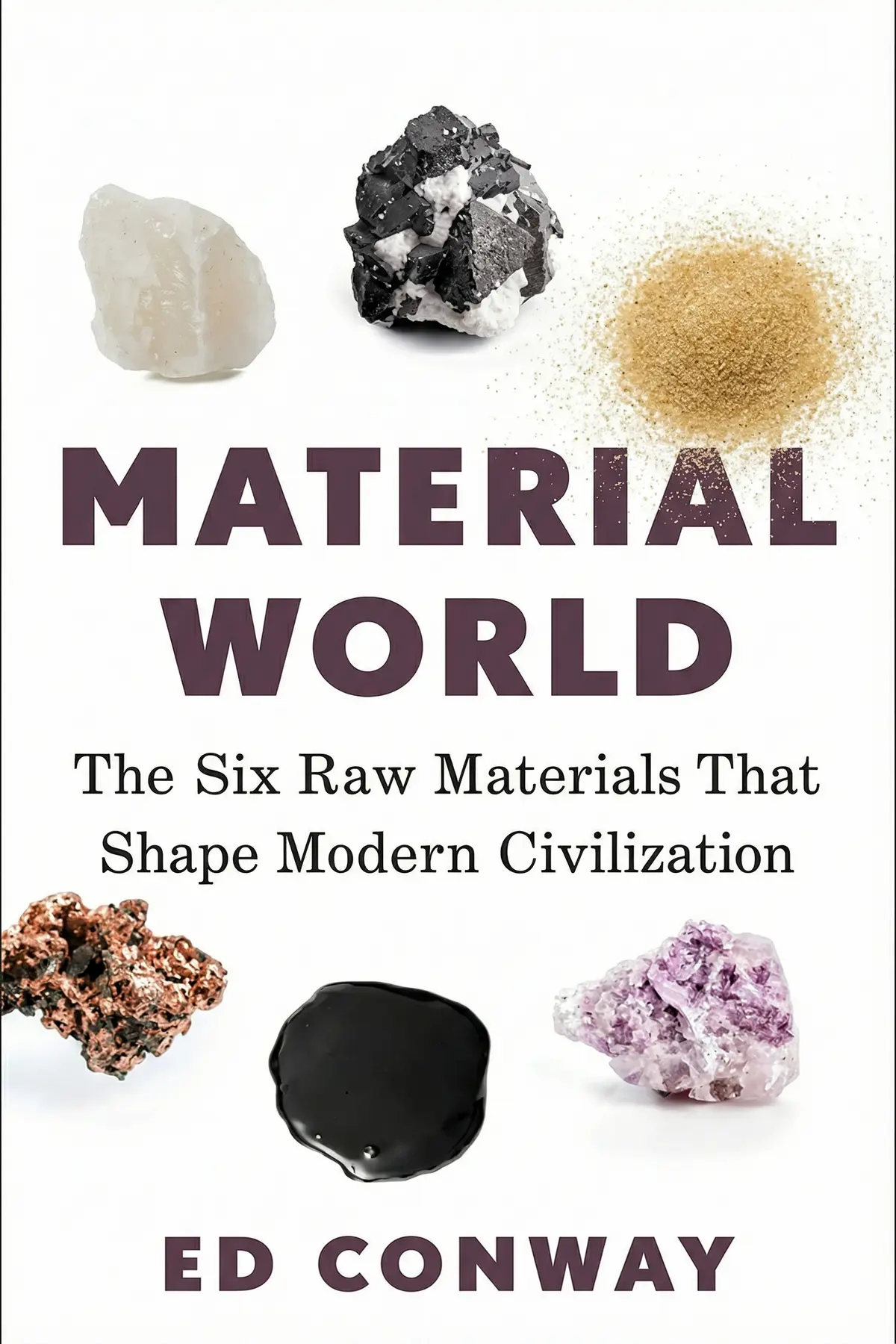
Material World investigates the essential raw substances—sand, salt, iron, copper, oil, and lithium—that form the backbone of modern civilization, revealing the hidden physical processes that drive our global economy and technological future.
1 min 44 sec
When you look around your room right now, what do you see? Perhaps there is a smartphone resting on a wooden table, or the glow of a television reflecting off a glass window. We tend to see these things as complete, singular objects—products of a digital age that feels increasingly abstract and detached from the physical earth. We talk about the ‘cloud’ as if our data exists in a weightless ether, and we treat our gadgets as if they appeared out of thin air. But the reality is far more grounded, far more ancient, and far more gritty. Every single piece of technology we rely on, from the simplest brick to the most complex microchip, is the result of a long, often violent process of extracting and refining the earth’s raw materials.
In the following pages, we are going to explore the remarkable biography of our civilization through the lens of six foundational materials: sand, salt, iron, copper, crude oil, and lithium. These aren’t just commodities traded on a stock exchange; they are the literal building blocks of human progress. They have the power to build empires, to feed billions, and to facilitate the next great leap in our evolution. However, they also carry a heavy price, one that involves environmental disruption and geopolitical tension. By understanding where these materials come from and how we transform them, we can begin to see the hidden machinery of the world. This is a journey through time and chemistry, revealing that our high-tech future is still very much a material one. Let’s dive into the fascinating story of the substances that make the modern world possible, starting with the most abundant yet overlooked foundation of all.
2 min 40 sec
Explore how the humble grains of sand from our beaches and riverbeds have been transformed into the silicon brains of the digital revolution.
2 min 31 sec
Discover the dual nature of a simple mineral that has simultaneously fueled the growth of the global population and the lethality of modern warfare.
2 min 44 sec
Trace the journey of iron from the heat of ancient forges to its role as the indestructible skeleton of our cities and machines.
2 min 29 sec
Understand how copper’s unique ability to conduct electricity made it the essential link between human ingenuity and the electrified world.
2 min 32 sec
Examine the liquid energy that built the global economy and the pharmaceutical industry, while leading us into an era of climate uncertainty.
2 min 39 sec
Take a journey to the salt flats of Chile to see how one of the oldest elements in the universe is powering the next generation of technology.
2 min 07 sec
The stories of these six materials—sand, saltpeter, iron, copper, crude oil, and lithium—reveal a profound truth about our existence: we are, and will always be, material beings. We have built a world that feels increasingly virtual, but that virtuality is supported by millions of tons of rock, metal, and liquid extracted from the earth. Every click of a button and every mile driven is an interaction with a vast, global network of physical matter that has its roots in deep geological time.
As we have seen, the history of human progress is the history of our mastery over these substances. They have allowed us to feed a global population, to build monumental cities, and to communicate across continents in an instant. But this mastery has come with a price that can no longer be ignored. The environmental and geopolitical costs of our material world are mounting, and we are now faced with the urgent task of finding a more sustainable way to live with the resources we have. We cannot simply abandon the materials that made us, but we can change how we use them. This means investing in circular economies, finding more efficient ways to refine and recycle, and being honest about the true cost of our technological lifestyle.
The throughline of our exploration is one of interconnectedness. A chip made of sand is powered by electricity carried through copper, stored in a battery made of lithium, and housed in a plastic case derived from oil. Our world is not a collection of separate technologies, but a single, integrated material system. Moving forward, the most important skill we can develop is an appreciation for this complexity. By understanding the material foundations of our lives, we can make better choices as consumers, as citizens, and as stewards of the planet. The future will be built with the same elements that shaped our past, but it is up to us to ensure that this next chapter is one of balance rather than exhaustion. The material world is a gift from the earth; our responsibility is to use it wisely.
Most of us view our modern world through the lens of digital interfaces and finished products, rarely pausing to consider the physical matter that makes these conveniences possible. This exploration pulls back the curtain on the fundamental materials that have shaped human history and continue to dictate our future. By focusing on six key substances—sand, salt, iron, copper, crude oil, and lithium—the narrative traces their journey from the earth’s crust to the heart of our most advanced technologies. The book promises to change the way you look at the mundane objects around you. It moves from the ancient origins of these materials to the high-stakes world of global geopolitics and industrial innovation. You will learn how sand became the brain of our computers, how salt transformed both warfare and agriculture, and how the quest for lithium is sparking a new kind of resource gold rush. Ultimately, it offers a profound meditation on our dependence on the physical world and the urgent need to balance industrial progress with environmental stewardship.
Ed Conway is a distinguished writer and broadcaster known for his deep dives into economic trends and data. He currently holds the position of economics and data editor at Sky News and shares his insights through regular columns in the Times and the Sunday Times. His expertise in complex global systems is further demonstrated in his acclaimed work, The Summit, which explores the historical significance of the Bretton Woods conference and the reshaping of the international economy.
Listeners find this work to be both thorough and well-researched, with one listener pointing out the surprising details provided about essential industries. The prose is expertly written, and listeners often describe the book as a captivating read driven by immersive storytelling. Additionally, listeners value the text’s clarity, with one listener praising its approachable vocabulary, and find the content enlightening, with one listener calling it an incredible story of the modern world. The substance is highly regarded, as one listener mentions how it successfully contextualizes material demand in modern society.
Ed Conway has managed to turn the seemingly mundane history of dirt and grease into a gripping geopolitical thriller. Before reading this, I never gave a second thought to the ultrapure quartz required for our fiber optics or the terrifyingly concentrated supply chains for high-end silicon. The book brilliantly deconstructs our 'ethereal' digital existence by showing the massive, violent physical toil required to sustain it. Frankly, the scale of the machinery he describes—like the colossal mines in Nevada—is almost impossible to wrap one's head around without his vivid prose. While the level of detail is occasionally overwhelming, it serves to hammer home just how vulnerable our modern comforts truly are. It’s an eye-opening journey through the six substances that define our era. This is essential reading for anyone who wants to understand the physical reality of the 21st century.
Show morePicked this up on a whim and I’m reeling from how much I didn’t know about basic chemistry and trade. The chapter on salt alone—specifically how a single site in Runcorn keeps the UK’s water supply from collapsing—is worth the price of admission. Conway has a knack for taking these 'boring' commodities and showing how they are the literal bedrock of civilization. It’s not just a history book; it’s a warning about our fragile supply webs and the environmental cost of our 'green' transition. The way he connects 19th-century breakthroughs to modern-day chip manufacturing is seamless and deeply engaging. It's a rare book that makes you look at a glass of water or a concrete wall differently. Absolutely stellar reporting.
Show moreAs a history buff, I was captivated by the way this book links ancient salt taxes to modern-day autocratic control. We like to think we’ve evolved past these primitive dependencies, but Conway proves we are more reliant on the 'Material World' than ever before. The discussion on how the US is aggressively restricting China’s access to high-end silicon was particularly timely and well-explained. It’s a comprehensive look at how minerals dictate the rise and fall of empires. The writing is accessible without being patronizing, which is a difficult balance to strike with such technical subject matter. If you want to understand the real forces shaping 21st-century conflict, read this book. It’s as much about power as it is about molecules.
Show moreThe chapter on copper really hit home for me because it highlights the massive gap between our environmental goals and our physical capabilities. We are planning a massive energy transition that requires tearing up the earth on a scale we’ve never seen before. Conway’s reporting from the deep mines of Chile and the oil fields of Saudi Arabia provides a gritty, necessary perspective that is usually missing from policy debates. I appreciated his journalistic approach—he’s not preaching, he’s just showing us the receipts. The storytelling is top-notch, especially when he recounts the WWII-era trade of glass between enemies. It’s a fascinating, sobering, and ultimately brilliant piece of non-fiction that everyone should read.
Show moreFew books actually change the way you perceive your surroundings, but this one managed it by the second chapter. I found myself staring at the bricks in my house and the salt on my table, thinking about the thousands of miles and massive amounts of energy required to put them there. Conway’s thesis about the 'ethereal' vs. the 'material' world is a perfect framework for understanding why our current supply chain issues feel so chaotic. He explains complex ideas like the fracking revolution and the nuances of high-grade silica with incredible clarity. It’s well-researched, deeply thoughtful, and surprisingly moving for a book about industrial resources. This is essential reading for anyone curious about how the world actually functions behind the scenes.
Show moreTo be fair, I usually find books about industrial processes a bit dry, but Conway's enthusiasm is infectious. He turns the history of lithium and oil into a narrative that feels as urgent as a breaking news report. The way he traces our reliance on fossil fuels—not just for energy, but for the very fertilizers that feed billions—is a stark reminder of our vulnerability. He avoids the typical doom-and-gloom approach, opting instead for a pragmatic look at human ingenuity and its unintended consequences. It’s an incredible story of the modern world that manages to be both informative and genuinely entertaining. I’ve already recommended this to three different people this week; it's just that good.
Show moreEver wonder why your smartphone actually exists? Conway takes us on a deep dive into the physical reality of sand, salt, and lithium, proving that we are still very much tied to the earth despite our cloud-based lives. I found the sections on the 'sand mafias' and the extreme secrecy surrounding companies like Sibelco particularly fascinating. The truth is, we’ve become dangerously detached from the industrial processes that keep us fed and connected. My only gripe is that the author sometimes gets lost in the weeds of his own travelogues, which can make the pacing feel a bit uneven in the middle sections. Still, it’s a masterclass in making complex economic data feel human and urgent. It bridges the gap between material science and global politics perfectly.
Show moreNot what I expected at all, but in the best way possible. I went in looking for a science book and came out with a much better grasp of global economics and the sheer difficulty of reaching 'net zero.' Conway doesn’t shy away from the messy reality that electric vehicles require a staggering amount of copper and lithium, often mined in ecologically sensitive areas. He challenges the easy narrative that we can simply 'innovate' our way out of physical limits without making hard choices. Look, it’s a dense read and some chapters definitely flow better than others, but the overarching message is essential. We are living in a house of cards built on materials most of us can't even identify. It's eye-opening, even if it's a bit dry in the middle.
Show moreFinally got around to reading this and I’m mostly impressed, though the sheer volume of data can be exhausting. I loved the "cloak-and-dagger" stories about silicon manufacturing and the extreme security measures used to protect trade secrets. It’s wild to think that our entire digital economy rests on a handful of obscure factories and mines. My only minor complaint is the lack of visual aids; with Conway’s background in data journalism, a few more charts would have been a great addition to the text. However, his prose is descriptive enough that you can almost feel the heat of the blast furnaces. A very solid four-star read that will definitely spark some long dinner table conversations about where our stuff comes from.
Show moreWhile the research is undeniable, I found myself struggling with the author’s tendency to wander off on lengthy tangents. The book starts strong at a gold mine in Nevada, but it frequently loses momentum when Conway describes every single flight and security gate he encounters. It felt a bit like a TV script that hadn't been fully converted into a tight narrative, which made the 500 pages feel much longer than necessary. To be fair, the information regarding the Haber-Bosch process and our dependence on salt for water purification is genuinely vital stuff. I just wish the editing had been sharper to keep the focus on the materials themselves rather than the author's travel itinerary. It's a bit of a slog, even if the 'factbites' are interesting.
Show moreAndrew Ross Sorkin
Ha-Joon Chang
Niall Kishtainy
William J. Bernstein

Yanis Varoufakis
AUDIO SUMMARY AVAILABLE
Get the key ideas from Material World by Ed Conway, plus 5,000+ more titles in English and Thai.







