
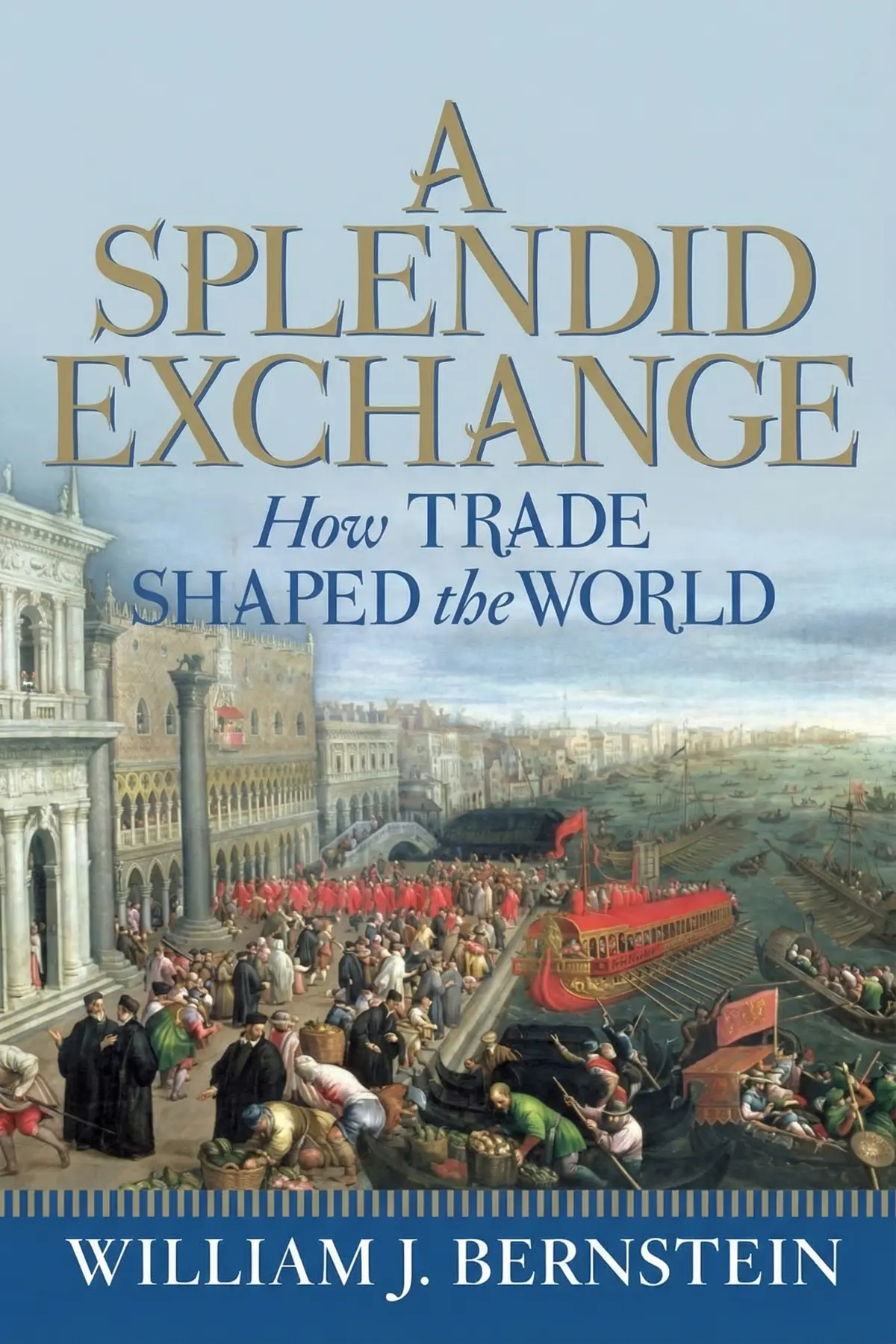
A Splendid Exchange: How Trade Shaped the World
William J. Bernstein
Economist Nouriel Roubini identifies ten interconnected global dangers, ranging from debt crises to climate collapse, that threaten to destabilize modern civilization unless we fundamentally rethink our economic and political systems.
1 min 48 sec
We often think of risk as a personal choice—something we manage when we decide to start a new business, invest our savings, or even just drive a car. But what if the risks we face are no longer just personal or local? What if we are living in an era defined by massive, overlapping dangers that threaten the very foundation of our global society? This is the central premise explored by economist Nouriel Roubini. He suggests that we have entered a period of ‘MegaThreats,’ where traditional problems like inflation and debt are merging with newer challenges like climate change and the rise of artificial intelligence to create a perfect storm of instability.
Roubini, often referred to as ‘Doctor Doom’ for his sobering but frequently accurate economic forecasts, argues that our current way of life is more fragile than we realize. We have spent decades ignoring the warning signs, preferring short-term gains over long-term stability. Now, those neglected issues are coming to a head all at once. The goal of this summary is to walk through these interconnected dangers, not to incite panic, but to foster a clear-eyed understanding of the world as it actually is.
By the end of our journey, you will see how a debt crisis in one corner of the world can trigger a social collapse in another, and how technological progress might be a double-edged sword. More importantly, we’ll look at why recognizing these patterns is the first step toward surviving them. It’s a call to shift our perspective from passive observers to active participants in shaping a more resilient future. The path ahead is undoubtedly difficult, but by identifying the throughline of these threats, we can begin to imagine the mega-solutions required to meet them.
2 min 28 sec
The world is currently suffocating under a massive mountain of debt that far exceeds historical precedents, creating a precarious economic environment where growth is stalling and inflation is rising.
2 min 27 sec
Technological advancement is accelerating at a rate that threatens to displace millions of workers, potentially leading to unprecedented levels of social inequality and economic disruption.
2 min 31 sec
The environmental crisis is doing more than just warming the planet; it is reshaping global migration patterns and creating the perfect breeding ground for future pandemics.
2 min 25 sec
A demographic shift toward older populations is placing an unsustainable strain on national budgets, threatening the future of pensions and healthcare systems worldwide.
2 min 24 sec
Central banks, once the stabilizing force of the economy, are now struggling with outdated tools and a global shift that threatens the dominance of the US dollar.
1 min 33 sec
As we have seen, the challenges facing our modern world are not isolated incidents but a web of MegaThreats that are deeply intertwined. From the crushing burden of debt and the displacement of workers by AI to the biological and social fallout of climate change, the common denominator is a system that prioritizes short-term fixes over long-term resilience. Nouriel Roubini reminds us that while we have achieved incredible things in the past—eradicating diseases and reaching the stars—our current trajectory is unsustainable.
The reality is that there is no single ‘magic bullet’ that will solve these problems. Instead, we need a fundamental shift in how we perceive risk and how we cooperate as a global society. We are currently making decisions based on biased, incomplete information and a desire to maintain a status quo that is already crumbling. To survive and thrive in the coming decades, we must demand mega-solutions: systemic reforms in our financial institutions, radical innovation in our energy sectors, and a new social contract that accounts for the technological and demographic shifts of the 21st century. The window for action is still open, but it is closing fast. By acknowledging these threats now, we give ourselves the best possible chance to build a future that is not just more stable, but more equitable for everyone. It’s time to stop looking at the horizon for help and start doing the hard work of reform today.
The world is currently facing a convergence of crises that are more than just temporary hurdles; they are systemic threats to our collective future. In this analysis, the focus is on ten massive trends that are no longer just distant possibilities but active forces shaping our reality. From the crushing weight of global debt and the displacement of workers by artificial intelligence to the existential risks of climate change and shifting demographics, these forces are interconnected, meaning one crisis often fuels the next. The promise of this exploration is not just to paint a picture of gloom, but to provide a necessary wake-up call. By understanding the mechanisms behind these 'MegaThreats,' readers can begin to see the patterns that lead to boom-and-bust cycles and social instability. The book offers a framework for navigating an increasingly volatile world, suggesting that while the dangers are immense, they also provide a rare opportunity for radical innovation and global cooperation if we choose to act before the window of opportunity closes.
Nouriel Roubini is a distinguished economist who gained international prominence for his accurate prediction of the 2007-2009 Global Financial Crisis well before it occurred. His expertise in international macroeconomics has made him a sought-after voice in global finance. In addition to his academic and consultative work, he is the author of the influential book Crisis Economics: A Crash Course in the Future of Finance and has contributed numerous scholarly papers on the complexities of the global economy.
Listeners believe the book is a valuable read and appreciate its quality of advice, with one listener noting it rapidly helps in understanding current threats. The educational aspect gets mixed feedback; some praise the economic analysis, while others find it overwhelming. The impact of political bias and the tempo also draw varied reactions, with one listener labeling the book as fearmongering.
Roubini earned his nickname for a reason, and this book proves he isn’t slowing down anytime soon. I found the sections on the debt supercycle particularly chilling because they connect global policy to our daily credit card struggles. While some call it pessimistic, I see it as a necessary wake-up call for anyone ignoring the news. The way he links climate change to zoonotic diseases shows a depth of research that goes beyond simple economic charts. It is a dense read, sure, but the stakes are literally the survival of our civilization. If you want to understand why the world feels so fragile right now, this is the blueprint. His analysis of the 2008 crisis remains unmatched, and he applies that same rigor here to the upcoming threats. We are ignoring these overlapping risks at our own peril.
Show moreFinally got around to reading this, and it blows Ray Dalio’s recent work out of the water. Roubini gets so much right about the deteriorating relations between the US and China, especially concerning the tech sector and trade wars. He isn't afraid to tackle touchy subjects with a refreshingly honest and open tone that makes complex geopolitics accessible. The dual scenarios at the end—optimistic vs. pessimistic—really make you think about the choices we are making today. It is an essential read for anyone trying to navigate the financial landscape of the next decade. The insights into how the West is addicted to debt are particularly piercing. I highly recommend this to anyone who wants to better understand the systemic risks we face. It’s an amazing, well-written book.
Show moreWow, this was a powerful and disturbing read that perfectly captures the "permacrisis" we seem to be living in. Roubini masterfully connects the dots between private debt, technological disruption, and the rising cost of social programs for retirees. Unlike other economists who stay in their silos, he bridges the gap between finance, ecology, and international relations. I especially liked the section on how AI might lead to universal basic income or total inequality, depending on our choices. It’s a wake-up call that demands we stop thinking in the short-term and start planning for a bumpy ride. The book accurately predicts the strain on China-USA relations we are seeing right now. It is a must-read for global citizens who want to see the bigger picture clearly.
Show moreEver wonder why everything seems to be falling apart at once? This book provides a cohesive framework for understanding how debt, aging populations, and AI are all colliding to create a perfect storm. I appreciate that Roubini doesn't sugarcoat the reality of our current economic trajectory or the failings of central banks. To be fair, some of the chapters on geopolitics feel a bit rushed, especially regarding the South China Sea. However, the analysis of how "cheap money" has fueled a boom-and-bust cycle is incredibly sharp. It’s a sobering look at the challenges our generation must face if we want to avoid a total collapse. The connection between environmental decline and pandemic risk was particularly eye-opening for me. It is a solid, well-researched piece of economic writing.
Show moreAfter hearing Roubini on a few podcasts, I decided to dive into his full argument, and it’s a heavy one. He breaks down the ten most pressing dangers with a focus on how they are interconnected, which is a perspective often missing from mainstream media. I was particularly impressed by the discussion on how aging demographics will inevitably strain government budgets and underfunded pensions. The book is definitely leaning toward the "Doctor Doom" side of things, but the logic behind the debt crisis is hard to ignore. My only gripe is that the writing can be a bit dry in the technical sections. Despite the somber tone, it provides an essential perspective on foreign policy and the shifting global order. It’s a worthwhile investment for those wanting to look beyond the headlines.
Show moreAs someone who works in finance, I found the critique of central bank reform to be the most compelling part of this book. Roubini explains how quantitative easing has essentially trapped us in a cycle where we keep making the same fiscal mistakes. He argues convincingly that the status quo is no longer working and that major technological and policy shifts are required. The writing is a bit "wordy" in spots, and his ego occasionally peeks through, but the core arguments are incredibly well-researched. It provides a level of detail that helps you quickly understand the threats facing our global markets today. Even if you disagree with his Malthusian leanings, the data on pension liabilities is impossible to ignore. It’s a very strong addition to current economic literature.
Show morePicked this up because of the buzz, but the pacing is a bit of a slog. The topic of global threats is obviously interesting, yet the prose often meanders and repeats the same points several times over. I found myself skimming through the middle sections where he lists example after example without adding much new framing or insight. Look, there is some utility here if you need a basic grounding in things like stagflation or the risks of automation. But for a regular news reader, it feels like a lot of wordy platitudes that don't quite deliver on the "mega" promise. The author clearly has a chip on his shoulder regarding his status as a forecaster. It’s a decent summary, but definitely not the academic powerhouse I was hoping for.
Show moreThis book feels like it was written in a rush just to capitalize on the current global anxiety. While the economic analysis of the COVID-19 aftermath is solid, other parts feel like fearmongering for the sake of it. The truth is that many of these "settled" topics are actually still under heavy debate among experts. I found the chapter on AI to be a bit "lite weight" and lacking the numerical data I expected from a professor. It’s a decent summary of world problems, but it often reads like a script for a talking head on a news circuit. The pacing is uneven, with some sections dragging while others fly by without enough detail. It’s helpful for a quick overview, but don't expect deep, original solutions here.
Show moreTruth is, this book sits somewhere between a tarot card reading and a serious economic forecast. On one hand, the warnings about climate-driven migration and habitat collapse are grounded in scary realities we see every day. On the other hand, the tone is so relentlessly bleak that it starts to lose its impact after a few hundred pages. I struggled with the lack of actionable solutions, as most of the "mega solutions" offered feel impossible given our current political climate. It’s a good primer on world problems, but don't expect to feel hopeful after finishing it. The prose is somewhat immature at times, feeling more like a collection of essays than a cohesive narrative. It works as a basic grounding in geopolitics, but little else.
Show moreNot what I expected from a scholar of this supposed caliber. The writing felt surprisingly amateurish, almost like an undergraduate essay where the student just lists events without offering any real editorial insight. I was hoping for an elevated academic discussion, but instead, I got pages of chronologies that I could have easily found on Wikipedia. Roubini spends too much time reminding us of his past successful predictions, which makes the tone feel self-serving rather than educational. Frankly, it is a Malthusian nightmare that lacks the nuanced perspective needed to tackle such complex global issues effectively. The book is excessively wordy and meanders through concepts without providing any fresh framing for the reader. I’d skip this one unless you are brand new to reading the news.
Show moreWilliam J. Bernstein

Yanis Varoufakis
Andrew Ross Sorkin
Ha-Joon Chang
Niall Kishtainy
AUDIO SUMMARY AVAILABLE
Get the key ideas from MegaThreats by Nouriel Roubini, plus 5,000+ more titles in English and Thai.







