
A Short History of Nearly Everything
Bill Bryson
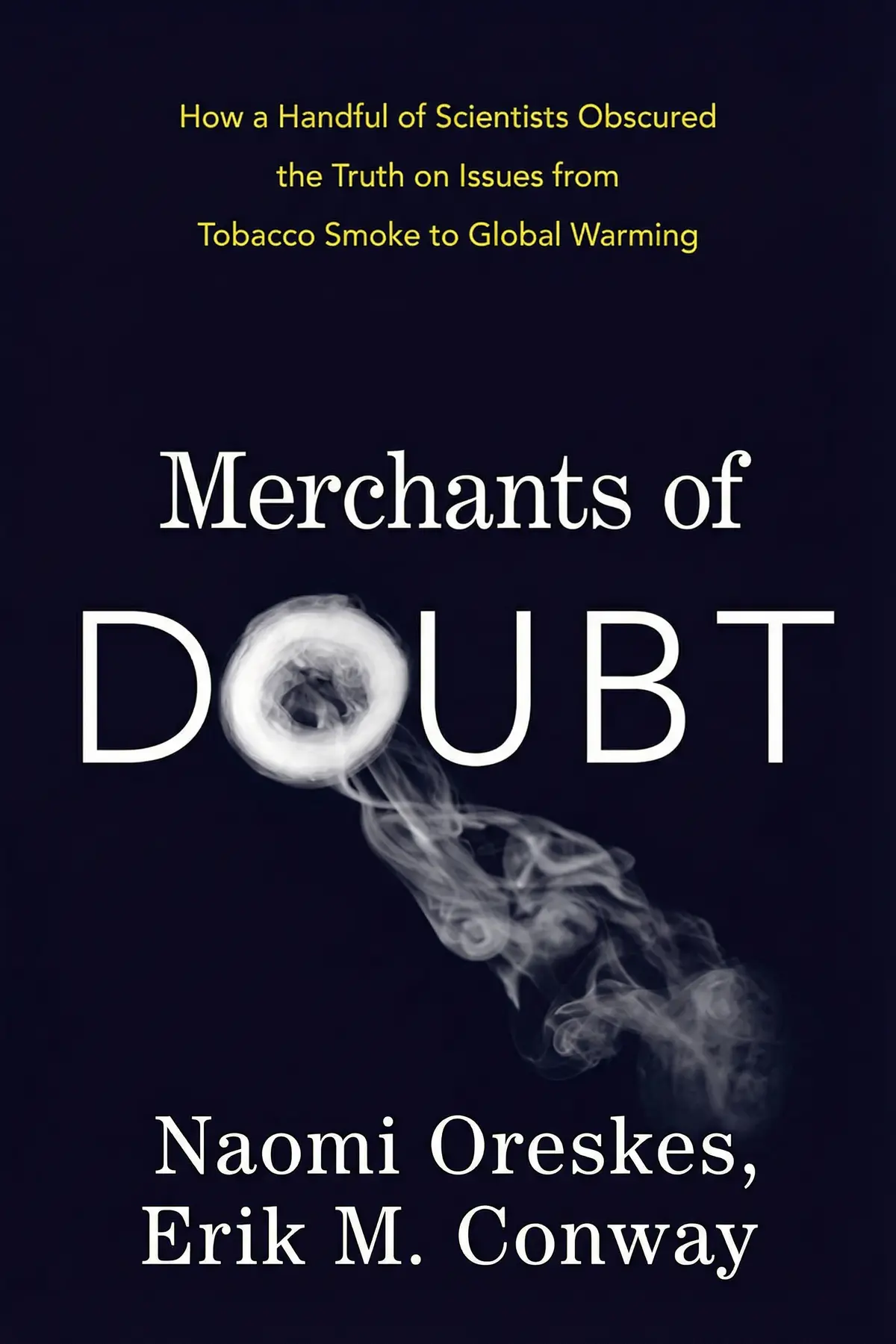
Merchants of Doubt reveals how a small group of influential scientists worked with major industries to systematically suppress scientific truths regarding public health and environmental crises through the strategic manufacture of uncertainty.
1 min 56 sec
Have you ever wondered why it takes decades for the public to accept truths that seem completely obvious today? Think about the warnings on a pack of cigarettes or the international agreements to limit carbon emissions. We often assume that the delay between scientific discovery and public action is just a natural part of how society processes new information. But what if that delay was actually a manufactured product, designed and sold by a small group of people with a specific agenda?
This is the unsettling reality explored in our summary of Merchants of Doubt. We are going to look at the history of how a tiny group of highly placed scientists, many of whom gained their prestige during the Cold War, used their authority to cloud the public’s understanding of science. Their goal wasn’t to win the scientific argument—because, in most cases, the science was already settled. Instead, their goal was to keep the debate alive. By creating the illusion that the scientific community was still divided, they effectively paralyzed the government’s ability to pass regulations that would protect the public and the environment.
Throughout this journey, we’ll see a recurring pattern. Whether the topic was the link between smoking and lung cancer, the destruction of the ozone layer, or the reality of human-caused climate change, the players and the tactics remained remarkably consistent. We’ll meet figures like Fred Seitz and Fred Singer, who stepped out of their specialized fields to become professional contrarians. We will uncover how they used the media, the legal system, and political connections to shield powerful industries from the consequences of their products. This isn’t just a story about science; it’s a story about how the machinery of doubt can be used to undermine democracy and threaten the health of the entire planet. Let’s dive into the blueprint of deception.
2 min 15 sec
Discover how the tobacco industry transformed a public health crisis into a scientific debate, creating a blueprint for doubt that would be used for decades.
2 min 22 sec
Learn how the tobacco industry expanded its tactics to fight the science of secondhand smoke by discrediting the very methods scientists use to establish truth.
2 min 17 sec
See how Cold War anxieties and a media policy intended for balance were manipulated to keep outdated and dangerous defense programs alive.
2 min 32 sec
Explore how the government and industry slowed environmental action by editing scientific reports and blaming natural phenomena for human-made problems.
2 min 15 sec
Uncover how the early warnings of global warming were suppressed by shifting the conversation from climate science to economic costs.
2 min 10 sec
Discover how the decades-old ban on DDT was resurrected in a smear campaign against Rachel Carson to undermine all environmental protections.
2 min 01 sec
As we look back at the decades of deception described in Merchants of Doubt, a chilling picture emerges. We see that the delay in addressing some of the most critical threats to our world—from cancer and acid rain to the melting of the polar ice caps—was not an accident. It was the result of a deliberate, well-funded, and highly organized campaign led by a small group of individuals who valued ideological purity and corporate profits over scientific truth.
The ‘merchants’ we’ve met throughout this summary didn’t need to win their arguments. They only needed to create enough confusion to prevent a consensus from forming. By exploiting the media’s commitment to ‘balance,’ they forced fringe, unscientific views into the center of public discourse. They turned the phrase ‘more research is needed’ into a weapon of mass delay. The lesson here is profound: science is a process, but it is also a body of evidence that requires us to act. Waiting for 100 percent certainty in a complex world is not a sign of scientific rigor; it is a recipe for paralysis.
Today, we live with the consequences of these delays. Our climate is changing at an accelerating pace, and millions have suffered from health issues that could have been prevented decades ago. But understanding the playbook of doubt is the first step in neutralizing it. When we hear someone claiming that the ‘science isn’t settled’ on a major issue, we must ask: Who is speaking? What are their credentials in this specific field? And whose interests are served by their uncertainty? By becoming more discerning consumers of information and demanding that our leaders act on the weight of evidence rather than the manufacture of doubt, we can ensure that the truth is no longer a commodity for sale. The history of the merchants of doubt is a warning, but it is also a call to protect the integrity of the facts that our collective future depends upon.
Merchants of Doubt explores a hidden history of scientific deception, tracing how a handful of high-level scientists with deep political connections used their credentials to protect corporate interests. By examining decades of public debates—ranging from the carcinogenic effects of tobacco and the reality of secondhand smoke to the causes of acid rain and the existential threat of global warming—the book uncovers a recurring playbook of denial. This summary details the specific strategies used to stall regulation and confuse the public, often by exploiting the media's desire for balanced reporting. It promises to reveal the individuals and organizations behind these campaigns, explaining how they successfully delayed action on critical issues by framing settled science as a matter of ongoing debate. Ultimately, it serves as a wake-up call about the vulnerability of public discourse to professional doubt-mongers.
Naomi Oreskes is a professor at Harvard University specializing in the history of science. Before her tenure at Harvard, she spent fifteen years at the University of California, San Diego. She is widely recognized as a leading authority on geophysics and the history of climate change. Erik M. Conway is a historian and author based at the California Institute of Technology in Pasadena, California.
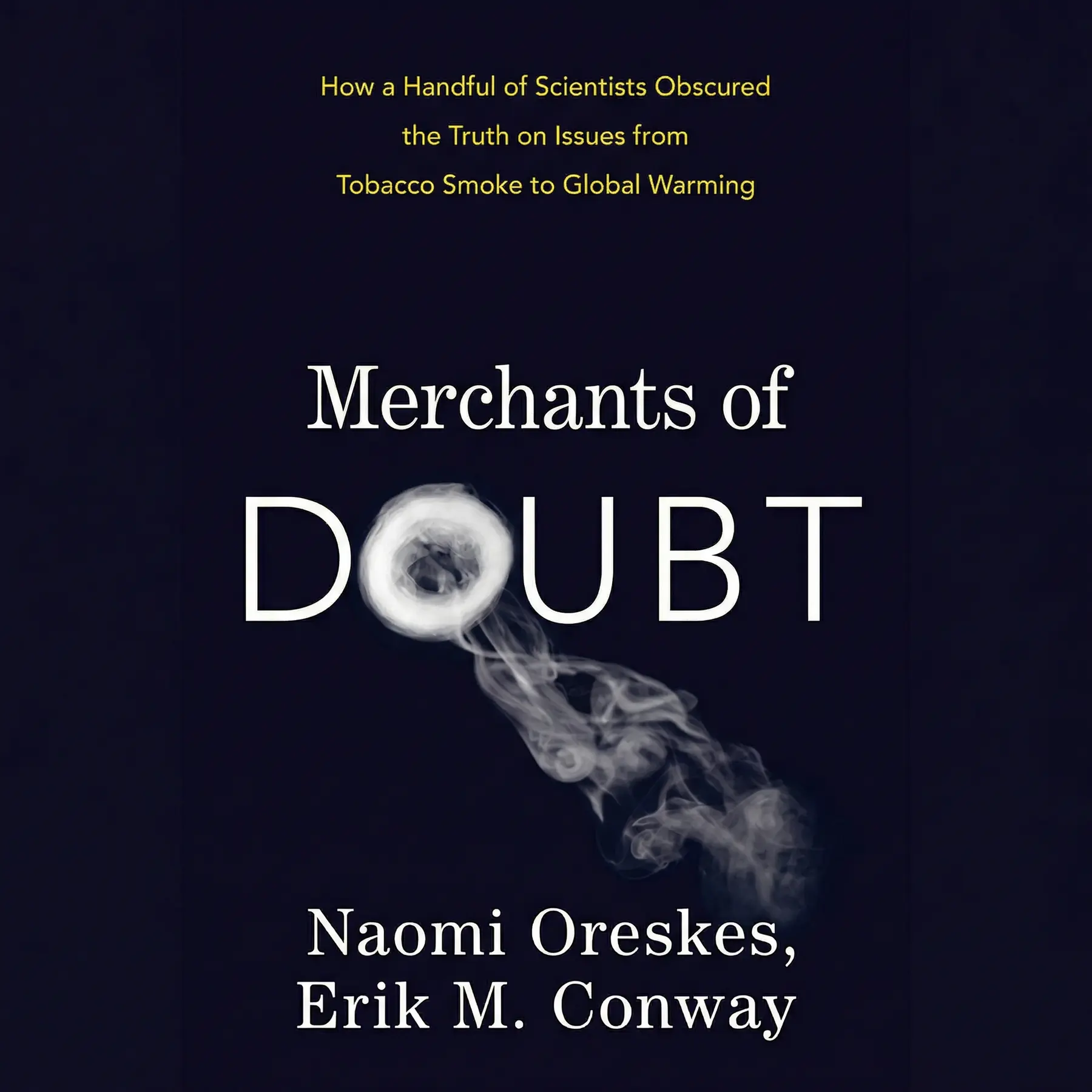
Listeners consider this work a vital resource, commending the deeply investigated material and impressive scientific expertise. It is regarded as exceptionally composed and of significant importance, as one listener highlights the effective combination of historical narrative and investigative journalism. While responses to the book's tempo are varied, several listeners characterize the content as both frightening and unsettling.
Picked this up after seeing the documentary, and the depth of the original text is honestly staggering. Oreskes and Conway meticulously track how a tiny group of Cold War physicists, including Fred Seitz and Fred Singer, repurposed their defense credentials to attack environmental science. It is an incredibly chilling look at the 'playbook' used to protect the tobacco industry before being applied to acid rain and climate change. The prose is dense but remains accessible, providing a historical autopsy of how 'doubt' became a manufactured commodity. If you want to understand why public perception lags so far behind scientific consensus, this is the definitive answer. The sheer volume of archival research presented here makes the authors' conclusions feel bulletproof and utterly necessary for our current political moment.
Show moreWow, this was a difficult but necessary pill to swallow. I never realized that the same individuals who defended secondhand smoke were the ones trying to discredit the holes in the ozone layer. This isn't just a book about climate science; it’s a terrifying history of how ideology can turn brilliant minds into merchants of misinformation. The authors use a blend of journalistic and historical storytelling that keeps you hooked, even when the subject matter makes your blood boil. Personally, I found the chapter on Rachel Carson and the revisionist attacks on Silent Spring to be the most shocking. We like to think of science as an objective vacuum, but this book proves how vulnerable it is to well-funded smear campaigns. Every voter should read this.
Show moreThis book should be mandatory reading in every high school civics class across the country. Ever wonder why the United States has failed to act on climate change despite decades of warnings? Oreskes and Conway provide a meticulous roadmap of the deliberate confusion sown by a handful of high-level scientists. The way they connect free-market ideology to the denial of acid rain and CFC damage is nothing short of masterful. It’s a remarkably well-researched work that exposes the 'fairness' doctrine in media as a tool for spreading lies. Truth is, I walked away from this feeling enlightened but also incredibly cynical about the power of unchecked capitalism. The writing is clear, authoritative, and deeply alarming.
Show moreNot what I expected, but exactly what I needed to read to understand the modern world. I thought this would be a dry climate change book, but it’s actually a gripping political thriller about the manipulation of public consciousness. The way the authors dismantle the 'scientific' arguments of the deniers is satisfyingly thorough. It’s horrifying to see how a small group of people could successfully delay life-saving legislation for decades. The prose is sharp and the documentation is exhaustive, leaving very little room for anyone to claim this is just a partisan hit piece. In my experience, very few books manage to be this informative while maintaining such a high level of intensity throughout. An absolute gold standard for science writing.
Show moreAs a scientist who deals with peer-review daily, I found this account of the intentional subversion of the process absolutely infuriating. The authors do a brilliant job explaining how legitimate scientific uncertainty is weaponized by ideologues to stall government regulation. While the history of Robert Jastrow and the George C. Marshall Institute was fascinating, the narrative does get a bit bogged down in the middle chapters. To be fair, some of the technical details regarding the Strategic Defense Initiative felt a tad repetitive compared to the punchy tobacco chapters. However, the overarching theme of free-market fundamentalism trumping empirical data is handled with remarkable skill. It is a scary, essential read that perfectly illustrates how easily a few influential voices can derail global progress.
Show moreFinally got around to this after it sat on my shelf for a year, and I’m kicking myself for waiting so long. The core argument—that a few physicists used their reputations to mask a lack of expertise in biology and meteorology—is handled with incredible precision. I especially appreciated the nuanced look at why these men did what they did; it wasn't just about the money, but a fanatical devotion to anti-communism. My only minor gripe is that the book can be quite repetitive as it moves through the different case studies. Once you understand the pattern, the subsequent chapters feel a bit like more of the same, though the specific details remain valuable. It’s an essential, if somewhat depressing, historical perspective on the war against facts.
Show moreAfter hearing Naomi Oreskes speak in a podcast, I knew I had to grab this for the full story. The historical context she and Conway provide regarding the Cold War is vital for understanding the motivations of the 'merchants' themselves. It turns out that a fear of government regulation was the primary driver for these scientists, leading them to abandon the very scientific method they once championed. While the book is excellently written, it is also deeply frustrating to see how easily the press was manipulated into presenting 'both sides' of a settled issue. I found the sections on the ozone layer particularly enlightening. It’s a valuable resource, though you might need to take breaks because the content is honestly quite infuriating.
Show moreThe truth is often more frightening than fiction, and this book proves it on every page. Watching the authors trace the line from the tobacco lobby's 'Doubt is our product' memo to modern climate denial is a masterclass in investigative history. They show exactly how a few smart men with the right connections can hold the entire planet hostage to their personal dogmas. The sentence lengths vary enough to keep the rhythm interesting, and the technical explanations are never so complex that a layperson would get lost. It is a scary read that leaves you questioning every 'controversial' headline you see in the news. While it’s not an easy, breezy read, it is an essential one for anyone who cares about the future of science.
Show moreLook, the research here is undeniable and incredibly thorough, but the reading experience itself was a bit of a slog for me. The authors are historians, and it shows in the dry, legalistic tone that seems to have been scrubbed by a legal department ten times over. I appreciate the importance of the facts regarding Nierenberg and the tobacco lobby, but the pacing felt uneven. Some sections were riveting while others felt like reading a very long series of academic footnotes. Frankly, it’s a disturbing and important book, but I struggled to stay engaged through the later chapters on global warming. It is definitely more of a reference text than a casual weekend read, though the message remains critically important.
Show moreGotta say, I have mixed feelings about the presentation here despite agreeing with the central premise. The authors have done a remarkable job uncovering the ties between big industry and these specific physicists, but the book feels bloated. Many of the points could have been made with half the word count, and the academic style occasionally drains the urgency from what should be a shocking narrative. To be fair, the chapter on the Strategic Defense Initiative was a total eye-opener for me and explained a lot about modern political alliances. It is a critically important book for our times, but the pacing might be a hurdle for those not used to dense historical non-fiction. Important, but a bit of a chore.
Show moreBill Bryson
Philip Freeman
Jeff Hawkins
Michael Axworthy
Tom Standage
AUDIO SUMMARY AVAILABLE
Get the key ideas from Merchants of Doubt by Naomi Oreskes, plus 5,000+ more titles in English and Thai.







