
A River in Darkness: One Man’s Escape from North Korea
Masaji Ishikawa
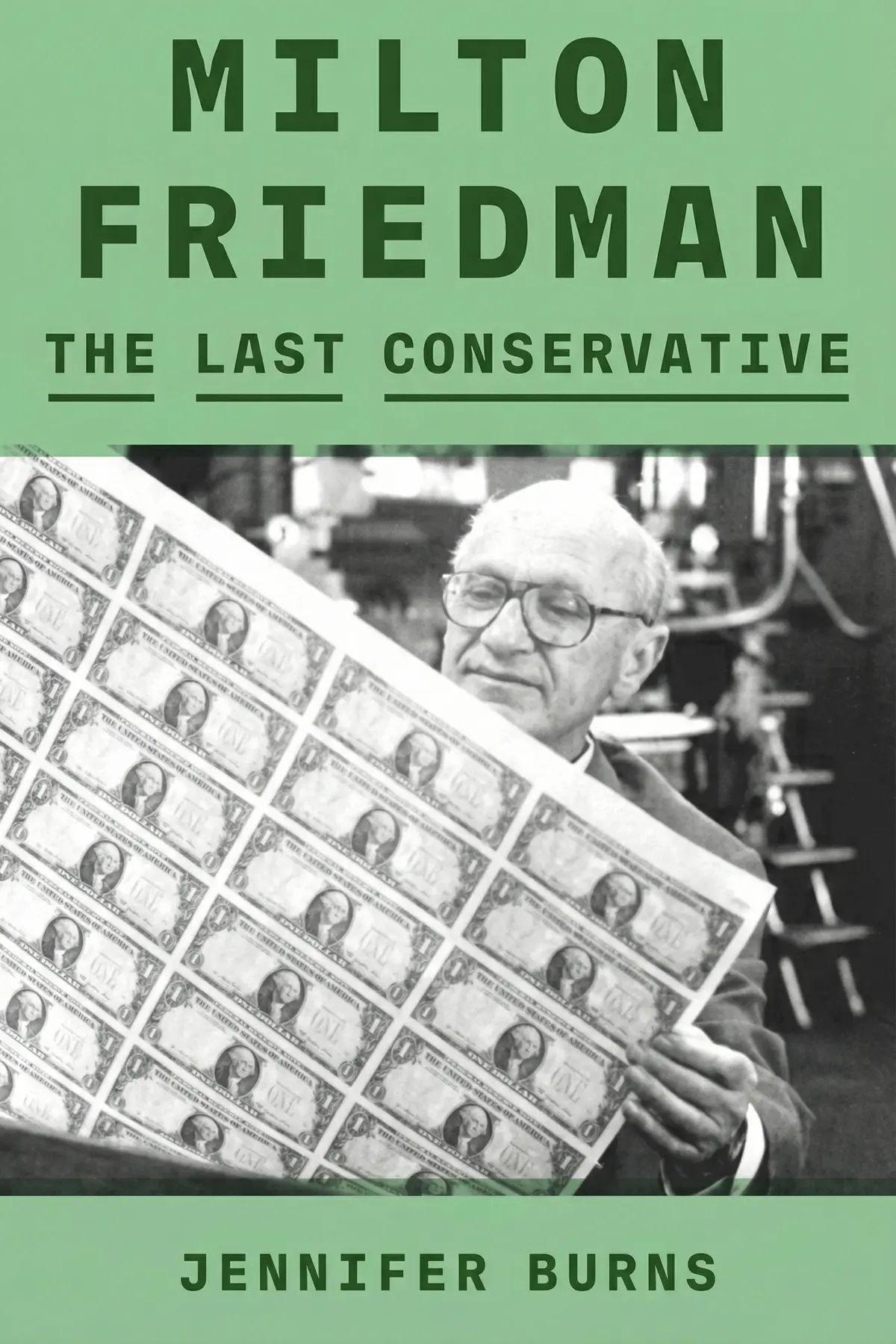
A comprehensive look at Milton Friedman’s life, tracing his journey from a gifted student to a primary architect of modern economic thought and a champion of free-market capitalism.
1 min 43 sec
At first glance, a modest man of small physical stature might not seem like a world-shaking revolutionary. Yet, the economist we are looking at today became one of the most recognizable and polarizing figures of the twentieth century. His name has become shorthand for a specific kind of economic philosophy, one that champions the power of the individual and the efficiency of the marketplace over the heavy hand of government control. To understand just how deep his influence goes, consider that decades after his passing, his name is still invoked by world leaders as both a warning and an inspiration.
During the 2020 American presidential race, Joe Biden famously noted that this man was no longer the one pulling the strings of the economy. This wasn’t just a passing remark; it was a recognition that for nearly half a century, the framework of our financial world was built on the foundation this economist laid. Whether he was being hailed as a visionary who saved the West from stagnation or criticized as an architect of inequality, there is no denying that he fundamentally changed the way we think about money, freedom, and the state.
In this exploration, we will trace the arc of his life. We’ll look at his humble beginnings as the son of immigrants and follow his path through the intense intellectual corridors of the University of Chicago. We will see how he navigated the chaos of the Great Depression and the Second World War to emerge with a set of ideas that would eventually topple the dominant economic theories of his day. This is more than just a story about numbers and charts; it is a story about the power of conviction and the enduring impact of a single mind on the global stage.
2 min 30 sec
Discover how a young student from a New Jersey immigrant family navigated personal tragedy and academic mentorship to find his true calling in the world of economics.
2 min 21 sec
Follow the journey from the halls of Columbia to the heart of wartime Washington, where professional disputes and high-stakes military research refined a rising economist’s perspectives.
2 min 20 sec
Witness the return to a transformed university where intellectual battles and the loss of a mentor led to the birth of a new brand of economic liberalism.
2 min 09 sec
Explore the groundbreaking research that challenged established views on the Great Depression and fundamentally changed how central banks manage the world’s money supply.
2 min 37 sec
Follow the ascent of a public intellectual who advised presidents and used the power of television to bring his free-market message to millions of households.
1 min 17 sec
The life of Milton Friedman is a testament to the power of ideas to reshape the world. He began his journey as the son of immigrants in a small New Jersey town and ended it as a global icon of liberty whose influence reached into every corner of economic policy. Through his unwavering commitment to price theory and his revolutionary work on monetarism, he challenged the dominant consensus of his era and provided a new way to understand the complex relationship between money, the state, and the individual.
Friedman’s legacy is not just found in textbooks or the policies of central banks; it is found in the very way we discuss freedom and government today. He taught us to be skeptical of central planning and to trust in the collective intelligence of the marketplace. While his ideas continue to spark intense debate and his prescriptions are often contested, the questions he raised remain as vital as ever. He reminded us that economic freedom is not just a technical matter of efficiency, but a fundamental pillar of a truly free society. To navigate the modern world, one must grapple with his vision, for whether he is ‘running the show’ or not, his intellectual fingerprints are everywhere.
This summary explores the intellectual and personal evolution of Milton Friedman, one of the most influential and controversial figures of the twentieth century. It moves beyond his famous public persona to examine his early struggles, his academic development during the Great Depression, and the personal relationships that shaped his worldview. You will follow Friedman as he navigates the ideological battles of the University of Chicago and the administrative hurdles of the New Deal era. The summary details his shift from actuarial mathematics to a deep focus on price theory and monetarism, explaining how he challenged the prevailing economic theories of his time. It also highlights his collaborative work with his wife, Rose Director, and other key thinkers who helped launch a movement centered on individual liberty. Ultimately, this account provides a clear understanding of how Friedman's insistence on the power of the market and the dangers of government overreach continues to influence global policy and political debate today.
Jennifer Burns is an associate professor of history at Stanford University and the author of Goddess of the Market. She has also written for major publications, including the New York Times and the Financial Times, and appeared on popular television programs like The Daily Show and The Colbert Report.
Listeners consider this biography an outstanding piece of economic history, with one review highlighting it as a comprehensive and nuanced exploration of Friedman’s life and philosophy. Furthermore, the narrative is compelling and well-constructed, with one listener remarking that it remains interesting without becoming tedious. Finally, listeners value how the work addresses Friedman’s significant impact on 20th-century economic thought.
Jennifer Burns has managed to condense a massive amount of archival research into a biography that feels both definitive and surprisingly fresh. It is easily the most comprehensive work on Friedman to date, far surpassing previous attempts to capture his complex legacy. I was particularly impressed by the chapter dealing with the Pinochet regime in Chile. Burns handles this controversial period with a level of scholarly detachment that is rare in discussions about neoliberalism. She avoids the typical villainization, choosing instead to contextualize his actions within his broader philosophical commitment to freedom. The book is thick, and the material is undeniably complex, but her 'plain English' explanations of macroeconomics are a godsend. It’s a brilliant look at how one man’s ideas came to dominate global policy. This is intellectual history at its absolute finest, and I can't recommend it enough for anyone serious about understanding the modern world.
Show moreFinally got around to finishing this behemoth, and it’s arguably the definitive work on the man. What I loved most was how Burns situated Friedman within his larger intellectual milieu. She gives due credit to his mentors like Arthur Burns and George Shultz, showing that his ideas didn't emerge in a vacuum. The exploration of how he toppled Keynesian dominance is gripping. To be fair, you have to be ready for some serious technical discussion. The book doesn't shy away from the math or the abstruse nature of monetary policy. Yet, the way she connects these theories to real-world outcomes—like the end of the draft—is masterful. It is a long, dense read, but it never feels like a waste of time. Burns has a gift for making even the driest economic models feel relevant to the current political landscape. This is a must-have for any history buff’s bookshelf.
Show moreThe way Burns traces Friedman’s shift from Rutgers to the Chicago School is incredibly detailed. She captures the urgency of the debates during the Gilded Age and the subsequent shock of the Depression perfectly. As someone who has read several biographies of 20th-century figures, I found this one to be uniquely thorough in its technical aspects. She doesn't just say he was influential; she proves it by walking you through the actual mechanics of his thought process. The book is a massive undertaking, yet the writing remains engaging throughout. I especially appreciated the nuanced take on his time in Chile. It's refreshing to see a historian move past the usual talking points to look at the actual evidence. This book shows Friedman as a man ahead of his time, whose ideas on globalization and freedom are still being debated today. A truly exceptional work of economic history.
Show moreWow, the sheer level of research Burns put into this is staggering. From his humble New Jersey roots to his status as a global icon, every stage of Friedman’s life is examined with surgical precision. I loved the deep dive into 'economics imperialism' and how he applied market lenses to every social issue imaginable. It’s a heavy book, both physically and intellectually, but the rewards are huge. You come away with a profound understanding of why our current economic system looks the way it does. The author’s ability to explain abstruse concepts in plain English is her greatest strength. Even the more technical chapters on monetarism were readable. It’s a meritorious book that manages to be both an academic triumph and a compelling portrait of a man who changed the world. If you want to understand the roots of contemporary capitalism, you have to read this. Highly recommended.
Show moreThis book is effectively a masterclass in the evolution of 20th-century economic thought. Jennifer Burns doesn't just chronicle Milton Friedman’s life; she reconstructs the entire intellectual atmosphere of the Chicago School. I appreciated how she gave weight to his collaboration with Anna Schwartz on the 'Monetary History of the United States,' which is often overlooked in more casual accounts. The prose is exceptionally clear for such a dense subject, yet the sheer volume of economic theory can feel like a heavy lift at times. Truth is, if you aren't interested in the nuances of monetarism or price theory, this might feel a bit like a textbook. However, for those who want a nuanced exploration of his influence on modern policy, from school vouchers to the all-volunteer military, this is an essential read. It isn't exactly a page-turner in the traditional sense, but it is deeply rewarding and remarkably objective.
Show moreTo be fair, you need to be prepared for a deep dive into monetary policy before cracking this open. This isn't a beach read. It is a dense, scholarly achievement that demands your full attention for all 400-plus pages. I found the sections on the Great Depression particularly illuminating, especially how Friedman used that crisis to catalyze his lifelong fascination with economic forces. Burns is a smart writer, and she does an excellent job of being fair to a subject who is often treated as a caricature. She addresses his blind spots—like his somewhat cold take on integration—without being preachy. My only real gripe is that it can feel like 'inside baseball' at times. If you don't have a basic grasp of macroeconomics, some of the arguments might fly over your head. Still, the epilogue alone, which connects his work to the 2008 financial crisis, makes the whole journey worth it.
Show moreWhat struck me most was how Burns balances the different facets of Friedman’s career as both a rigorous researcher and a public proselytizer. Most people know him from 'Free to Choose,' but this book shows the decades of hard data-crunching that came first. It’s a very good book about a very significant man. The prose is sophisticated and the research is clearly top-tier. I did find the pacing a bit sluggish in the middle sections, particularly when the focus shifted heavily toward the more esoteric aspects of price theory. Frankly, the narrative can get overwhelmed by the subject matter. However, the insights into his relationship with his wife, Rose, who was also a trained economist, added a much-needed human element to the story. It isn't a 'fun' read, but it is an enlightening one. It provides a necessary corrective to the oversimplified versions of Friedman we usually see in the media.
Show moreFrankly, it’s about time someone wrote an intellectual history this thorough. Burns manages to be fairly positive about Friedman while still acknowledging the inequality his policies helped drive. She depicts him as a man who genuinely cared about poverty, even if his solutions—like the negative income tax—were often misunderstood. The book is scholarly and thoughtful, providing a level of historical context that puts earlier biographies to shame. It’s interesting without being tedious, provided you have at least a passing interest in how money works. I was particularly fascinated by the discussion of his TV series and how he became a household name. My only criticism is that the focus is so narrow that it sometimes feels like he lived in a vacuum of ideas rather than the real world. Still, it’s an uncommonly revealing look at one of the most important thinkers of our era.
Show morePersonally, I found the lack of personal detail in this biography quite frustrating. While Jennifer Burns is clearly a talented historian, she focuses almost exclusively on Friedman's professional life and economic theories. Where are the stories about his children? What were his hobbies? We get almost nothing of the man behind the desk. Instead, the narrative is an endless stream of intellectual debates and policy shifts. Not gonna lie, I found myself skimming several sections that went into the weeds of sequential analysis and munitions testing. If you are looking for a standard biography with a balance of personal drama and career highlights, look elsewhere. This is an academic study of his brain, not a portrait of his life. It’s well-written for what it is, but for the average reader, it is unavoidably tedious. It serves a very specific, narrow audience of economics nerds.
Show moreNot what I expected when I bought a biography of such a famous figure. I was hoping for more of a 'life and times' approach, but this is strictly an intellectual biography. The truth is, I struggled to stay engaged with the long-winded explanations of fiscal policy and sequential analysis. It felt less like a story and more like a very long lecture. Burns is obviously brilliant, but she often assumes the reader has a PhD-level understanding of the field. While I appreciate the scholarly effort, it lacked the narrative drive that makes a biography truly 'scintillating.' There are long stretches where his personal life and family are completely absent from the pages. It serves its purpose as a deep dive into his ideas, but it’s a bit of a slog for anyone not already obsessed with the intricacies of the Chicago School. It's profitable, but not exactly likeable.
Show moreMasaji Ishikawa
Andrew Ross Sorkin
Ben Macintyre
Ha-Joon Chang
James Shapiro
Niall Kishtainy

AUDIO SUMMARY AVAILABLE
Get the key ideas from Milton Friedman by Jennifer Burns, plus 5,000+ more titles in English and Thai.







