

A Liberated Mind: How to Pivot Toward What Matters
Steven C. Hayes
Explore how our underlying beliefs about intelligence and talent determine our success. Carol Dweck reveals the transformative power of the growth mindset and how it can be cultivated at any age.

1 min 58 sec
Think for a moment about your physical traits. You have a certain height, a specific eye color, and a unique bone structure. For the most part, these features are permanent. Aside from minor changes or medical interventions, you are born with a physical blueprint that stays with you for life. But when we move beyond the physical and look at the mental—your ability to lead a team, your talent for music, or your capacity for complex mathematics—is the blueprint just as rigid?
This is the central question that defines our lives. For decades, a debate has raged over whether greatness is born or made. We often wonder if a concert violinist was simply gifted with musical hands or if they labored their way to mastery. Today, the consensus among experts suggests that while we might start with different dispositions, the true differentiator is the dedication to practice. However, what matters more than the scientific consensus is your own personal belief about the matter.
In this exploration of human psychology, we find that our internal belief system acts as a lens through which we view every challenge, every success, and every setback. This lens is what Carol Dweck calls our mindset. It determines whether we see a difficult task as a threat to our identity or an invitation to expand our horizons. There are two primary ways of viewing the world: the fixed mindset and the growth mindset. One keeps us anchored in place, perpetually seeking validation, while the other sets us on a path of continuous evolution.
Over the next several sections, we will dive deep into how these mindsets operate in the real world. We will see how they manifest in the classroom, on the sports field, and in the boardroom. Most importantly, we will discover that our mindset is not a life sentence. We have the power to shift our perspective, turning obstacles into stepping stones and realizing a level of potential we might never have thought possible. By understanding the mechanics of these two mental frameworks, we can begin to reshape our future and the futures of those around us.
2 min 31 sec
Discover why believing you were born with a set amount of intelligence can lead to a constant need for external validation and a paralyzing fear of being exposed as a failure.
2 min 19 sec
Learn how viewing your brain as a muscle allows you to embrace challenges and find satisfaction in the process of learning rather than just the final outcome.
2 min 32 sec
Contrast the management styles of famous CEOs to see how a leader’s personal belief system can either drive a company to ruin or lead it to long-term success.
2 min 19 sec
Compare the reactions of elite athletes to understand why some crumble under pressure while others use their mistakes as fuel for future greatness.
2 min 26 sec
Examine how our beliefs about effort can either hold us back from trying new things or give us the strength to overcome seemingly impossible physical and mental odds.
2 min 17 sec
Explore the origins of mindset in childhood and see how the way parents and teachers praise children can accidentally set them up for a lifetime of self-doubt.
2 min 25 sec
Discover the practical steps you can take today to retrain your brain and shift your internal monologue from self-criticism to constructive growth.
1 min 31 sec
As we reach the end of this journey into the psychology of success, the core message is clear: the way you view yourself is the single most important factor in your ability to achieve your goals. A fixed mindset is a self-imposed prison. It limits your experiences, creates a paralyzing fear of failure, and forces you into a never-ending cycle of seeking external validation. It tells you that you are already everything you will ever be, which is a discouraging and ultimately false perspective.
On the other hand, a growth mindset is a key that unlocks a world of endless possibility. It transforms effort from a sign of weakness into the very engine of mastery. it turns failure from a catastrophic identity into a valuable source of information. By believing that your qualities can be developed, you give yourself permission to be a beginner, to make mistakes, and to take the risks necessary for true innovation and personal fulfillment.
So, as you go back into your daily life, I challenge you to start noticing the “fixed” thoughts that hold you back. When you face a challenge that feels too big, or when you experience a setback that makes you want to quit, remember that your brain is capable of incredible change. You are not a static entity; you are a dynamic process. Whether you are leading a company, raising a child, or simply trying to learn a new hobby, the growth mindset offers a path toward a more resilient and meaningful life. Start choosing the path of development today, and watch as your world begins to expand in ways you never thought possible.
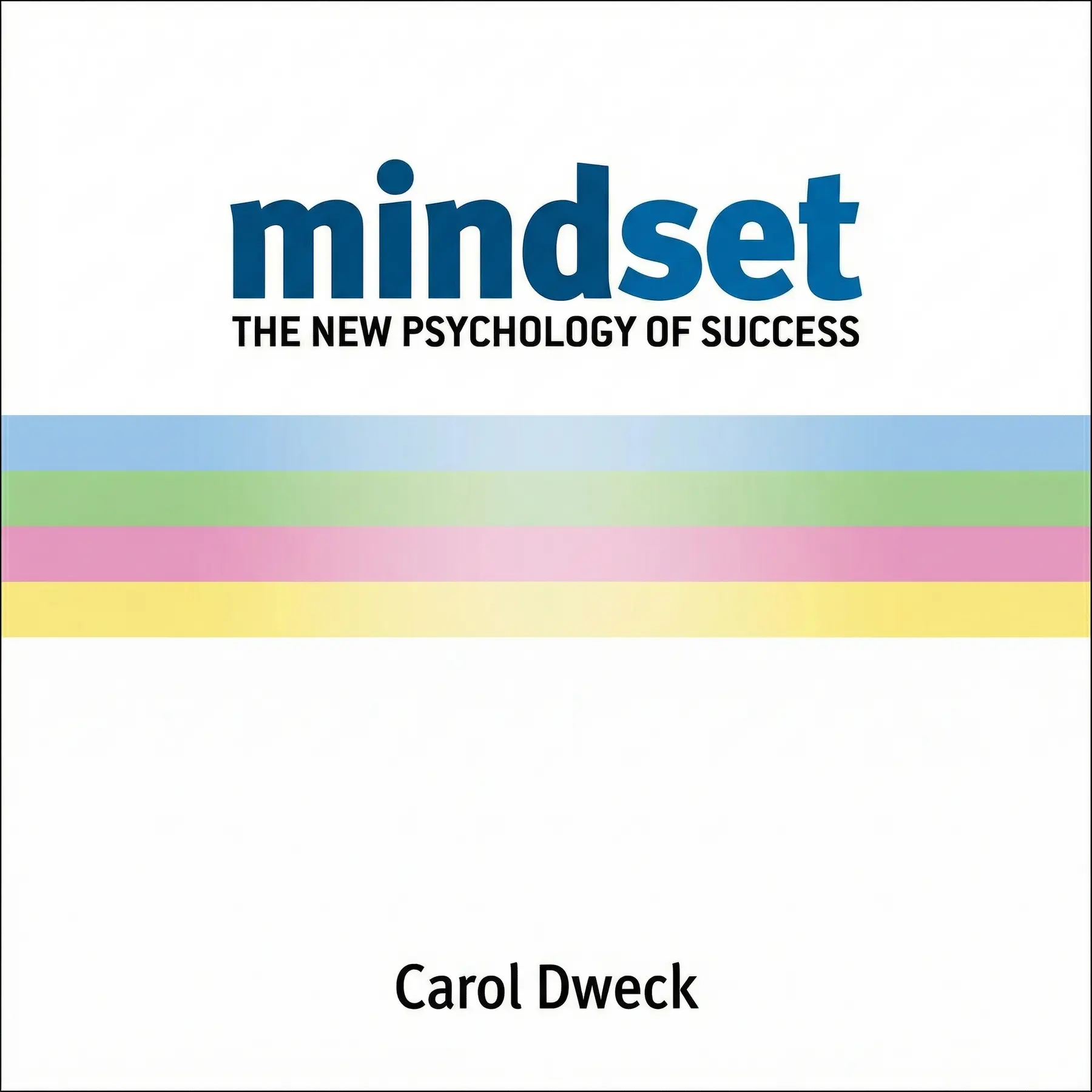
Mindset explores the profound difference between believing your abilities are fixed traits versus believing they can be developed through dedication and hard work. Drawing on decades of psychological research, Carol Dweck explains how these two distinct mindsets—fixed and growth—shape every aspect of our lives, from how we handle failure in sports to how we lead multi-billion dollar corporations. The book promises a path toward self-improvement by showing that our potential is not a predetermined limit but a starting point. By understanding the psychology of success, readers learn how to foster a growth mindset in themselves, their children, and their professional environments, ultimately unlocking a more resilient and fulfilling way of living.
Carol Dweck is a professor of psychology at Stanford University. In addition to Mindset, she has also published Self-Theories: Their Role in Motivation, Personality and Development and Handbook of Competence and Motivation.
Listeners find this work to be an excellent read with impressive research and useful takeaways, specifically highlighting how a growth mindset is advantageous across personal and professional life. Furthermore, the text helps individuals reassess themselves and shift their outlook on education and lifelong learning, while proving helpful for teachers and offering functional guidance. However, the book receives varied reactions regarding its premise, with some valuing the theory while others find it repetitive.
Picked this up after hearing every educator in my district rave about it, and I finally see what the hype is about. Dweck’s exploration of how we praise children—focusing on effort rather than innate 'smartness'—is a total game-changer for my parenting style. It’s scary to think how many times I’ve inadvertently reinforced a fixed mindset by telling my daughter she’s a 'natural' at math. The book provides clear, actionable advice on how to shift that internal dialogue toward growth and resilience. While some of the sports examples felt a bit dated, the core psychological principles are incredibly solid and well-researched. This isn't just a self-help book; it’s a manual for anyone who wants to stop being afraid of failure. I find myself constantly thinking about 'the power of yet' when I run into obstacles at work now. This book truly delivers on its big promise.
Show moreWow, I didn't expect a psychology book to make me feel so much hope for my own future. As someone who grew up being told I was 'gifted,' I realized I’ve spent my entire life avoiding challenges just to keep that label intact. This book exposed all my insecurities and showed me that my fear of looking stupid was actually what was holding me back. It’s a bit of a wake-up call to realize that effort is actually the path to mastery, not a sign of a lack of talent. Dweck’s writing is accessible, though she definitely leans into the anecdotal evidence quite heavily throughout the middle chapters. Personally, I found the section on relationships particularly enlightening because it debunked the myth that 'true love' shouldn't require work. I am genuinely trying to embrace the struggle now instead of running from it.
Show moreAs a high school teacher, I see these two mindsets playing out in my classroom every single day. Some students are so terrified of being 'wrong' that they won't even try, while others treat every mistake as a puzzle to be solved. Dweck provides the vocabulary I needed to help my students understand that their brains are like muscles that grow with exercise. I've already started changing the way I give feedback on assignments, focusing more on the process and the strategies used rather than just the final grade. The book is filled with valuable lessons that could honestly revolutionize the way we approach education in this country. It’s a wonderful read that empowers both the educator and the learner to believe in the possibility of change. I’m recommending this to every parent at our next conference because it's that important.
Show moreShort, sweet, and life-changing if you actually apply the principles. Mindset helped me reevaluate my entire approach to lifelong learning and personal development. I realized I had a fixed mindset about my creative abilities, always assuming I just 'wasn't the artistic type.' After reading this, I've started taking pottery classes and I'm actually enjoying the process of being a beginner for once. The book is a bit repetitive, sure, but sometimes you need to hear a message multiple times for it to really sink in. It’s a wonderful resource for anyone feeling stuck in their career or personal life. It teaches you that your potential is not a fixed point, but a landscape you can expand through dedication and hard work. This is definitely worth taking the time to read.
Show moreThe chapter on business and leadership really hit home for me as someone currently managing a small team. Carol Dweck explains how a fixed mindset can lead leaders to surround themselves with 'yes-men' to validate their own brilliance, which eventually leads to stagnation. It’s a fascinating look at how our underlying beliefs about intelligence shape our professional destinies. I’ll admit the book is quite repetitive and could have been summarized in a lengthy article, but the sheer number of examples helps the concept stick. You see the same pattern everywhere from Enron to the Yankees. To be fair, she does tend to shoehorn her theory into every historical event she mentions, but the underlying logic is hard to argue with. If you can get past the somewhat 'salesy' tone, there’s a lot of value here for people wanting to foster a more innovative culture.
Show moreEver wonder why some people crumble under pressure while others seem to thrive on it? Dweck’s research into the psychology of success offers a pretty compelling answer by distinguishing between those who believe talent is static and those who think it can be developed. I found the contrast between Michael Jordan’s work ethic and the 'natural' athletes who fizzled out to be a great illustration of her point. It really changed how I view my own failures in the gym and at the office. Instead of thinking 'I'm just not a runner,' I'm learning to think 'I'm not a runner yet.' The writing is clear and the advice for teachers is especially practical, though the tone can occasionally feel a bit patronizing. Despite the repetition, the message is one that most people—especially parents—desperately need to hear.
Show moreFinally got around to reading this after seeing it on so many 'must-read' lists for years. The core message is revolutionary, especially the idea that our self-worth shouldn't be tied to our 'innate' abilities but rather our willingness to learn. I particularly liked the section on 'Effort Gone Awry' where she talks about people who work hard but for the wrong reasons, like seeking validation. It’s a nuanced take on success that goes beyond the typical 'just try harder' platitudes you find in most self-help fluff. My only gripe is that the book leans quite heavily on sports legends like Tiger Woods and John Wooden, which might feel a bit dated to younger readers today. Still, the practical insights on how to foster a growth mindset in yourself and others are incredibly valuable. It’s a solid read that offers a much-needed perspective shift.
Show morePersonally, I found this to be a real find for anyone who feels like they’ve plateaued in their personal growth. The distinction between a fixed mindset and a growth mindset is so simple, yet it explains so much about human behavior. I found myself cringing at some of the descriptions of the fixed mindset because they described my own defensive reactions to criticism perfectly. It’s hard to admit when you're wrong, but Dweck makes a great case for why that admission is the only way to actually get better. To be fair, she does go a bit overboard with the 'everything is mindset' argument, ignoring things like systemic issues or pure luck. However, as a tool for individual empowerment and shifting your perspective, it’s hard to beat. It’s a helpful guide for reevaluating your internal monologue. I will definitely revisit these chapters later.
Show moreThis book makes an excellent point about the value of persistence, but it really beats you over the head with it for nearly 300 pages. The concept of the growth mindset is brilliant and useful, yet Dweck spends way too much time recounting sports anecdotes that feel cherry-picked to fit her narrative. If a team won, they had a growth mindset; if they lost, they were clearly stuck in a fixed mindset. It’s all a bit too simplistic for my taste, as if luck and external circumstances don't exist at all. Truth is, you could probably read the first two chapters and get everything you need to know. I appreciate the research she’s done at Stanford, but the execution of this particular book felt bloated and unnecessarily long. It’s worth a read for the core idea, but don’t be afraid to skim the repetitive parts once you get the gist.
Show moreAfter hearing so much praise for this book, I was frankly disappointed by the lack of depth in the actual writing. The idea is simple: believe you can improve and you probably will. That’s great, but did it really need to be an entire book of repetitive anecdotes? It felt like Dweck was trying to force every single success story in history into her specific framework, regardless of other factors. Not gonna lie, the tone started to grate on my nerves after about fifty pages because it felt more like a sales pitch than a scientific study. I was hoping for more deep psychological insights or neurological data, but instead, I got endless stories about CEOs and basketball stars. If you’ve heard the term 'growth mindset' before, you’ve basically already read the book. It just felt very redundant.
Show moreSteven C. Hayes
Deborah Gruenfeld

Anthony Pratkanis
AUDIO SUMMARY AVAILABLE
Get the key ideas from Mindset by Carol Dweck, plus 5,000+ more titles in English and Thai.







